
Jerez de la Frontera: Sherry, Dancing Horses and the Real Andalusia
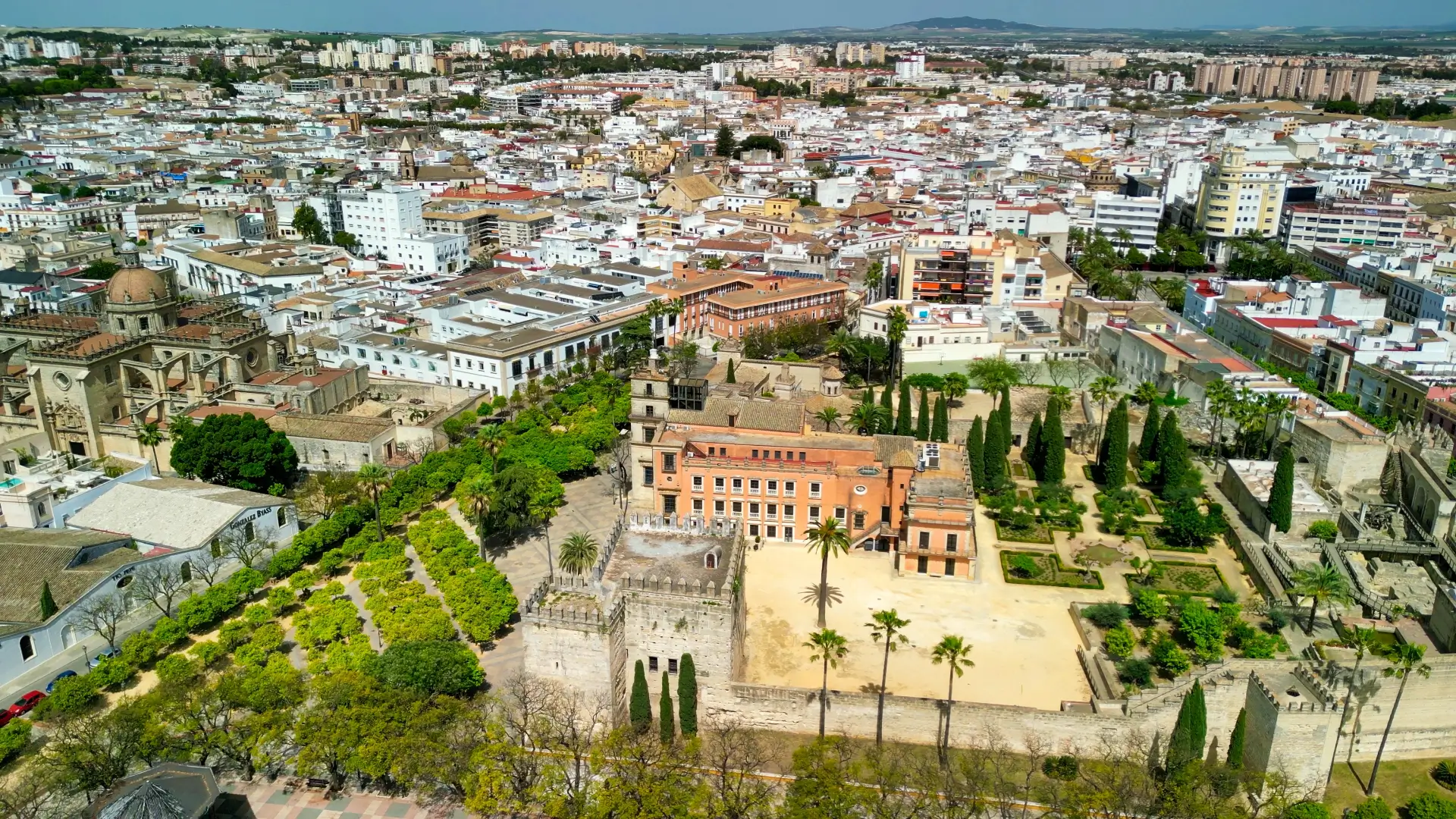
Jerez de la Frontera is the working heart of sherry country, set in the flat farmland of Cádiz province, just east of the Bay of Cádiz. This is the city that gave the wine its name. Its old bodegas, its dancing Andalusian horses and its deep flamenco roots make it one of the strongest bases in the south — busier than the White Villages next door, but calmer and more real than Seville.
Why Visit Jerez de la Frontera
Most towns in this corner of Cádiz are white hill villages. Jerez is not one of them. It is a proper city, low and wide on the plain, and it wears three things on its sleeve: wine, horses and flamenco. Sherry is named after Jerez, not the other way round. The old sherry houses, or bodegas, still stand in the centre with their tall, cool, cathedral-like cellars. This is also one of the birthplaces of flamenco, and the place where the fast, joyful bulería style was born.
Jerez de la Frontera, a calm, cultured base — with an honest word on crowds
Jerez is popular, and we will not pretend otherwise. It fills up for its two big events: the flamenco Festival de Jerez in late winter and the Feria del Caballo, or Horse Fair, in May. But outside those weeks it stays refreshingly unhurried. You can walk the old town, drink a cold fino in a tabanco, and never feel processed the way you might in Seville. In 2026 Jerez holds the title of Spain's Capital of Gastronomy, so its food and wine are having a real moment. It suits the traveller who wants a genuine Andalusian city with monuments, tapas and atmosphere, but without the full tourist crush.
Day trip or overnight?
You can see the shape of Jerez de la Frontera in an afternoon. Many people do, as a quick stop between Seville and Cádiz, or a break from the White Villages. But that means leaving just as the city wakes up. Our honest advice is to stay the night. The bodega tours and the horse school fill the day, and the flamenco lives in the evening. A perfect short visit looks like this: a morning bodega tour, lunch and a sherry flight in a tabanco near Plaza Plateros, the Alcázar and its cámara oscura in the warm afternoon light, then an early-evening walk through the Barrio de Santiago before dinner and, if the timing is right, live flamenco after dark. None of that fits into a day trip. Sleep here, and the streets empty out for you.
What to See in Jerez de la Frontera

Alcázar de Jerez
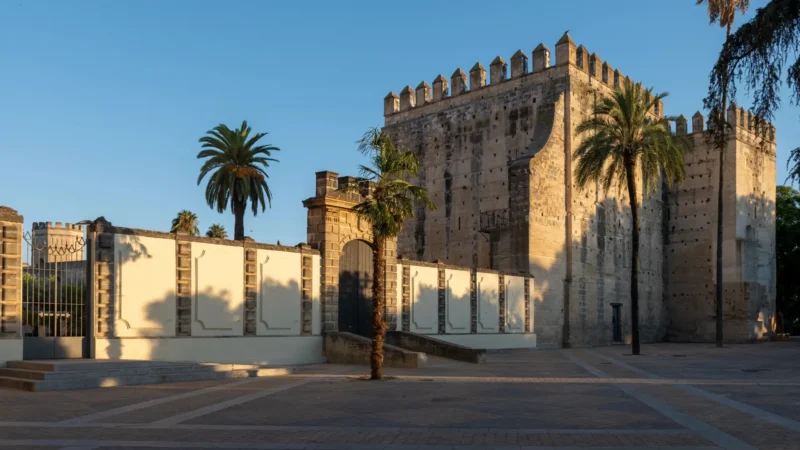
The city’s oldest monument is a 12th-century Moorish fortress, one of the few Almohad-era survivors in Spain. Inside the walls are Arab baths, a mosque turned chapel, quiet gardens and the octagonal tower. Climb up to the cámara oscura in the Villavicencio palace tower, where a system of lenses projects a live, moving image of the whole city onto a screen. It sits on the Alameda Vieja, in the heart of the old town.
Catedral de Jerez
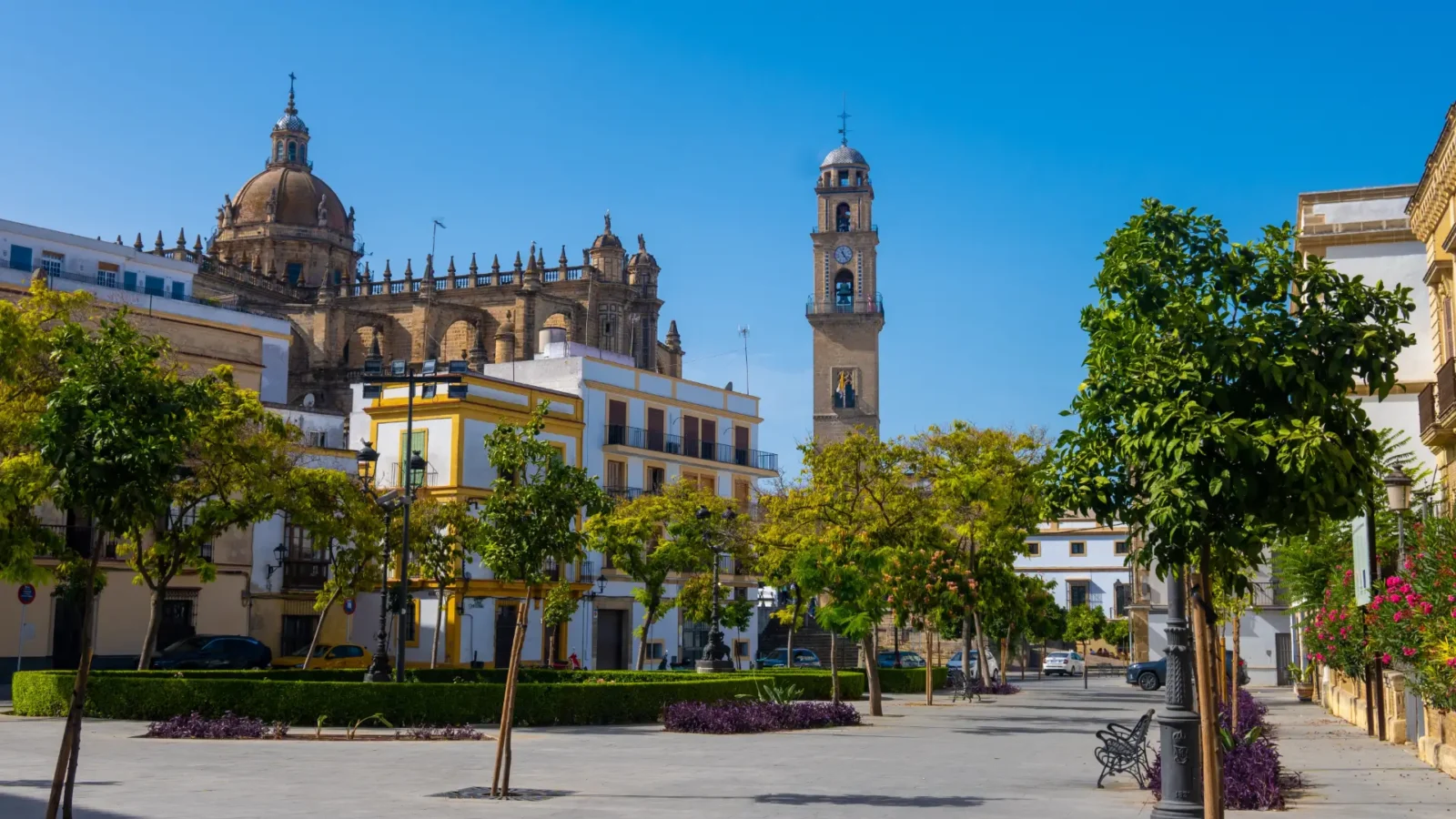
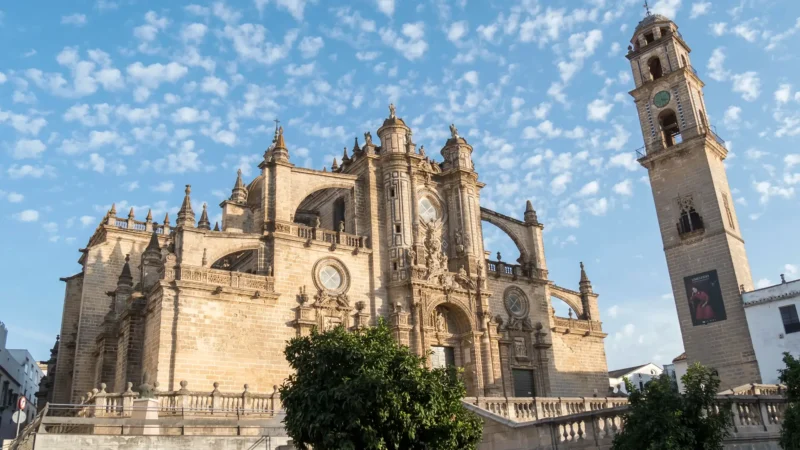
Jerez’s cathedral rises just beside the Alcázar, a huge stone pile that mixes Gothic, Baroque and Neoclassical styles. It was built on the site of an old mosque and later church, and only became a cathedral in 1980. Step inside for the five naves and the dome; the free-standing bell tower stands apart on the square. It looks its best in the late-day sun, when the honey-coloured stone glows.
Iglesia de San Marcos
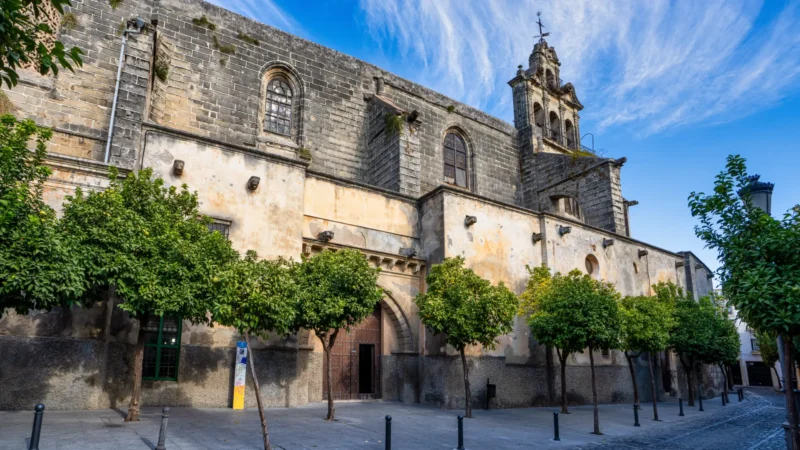
One of six parish churches founded after the city was taken in 1264, San Marcos is a fine example of Jerez’s Gothic-Mudéjar style. The single nave has flamboyant Gothic vaults, and the Baroque high altar is one of the richest in the city. Its stone bell tower rises over the small square and old streets around it. A quiet, un-touristed church worth stepping into as you walk the centre. (
Plaza de la Asunción
This is one of the loveliest squares in Jerez, ringed by historic buildings. On one side stands the 15th-century church of San Dionisio, in the same Gothic-Mudéjar style. It is dedicated to the city’s patron saint, and the tall Torre de la Atalaya watchtower rises beside it. Facing the church is the Antiguo Cabildo, the Renaissance old town hall from the 16th century, with marble columns and a carved façade. Together they make an easy, atmospheric stop in the heart of the old town.

The sherry bodegas
Sherry is made and aged in Jerez’s bodegas, the tall, cool store-houses that fill the centre. Inside, rows of oak barrels rest in dim, cathedral-like halls, marked in chalk and aged for years through the solera system. Some houses, like González Byass (home of Tío Pepe), are huge and give tours; others are small, working cellars. Seeing the barrel halls is the heart of any Jerez visit.
Cartuja de Jerez
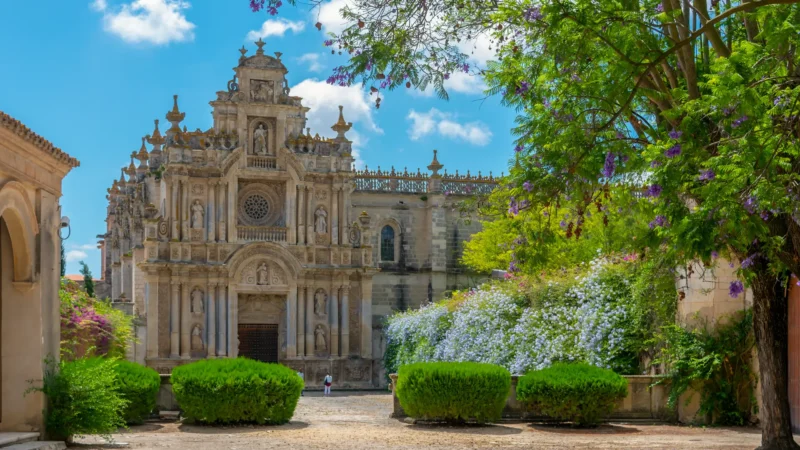
Just outside the city, on the banks of the Guadalete river, stands this grand 15th-century monastery, one of the finest historic buildings in Cádiz province. Its Gothic cloisters and carved stone gateway are remarkable. It is now home to a closed order of nuns, so access is limited and changes with religious events; the grounds, gateway and church can usually be seen, but the full interior is not always open.


What to Do in Jerez de la Frontera
Affiliate note: some links below are affiliate links. If you book through them, we may earn a small commission at no extra cost to you. It helps us keep GoHiddenSpain running and growing. We only suggest services we'd feel comfortable recommending.
Tour a sherry bodega
This is the thing to do in Jerez. A bodega tour walks you through the tall cellars, the rows of ageing barrels and the solera system, and ends with a tasting. González Byass, the maker of Tío Pepe, runs the best-known visit: it is large, with a little train through the grounds and a cellar designed by Gustav Eiffel. Others, such as Lustau, Bodegas Tradición and Fundador, offer smaller, more focused tastings. You can arrange most of this yourself online. A good guided tour is still worth it, though: a proper cellar guide teaches you to read the solera, to tell a bone-dry fino from a nutty amontillado, and to taste like a local rather than guess.
See the dancing horses
The Real Escuela Andaluza del Arte Ecuestre, the Royal Andalusian School of Equestrian Art, puts on a famous show called How the Andalusian Horses Dance. It is a kind of horse ballet, set to Spanish music, with riders in 18th-century dress. Show days change with the season, usually falling on set weekdays, and tickets sell fast in Horse Fair week. On non-show days you can often visit instead for a training session and the museums, which is quieter and cheaper.
Book the show as an experience on TiqetsSee flamenco in a Sacromonte cave
A tabanco is a traditional Jerez sherry tavern, part bar, part shop, where the wine comes straight from the barrel. The best cluster around Plaza Plateros and Calle Santa María. Order a flight and you get fino, amontillado, oloroso and sweet Pedro Ximénez side by side, often with a plate of cheese or Iberian ham. Some tabancos put on live flamenco too. It is the cheapest, most local thing you can do here, and you do it entirely on your own.
Go looking for flamenco in the Barrio de Santiago
Jerez is a serious flamenco city, and this is where it lives. The Barrio de Santiago is a knot of low streets north of the centre. It is the heartland of the bulería and home to famous singing families. There is nothing to buy a ticket for; the point is to walk it, see the Iglesia de Santiago, and feel where the music comes from. Come back after dark for the peñas, the small members’ clubs in Santiago and next-door Barrio de San Miguel. They often welcome visitors for a night of song. Some tabancos in the centre also run regular flamenco evenings. Ask around in the afternoon for what is on that night; the scene is informal and changes week to week.
Step inside a Jerez palace
The sherry families built grand houses all over Jerez, and two of the best are open to visit. The Palacio Domecq is the finest. It is a Baroque mansion from the 1770s, on the Alameda Cristina. It has a courtyard of red Italian marble and a wide, sweeping staircase. Inside are grand rooms full of tapestries and art. You tour it with an English audio guide, in about 50 minutes. It is the clearest window into the sherry families who shaped the city. Nearby, the Palacio del Virrey Laserna gives a shorter guided walk through a palace still lived in by one family.
Book the Palacio Domecq visit on Tiqets
Prefer to go with a guide for any of this? Ask where you’re staying, or at the tourist office on Plaza del Arenal (Edificio Los Arcos) — they’ll know what’s running, in which language, and can point you to something that fits.
Seasonal Events and Festivals
Festival de Jerez (late February to early March)One of the world’s most important flamenco festivals, held over about two weeks. The Teatro Villamarta, the bodegas, the peñas and the tabancos all fill with performances. Check exact dates at festivaldejerez.es (website is in Spanish but you can use browser translation).
Feria del Caballo — Horse Fair (May)The city’s biggest party, a week of horses, carriages, riders in traditional dress, flamenco and sherry at the González Hontoria fairground. This is the busiest, priciest week of the year; book far ahead.
Semana Santa — Holy Week (spring)The processions of Easter week fill the old town with incense and slow-moving brotherhoods. Dates move with the church calendar.
Fiesta de la Bulería (August)A summer celebration of Jerez’s own flamenco style, the bulería, with big local names.
Zambombas (late November to December)In the run-up to Christmas the Barrio de Santiago and the tabancos host zambombas, warm, boisterous gatherings of flamenco Christmas songs. A very Jerez tradition, and largely for locals.
Getting There and Around
Jerez sits on the flat land of Cádiz province, on the main road and rail line between Seville and Cádiz, just inland from the coast.
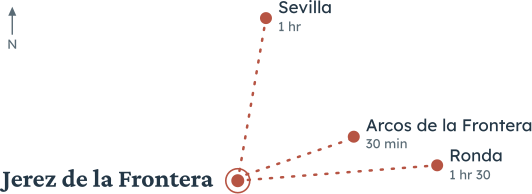
From Sevilleabout 1 hour by car (roughly 90 km) on the AP-4 motorway. Direct trains run about every hour and take under an hour.
From Cádizabout 40 minutes by car; frequent local and regional trains also connect the two.
From Arcos de la Fronteraabout 30 minutes by car (roughly 30 km) — the nearest White Village.
Nearest airportsJerez Airport (XRY) is only about 8 km northeast of the centre, around 15 minutes by taxi, with its own train station on the Seville–Cádiz line. It is a small regional airport with limited routes, so many visitors fly into Seville instead, about an hour away.
By trainJerez has direct services from Seville, Cádiz and Madrid; the station sits about a 15-minute walk east of the old town.
Getting around
You do not need a car inside Jerez. The old town is small and flat, and the sights, bodegas and tabancos are all within an easy walk. Park outside the historic core or use a central car park, as the old streets are tight. You do want a car for the wider trip, though: it is the easy way to reach the White Villages, Arcos, and the other sherry towns of the coast, El Puerto de Santa María and Sanlúcar de Barrameda, which together with Jerez form the Sherry Triangle.
Looking for a ready-made plan? See our Andalucía road trips.
Practical Info
- TicketsThe Alcázar and the cathedral are ticketed separately, each with its own straightforward admission (the Alcázar has an add-on for the cámara oscura). Hours change with the season, and some sights close on certain days, so check the official sites or at the tourist office before you go.
- Best time of dayVisit the bodegas and horse school in the morning, save the Alcázar and old town for the softer late-afternoon light, and keep the evening for tabancos and flamenco.
- Getting aroundFlat and walkable; no car needed inside the centre. Park outside the old core.
- ClimateJerez has hot, dry summers and mild, wetter winters. July and August highs sit around 33–35°C and can top 40°C, with almost no rain. The most comfortable months are roughly March to May and October to November, with pleasant highs of about 18–24°C. The rain mostly falls in late autumn and early winter, wettest around November and December.
Where to Eat in Jerez de la Frontera
You’ll eat and drink well in Jerez, at every budget — and in 2026 it is officially Spain’s Capital of Gastronomy, so the whole city is leaning into its food. This is sherry country, so the wine is part of every meal, from a barrel-poured fino in a tabanco to a full pairing in a smart dining room. Two simple rules make it easy: for a relaxed lunch while you’re out walking, aim for the tabancos and squares around Plaza Plateros; for dinner, settle into the old town, where the best kitchens are. The picks below run from a stand-up sherry-and-tapas bar to a proper special-occasion table.
A classic Jerez tabanco near Plaza Plateros, with sherry straight from the barrel and honest tapas. Order a flight of five sherries with cheese or Iberian ham for an education in a glass. Local, lively and cheap.
Set in a former tobacco warehouse, this is a warm, character-filled spot for well-made Andalusian dishes and local sherry. A reliable, mostly-locals choice a short walk from the centre.
Set in a former tobacco warehouse, this is a warm, character-filled spot for well-made Andalusian dishes and local sherry. A reliable, mostly-locals choice a short walk from the centre.
A long-standing Jerez name on a quiet square, good for a sit-down lunch with a strong wine list. Solid, creative Andalusian cooking and a nice terrace for people-watching.
Housed in a former bodega, with its old cellar arches still overhead, this is the place to eat a full menu matched to Jerez sherries. Ambitious, local-led cooking in a genuinely atmospheric room. Book ahead.
Jerez’s two-Michelin-star table, serving avant-garde tasting menus that fuse French technique with Andalusian ingredients and a deep sherry list. A destination meal; reserve well in advance.
Where to Stay in Jerez de la Frontera
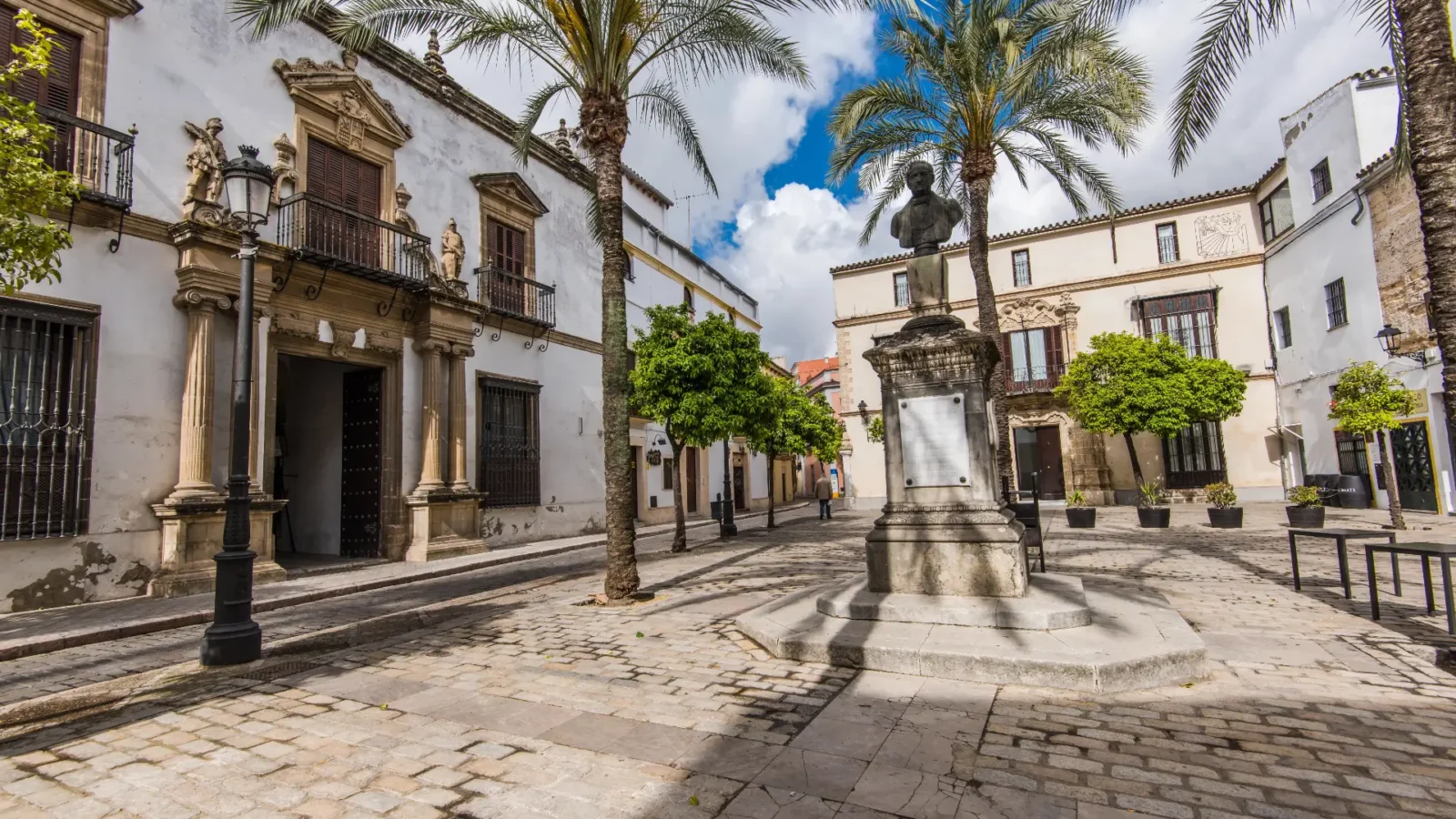
Picture the old town after the day-trippers have gone: the bodega tours are over, the squares are quiet, and a glass of chilled fino is waiting in a lamplit tabanco. That evening is the real reason to stay the night in Jerez — and the city has beautiful places to sleep, from working sherry-house hotels to old palaces. Here’s where we’d stay.
Hotel Bodega Tío Pepe
Sleep beside the most famous sherry house of all, steps from the cathedral, with a rooftop pool and terrace looking over the Alcázar. The clearest way to make the wine the centre of your stay.
Check prices & availability for Hotel Bodega Tío Pepe on Booking.comCasa Palacio María Luisa
A grand 19th-century palace, once the city’s casino, now a five-star hotel with a courtyard garden and pool in the heart of the old town. For a special stay wrapped in Jerez history.
Check prices & availability for Casa Palacio María Luisa on the accommodation's websitePalacio del Virrey Laserna
A lived-in aristocratic palace where you sleep among family antiques and art, with a garden and pool behind the walls. Guided tours of the house bring its history alive. Characterful and central.
Check prices & availability for Palacio del Virrey Laserna on the accommodation's websiteLa Gitanilla Alojamiento & Encanto
A small, warmly-run guesthouse in a 19th-century building, with a roof terrace looking straight at the Alcázar and cathedral. Personal service and a proper Jerez welcome.
Check prices & availability for La Gitanilla Alojamiento & Encanto on the accommodation's websiteHotel San Andrés
A friendly, family-style hotel built around a plant-filled patio, right in the old town. Simple, spotless and excellent value — the budget choice that still has charm.
Check prices & availability for Hotel San Andrés on the accommodation's websiteNuevo Hotel
A family-run hotel just off the main square, in the same hands since 1927, with a few beautifully tiled Moorish-style rooms. Great-value old-Spain character in the very centre.
Check prices & availability for Nuevo Hotel on the accommodation's website
Region, Nearby and Routes
Part of Andalucía
Jerez de la Frontera is in Cádiz — Andalucía
Nearby places
- Arcos de la FronteraA white town perched on a sandstone cliff, ringed by the Guadalete, with sudden sweeping views at every turn.
- RondaThe dramatic gorge town split by the Puente Nuevo — the biggest, best-known stop on the White Villages Trail.
- SevilleAndalucía’s grand capital, with three UNESCO monuments, orange-tree squares and Spain’s best tapas scene.
Frequently Asked Questions
Yes. It is the home of sherry, one of the cradles of flamenco, and the seat of a famous horse-riding school. It has real monuments, a walkable old town and a strong food scene, yet stays calmer and more authentic than Seville.
Three things above all: sherry wine (which is named after the city), the dancing horses of the Royal Andalusian School of Equestrian Art, and flamenco, especially the bulería style born here. It is also Spain’s Capital of Gastronomy for 2026.
One full day covers the highlights, but two days let you fit a bodega tour, the horse show, the Alcázar and an evening of flamenco without rushing. We’d stay at least one night.
Spring and autumn are ideal. March to May and October to November are the most comfortable, with highs around 18–24°C. July and August are very hot, often 33–35°C and sometimes over 40°C, with almost no rain. Late autumn is the wettest time. Note that the city is busiest and priciest during the May Horse Fair and the late-winter flamenco festival.
Yes. Direct trains take under an hour and run about hourly, so a day trip is easy. But you’ll see it at its best if you stay the night, when the day-trippers leave and the flamenco starts.
It’s strongly recommended. Popular bodega tours like Tío Pepe and the horse-school show sell out on busy days, and both are essential to book ahead during the May Horse Fair. Outside peak weeks you can often book a day or two ahead.
The old town is the place to be. Hotel Bodega Tío Pepe puts you beside the famous sherry house with a rooftop pool, and Casa Palacio María Luisa is a grand five-star palace. For character on a smaller budget, try the La Gitanilla guesthouse, the family-run Nuevo Hotel, or the good-value Hotel San Andrés.
For a local, low-key meal, head to a tabanco such as Tabanco Plateros for sherry and tapas, or Las Banderillas for classic dishes. For dinner, La Carboná offers a sherry-paired menu in a former bodega, and LÚ Cocina y Alma is the city’s top fine-dining table.