
Arcos de la Frontera: the cliff-top gateway to the white villages
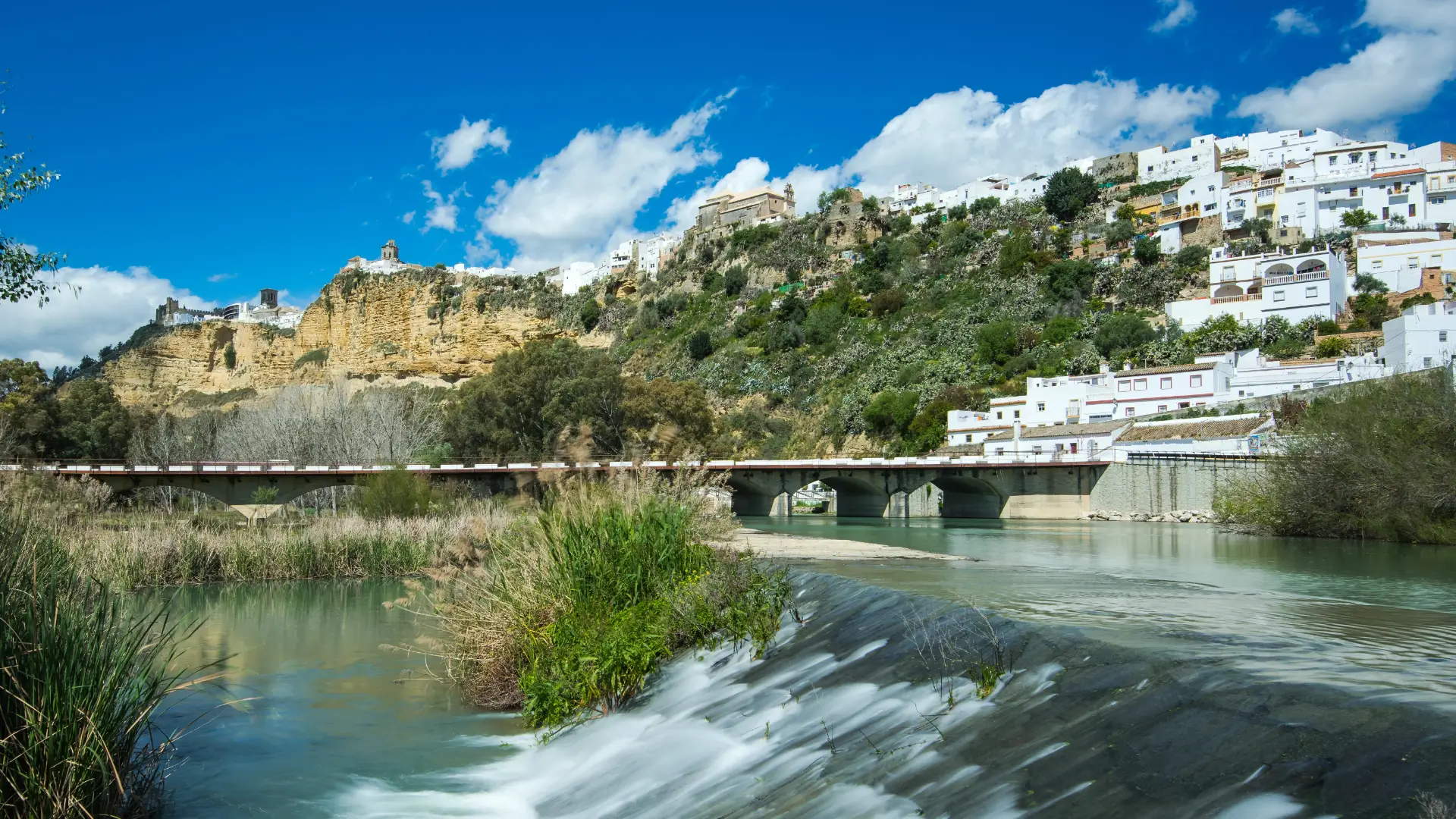
Arcos de la Frontera sits high on a sandstone cliff in the province of Cádiz, with the Guadalete river looping around its foot. It is the western gateway to Andalucía’s white villages, and the calmest base for the trail. The old town is small, Moorish and steep. Most day-trippers leave by late afternoon, so the real reward is a night here — quiet lanes, warm stone and long views.
Why Visit Arcos de la Frontera
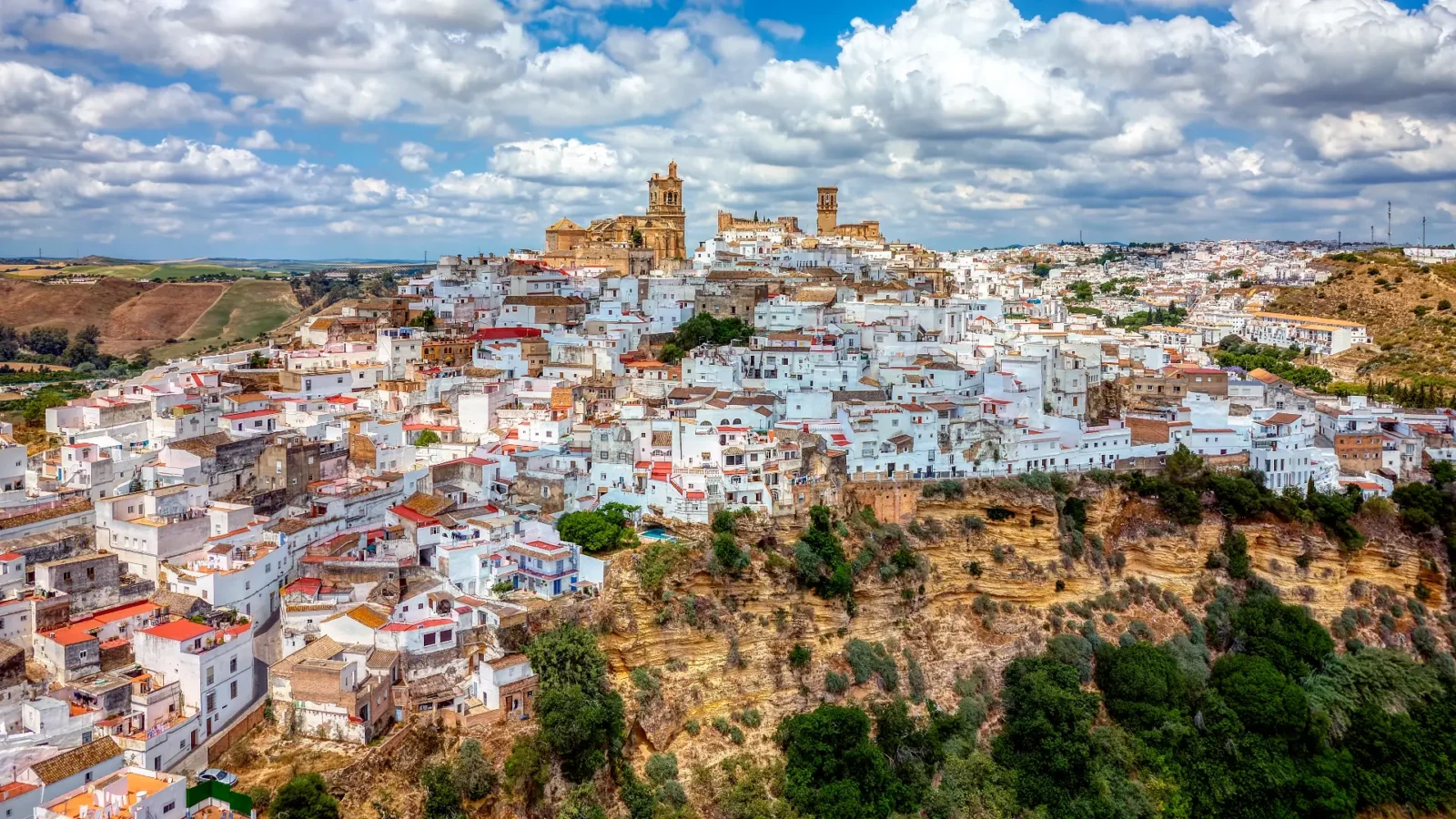
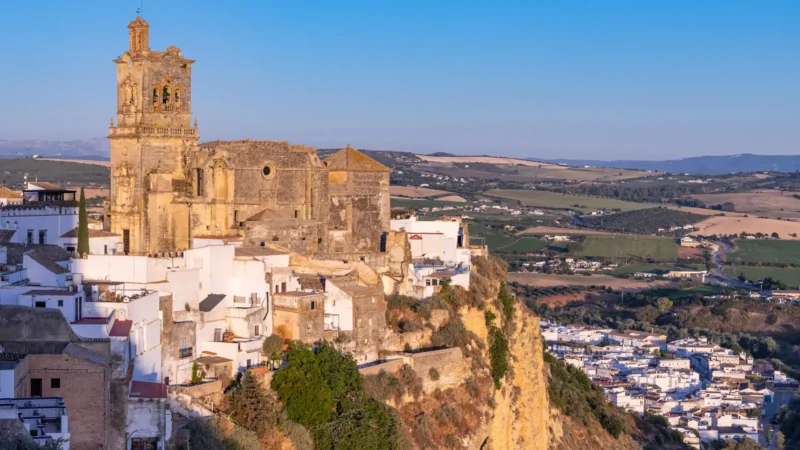
The first sight of Arcos does the work no guidebook can. The town rises straight off a sheer cliff, a wall of white houses above the green river valley. Up close, the charm is different and quieter. You climb narrow, whitewashed lanes, past iron-grilled windows and small squares, until the streets open onto a viewpoint and the whole plain drops away below you. The old town is compact, so the pleasure is in the climb and the sudden views, not in a long list of monuments.
Who Arcos de la Frontera is for
Arcos suits travellers who like to wander and look, rather than tick off sights. It rewards a slow morning in the lanes and an evening on a mirador. It also makes the most comfortable base at the western end of the white villages, close to Jerez and its airport. If you want one calm town to sleep in while you explore the Sierra de Cádiz, this is it. Crowds thin out fast once the tour coaches leave.
Day trip or overnight?
You can see the core of Arcos in an afternoon. The old town is small, and the main climb takes an hour or two at an easy pace. But an afternoon means leaving just as the town turns quiet and gold. Our honest advice: stay the night. A perfect short visit looks like this. Arrive after lunch and walk up the Cuesta de Belén into the old town.
Spend the late afternoon on Plaza del Cabildo and climb the Santa María bell tower for the wide view. As the light drops, follow the miradors round to the San Pedro side. Have a slow dinner in the lanes, then walk the empty streets after dark, when the day visitors have gone and the stone still holds the day's warmth. Sleep here, and start the trail fresh the next morning.
What to See in Arcos de la Frontera

Basílica Menor de Santa María de la Asunción
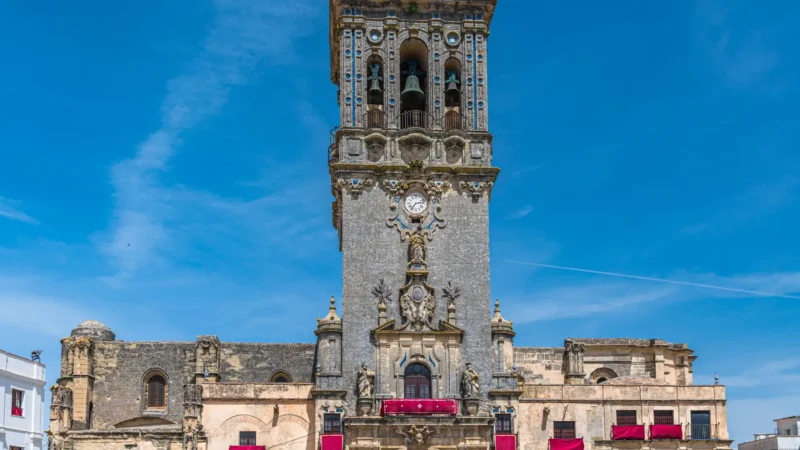
Arcos’s main church rises over Plaza del Cabildo. It was built after the Reconquest on the site of an old mosque, and mixes late Gothic and Plateresque styles. The carved west doorway is the highlight outside; the star-vaulted interior is the reward within. You can visit the church, and climb the bell tower for the best rooftop view in town.
Castillo Ducal de Arcos
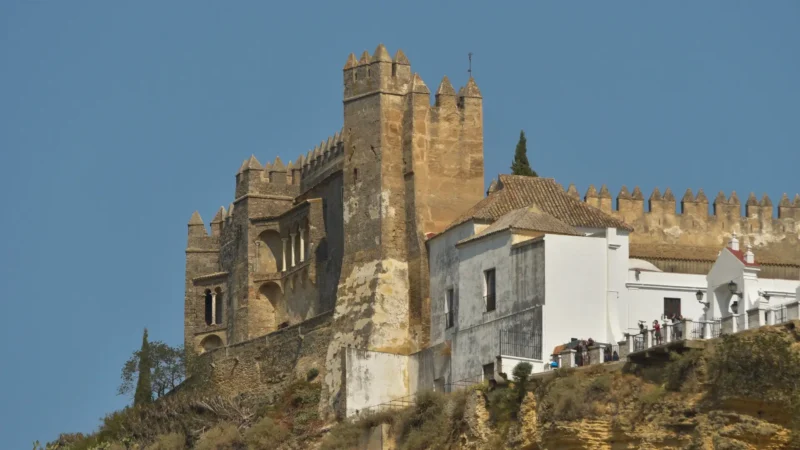
The castle on Plaza del Cabildo began as a Moorish fortress and was rebuilt in the 14th and 15th centuries. It is private property and closed to the public, apart from a few open days each year. You can still admire its walls and towers from the square, and see it best from the basilica bell tower. It anchors the skyline you photograph from every viewpoint.
Iglesia de San Pedro
On a cliff at the far end of the old town stands the church of San Pedro, once a rival to Santa María. It was built between the 15th and 17th centuries over an earlier Moorish tower. Its tall Baroque front seems to grow straight out of the rock. The walk to reach it, through quiet lanes and past small miradors, is half the pleasure.
Plaza del Cabildo and the Balcón de Arcos
The heart of the old town sits at the top of the climb. This three-sided square holds the basilica, the ducal castle and the Parador, and opens on its fourth side to the Balcón de Arcos. This viewpoint stands on a rock almost 100 metres above the valley, with the Guadalete winding below. It is the town’s signature view, and it is free.
The old town (casco antiguo)
The whole historic centre is protected as a monument, and it repays slow wandering. Look for Calle Nueva, which follows the castle’s old moat, and the Callejón de las Monjas, where stone arches brace the walls overhead. Whitewashed houses, flower pots and worn stone corners fill every lane. Getting a little lost here is the point.


What to Do in Arcos de la Frontera
Climb the Santa María bell tower
The bell tower of the basilica gives the widest view in Arcos: the old town roofs, the castle, San Pedro across the way and the plain beyond. It is a steep stair, but short, and cheaper than most church climbs in Spain. A combined ticket usually covers the church and the tower. Go late in the day, when the light turns the stone gold.
Follow the mirador trail
Arcos is ringed with viewpoints, and linking them makes a natural walk. Start at the Balcón de Arcos on Plaza del Cabildo, then work round to the Mirador de Abades behind San Pedro. The Mirador de San Agustín and Peña Vieja add more angles a little further out. Each one frames the river, the cliffs and the white houses in a different way.
Walk the Ruta Fluvial by the Guadalete
For a change from the climb, drop down to the river. The Ruta Fluvial leaves the old town near the Puerta de Matrera and follows the Guadalete below the cliffs. It is an easy, mostly flat loop, and it gives you the classic view of Arcos from underneath, the whole town stacked on its rock. Best in the cooler morning hours.
Paddle the Arcos reservoir
Just below the town, the Guadalete widens into the Arcos reservoir (Embalse de Arcos). On the water you get the rare low-angle view of the cliff town, and a cool break on a hot day. Kayaks and paddleboards can be hired at the lakeside in the warmer months. A local operator adds the gear, the safe put-in and the best route along the shore, so you spend the time paddling, not planning.
Prefer to go with a guide for any of this? Ask where you're staying, or at the tourist office on Cuesta de Belén — they'll know what's running, in which language, and can point you to something that fits.
Seasonal Events and Festivals
CarnivalArcos keeps its old traditions alive, and a few are worth planning around. Carnival brings float parades and satirical street-singing groups in February.
Semana Santa (Holy Week, March or April)the town’s most famous event and is listed as of National Tourist Interest, with slow processions winding through the narrow old-town lanes.
Crosses of May (early May)dressing the old squares with crosses made of flowers.
Virgin of Las Nieves (August 5th)the town honours its patron, the Virgin of Las Nieves, with a procession and flamenco evenings.
Feria de San Miguel, (late September)the biggest fair of the year and marks the town’s patron saint.
Live Nativity (Christmas)Arcos sings zambomba carols and stages a Live Nativity (Belén Viviente) through the old quarter — both protected as cultural heritage.
For exact dates each year, which often move with Easter or are set locally, check the town’s official festival calendar: Arcos de Fiesta
Getting There and Around
Arcos sits just off the A-382, on the western edge of the Sierra de Cádiz. It is an easy first stop on a drive up from the coast or in from Jerez.
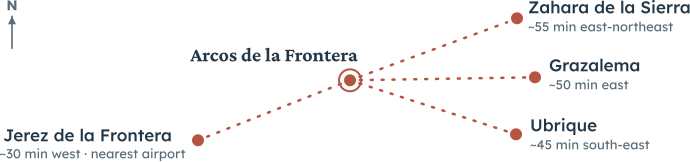
From Jerez de la Fronteraabout 30 minutes by car (roughly 37 km) via the A-382. Regular buses also run from Jerez in about 40–45 minutes.
From Sevilleabout 1 hour 15 minutes by car (roughly 93 km) via the A-4 and A-382.
From Cádizabout 1 hour by car, or a direct bus in around an hour.
Nearest airportsJerez (XRY) is closest, about 30 minutes away; Seville (SVQ) is the larger international option, about 1 hour 15 minutes. Málaga (AGP) is roughly 2 hours 30 minutes.
Getting around
You do not need a car inside Arcos, and you would not want one. The old-town streets are steep and very narrow, and you cannot park up top. Leave the car in the underground car park at Paseo de Andalucía, or in a free space in the lower town, and walk up. But you do want a car for the region: it is the only practical way to link the white villages and reach the Sierra de Grazalema. Arcos is the natural place to pick one up if you have flown into Jerez.
Looking for a ready-made plan? See our Andalucia road trips.
Practical Info
- Getting in and upPark below the old town (underground car park at Paseo de Andalucía, or free spaces in the lower town) and walk up. A small tourist train also runs up the hill in season for those who would rather not climb.
- Tourist officeThe municipal tourist office is on Cuesta de Belén, on the way up to Plaza del Cabildo. It hands out a town map and the Ruta Monumental leaflet, and shares a building with the town’s interpretation centre.
- TicketsThe basilica charges a small entry fee, with a slightly higher combined ticket for the church and the bell tower. Hours change with the season, so check the official source for the current times before you go. The castle is private and not open, so no ticket applies.
- ClimateArcos sits on the low plain, so it runs hotter than the mountain villages nearby. July and August are the hottest months, with highs around 34°C and very little rain. The most comfortable months are roughly March to May and October to November, with pleasant highs of about 18–26°C. Rain falls mainly in late autumn and winter, peaking in December; summers are dry.
Where to Eat in Arcos de la Frontera
You’ll eat and drink well in Arcos, at every budget. This is inland Cádiz cooking, built on garden vegetables, pork and old country recipes, with the sherry country of Jerez just down the road. Two simple rules make it easy: for a light lunch while you’re out walking, the tapas bars in the old town do the job; for a slower dinner, take a table with a view and let the evening run long. Look out for the town’s own dishes — the garlic-and-bread ajo caliente (also called ajo molinero), wild-thistle tagarninas, chickpea-and-pumpkin alboronía, and the sweet biscuits the convent nuns still sell from behind a small hatch.
The Parador’s own dining room, in the Casa del Corregidor, with a terrace on the cliff edge above the Guadalete valley. The cooking is inland-Cádiz regional — think oxtail (rabo de toro), Atlantic corvina and old dishes like potaje de acelgas and ajos molineros — paired with local wines. The finest view in town, and the place for a special dinner at golden hour.
A well-regarded tapas spot in the historic centre, run with real care for the produce. Try the local queso de Arcos, the coquinas (small clams) and the fried artichokes. Easy for a lunch stop between sights.
A small modern kitchen doing refined tapas from good local products, with pork cheek and tuna among the picks. A strong wine list, including local labels. A nice half-step up from the classic bars.
Taberna Jóvenes Flamencos
A small, characterful tavern in the heart of town, with a tiny flower-hung terrace. Good value tapas and portions, and a place to try the local abajao and scrambled eggs with tagarninas. Friendly and firmly local.
La Taberna del Casino
A traditional restaurant set in a quiet courtyard in the heart of the old town, with high terraces that catch the valley views. Andalusian dishes, done well, in a characterful old
A simple old-town bar full of locals — always a good sign — with a great-value set menu. Look for country dishes like sopa de picadillo, chard stew, artichokes and huevos a la flamenca. Honest, generous and cheap.

Where to Stay in Arcos de la Frontera
Stay the night and Arcos changes. The coaches leave, the lanes empty, and the miradors are yours in the low evening light. You can walk out after dinner to a viewpoint with the whole valley dark below and the town warm and quiet behind you. That evening is the real reason to sleep up here — and these are the places we’d choose to do it.
Hacienda El Santiscal
A restored 15th-century country house a few minutes’ drive from town, near the Arcos reservoir, with gardens and a pool. It trades the old-town lanes for space, quiet and a rural setting. Good if you want to swim and slow down between drives.
Check prices & availability for Hacienda El Santiscal on the accommodation's websiteHostal Rural La Plata
A simple, well-kept hostal with its own free parking, a real plus when the old-town streets are so tight. It is a short hop from the historic centre and an easy, affordable base for a road trip. Clean, friendly and no fuss.
Check prices & availability for Hostal Rural La Plata on the accommodation's websiteHotel El Convento
A small hotel in a former 17th-century convent, tucked behind the Parador on the cliff. Many rooms have a private terrace or balcony over the valley, and the rooftop shares that same big view. Central, calm and good value for the old town.
Check prices & availability for Hotel El Convento on the accommodation's websiteHotel Los Olivos
A friendly, traditional hotel a short walk from the historic centre, set around a leafy Andalusian courtyard with a stone well. Simple, comfortable rooms and an easy base for exploring on foot. A sensible mid-range pick.
Check prices & availability for Hotel Los Olivos on the accommodation's websiteLa Casa Grande
A characterful small guesthouse in a restored old house in the historic centre, with a rooftop terrace over the cliff and valley. A warm, personal alternative to the parador at a gentler price, and right among the white-washed lanes.
Check prices & availability for La Casa Grande on the accommodation's websiteParador de Arcos de la Frontera
The classic Arcos stay: a former magistrate’s house right on Plaza del Cabildo, with a cliff-edge terrace over the Guadalete. Ask for a valley-facing room and you wake to the view the whole town climbs up to see. Sleep at the very heart of the old town.
Check prices & availability for Parador de Arcos de la Frontera on the accommodation's website
Region, Nearby and Routes
Part of Andalucía
Arcos de la Frontera is in Andalucía
Part of these routes
Arcos de la Frontera opens our White Villages Trail see the full route.
Nearby places
- GrazalemaA cool, green mountain village in the Sierra de Grazalema park, built for hiking and payoyo cheese.
- Zahara de la SierraA white village wrapped round a crag under a Moorish tower, high above a turquoise mountain lake.
- OlveraA white town crowned by a Moorish castle and a great church, and the start of the Vía Verde greenway.
- UbriqueThe biggest white village and Spain’s leather-craft capital, wrapped in cliffs and Roman history.
- SevilleAndalucía’s grand capital, with three UNESCO monuments, orange-tree squares and Spain’s best tapas scene.
- Jerez de la FronteraThe birthplace of sherry, with dancing horses and deep flamenco roots — a working Andalusian city that stays real.
Frequently Asked Questions
Yes. It is one of the most dramatic of Andalucía’s white villages, a whole town stacked on a sheer cliff above the Guadalete river. The old town is small but full of character, and the viewpoints are superb. It also makes the calmest base for the wider white villages route.
It is known for its cliff-top setting, its Moorish old town and its sweeping viewpoints. The main square, Plaza del Cabildo, holds the basilica, the ducal castle and a famous balcony over the valley. Arcos is also seen as the gateway to the Route of the White Villages.
Half a day covers the main sights, as the old town is compact. But it is best enjoyed with an overnight stay, so you can walk the quiet lanes and miradors in the evening after the day-trippers leave. One night is ideal for most visitors.
Spring and autumn are the most comfortable. Expect pleasant highs of about 18–26°C from roughly March to May and October to November. July and August are hot, with highs around 34°C and little rain. Most rain falls in late autumn and winter, peaking in December.
Yes. Arcos is about 30 minutes by car from Jerez and about 1 hour 15 minutes from Seville, and buses run from both areas. It works well as a day trip, but staying the night rewards you with the town at its quietest and most beautiful.
For the old town, the Parador de Arcos de la Frontera sits right on the main square with a cliff-edge terrace, while La Casa Grande and Hotel El Convento offer characterful rooms with valley views. For a rural stay with a pool, Hacienda El Santiscal is a short drive out. Hostal Rural La Plata is a good affordable option with parking.
For a special dinner with a view, the Restaurante del Parador, on Plaza del Cabildo, is hard to beat. For tapas in the old town, try Bar La Cárcel or the modern Gastrobar El Retablo, and for a table with a view in a quiet courtyard, La Taberna del Casino. For traditional, great-value cooking full of locals, look to Taberna Jóvenes Flamencos or Pensión-Bar San Marcos.