
Grazalema: the green heart of the white villages
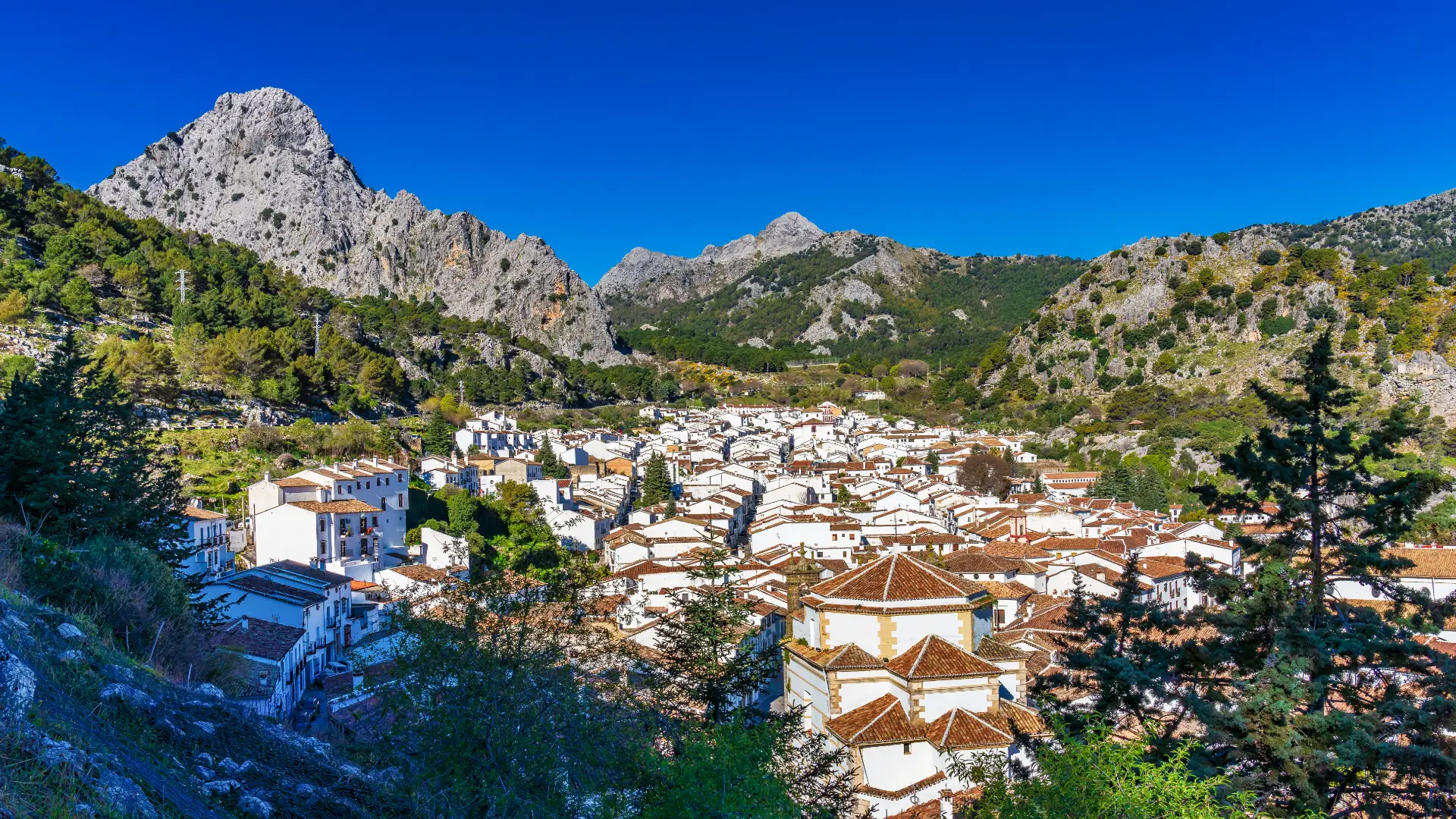
Grazalema is a white village in the mountains of Andalucía, deep inside the Sierra de Grazalema Natural Park. It is known for two things: some of the best hiking in southern Spain, and more rain than almost anywhere else in the country. The result is a cool, green world of limestone peaks, griffon vultures and payoyo cheese — far from the crowds on the coast.

Why Visit Grazalema
Most white villages sell you a view. Grazalema sells you a whole landscape. The village sits at around 800 metres, pressed against the grey rock wall of the Peñón Grande. Around it lies the Sierra de Grazalema Natural Park, a UNESCO Biosphere Reserve of limestone peaks, deep gorges and the rare pinsapo fir — a tree that survives almost nowhere else in Europe. Griffon vultures circle overhead most days.
The rain is part of the story. Grazalema records around 2,200 mm in an average year, more than almost anywhere in Spain. That water keeps the sierra green when the rest of Andalucía turns brown, and it built the village too: for two centuries, mountain streams powered looms that made Grazalema's wool blankets famous. You can still watch them being woven. Add payoyo goat's cheese, more than fifty stone fountains, and streets that empty by early evening, and you have the mountain counterpart to sun-baked Arcos — cooler, greener and slower.
Who Grazalema is for
Grazalema suits walkers first: four of Andalucía's finest trails start within a few kilometres. It also rewards slow travellers who want a quiet square, a long lunch and mountain air. If you collect monuments, other stops on the route offer more; Grazalema's charm is the setting, not a sightseeing list.
Day trip or overnight?
You can see the village itself in two or three hours — the square, a mirador, a slow coffee — and most people on the White Villages Trail visit it that way, as the first stop of a day that ends in Zahara. That works. But if you want to walk in the park, stay the night. The permit trails start early and begin just outside the village, so sleeping here saves you a mountain drive at dawn. A perfect short visit looks like this: arrive late afternoon, walk Calle Las Piedras up to the Mirador de los Peñascos, eat roast lamb at Cádiz El Chico, and set out for the Pinsapar or El Torreón while the vultures are still waking up. Our honest advice: day-trip it on the route, come back with boots.
What to See in Grazalema
Artesanía Textil de Grazalema
A short walk from the square on the Ronda road, this working factory still weaves the wool blankets — mantas de Grazalema — that made the village wealthy in the 18th and 19th centuries. Old looms and machinery are on display, and the shop sells blankets, ponchos and scarves. Hours change with the season, so check locally before you walk up.
Iglesia de Nuestra Señora de la Aurora
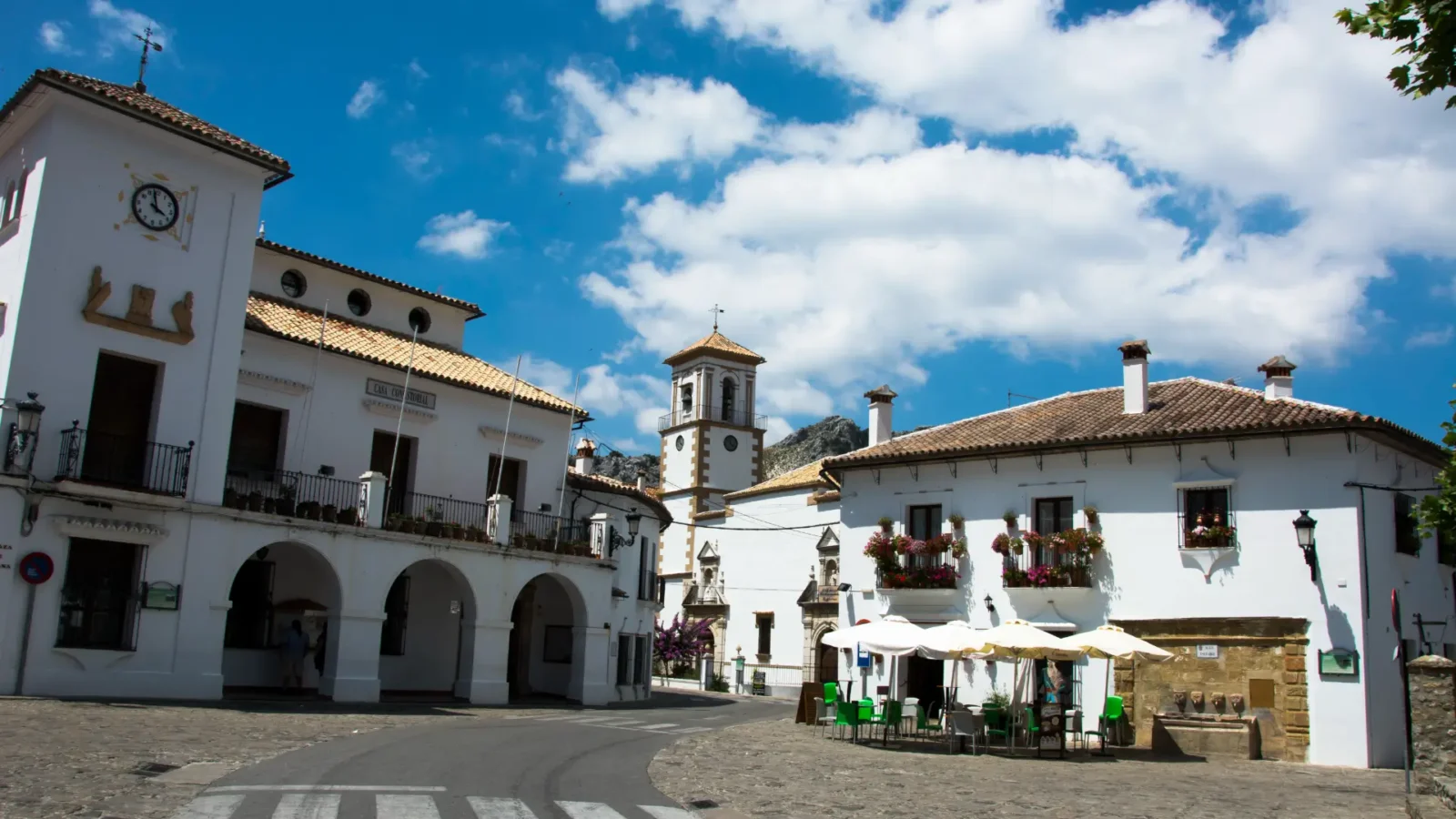
Grazalema’s most recognisable church closes off the Plaza de España. Building began in 1760, and the stone facade mixes late Renaissance and Baroque lines. Badly damaged in the Civil War, it was carefully restored; it opens mainly for services, so admire it from the square if the doors are shut.
Iglesia de Nuestra Señora de la Encarnación
The parish church stands just off the square, first built in the late 15th century over an older Mudéjar temple and rebuilt after war damage. Inside is the image of San Atanasio, the village’s patron saint. It is a working church: visit around service times.
Plaza de España
The long main square is where village life happens, framed by the town hall at one end and the Iglesia de la Aurora at the other. Its four-spouted stone fountain is thought to have Visigothic origins. Take a terrace table and watch the mountains change colour.
The miradors: Los Asomaderos and Los Peñascos
Two viewpoints frame the village. The Mirador de los Asomaderos, next to the main car park and the tourist office, looks out over the Guadalete valley. The Mirador de los Peñascos, up in the high town near the Iglesia de San José, gives the classic view over the rooftops to the Peñón Grande. Sunset is best at either.
What to Do in Grazalema
Hike the permit trails
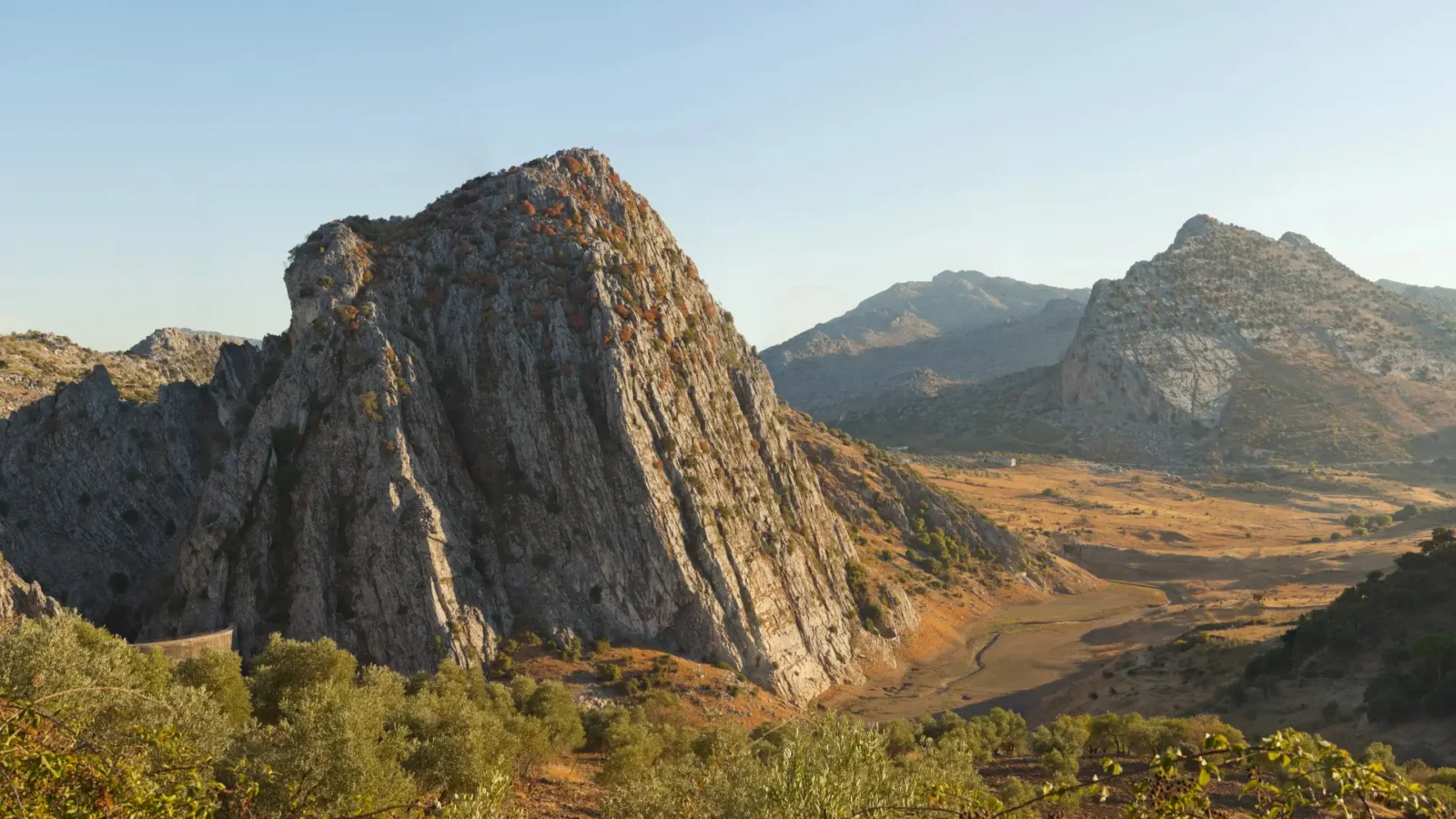
Four of the park’s finest walks cross a protected reserve and need a free permit. El Pinsapar is the classic. It runs about 6 hours, linear, through the rare pinsapo fir forest, with a steep start 2 km outside Grazalema. El Torreón is a hard climb of roughly 5 hours return to the highest peak in Cádiz province, at 1,654 m. You have a good chance of ibex and raptors on the way up. The Garganta Verde takes about 4 to 5 hours return. It drops steeply into a 400-metre-deep gorge below a griffon-vulture colony, and starts from the Zahara side of the pass. The gentlest is the Llano del Rabel, around 3 hours return on an easy gravel track towards the edge of the forest. Permits are free but limited, and the booking site is in Spanish only. The full step-by-step is in the FAQ below, and you book through the Junta de Andalucía’s official reservation site. These four trails close or restrict access from roughly 1 July to 15 October because of fire risk. Weekdays are far easier to book than weekends.
Walk the free trails
Plenty of the sierra needs no permit at all. Cerro Coros is an easy circular walk of about 2 hours from the Puerto de las Palomas car park. It has sweeping views over both Grazalema and Zahara, with vultures often gliding close overhead. The Río Majaceite is a shady, level riverside path of roughly 2 to 3 hours one way. It runs from Benamahoma down to El Bosque, and makes a fine choice on a hot day. The Llanos del Republicano is about 2 hours. It sets off from Villaluenga del Rosario, past the Payoyo cheese factory, to reach the Sima del Republicano — a deep karst sinkhole in a quiet upland plain. Closer to home, a stepped, cobbled path climbs from the village to the ruined Ermita del Calvario, about 500 metres up. It follows an old Vía Crucis, and the mirador beside it — the Mirador del Santo — gives a sweeping view over the rooftops. The 18th-century chapel was burnt in 1936 and never rebuilt. Only its ivy-covered walls, brick arches and little bell-gable still stand. The recovered stretch of medieval stone road below the Asomaderos makes another short, atmospheric stroll. All of these are free and open year-round.
Drive the Puerto de las Palomas
The mountain road to Zahara de la Sierra climbs over a pass at more than 1,300 metres in a ladder of hairpins. Stop at the mirador near the top for one of the great views of the sierra, then — if your legs agree — link it with the easy Cerro Coros loop from the car park, where griffon vultures often glide past at eye level.
Go deeper with a guide
The Garganta Verde is also a canyoning route, and the park’s birds, orchids and pinsapos reveal far more with someone who knows where to look. A good local guide handles the permits, the ropes and the reading of the landscape — things that are hard to arrange alone, especially in the restricted summer months.
Prefer to go with a guide for any of this? Ask where you’re staying, or at the tourist office on the Plaza de los Asomaderos — they’ll know what’s running, in which language, and can point you to something that fits.
Seasonal Events and Festivals
Grazalema’s calendar peaks in summer, and the village whitewashes its facades before the big week.
Fiestas del Carmen and the Lunes del Toro de Cuerda (mid-July, around the feast of the Virgen del Carmen on 16 July) A flamenco night, fireworks and a solemn procession, closing on the Monday with one of Spain’s oldest rope-bull runs, when a bull on a long rope is run through fenced village streets.
Romería de San Isidro (last Sunday of May)A country pilgrimage to the green Ribera de Gaidovar, with families picnicking along the river meadows.
Feria y Fiestas Mayores (late August)The village’s summer fair: music, a torch-lit mountain run and long nights on the square.
Exact dates shift year to year; check the official Grazalema tourism site before you plan around one.
Getting There and Around
Grazalema hangs on a mountainside in the eastern Sierra de Cádiz, reached on the winding A-372 between Arcos de la Frontera and Ronda.
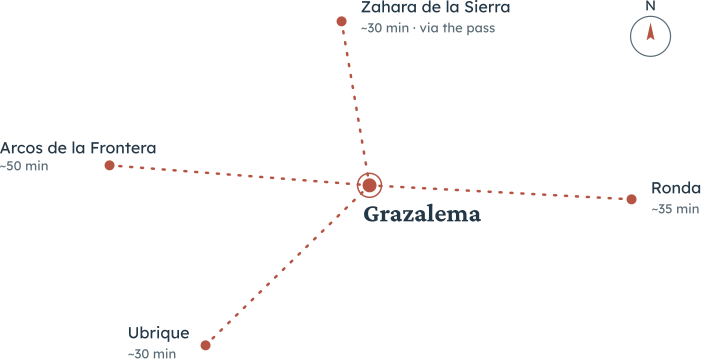
From Arcos de la Frontera about 50 minutes by car on the A-372 via El Bosque (roughly 46 km), climbing steadily into the park.
From Rondaabout 35 minutes on the A-372 (roughly 30 km).
From Zahara de la Sierraabout 30 minutes over the Puerto de las Palomas pass (roughly 17 km) — short, but all hairpins.
Nearest airports Jerez (XRY) is closest, about 90 km / 1 h 20; Seville (SVQ) and Málaga (AGP) are the main international options, each roughly 130 km / around 1 h 45–2 h away.
By public transportthere is no train; a few weekly Damas buses link Ronda and Grazalema, but they won’t fit a touring day.
Getting around
Inside the village you won’t want a car: the lanes are steep, narrow and best on foot. Leave it at the free car park on the Plaza de los Asomaderos at the village entrance, or at the larger park by the Mirador del Tajo, and walk everything from there. For the region, though, a car is essential — the trailheads, the pass and every neighbouring village sit spread across mountain roads with little useful bus service.
Looking for a ready-made plan? See our Andalucia road trips.
Practical Info
- ClimateGrazalema has a real mountain climate — noticeably cooler and much wetter than Arcos. July and August highs run around 30°C (Arcos pushes 35°C), and nights stay fresh at this altitude. May, June, September and October are the comfortable months, roughly 22–30°C by day. Almost all of the village’s famous rain — around 2,200 mm a year — falls between late autumn and early spring; summers are largely dry.
- Hiking permitsthe four reserve trails (Pinsapar, Torreón, Garganta Verde, Llano del Rabel) are free but capacity-limited, booked through the Junta de Andalucía’s online system (see What to Do). From about midsummer to mid-October they close or restrict access for fire risk. All other marked trails are free and open.
- Pack for the mountaineven in summer, evenings are cool and fog or a shower can roll in fast. A warm layer and proper footwear earn their place year-round.
- Tourist officeon the Plaza de los Asomaderos, next to the main car park and mirador — good for trail maps and same-day advice.
- The village on footexpect steep, cobbled lanes; comfortable shoes matter more here than in the flatter villages.

Where to Eat in Grazalema
You’ll eat heartily in Grazalema — this is mountain food country. The village gives its name to payoyo goat’s cheese, one of Spain’s most awarded, and to sopa de Grazalema, a warming soup of bread, chorizo, egg and mint. Kitchens here roast local lamb in wood ovens and cook game from the sierra. For a tapas lunch between walks, stay on and around the Plaza de España; for dinner, book the classic dining rooms — the village is small and tables go early.
Bar La Plaza
A terrace on the Plaza de España itself, serving generous tapas, cheeses and simple plates. The spot for a slow drink while the square does its thing.
Creative tapas with a local heart — think payoyo cheese worked into modern plates. Small, popular and easy to like after a morning on the trails.
Unpretentious home-style food in the village centre, with a comforting picadillo soup and honest daily plates. A good-value stop between sights.
On the Plaza de los Asomaderos by the mirador, with mountain views and a menu built on grilled meats and fried payoyo cheese. The weekday lunch menu is strong value.
The village classic near the Plaza de España, known for local lamb from the wood-fired oven and a proper sopa de Grazalema. Leave room for the payoyo cheese tart or the house acorn cake.
A warm dining room on Calle Agua where the sierra lands on the plate: venison, partridge and much-loved croquettes. Good wines and honest cooking, without fuss.
Where to Stay in Grazalema
Stay the night and Grazalema changes register. The day cars leave over the pass, the fountains get louder, and the Peñón Grande turns copper in the last light. Morning is better still: mist in the valley, vultures lifting off the cliffs, and a permit trail starting ten minutes from your bed. Here’s where we’d stay.
Cuevas del Peñón
Bright, simple apartments in the village itself, an easy stroll from the square and the miradors. A budget-friendly key to your own front door in the mountains.
Check prices & availability for Cuevas del Peñón on the accommodation's websiteHospedería Casa de las Piedras
A simple, century-old inn on the prettiest street in the village, steps from the Plaza de España. Basic, friendly and perfectly placed for an early trail start.
Check prices & availability for Hospedería Casa de las Piedras on the accommodation's websiteHotel Fuerte Grazalema
A four-star rural hotel inside the natural park, where every room’s balcony looks over the Guadalete valley to the white village. Pool, hot tub and trails from the door — the comfortable base for a hiking stay.
Check prices & availability for Hotel Fuerte Grazalema on the accommodation's websiteLa Mejorana
A much-loved guesthouse with a garden and small pool tucked below the high town. The kind of place where the host helps you book your hiking permit over breakfast.
Check prices & availability for La Mejorana on the accommodation's websiteTambor del Llano
A rural retreat on a farm in the park, with an infinity pool, horses in the meadow and evenings by the fire. Sleep with the sierra at the window and ride out in the morning.
Check prices & availability for Tambor del Llano on the accommodation's websiteVilla Turística de Grazalema
A rural hotel on the hillside just above the village, about 400 metres from the centre and inside the natural park. Whitewashed and traditional, with an outdoor pool facing the Peñón Grande and its own restaurant, El Olivar, serving mountain cooking. An easy, comfortable base for walking days.
Check prices & availability for Villa Turística de Grazalema on the accommodation's website
Region, Nearby and Routes
Part of Andalucía
Grazalema is in Andalucía
Part of these routes
Grazalema is one stop on our The White Villages Trail see the full route.
Nearby places
- Arcos de la FronteraA white town perched on a sandstone cliff, ringed by the Guadalete, with sudden sweeping views at every turn.
- Zahara de la SierraA white village wrapped round a crag under a Moorish tower, high above a turquoise mountain lake.
- Setenil de las BodegasA white village where houses are tucked under vast rock overhangs, famous for its cave streets and cave-cool tapas bars.
- UbriqueThe biggest white village and Spain’s leather-craft capital, wrapped in cliffs and Roman history.
- RondaThe dramatic gorge town split by the Puente Nuevo — the biggest, best-known stop on the White Villages Trail.
Frequently Asked Questions
Yes — especially if you like mountains. Grazalema is a white village at around 800 metres inside the Sierra de Grazalema Natural Park, with some of the best hiking in southern Spain, famous payoyo cheese and far fewer crowds than the coast.
Three things: being one of the rainiest places in Spain, which keeps its sierra unusually green; its hand-woven wool blankets, still made in a working factory; and payoyo goat’s cheese, one of Spain’s most awarded cheeses.
Only for four reserve trails: El Pinsapar, El Torreón, the Garganta Verde and the Llano del Rabel. Permits are free but limited, and these four trails close or restrict access from about 1 July to 15 October for fire risk. Every other marked trail, including Cerro Coros, the Río Majaceite and the Llanos del Republicano, is free and open all year.
Permits are free but must be booked ahead, and the booking site is in Spanish only. You book through the Junta de Andalucía’s CUPOS reservation system. Choose “particulares”, then “Acceso sin certificado digital”, and enter your passport number under “Otros del titular”. Next, pick the space (Sierra de Grazalema), the walk, the date, the entry time and the group size. Then add your name, email and mobile number. You can book up to two months ahead, and weekdays are far easier than weekends. One key step: after you submit, you get an email with a confirmation link — you must click it within 25 minutes, or the booking is lost. A final email then holds your reservation; show it on the trail if a ranger asks. If you would rather skip the Spanish form, many local guesthouses and guides arrange permits for their guests.
May, June, September and October are ideal, with daytime temperatures of roughly 22–30°C and open hiking trails. July and August reach around 30°C — cooler than the lowland towns — but the best permit trails are closed then. Most rain falls between late autumn and early spring.
Easily. It is about 50 minutes from Arcos de la Frontera and 35 minutes from Ronda, and the village itself takes two or three hours to enjoy. Stay overnight if you plan to hike, since the permit trails start early and close to the village.
For comfort, Hotel Fuerte Grazalema, a four-star rural hotel just outside the village. In the village itself, Hospedería Casa de las Piedras is a simple, well-placed inn and La Mejorana a much-loved guesthouse. Tambor del Llano offers a rural farm stay with horses nearby.
Restaurante Cádiz El Chico for wood-oven lamb and sopa de Grazalema, Restaurante El Torreón for game dishes, and Mesón El Simancón for grilled meats with a view. For tapas, try Gastrobar La Maroma or Bar La Plaza on the square.