
The Medieval Loop
A five-day drive through Extremadura’s Roman, medieval and conquistador heart
- Distance~310 km (~193 miles) total driving
- Duration5 days, 4 nights
- Route TypeLinear (the base moves with you — see “Why linear” below)
- Best forCar
- DifficultyEasy. Good motorways between the main cities, one slower mountain road to Guadalupe
- Best seasonSpring (April–May) or autumn (September–October); summer is very hot inland
- ThemeHistorical. Roman, medieval and conquistador Spain
Why this Route Exists
Extremadura holds three UNESCO World Heritage sites within a short drive of each other, plus a fourth a little further east — and almost no crowds. This is the part of Spain where Roman engineers, medieval stonemasons and the explorers who sailed for the Americas all left their mark, often in the same square. The Medieval Loop strings together the four places where that story is clearest: Cáceres, Trujillo, Mérida and Guadalupe.
Depth over speed
It is built for travellers who want depth over speed. Five unhurried days is enough to walk each old town properly, sit in its main square, and still drive on without rushing. You could see the headline sights faster — but that is not why you came to the part of Spain most people skip.
Why linear, not a loop
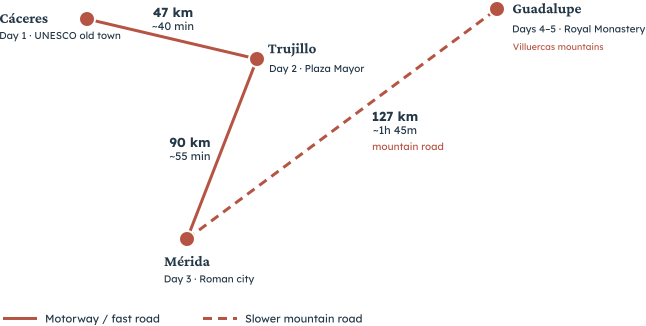
The three main cities sit close together: Cáceres to Trujillo is about 47 km, Trujillo to Mérida about 94 km. From a single base you could day-trip all three. But Guadalupe, the fourth UNESCO site, sits alone in the eastern mountains — roughly 77 km from Trujillo on a slower road. Day-tripping there from a western base would mean driving the same mountain stretch twice and losing the better part of a day.
So this route moves with you instead: you sleep where you finish each day, and end in Guadalupe rather than doubling back. It is a gentle line, not a hard point-to-point — most days involve under an hour of driving.
Getting to the start
Extremadura has no major international airport of its own, which is part of why it stays so quiet. The nearest, Badajoz (BJZ), has very few connections, so most travellers fly into one of three larger airports and drive in. All three put you in Cáceres in under four hours:
Madrid (MAD)about 3 hours by car (~300 km), and the airport with by far the most international flights. There is also a direct train from Madrid to Cáceres (around 3.5 hours) if you would rather not drive on arrival day.
Seville (SVQ)about 2.5 hours by car (~270 km) straight up the A-66. The closest of the three, and an easy approach if you are pairing this trip with Andalusia.
Lisbon (LIS) about 3.5 hours by car (~315 km), worth considering if it has the cheapest flights for you, or if you are combining Spain with Portugal. (Note: Portugal is one hour behind Spain.)
This is a self-drive route, so you will want a car for the whole trip. The simplest approach is to hire a car at your arrival airport and keep it until you fly home.
Compare car hire on LocalRent for Madrid, Seville or Lisbon airports.
We may earn a small commission if you book through this link, at no extra cost to you — it helps us keep this guide growing.Arriving late? If your flight lands in the evening, it is often more relaxing to spend the first night near your arrival airport and start the drive fresh the next morning, rather than tackling an unfamiliar road in the dark. See our Practical Info page for how to handle late arrivals, plus everything on driving in Spain (low-emission zones, tolls, fuel and parking).
The Itinerary
This is a linear route — you sleep where you finish each day and end in Guadalupe, rather than day-tripping from one base (see “Why linear” above). The map shows the shape; the days follow beneath it.
Day 1 — Cáceres
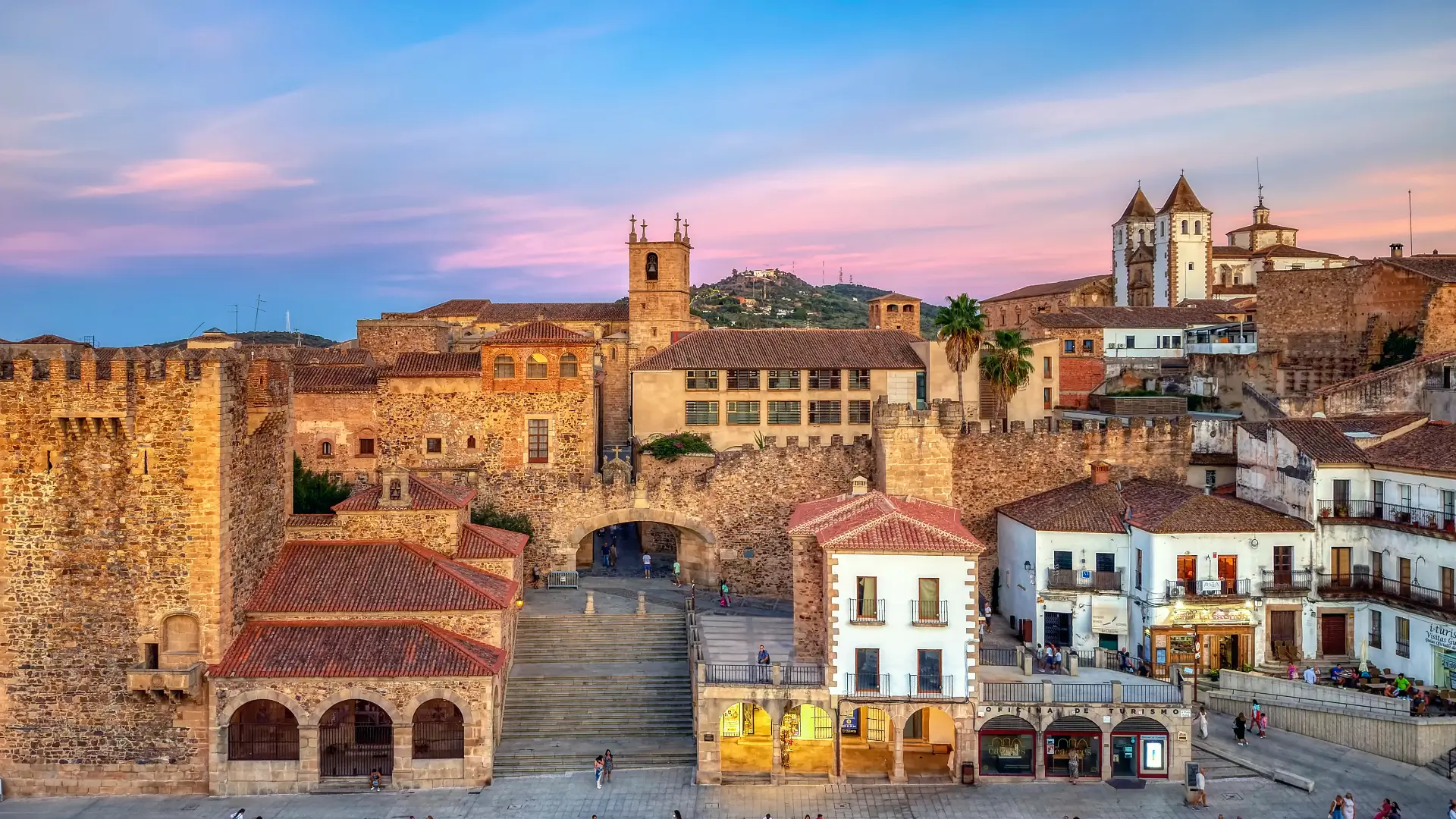
Start in Cáceres, whose walled old town (the Ciudad Monumental) is a UNESCO World Heritage Site and one of the best-preserved medieval quarters in Spain. Its stork-topped towers and honey-coloured palaces were built on wealth flowing back from the Americas in the 16th century, and the cobbled lanes are so intact they have stood in for other times and places on screen.
Spend the day on foot inside the walls. This is a place to wander rather than tick off a list — though the Plaza de San Jorge, the Bujaco Tower and the viewpoints over the rooftops are worth seeking out. Cáceres also has a strong food scene, which makes it a comfortable first night.
Tonightstay in Cáceres. See where we’d stay.
Day 2 — Trujillo
Drive: Cáceres → Trujillo, ~47 km, about 40 minutes on the A-58.
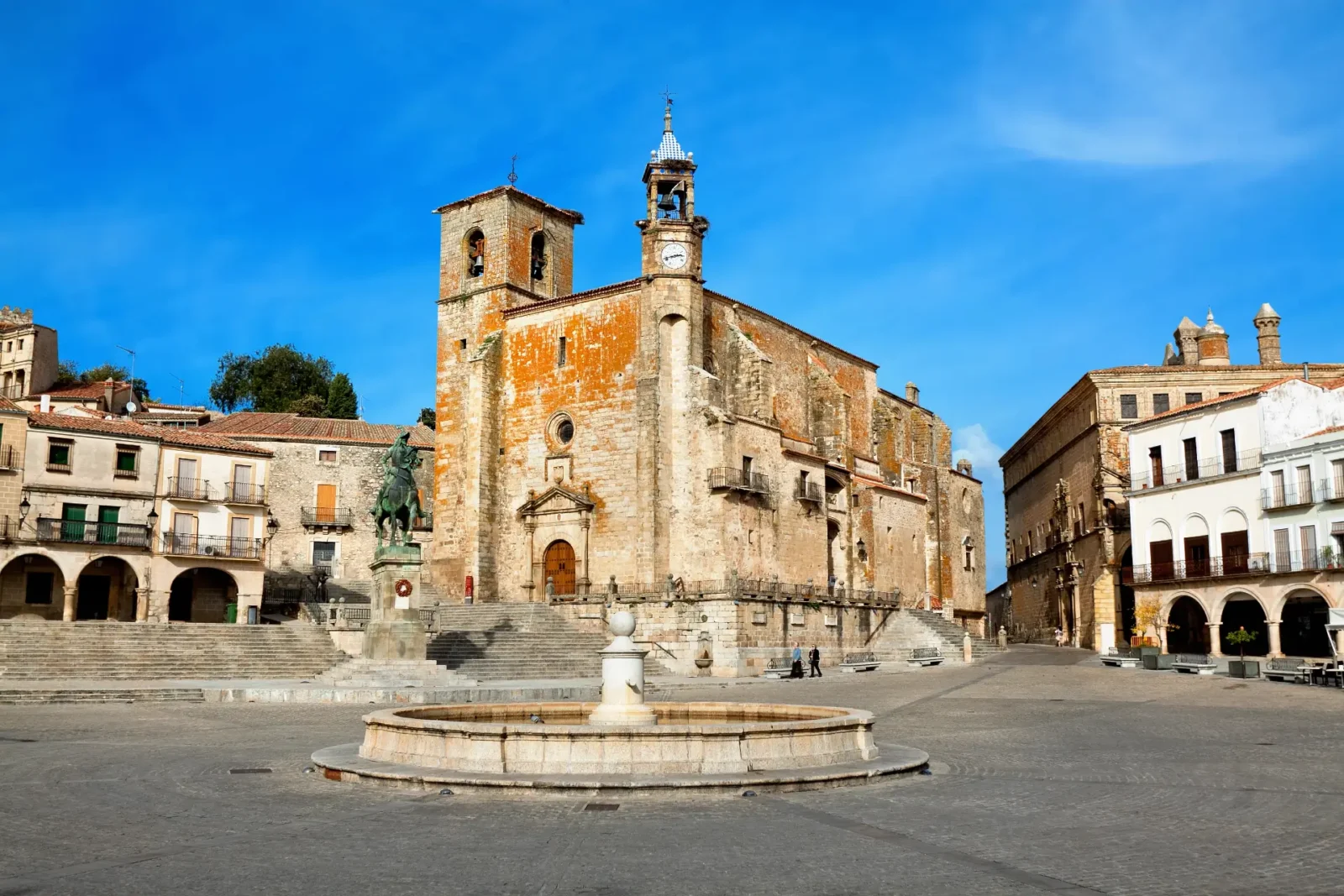
Trujillo is small, and that is its charm. Its Plaza Mayor is often called one of the finest squares in Spain, ringed by palaces and watched over by a statue of Francisco Pizarro — the conquistador born here, who went on to Peru. Above the square, the medieval streets climb to an Arab-origin castle (the Alcazaba) with wide views over the dehesa, Extremadura’s oak parkland.
Half a day covers the highlights, but Trujillo rewards staying the night: the floodlit square after dark is the kind of quiet, authentic moment this whole route is about.
Tonightstay in Trujillo. See where we’d stay.
Day 3 — Mérida
Drive: Trujillo → Mérida, ~94 km, about 55 minutes on the A-5.
Mérida was Augusta Emerita, capital of the Roman province of Lusitania, and it holds the finest collection of Roman remains in Spain. The Roman theatre and adjoining amphitheatre are the centrepiece — still used for performances today — alongside a Roman bridge, the Temple of Diana and an aqueduct. The National Museum of Roman Art puts it all in context.
This is a fuller, more spread-out day than the medieval old towns: the sites sit across the modern city rather than in one tight quarter. Give it a relaxed full day.
Tonightstay in Mérida. See where we’d stay.
Day 4 — Mérida to Guadalupe
Drive: Mérida → Guadalupe, ~127 km, roughly 1h 45m to 2h. The final stretch is a slower mountain road (allow extra time), but it is scenic.
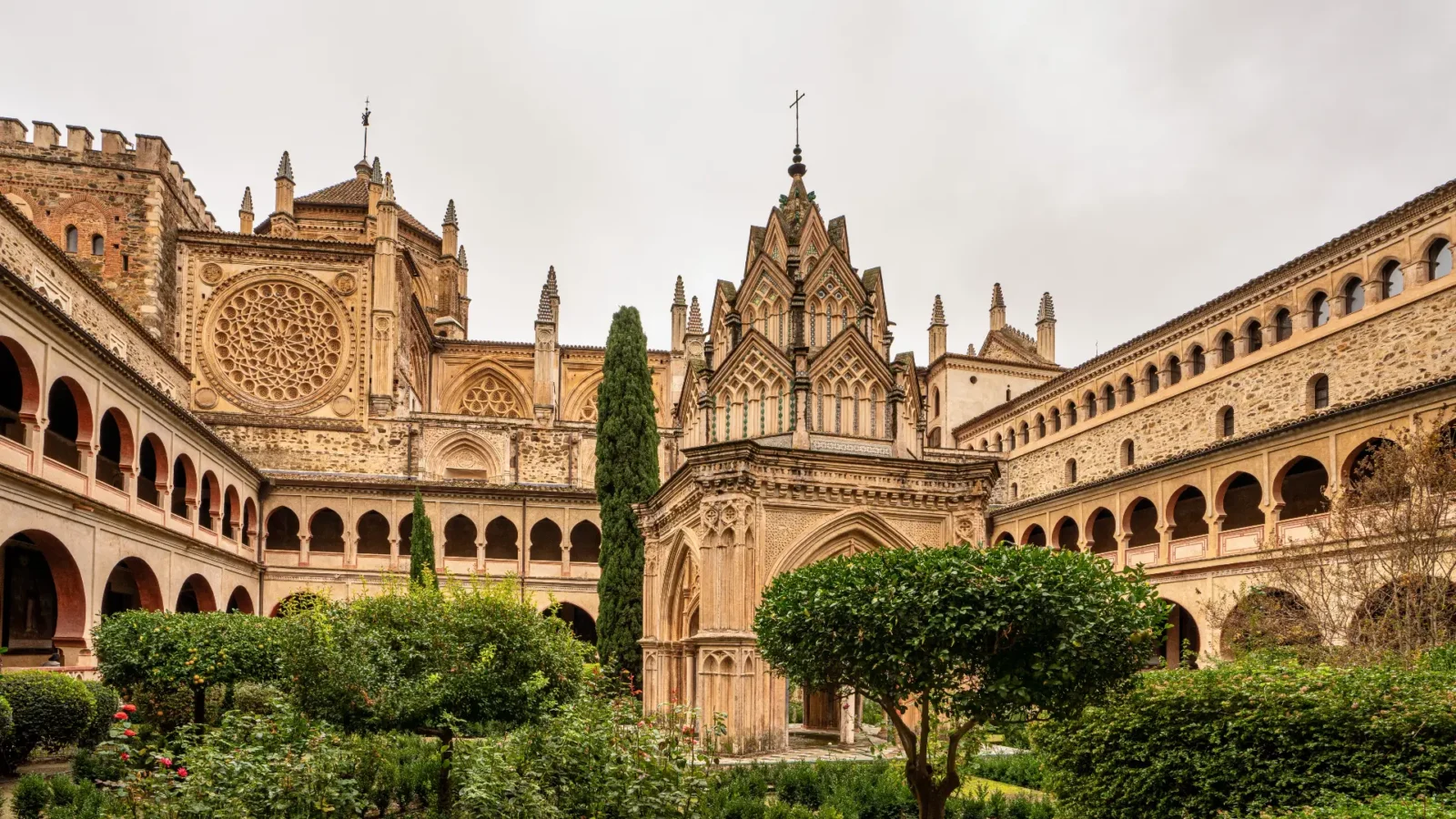
Break the drive in the morning if you want more time with Mérida’s sites, then head east into the Villuercas mountains. Guadalupe is a tiny village of around 2,000 people built around one extraordinary building: the Royal Monastery of Santa María de Guadalupe, a UNESCO World Heritage Site and, for centuries, one of Spain’s most important pilgrimage destinations after Santiago de Compostela. Its treasury, cloisters and a sacristy hung with Zurbarán paintings are remarkable.
The village itself — narrow medieval streets, arcaded squares, the Plaza de Santa María in front of the monastery — is worth slow exploration once the day-trip coaches have left.
Tonightstay in Guadalupe. See where we’d stay.
Day 5 — Guadalupe and onward
Use the morning for the monastery (guided tours run morning and afternoon — check times in advance and book ahead in busy periods) and a final wander through the village before you decide where to go next.
Where to next
The Medieval Loop ends in Guadalupe, high in the eastern Villuercas mountains — which leaves you well placed to drive on in several directions:
East to Madrid or ToledoMadrid is about 2¾ hours away, good for a flight home or the end of a longer trip. Toledo is about 2½ hours — a UNESCO city of Roman, medieval and imperial layers, whose hilltop Alcázar was rebuilt under Charles V. It makes a fitting next stop, and a neat link to the emperor whose own route lies to the north.
Back west into ExtremaduraThe A-5 takes you back toward Trujillo and Cáceres, and on to the quieter north of the region. From there you can link to our Emperor’s Valley Route through La Vera and the Jerte Valley — the two trips combine into a full week of Extremadura.
South to Andalusiafrom Mérida, the N-432 runs down to Córdoba in about 2 hr 45, one of Andalusia’s great gateway cities and the start of the road east toward our Renaissance and Olive Trail (Úbeda, Baeza, the Jaén olive country)
Heading north?Salamanca and our Three Walled Cities route are about 2 hr up the A-66 from Cáceres.
Want the full picture of each town? Each stop links to its own guide above, with every sight, restaurant and place to stay. See how this route pairs with the Emperor's Valley Route
Where we’d Stay
We’ve picked these for location and character. Booking links are affiliates that help support this site — they cost you nothing extra. One strong pick per overnight stop is below. For more options across every budget in each town, see the place pages
Casa Pizarro Hotel
A beautifully restored mansion turned design-led boutique hotel right inside the historic centre. Stylish rooms and warm service and some terraces overlooking the city. Walking distance to the old town and the (free) contemporary art museum next door. Parking is a short walk away, as it is everywhere in the walled quarter.
Check prices & availability for Casa Pizarro Hotel on the accommodation's websiteEurostars Palacio Santa Marta
A comfortable four-star hotel in a restored old palace, a short walk from the Plaza Mayor and with its own private parking — the easy, reliable choice when you want character without giving up modern hotel comforts.
Check prices & availability for Eurostars Palacio Santa Marta on the accommodation's websiteParador de Mérida
Sleep in an 18th-century former convent in the centre of town, a short walk from the Roman sites, with quiet rooms set around cool cloistered spaces and a well-regarded restaurant. The kind of building you come to Spain to stay in, not just walk past.
Check prices & availability for Parador de Mérida on the accommodation's websiteHospedería del Real Monasterio
Sleep inside the monastery itself. Run by the Franciscan community, this hotel occupies part of the World Heritage complex, around a beautiful Gothic cloister. Rooms are simple in keeping with the setting, but the experience — staying within the walls, a courtyard to yourself in the evening — is unique in Spain.
Check prices & availability for Hospedería del Real Monasterio on the accommodation's website
Practical Info
- RoadsThe A-58 (Cáceres–Trujillo) and A-5 (Trujillo–Mérida) are fast, toll-free motorways. The Mérida–Guadalupe leg uses slower regional roads through the mountains — fine for any car, but allow more time and avoid rushing it after dark.
- ParkingAll four old towns have narrow, partly pedestrian centres. Expect to park just outside the historic core and walk in; most recommended hotels can advise on nearby parking.
- When to goInland Extremadura is very hot in July and August. Spring and autumn are far more comfortable for walking the old towns.
- Tolls and fuelNo motorway tolls on this route. Fill up in the main towns; fuel stops thin out on the road east to Guadalupe.
- Booking aheadThe Guadalupe monastery is visited by guided tour with limited daily places — book in advance, especially in spring and around festivals.
Frequently Asked Questions
Five days is ideal and unhurried: it gives each old town a proper day on foot, plus the slower mountain drive to Guadalupe at the end. You can do it in four if you treat Mérida and Guadalupe as a single long day, but five lets you walk each square without rushing — which is the point of this route.
Despite the name, it is a linear route: you sleep in a new town each night and finish in Guadalupe, rather than returning to where you started. The three western cities sit close enough to day-trip from one base, but Guadalupe is alone in the eastern mountains, so the route moves with you instead of doubling back.
Yes. There is a direct train from Madrid to Cáceres, but once you are exploring, public transport between these towns is limited and slow. A car gives you the freedom to drive the quiet roads and stop where you like — and it is essential for the mountain leg to Guadalupe.
Easy for most of the route: the Cáceres–Trujillo–Mérida legs use fast, toll-free motorways, each under an hour. The exception is the final stretch from Mérida to Guadalupe, a slower regional road through the mountains — fine for any car, but allow extra time and avoid rushing it after dark.
Spring (April–May) or autumn (September–October) are ideal: warm, comfortable days for walking the old towns. Avoid July and August if you can, as inland Extremadura gets very hot, which makes long days on foot hard going.
The route starts in Cáceres. Seville is the closest airport (about 2.5 hours), Madrid has the most flights and a direct train to Cáceres, and Lisbon is worth checking for cheap fares. All three are under four hours by road.
The Royal Monastery is visited by guided tour with a limited number of daily places. Book ahead, especially in spring and around festivals, so you are not turned away. Tours run morning and afternoon — check current times before you go.
Sleep one night in each town as you go: Cáceres, Trujillo, Mérida and Guadalupe. Each has characterful places inside or beside the historic centre — including, in Guadalupe, a hotel within the monastery walls. Each town’s guide lists options across every budget.