
Guadalupe: a Medieval Village Around a Great Monastery
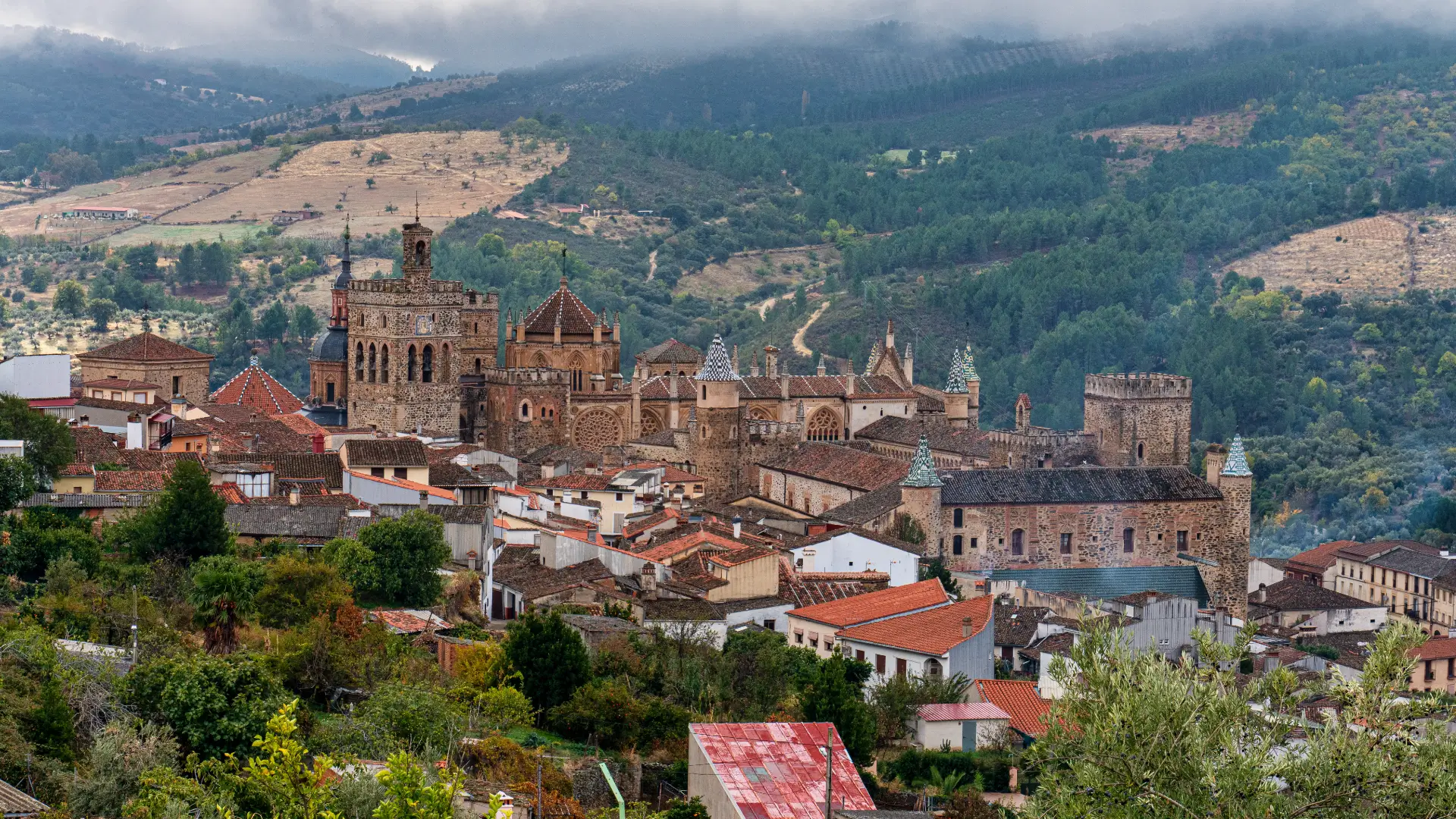
Guadalupe is a small medieval village in eastern Extremadura, built around one of Spain’s great monasteries. Its Royal Monastery of Santa María is a UNESCO World Heritage Site, a huge Gothic-Mudejar church that has drawn pilgrims for 700 years. The village climbs around it in steep cobbled lanes, set deep in the Villuercas mountains. Few foreign travellers come this far. That is the reward.

Why Visit Guadalupe
Most people know Guadalupe for one thing: its monastery. And that monastery is reason enough to come. It rises straight out of the main square, a fortress of towers and Mudejar stone that has pulled pilgrims here since the 14th century. Columbus was received in this town by the Catholic Monarchs, and the village’s role in Spain’s history runs deep. But Guadalupe is more than its great church. The lanes around the square are some of the most photogenic in Extremadura: cobbled, arcaded, lined with old houses and small fountains, climbing the hillside toward the mountains.
Who Guadalupe is for
It suits the traveller who wants history and quiet in the same place, well away from the crowds. The village works on two levels at once. It is a place of deep art and faith around the monastery, and a base for walking in some of Extremadura's least-visited country. It sits inside the Villuercas-Ibores-Jara Geopark, a UNESCO-listed range of folded ridges and quiet valleys. A morning of museums and cloisters can turn into an afternoon on an empty mountain trail. The crowds that do come are mostly Spanish day-trippers and pilgrims, and most leave by late afternoon. It is a slower, more remote stop than the bigger Extremadura towns. Come for one or two unhurried days, not a quick tick on a list.
Day trip or overnight?
You can see Guadalupe in an afternoon. The monastery tour takes about an hour, the old town another hour to walk, and many people fold it into a drive between Trujillo and the east. But that means leaving just as the village gets good. Our honest advice: stay the night. A perfect short visit looks like this. Arrive in the early afternoon and join a monastery tour. Walk the cobbled lanes afterwards, through the old Jewish quarter and under the medieval arches, then climb to the viewpoint south of the village for the classic view of the towers against the mountains. Eat migas and morcilla in the square at dusk, when the day-trippers have gone and the floodlit facade is yours. Sleep inside the monastery walls or in a courtyard house nearby. The empty evening streets, and the quiet morning before the first coach, are the real reward.
What to See in Guadalupe

Royal Monastery of Santa María de Guadalupe
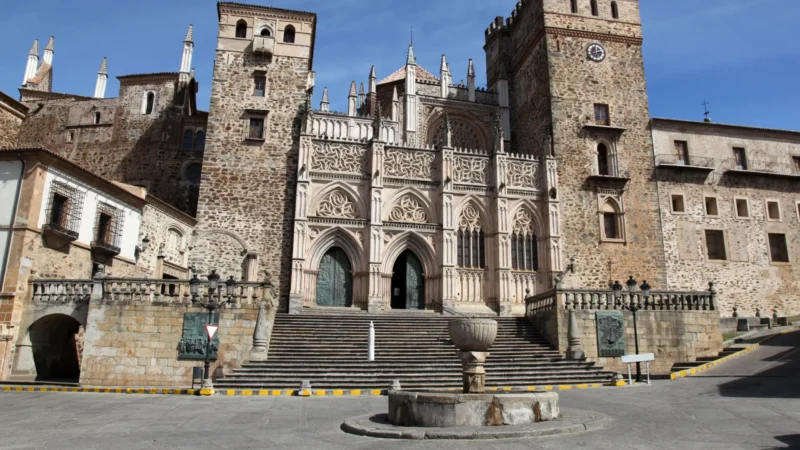
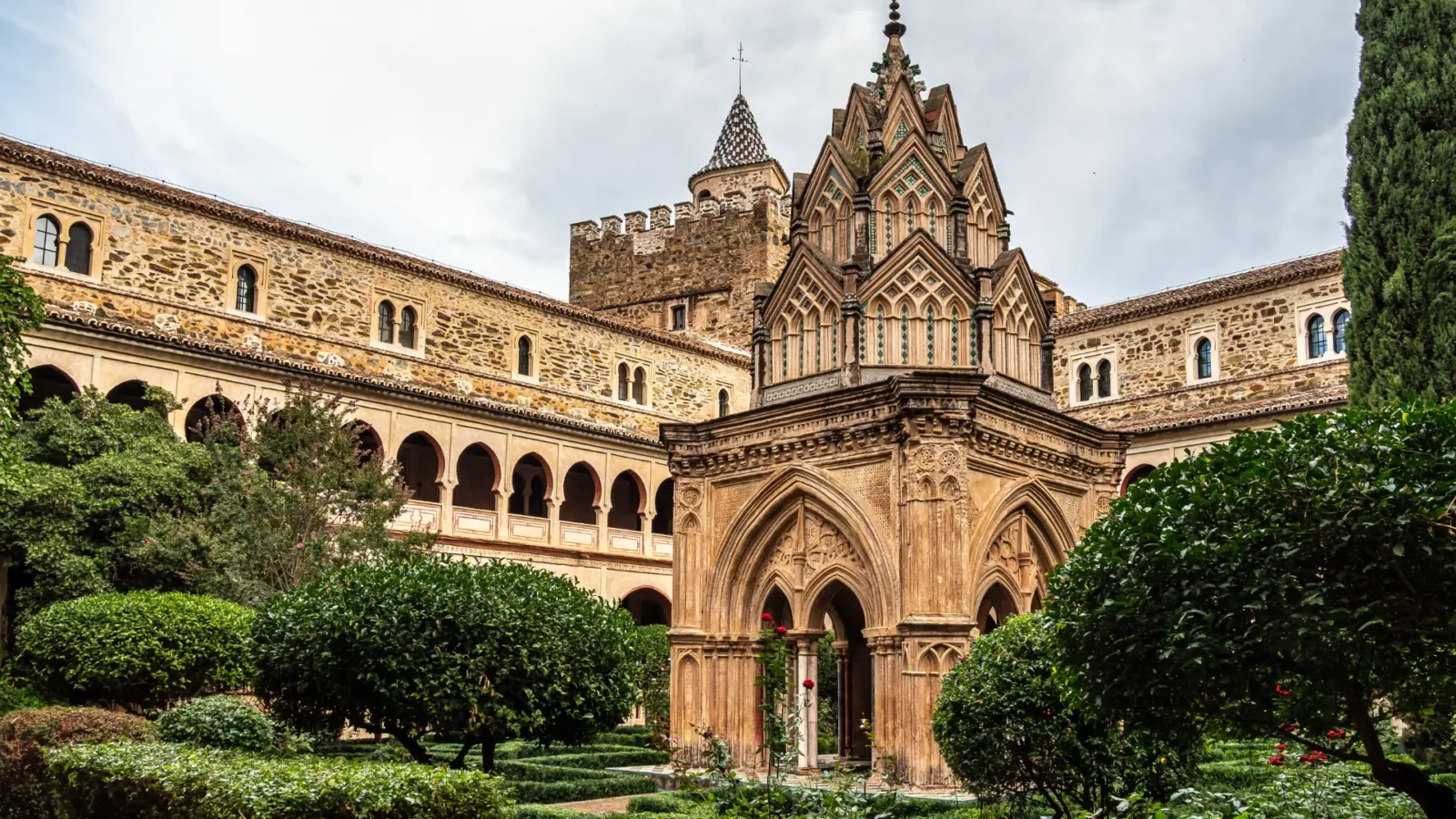
The reason most people come, and worth the drive on its own. Founded in the 14th century and a UNESCO World Heritage Site since 1993, it mixes Gothic, Mudejar, Renaissance and Baroque styles under one roof. It rises straight out of the Plaza de Santa María, the village’s main square — in the middle of which stands an old Gothic fountain whose upper basin was once a font, where the first two Native Americans Columbus brought back from the Americas, Cristóbal and Pedro, are said to have been baptised. The basilica is free to enter; the rest is seen on a guided tour bought on site (about an hour). That tour takes you through the beautiful Mudejar cloister, the small museums — richly worked embroidery and vestments, illuminated books from the monastery’s own scriptorium, and paintings linked to Zurbarán, El Greco and Goya — and up to the camarín, the ornate chamber behind the altar that holds the venerated statue of the Virgin.
The Fuente de los Tres Caños
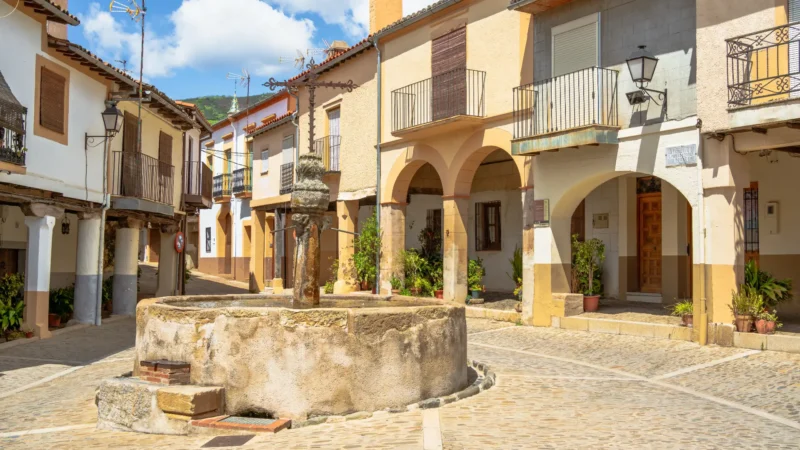
Down in the old Jewish quarter, reached through the flower-decked Arco de Sevilla, is one of Guadalupe’s most photographed corners: the Fuente de los Tres Caños (also called the Fuente de los Tres Chorros), a 15th-century stone fountain with three water spouts, crowned by a simple wrought-iron cross. It stands in a small arcaded square ringed by two-storey houses with timber balconies — the heart of the lower town, the Puebla Baja. The fountain was once a main terminal of the medieval Arca del Agua, the town’s old water-supply system and one of the oldest still working in Spain. For centuries it was where locals and pilgrims met to draw water and talk; today it is simply a quiet, pretty place to pause.
The medieval gateway arches
Guadalupe was once walled, and five of its old gateway arches still stand — the surviving entrances to the medieval town. Each has its own character and history: the flower-framed Arco de Sevilla, the Arco del Chorro Gordo with its old battlements, the Arco de San Pedro that controlled pilgrims arriving from the north, and the Arco de las Eras and Arco del Tinte, named for the dyers’ guild. Tracing them on foot is one of the best ways to wander the steep cobbled lanes and piece together how the town grew around its monastery.
Viewpoint over the village
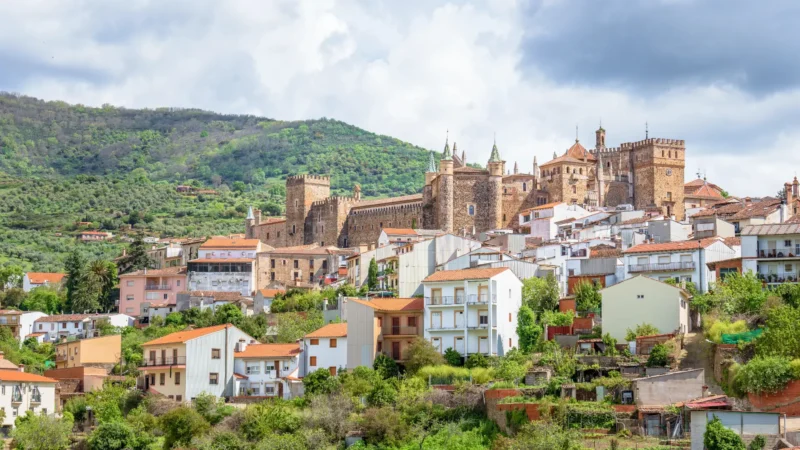
A short walk south of the centre, just off the CC-171, is the classic postcard view of Guadalupe: the whole village climbing the hillside, with the monastery’s towers and battlements rising above the red rooftops and the green Villuercas ridges behind. It is about twelve minutes on foot from the main square, and best in late-afternoon light.

What to Do in Guadalupe
Walk in the Villuercas Geopark
Guadalupe is the gateway to the Villuercas-Ibores-Jara UNESCO Global Geopark, a massif of parallel ridges and deep valleys 300 million years in the making. Marked trails run straight from the village into oak woods, past old water mills and up toward the high points. It is genuinely uncrowded walking — you can spend a half-day on a trail and meet almost no one.
Drive the Geopark villages
With a car, Guadalupe opens up the whole eastern corner of Extremadura. Quiet mountain villages — Cañamero, Logrosán, Berzocana — sit within half an hour, linked by scenic roads with few other cars. In Logrosán you can tour a 1920s phosphate mine; Cañamero is wine country. It is the kind of slow, map-in-hand driving the region rewards.
Drive up to the Ermita del Humilladero
Four kilometres out of town, on the road towards Navalmoral, a small 15th-century Gothic-Mudejar chapel sits on a hilltop. It comes with the finest view of Guadalupe there is. This was the pilgrims’ last stop. After a long journey, travellers first caught sight of the monastery below from here, and stopped to give thanks. The writer Cervantes is said to have left the chains from his captivity in Algiers here as an offering. Today there are stone picnic tables, wide views over the village and the Villuercas, and the old railway viaduct in the distance. A quick, rewarding detour. One caution: the turning off the main road is on a blind, sharp bend, so approach slowly.
Shop the local food and crafts
Calle Sevilla and the lanes off the square are lined with small shops selling the area’s specialities: traditional copperwork and lace, local honey, and Guadalupe’s own morcilla (black pudding). Look out too for roscas de muérdago, a local sweet bread. It is an easy, low-key way to spend an hour and take a taste of the Villuercas home.
Prefer to go with a guide for any of this? Ask where you're staying, or at the tourist office on the Plaza de Santa María — they'll know what's running, in which language, and can point you to something that fits.
Seasonal Events and Festivals
Día de la Hispanidad (12 October) Guadalupe’s biggest day. The village is the spiritual home of the Virgin of Guadalupe, “Queen of Hispanidad”, and on 12 October it fills with a horseback pilgrimage (romería): riders in regional dress arrive from across Spain and Portugal, and the streets turn into a sea of horses. Book a room far ahead for this date.
Día de Extremadura / Virgen de Guadalupe (8 September) The Virgin of Guadalupe is the patron saint of all Extremadura, and her feast falls on 8 September, the region’s official Día de Extremadura. It is the village’s main patronal celebration: a solemn Mass and a procession of the statue through the Mudejar cloister and basilica, with a town fair (feria) over several days around it and fireworks in front of the monastery. A quieter, more local and religious affair than October, but a special time to be here.
Both main dates are fixed — 8 September and 12 October — but the exact programme of events changes each year and is not always published far ahead. If you want to time a visit around either festival, the tourist office on the Plaza de Santa María is the most reliable place to ask once you are in town, or closer to the date.
Getting There and Around
Guadalupe sits high in the Villuercas mountains in eastern Cáceres province, reached by winding regional roads — there is no motorway to the door, which is part of why it stays quiet.
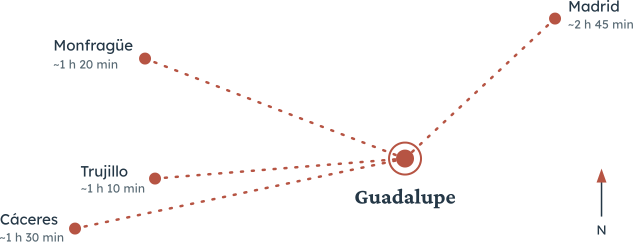
From Trujilloabout 1 hour 10 minutes by car (roughly 80 km). A direct ALSA bus also runs, taking about 1 hour 35 minutes.
From Cácerasabout 1 hour 30 minutes by car via Trujillo.
From Madridabout 2 hours 45 minutes by car (around 220 km). A direct bus (Grupo Samar) runs from Estación Sur, taking around 3 hours 45 minutes.
Nearest airportsMadrid (MAD) is the main international gateway, about 2 hours 45 minutes by car. Seville (SVQ) is a similar distance to the south.
By trainthere is no train to Guadalupe; the village is reached by car or bus only.
Getting around
You do not need a car inside Guadalupe — the village is small and walkable, though the cobbled lanes are steep, so wear good shoes. Park in the lower town or the marked areas outside the centre rather than driving up into the old streets. For the region, though, a car changes everything: the Geopark villages, the mountain trails and the drive on to Trujillo or Monfragüe all need one, and bus links between the small villages are thin.
Looking for a ready-made plan? See our Extremadura road trips.
Practical Info
- The monastery interior is guided-tour onlyThe basilica is free, but the cloister, museums and camarín are seen on a roughly one-hour tour bought on site. Tours generally run in Spanish only — worth knowing before you arrive.
- Bring cashThe monastery has at times not accepted cards for tickets; carry some euros to be safe.
- Allow about half a day for the village and monasterya full day or overnight if you add a Geopark walk.
- Hours and fees change with the seasoncheck the official monastery site monasterioguadalupe.com for current times and prices.
- Climatehot, dry summers and cool winters. July highs reach about 34°C, though the hill setting keeps evenings fresher than on the plains. May and October are the most comfortable for walking, at roughly 20–26°C. Guadalupe is greener and wetter than the rest of Extremadura (autumn is the rainiest, October wettest). You may want to avoid October unless you want the festival crowds.
- The lanes are steep and cobblednot ideal for limited mobility or pushchairs in the upper town.
Where to Eat in Guadalupe
You’ll eat and drink well in Guadalupe, and honestly — this is hearty mountain food, not fuss. The village is known for its own morcilla de Guadalupe (black pudding), migas extremeñas and slow-cooked lamb and kid stews, all built on first-class local ingredients. Two simple rules make it easy: for lunch while you’re out walking, the square and its edges are full of good-value spots with monastery views; for dinner, the small mesones in the back lanes serve the most honest local cooking. The picks below cover both.
Right on the Plaza de Santa María with terrace tables and a long day. An easy stop for a tapas lunch or local wine between sights, with vegetarian options — the classic migas extremeñas are the thing to order.
Las Ánimas del Tiempo
A warm, antique-filled room that locals and walkers rate highly. The kitchen leans into Extremaduran classics and the famous morcilla; big portions, friendly service and a genuine sense of place. Limited opening days, so check ahead.
Mesón El Zaguán
A small, homely mesón serving unpretentious mountain stews: caldereta (lamb), migas with egg and chorizo, local cheeses. Lunch only, and reservations are wise — this is where you go for real home cooking, not the view.
Just off the main square and a local favourite away from the tourist terraces. Known for proper regional cooking — migas, slow beef stew, river trout — in a busy, no-frills room. Good value and reliably good.
The special-occasion table in town. Set in the Parador’s 15th-century former hospital, the kitchen takes regional cooking up a notch — bacalao monacal, slow-roast lamb shoulder, local game in season — and finishes on the celebrated Ibores-cheese ice cream. Eat on the patio under the orange trees; you don’t have to be staying to book a table.
A small, well-run Italian for the night you’ve had enough migas. Fresh pasta, a good wine and beer list and warm service — a useful, high-quality change of pace in a town built on tradition.
Where to Stay in Guadalupe
Stay the night and Guadalupe becomes a different place. The day-trippers and coaches drain away by late afternoon, and the square empties out under the floodlit towers. You can eat morcilla at a terrace table, walk the cobbled lanes in the cool of the evening with the monastery lit above you, and wake to a quiet village before the first tour arrives. Here’s where we’d stay to have exactly that.
Casimiro Alojamiento Rural
A beautifully restored village house split into stylish self-catering apartments, a two-minute walk from the monastery. Comfortable beds, a patio for late-night wine under the stars, and a hostess who leaves homemade touches. A warm, characterful mid-range base.
Check prices & availability for Casimiro Alojamiento Rural on the accommodation's websiteEl Patio del Nogal
Rural-luxury apartments around a magical walled courtyard with a walnut tree and a fountain, 50 metres from the monastery. A private pool with monastery views, spotless rooms and an owner who looks after the details. Quiet, central and special — the upper-end self-catering choice.
Check prices & availability for El Patio del Nogal on the accommodation's websiteHospedería del Real Monasterio
Sleep inside the monastery itself. Run by the Franciscan community, this hotel occupies part of the World Heritage complex, around a beautiful Gothic cloister. Rooms are simple in keeping with the setting, but the experience — staying within the walls, a courtyard to yourself in the evening — is unique in Spain.
Check prices & availability for Hospedería del Real Monasterio on the accommodation's websiteHostal Cerezo 2
Right on the Plaza de Santa María, facing the monastery — some rooms have a balcony looking straight at the floodlit facade. A simple, friendly hostal above a traditional bar-restaurant (roast lamb and kid, local wines). The budget pick with the best view in town, and an easy walk to everything.
Check prices & availability for Hostal Cerezo 2 on Booking.comHotel Rural Posada del Rincón
A rustic hotel right on the Plaza de Santa María, so you step out into the square below the monastery. Rooms at the back look onto the church and stay quiet; downstairs is a well-liked bar-restaurant. Great value and an unbeatable position in the heart of the village.
Check prices & availability for Hotel Rural Posada del Rincón on the accommodation's websiteParador de Guadalupe
The grand choice, in a 15th–16th-century Mudejar complex next to the monastery — the old Hospital de San Juan Bautista. Expect arcaded patios, orange and lemon trees, a pool and a garden, with some rooms and terraces looking straight at the monastery. Comfortable, characterful and a destination in itself.
Check prices & availability for Parador de Guadalupe on the accommodation's website
Region, Nearby and Routes
Part of Extremadura
Guadalupe is in Extremadura
Part of these routes
Guadalupe is one stop on our 4 day Extremadura Medieval Trail
Guadalupe is also a stop on our Castilla y León & Extremadura Road Trip: 9 Days
Nearby places
- CáceresA complete walled medieval old town of palaces, towers and stork nests — UNESCO-listed and famous on screen, yet still quiet to walk.
- MéridaRoman Spain’s old capital, with a UNESCO ensemble of theatre, amphitheatre and aqueduct in a calm, walkable city.
- TrujilloA walled hilltop town of conquistadors and one of Spain’s grandest plazas.
Frequently Asked Questions
Yes. Its Royal Monastery is a UNESCO World Heritage Site and one of Spain’s most important pilgrimage sites, set in a beautiful medieval village deep in the Villuercas mountains. It is well off the main tourist trail, so it stays quiet, especially in the evening.
The Royal Monastery of Santa María de Guadalupe — a 14th-century Gothic-Mudejar sanctuary and UNESCO site — and the Virgin of Guadalupe, patron saint of Extremadura and a symbol tied to Spain’s history in the Americas.
You can see the monastery and old town in about half a day. To enjoy the quiet evening and add a walk in the Villuercas Geopark, stay overnight and allow a full day.
The basilica is free to enter. The cloister, museums and camarín of the Virgin are seen only on a guided tour, bought on site, that runs for about an hour and is usually in Spanish.
Yes — it is about 1 hour 10 minutes by car each way. But staying the night is far better: the village is at its best once the day-trippers leave.
May and October are the most comfortable for walking, at around 20–26°C, and the hill setting keeps Guadalupe greener and a little cooler than the plains. July highs reach about 34°C, so summer days are hot. On 12 October the village fills for a big horseback pilgrimage — go then only if you want the festival and the crowds.
For a unique stay, the Hospedería del Real Monasterio lets you sleep inside the World Heritage monastery itself, while the Parador de Guadalupe offers grand comfort in an old Mudejar hospital next door. For something smaller, courtyard places like El Patio del Nogal and Casimiro sit a short walk from the square, and Hostal Cerezo 2 is the friendly budget choice right on the main square.
This is hearty mountain food. For honest local cooking head to the back-lane mesones like El Zaguán or Altamira, where you’ll find migas, lamb stew and the village’s own morcilla (black pudding). For a tapas lunch with a monastery view, the terrace at Guadalupe Jordá on the Plaza de Santa María is hard to beat. For a special meal, the Parador’s restaurant is the upper-end choice.