
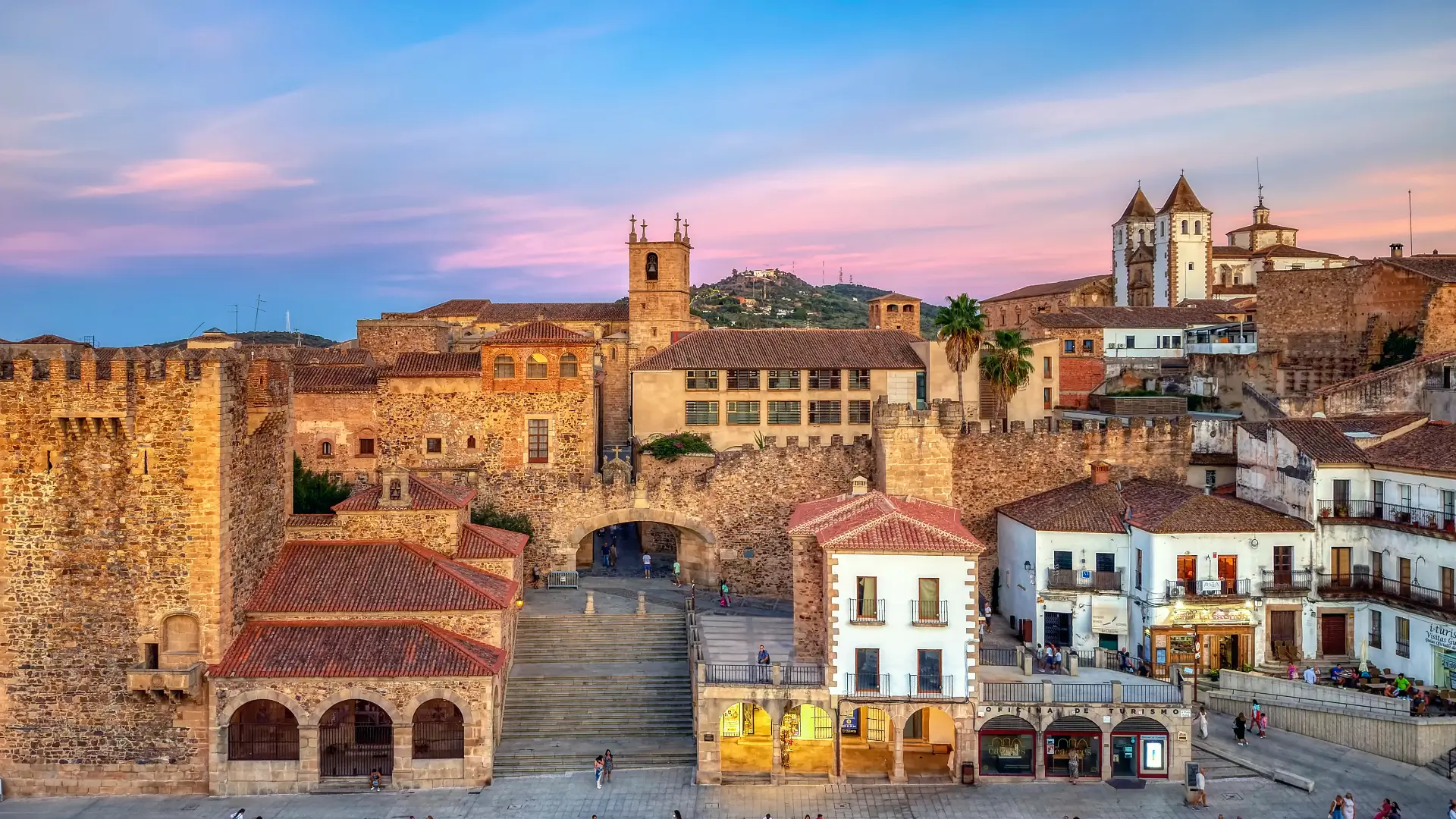
Extremadura Medieval Trail
From Cáceres to Guadalupe — four unhurried days across Extremadura’s medieval and Roman heart, through walled old towns, a Roman capital and a mountain monastery.
- StartCáceres
- EndGuadalupe
- Duration4 driving days, 4 nights
- Total distanceAbout 270 km driving
- NightsCáceres ×1 · Trujillo ×1 · Mérida ×1 · Guadalupe ×1
- Best forCar or motorbike
- DifficultyEasy — fast toll-free motorways between the towns; one slower mountain road at the end
- Best seasonSpring (April–May) or autumn (September–October); inland summers are very hot
- PaceRelaxed
- Flying in?Seville (SVQ), Madrid (MAD) or Lisbon (LIS) in · Madrid (MAD) out. If you fly, allow an extra day to reach Cáceres at the start and an extra day to fly home from the end, on top of the four driving days. Driving down in your own car or on a bike? Ignore this line — you start straight in Cáceres.
Why this Route?
Extremadura holds four UNESCO World Heritage sites within a short drive of each other, and almost no queues. This is the corner of Spain where Roman engineers, medieval stonemasons and the men who sailed for the Americas all left their mark, often in the same square. This trip strings together the four places where that story is clearest — Cáceres, Trujillo, Mérida and Guadalupe — and asks you to take them slowly. You walk through most of the history rather than look at it behind glass, and you rarely share it with a crowd.
Four towns, west to east
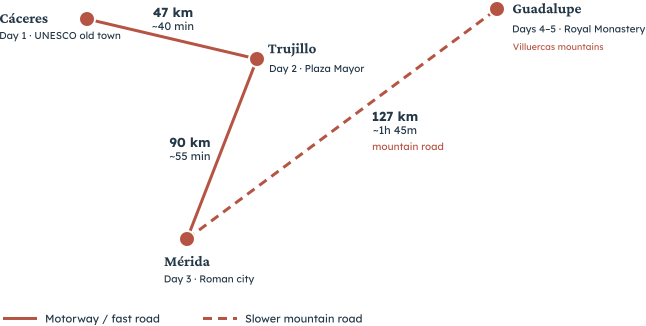
The trip runs as a line, not a loop. You start in walled Cáceres, drive the short hop to hilltop Trujillo, drop south to Roman Mérida, then climb east into the Villuercas mountains to finish at Guadalupe. Each town gives you a different layer: golden-stone palaces you can get lost in, a square where a conquistador statue watches the terraces, a Roman theatre where actors still perform, and a fortress-monastery that has pulled pilgrims up the mountain for 700 years. The distances are short — most driving days are under an hour — so the car never dominates the day.
A relaxed plan, not a checklist
This is the drive from Cáceres to Guadalupe, and it reads the same whether you flew in and hired a car or drove down from home in your own. Four days is enough to walk each old town properly, sit in its square, and still move on without rushing. You could see the headline sights faster — but speed is not why you came to the part of Spain most people skip. Each day here has something to see and something to do, with time left over to sit still. If you’re arriving by plane, you pick up a car at the airport and start in Cáceres; if you’re driving down, you simply reach Cáceres when you do. Either way, the trip begins the moment you walk into the old town — the ways in are covered next.
Getting there and around
The trip begins in Cáceres, and there are two equal ways to reach it: fly into a nearby airport and hire a car or bike, or drive down from home and start straight in the old town. Neither is the default — Cáceres is where the trip starts, and flying and driving-down are just two ways to get to it. This section is the shell around the trip; it does not count toward the four driving days.
If you’re flying inExtremadura has no major international airport of its own — part of why it stays so quiet. Three larger airports each put you in Cáceres in under four hours:
- Seville (SVQ)About 3 hours by car, ~265 km straight up the A-66. The closest, and an easy approach if you’re pairing this with Andalusia.
- Madrid (MAD)About 3 hours by car (~300 km), and by far the most international flights. There’s also a direct train from Madrid to Cáceres (around 3 hours, roughly five a day) if you’d rather not drive on arrival day.
- Lisbon (LIS)About 3.5 hours by car (~315 km), worth checking for cheap fares or if you’re combining Spain with Portugal. (Portugal runs one hour behind Spain.)
If you fly, be honest with your calendar: reaching Cáceres eats an arrival day, and flying home from the end (see Where to next) eats a departure day — so the four driving days sit inside roughly six days away from home.
If your flight lands late.If your flight lands in the evening, it’s often calmer to sleep near the airport that first night and start the drive fresh next morning, rather than tackling an unfamiliar road in the dark. Check your car-hire desk’s hours before you count on a late pickup — many run to about midnight and some offer 24-hour or key-box collection, but not all, so an airport hotel plus a morning pickup is the clean fallback if the desk is shut. See our Practical Info page for driving-in-Spain details.
Self-drive — car or motorbikeThis is a self-drive trip: you’ll want a vehicle for the whole route. The simplest approach is to hire at your arrival airport and keep it until you fly home. Most people take a car; a touring motorbike rides these same roads well, and the short legs and mountain finish suit two wheels if that’s your thing. Inside each town you won’t touch the vehicle — the old quarters are walkable and partly pedestrian, so you park just outside the historic core and walk in. Flying into one airport and out of another (say Seville in, Madrid out) means a one-way hire, which usually costs a little more than returning to the same airport — factor that in. In and out of Madrid keeps it a simpler round trip.
If you’re arriving in your own car or motorbikePlenty of travellers drive down from the Netherlands, Belgium, France, England or Germany, already have a place in Spain, or roll straight off the end of another trip. You don’t need the flights or the hire car — the trip begins in Cáceres, so you skip the airport detail above and simply plot your own way in.
See the drive to the startOpen in Google Maps. This shows the route to Cáceres. Set your starting point in the “from” field — your home if you’re driving down, or your arrival airport if you’re flying in — then send it to your phone or car if you want it ready for the road.
The Itinerary
Four towns on one gentle line, west to east — a short first hop, a dip south to the Romans, then a climb into the mountains to finish. The map shows the shape; the days follow beneath it.
Day 1 — Cáceres
Getting inIf you’re flying, Seville, Madrid or Lisbon to Cáceres is about 3 hours (see Getting there). Arriving in your own car, or from an earlier stop, you just reach Cáceres when you do.
The shape of the dayAn easy arrival, then a full afternoon on foot inside the walls, timed so your last loop lands at golden hour.
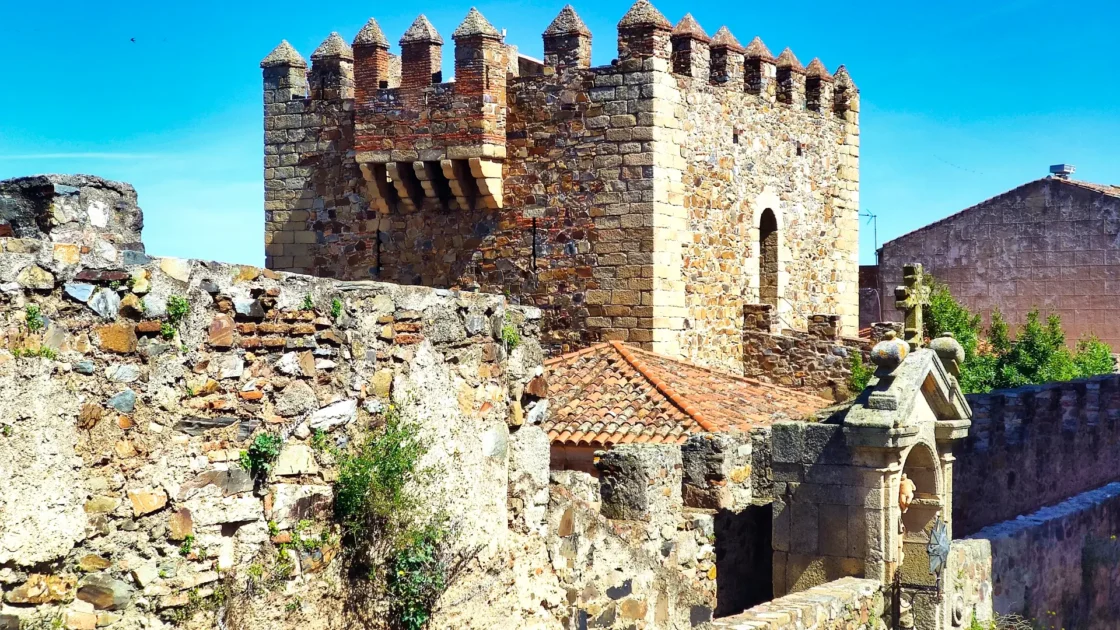
The day belongs to one thing: the walled old town, the Ciudad Monumental. Walk in through the Arco de la Estrella and the present drops away — granite palaces with carved coats of arms, lanes that open onto silent squares, storks clattering on the towers. There are no cars and no modern shopfronts inside the walls, which is why film crews keep using it. Give it the full afternoon on foot: climb the Bujaco Tower over the Plaza Mayor while the light is long, lose an hour in the upper squares and the whitewashed Judería, and time your last loop for golden hour, when the day-trippers have gone and the stone turns gold. Allow about half a day at an unhurried pace; the quarter is small enough that getting lost is the point.
Want a different pace?Swap a tower climb for the Museo de Cáceres and its remarkable Almohad cistern, held up by horseshoe arches and Roman columns — a cool, quiet hour indoors. Or, for the do-something option, walk into an old-town bar and taste the region straight: point to the acorn-fed ham, ask for the spoonable Torta del Casar cheese, and let whoever’s pouring suggest a local glass. Pick at most one; it’s still one day, and your base is unchanged.
Where to eatThe cheese to try here is Torta del Casar, made just outside Cáceres. It’s ripened until you slice off the top and spoon the molten inside straight onto bread.
- Lunch tipTapería La Tula (€ · Tapas bar · Cáceres). Traditional Extremaduran plates to share right on the square — the pork cheeks with rice or the croquetas — an easy stop while you’re walking. Open daily.
- Dinner tipNolasco (€€ · Traditional Extremaduran · Cáceres). A small, highly regarded kitchen with a short à-la-carte menu and a tasting option, creative cooking in an intimate historic room. Book ahead. Closed Monday — if you land on a Monday, El Mirador de Galarza (€€ · Traditional / grill · Cáceres), on the edge of the old town does grilled Iberian pork with a terrace over the medieval quarter; time it for sunset.
Where you sleep tonightTonight you sleep in Cáceres, inside or beside the walls, for the lamplit-streets-after-dark that staying buys you. See where we’d stay.
Day 2 — Trujillo
The driveCáceres → Trujillo, ~47 km, about 40 minutes on the A-58.
The shape of the dayA short morning hop, lunch on the great square, then a slow climb up to the castle for the late-afternoon light — a half-day town you give a full one.
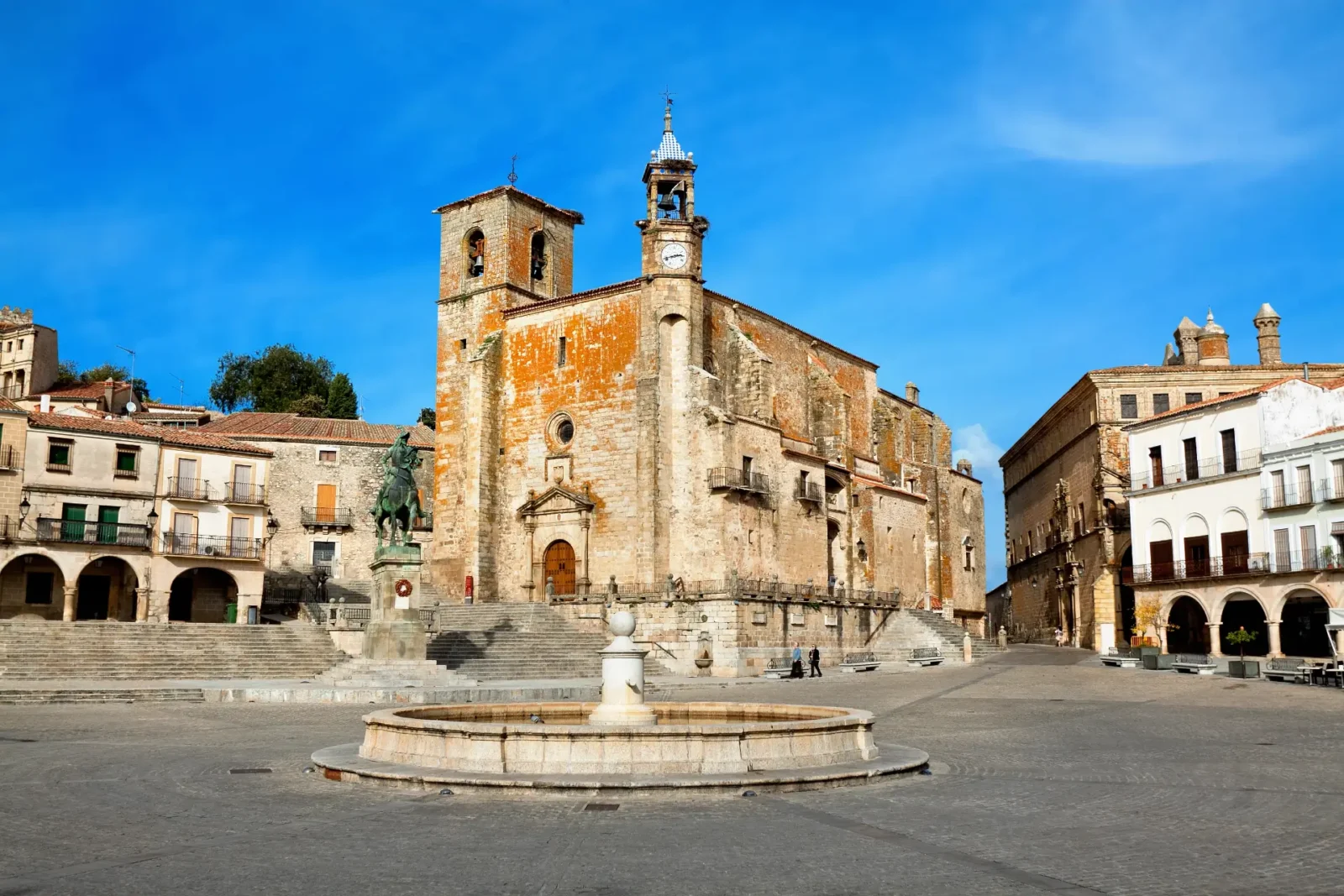
Trujillo is small, and that’s its pull. Its Plaza Mayor is one of the largest and finest squares in Spain, ringed with arcaded palaces and watched over by the bronze statue of Francisco Pizarro on horseback — the conquistador born here who went on to Peru. Above the square, granite streets climb past noble mansions to a Moorish castle (the Alcazaba) with a wide view over the dehesa, Extremadura’s oak parkland. Time the climb so you reach the ramparts in the late afternoon: the light over the plains is best then and the heat has eased. Half a day covers the highlights, but Trujillo rewards staying — cross the empty, floodlit square once more after dark, and see the Casa-Museo Pizarro and the church of Santa María la Mayor next morning before the first visitors arrive.
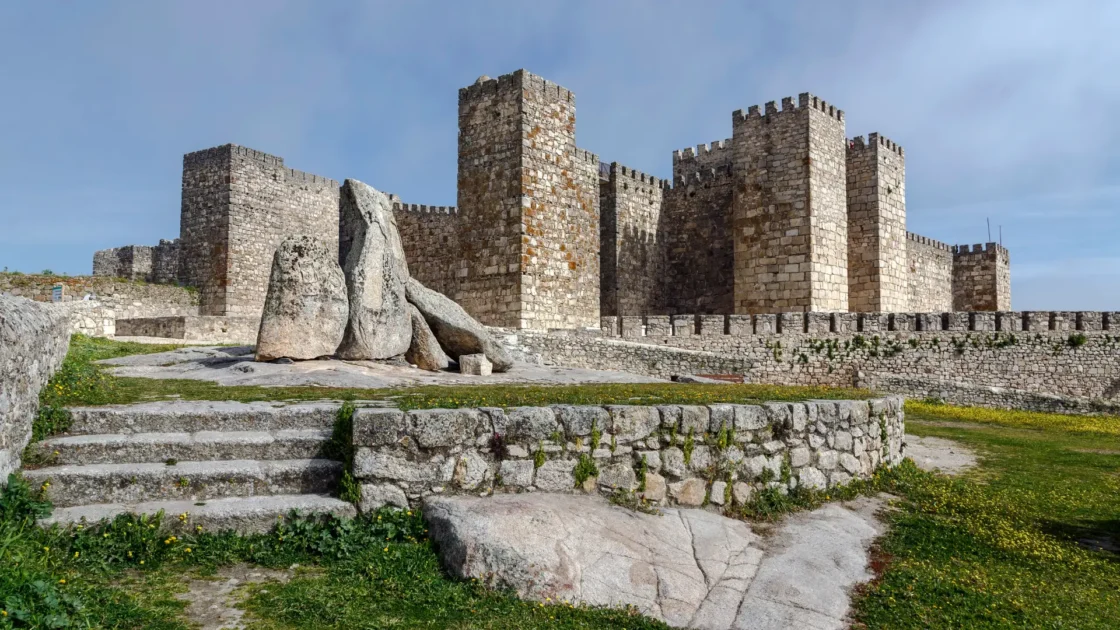
Want a different pace?Instead of the castle, spend the afternoon on the cheese trail — Trujillo is serious Torta del Casar country, and the bars and shops around the square are the easy way in (the town hosts Spain’s National Cheese Fair each spring). Or add the Casa-Museo Pizarro for the local-and-American side of the conquest story. One, not both; the day and the base stay the same.
Where to eatThis is dehesa country, where the black Iberian pigs fatten on acorns. Order the jamón ibérico de bellota cut thin, and you taste the oak parkland you drove through.
- Lunch tipEl Medievo (€€ · Tapería · Trujillo). A characterful taperia on the square — Iberian ham, croquettes, tostas piled with local meats — best on the terrace with the plaza in front of you. An easy first stop when you arrive.
- Dinner tipEl 7 de Sillerías (€€€ · Regional · Trujillo). A polished kitchen in a historic house with a courtyard for warm evenings, traditional Extremadura with a modern “neorural” turn and a notable wine list — dinner as an occasion without city prices. Open daily.
Where you sleep tonightTonight you sleep in Trujillo, a short walk from the Plaza Mayor. See where we’d stay.
Day 3 — Mérida
The driveTrujillo → Mérida, ~94 km, about 55 minutes on the A-5 and A-66.
The shape of the dayThis is the fullest day of the trip. Take the big Roman monuments early, before the heat, and the museum in the middle. Leave the softer sites and the river bridge for the evening.
Mérida was Augusta Emerita, capital of Roman Lusitania, and it holds one of the best-preserved Roman ensembles in Europe — yet you walk it at your own pace, with a fraction of the crowds that fill Rome. The great advantage here is that almost everything sits on one flat walking circuit. Start early on the big pair, the Roman theatre and the amphitheatre beside it, before the heat: the theatre’s tall colonnaded stage front, rebuilt from its own fallen stones, is the image of the city, and it’s still used for plays every summer. Tie it together at the National Museum of Roman Art, then take the softer afternoon for the Temple of Diana, the Arch of Trajan and the riverside Alcazaba. Cross the 790-metre Roman bridge at golden hour, when it empties and the far bank glows. This is a fuller, more spread-out day than the walled old towns — give it a relaxed full day.
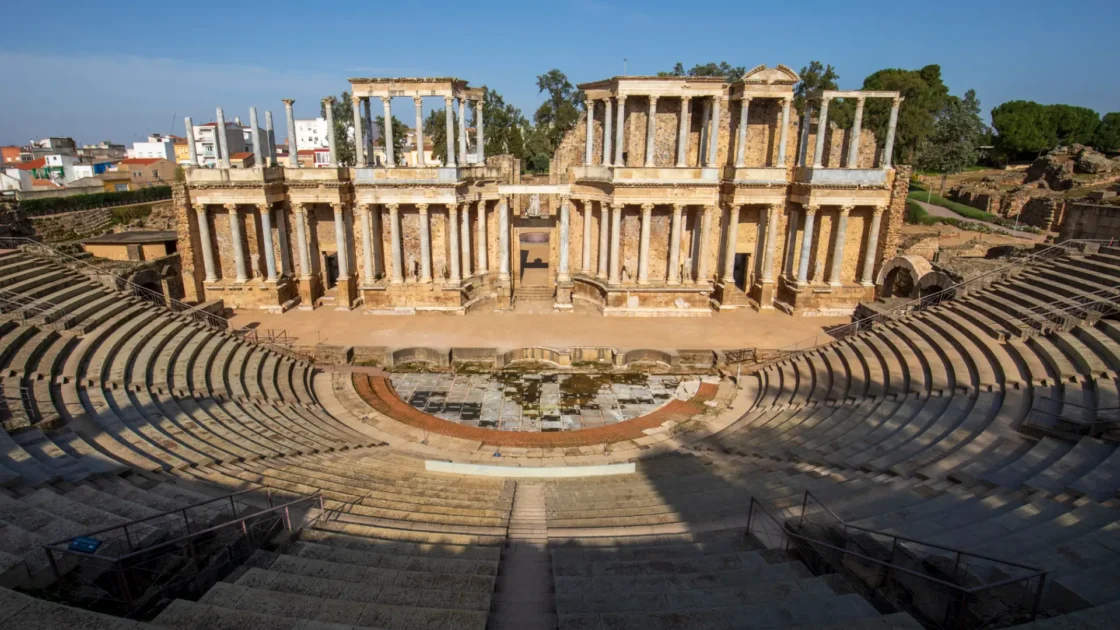
Want a different pace?For the do-something option, drive ten minutes out to the Proserpina reservoir — a lake held back by a working Roman dam, a local beach in summer where you can swim and picnic under the trees. Or, to tie the food to the history, book the special-occasion table at Tuétano (€€€ · Creative Spanish · Mérida), a Michelin-recommended restaurant built over a Roman site with a glass floor above the ruins. Pick one; the day still counts as one and your base doesn’t move.
Where to eatThe regional dish to order is migas extremeñas. Day-old bread is torn small and fried with garlic, pimentón and pork until the crumbs crisp, then often crowned with a fried egg.
- Lunch tipMesón El Lebrel (€ · Traditional Extremaduran · Mérida). A family-run mesón serving hearty Extremaduran raciones — migas, wild asparagus, Iberian pork — good value with a genuinely local feel, and menus in English if you need them. Graze between the monuments.
- Dinner tipCachicho Casa Benito (€€ · Tapas bar · Mérida). A lively tapas-and-grill spot known for grilled Iberian pork (presa, secreto) and good ham; order a spread to share, inside or out.
Where you sleep tonightTonight you sleep in Mérida, in the centre a short walk from the Roman sites. See where we’d stay.
Got an extra day? Spend it here.Mérida is the one town on this trip that holds more than a single day. The monuments are many and spread out, and the museum, the reservoir and the food all reward not rushing. So if you have a fifth day to give, a second night here is where it’s best spent. Do the theatre, amphitheatre and museum on the first day. Keep the temple, the Alcazaba, the aqueduct and a slow riverside evening for the second. The rest of the route stays exactly as it is.
Day 4 — Guadalupe
The driveMérida → Guadalupe, ~127 km, roughly 1h 45m to 2h. The final stretch is a slower mountain road — allow extra time, and don’t rush it after dark — but it’s a scenic climb into the Villuercas, and the emptiness is part of it.
The shape of the dayA scenic morning drive into the mountains, then the monastery tour on arrival. After that the small village is yours, as the coaches leave and the facade lights up.
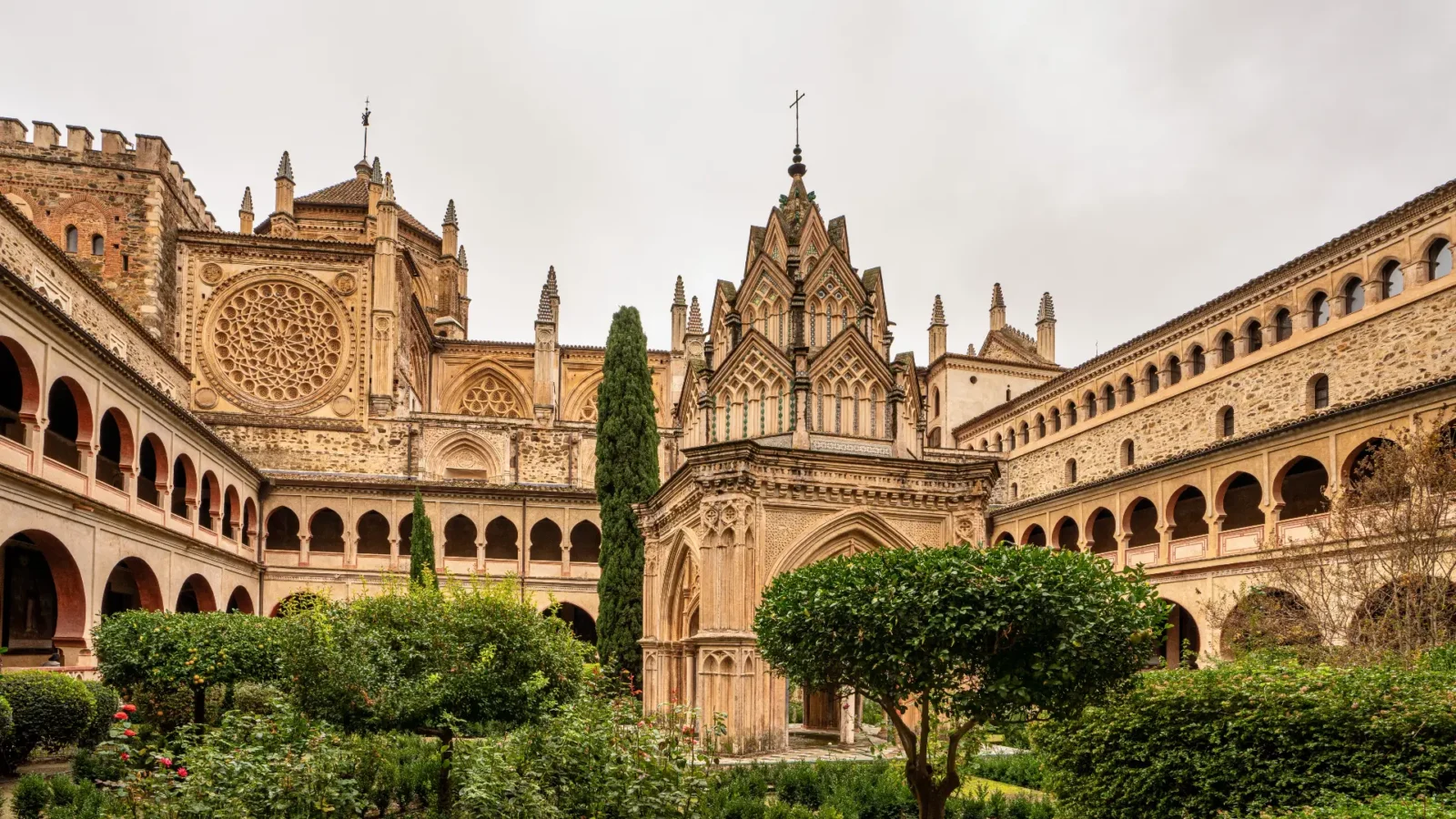
Break the morning in Mérida if you want more time with the Romans, then head east into the mountains. Guadalupe is a village of around 2,000 people built around one extraordinary building: the Royal Monastery of Santa María, a UNESCO World Heritage Site and, for centuries, one of Spain’s most important pilgrimages after Santiago. The basilica is free; the rest — the Mudejar cloister, the small museums of embroidery and illuminated books, a sacristy hung with Zurbarán paintings, and the ornate camarín behind the altar — is seen on a roughly hour-long guided tour bought on site (usually in Spanish; bring cash, as cards aren’t always taken).
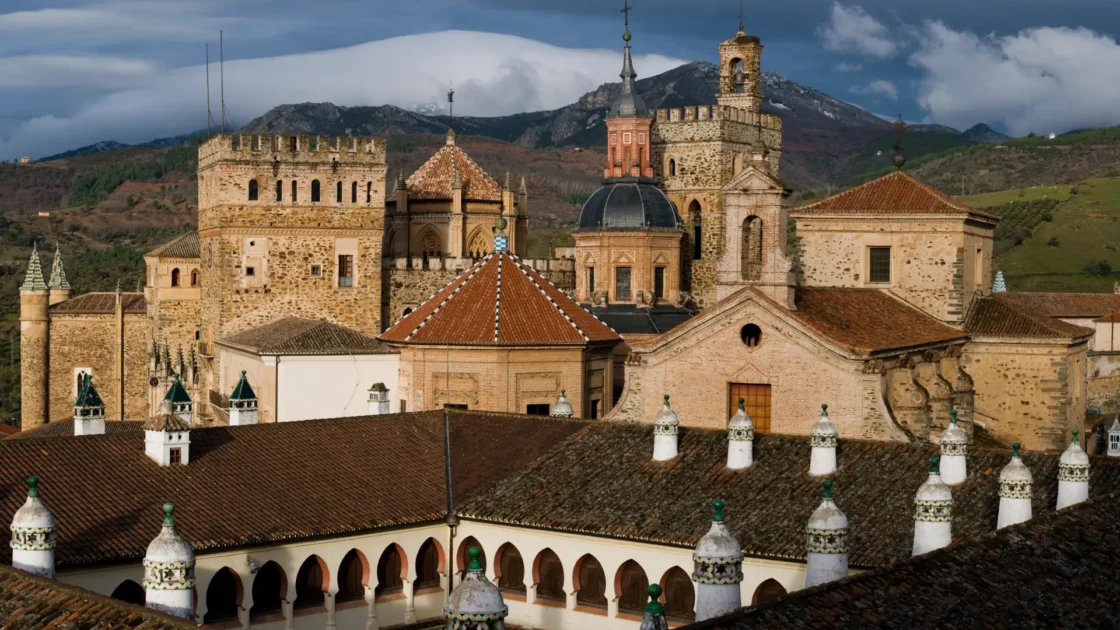
Then let the village itself slow you down: cobbled, arcaded lanes climb past old fountains and medieval gateway arches, and a twelve-minute walk south brings the postcard view of the towers against the ridges. Stay until dusk, when the coaches have gone and the floodlit facade is yours.
Want a different pace?This is walking country — Guadalupe is the gateway to the Villuercas-Ibores-Jara UNESCO Geopark, and marked trails run straight from the village into oak woods and up toward the ridges, genuinely uncrowded. If you’d rather drive, the hilltop Ermita del Humilladero four kilometres out gives the pilgrims’ first-sight view of the monastery below (approach slowly — the turning is on a blind bend). One, not both.
Where to eatUp in the mountains the dish turns to caldereta. Lamb or kid is slow-stewed with garlic, bay and pepper until the meat pulls off the bone — the shepherd’s supper of these hills.
- Lunch tipGuadalupe Jordá (€ · Tapas / traditional · Guadalupe). Terrace tables facing the monastery, a long serving day and the classic migas extremeñas — easy between sights, with vegetarian options.
- Dinner tipRestaurante Altamira (€€ · Traditional Extremaduran · Guadalupe). A local favourite away from the tourist terraces, proper regional cooking — migas, slow beef stew, river trout — in a busy, no-frills room.
A note on GuadalupeThe village is small and opening days shift, so check ahead; Mesón El Zaguán is lunch-only and closed Monday, and Las Ánimas del Tiempo keeps limited days, which is why Altamira is the steadier dinner pick.
Where you sleep tonightTonight you sleep in Guadalupe, ideally within the monastery walls.See where we’d stay.
Practical Info
- RoadsThe A-58 (Cáceres–Trujillo) and the A-5/A-66 (Trujillo–Mérida) are fast, toll-free motorways. The Mérida–Guadalupe leg uses slower regional roads through the mountains — fine for any car or bike, but allow more time and avoid rushing it after dark.
- Parking and low-emission zonesAll four old towns have narrow, partly pedestrian centres — expect to park just outside the historic core and walk in. Extremadura’s towns are small and low-emission-zone restrictions are light compared with Madrid or Seville, but check signage before driving into any historic centre; most recommended hotels can advise on nearby parking.
- Electric vehiclesFast chargers are reliable along the A-66 and A-5 corridors around Cáceres, Trujillo and Mérida, so the first three days are comfortable in an EV. The weak link is the mountain leg to Guadalupe — charging thins out east of Mérida, so arrive at Guadalupe with enough range for the return climb and plan a top-up in Mérida using a charging app before you head into the Villuercas. A zero-emissions label also enters low-emission city zones freely and often parks cheaper.
- Tolls and fuelNo motorway tolls on this route. Fill up (or charge) in the main towns; fuel and chargers both thin out on the road east to Guadalupe.
- When to goInland Extremadura is very hot in July and August (highs around 35°C, little shade in the old towns). Spring and autumn are far more comfortable for walking.
- Booking aheadThe Guadalupe monastery is visited by guided tour with limited daily places — book or arrive early, especially in spring and around the 8 September and 12 October festivals.
Where we’d Stay
Your four nights, in order — one strong pick per night, mostly €€, chosen so you can just book and go. For the full range of places to stay in each town, across every budget, see that town’s own guide, linked from its day in the itinerary above. Flying in? We’ve also added an optional airport-side stay for the night before the trip starts and the night before you fly home — outside the four trip nights, for whoever needs them.
Meliá Madrid Barajas
Beside Adolfo Suárez Madrid-Barajas (MAD). If you land late or fly out early, skip the drive into the city and stay by the airport instead. This comfortable 4-star sits right next to the terminals. It runs a free shuttle to T1, T2 and T4 through the small hours, so a late arrival or a dawn departure is easy. Pick up the hire car fresh the next morning, or drop it and walk to check-in the night before.
Check prices & availability for Meliá Madrid Barajas on the accommodation's websiteHotel Vértice Sevilla
Great place if you arrive late or have a very early flight home. This modern hotel sits right on the airport approach road, with 24-hour reception and on-site parking, so you can drop the car and reach the terminal in minutes. Use it as a swap for the Mérida night, or as an extra night at the end.
Check prices & availability for Hotel Vértice Sevilla on the accommodation's websiteCasa Pizarro Hotel
A beautifully restored mansion turned design-led boutique hotel right inside the historic centre. Stylish rooms and warm service and some terraces overlooking the city. Walking distance to the old town and the (free) contemporary art museum next door. Parking is a short walk away, as it is everywhere in the walled quarter.
Check prices & availability for Casa Pizarro Hotel on the accommodation's websiteEurostars Palacio Santa Marta
A comfortable four-star hotel in a restored old palace, a short walk from the Plaza Mayor and with its own private parking — the easy, reliable choice when you want character without giving up modern hotel comforts.
Check prices & availability for Eurostars Palacio Santa Marta on the accommodation's websiteParador de Mérida
Sleep in an 18th-century former convent in the centre of town, a short walk from the Roman sites, with quiet rooms set around cool cloistered spaces and a well-regarded restaurant. The kind of building you come to Spain to stay in, not just walk past.
Check prices & availability for Parador de Mérida on the accommodation's websiteHospedería del Real Monasterio
Sleep inside the monastery itself. Run by the Franciscan community, this hotel occupies part of the World Heritage complex, around a beautiful Gothic cloister. Rooms are simple in keeping with the setting, but the experience — staying within the walls, a courtyard to yourself in the evening — is unique in Spain.
Check prices & availability for Hospedería del Real Monasterio on the accommodation's website
For the full range of places to stay in each town — every budget — see the individual town guides linked through the itinerary above."
Frequently Asked Questions
Four driving days is ideal for this Extremadura road trip: a day each for Cáceres, Trujillo, Mérida and Guadalupe, on foot, plus the slower mountain drive to Guadalupe at the end. You can compress it to three by treating Mérida and Guadalupe as one long day, but four lets you walk each square without rushing — which is the point.
Extremadura has no major international airport, so most travellers fly into Seville, Madrid or Lisbon and drive in — each puts you in Cáceres, the start, in under four hours. Seville is closest (about 3 hours), Madrid has the most flights and a direct train to Cáceres, and Lisbon is worth checking for cheap fares.
Yes — a car (or a touring motorbike) is essential for this Extremadura trip. There’s a direct train from Madrid to Cáceres, but public transport between the four towns is limited and slow, and the mountain leg to Guadalupe has no train at all. A vehicle is what lets you drive the quiet roads and stop where you like.
Easy for most of the route: the Cáceres–Trujillo–Mérida legs use fast, toll-free motorways, each under an hour. The exception is the final stretch from Mérida to Guadalupe, a slower regional road through the Villuercas mountains — fine for any car or bike, but allow extra time and avoid rushing it after dark.
The best time to drive this Extremadura trail is spring (April–May) or autumn (September–October), when days are warm and comfortable for walking the old towns. Avoid July and August if you can — inland Extremadura gets very hot, around 35°C, which makes long days on foot hard going.
No — four days across Extremadura is a relaxed pace, not a rushed one. Most driving days are under an hour, so you spend the time in the towns, not the car. If anything, Mérida and Guadalupe each reward a slower morning, so build in the extra time if you have it rather than cutting the trip shorter.
Yes — the trip is the drive from Cáceres to Guadalupe, so if you’re coming down in your own car or motorbike you skip the flights and start straight in Cáceres. And because it ends inland rather than back at an airport, it extends naturally: you can drive on to Toledo or Madrid, join the Emperor’s Valley route in northern Extremadura, or head south to Andalusia — see Where to next.
The Royal Monastery of Guadalupe is visited by guided tour with a limited number of daily places, usually in Spanish, and cards aren’t always accepted — so bring cash and book or arrive early, especially in spring and around the 8 September and 12 October festivals.
Where to Next
The trip ends in Guadalupe, high in the eastern Villuercas — which leaves you well placed to fly home or drive on in several directions.
- If you fly home earlyThe nearest sensible airport from Guadalupe is Madrid (MAD), about 230 km and roughly 3 hours by car — a straightforward run east for a flight home or the end of a longer trip. (Verify the current drive time before publishing.) If you’re flying out early, you can spend your last night near the airport instead of in Guadalupe — the same four nights, just a different final base, so the trip stays four days. (For an extra day, extend the trip yourself below rather than adding a buffer night.)
- Add a day for MonfragüeOne of Europe’s best places to watch birds of prey — griffon vultures, black storks and, with luck, the Spanish imperial eagle — sits about an hour north of Trujillo. It’s a detour off this route rather than a stop on it, so treat it as an extra day rather than folding it into a driving day: the viewing is best at first light from the Salto del Gitano cliff, and the park’s short walking trails reward a slow half-day of their own.
- See the drive onwardThis starts from Mérida, the last stop. Set your destination in the “to” field — Seville airport if you’re flying home, your next route’s first stop if you’re driving on, or home if you’re heading back — and send it to your phone if you want to navigate it. Open in Google Maps
- Carry the trip on
- Join the Emperor’s Valley routeHead back west and north into Extremadura and you can link to our Emperor’s Valley route through La Vera and the Jerte Valley — the two combine into a full week in the region.
- South to AndalusiaFrom Mérida the N-432 runs down to Córdoba in about 2h 45 — a great gateway city and the start of the road east toward our Renaissance & Olive Trail (Úbeda, Baeza, the Jaén olive country).
- North to SalamancaSalamanca and our Three Walled Cities route are about 2 hours up the A-66 from Cáceres.
Essential Reading
Regions this trip crosses
Related routes
- Castilla y León & Extremadura Road Trip: 9 Days
This trip is also the middle stretch of a longer drive. If you have more time, our Castilla y León & Extremadura Road Trip: 9 Days threads Cáceres and Mérida into a nine-day trip across two regions — do the whole thing, or pick the Extremadura part you see here.