
Salamanca: Spain’s Golden City of Stone and Students
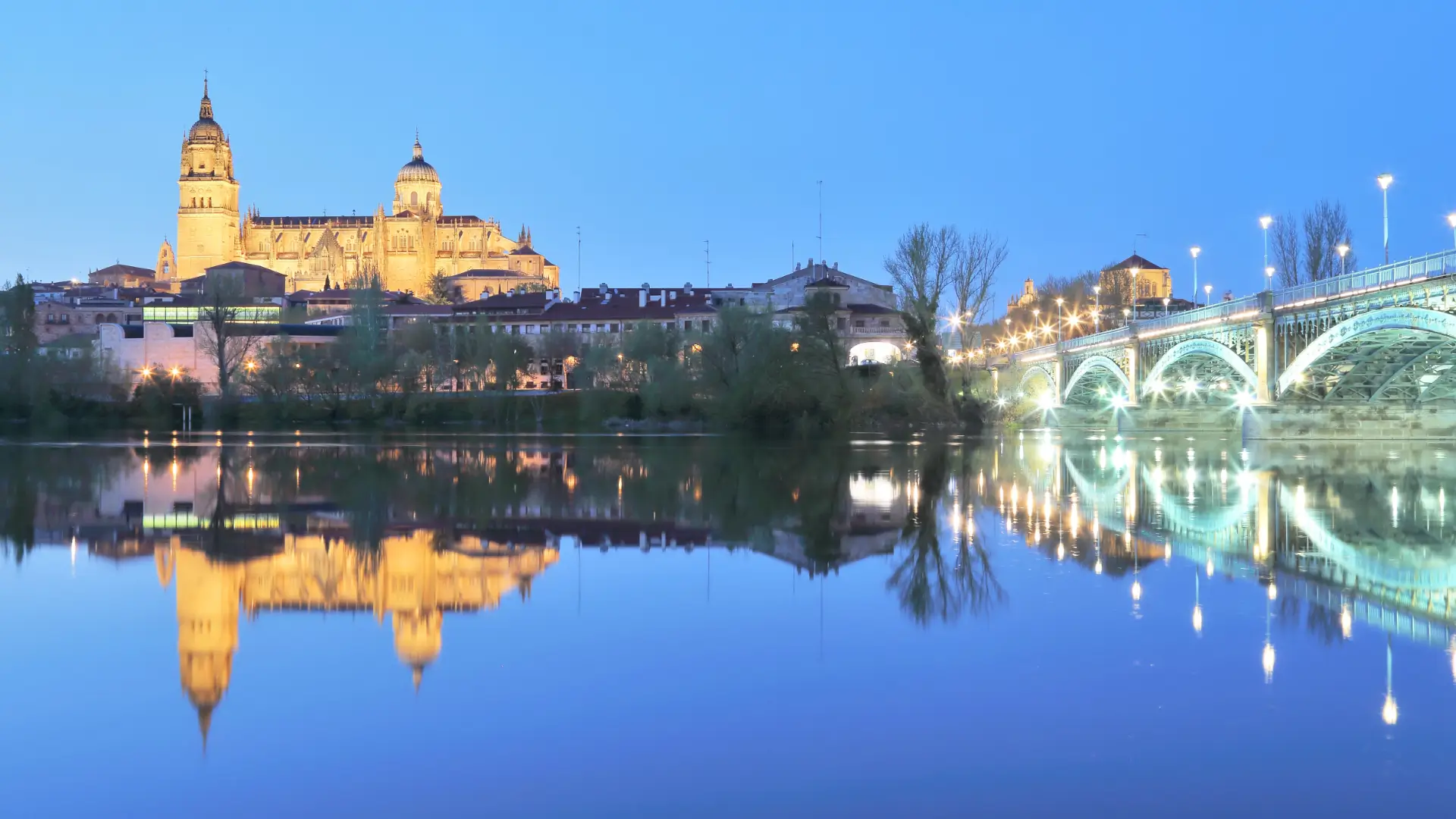
Salamanca is a UNESCO city of warm sandstone on the Río Tormes, west of Ávila. Spain’s oldest university has drawn students here since the 13th century. Its baroque Plaza Mayor, its two joined cathedrals and its Plateresque façades all glow amber at dusk. This is the warm end of Castilla y León: not a sleepy monument town, but a lively city that comes alive after dark. Come for the stone, stay for the evening.
Why Visit Salamanca
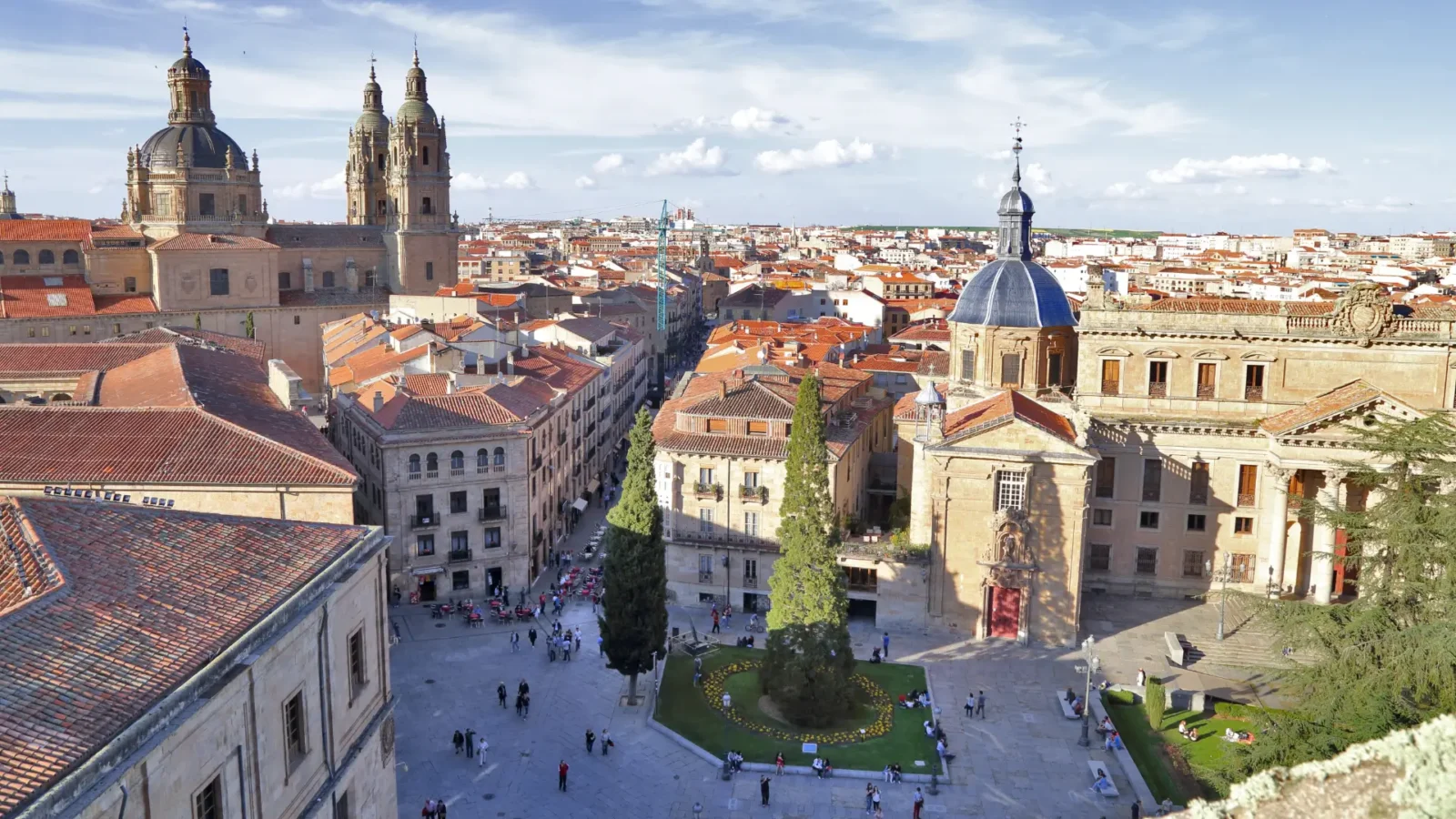
Salamanca is built from a single, remarkable material: Villamayor sandstone, a soft golden stone that seems to hold the light. In the low sun of morning and evening the whole old town turns honey and amber. That is how the city earned its nickname, La Dorada, the golden one. It is one of the great set pieces of Spanish architecture, wrapped around a river and crowned by two cathedrals. The whole old town is a UNESCO World Heritage Site.
Who Salamanca is for.
But stone is only half the story. This is a university city, and has been since 1218, home to the oldest university in Spain and one of the oldest in Europe. That gives Salamanca something most monument cities lack: a young, living heart. The streets are full of students, the plazas full of terraces, and the evenings are genuinely alive. Where a place like nearby Ávila empties out after the day-trippers leave, Salamanca does the opposite. It wakes up. So this is the honest pitch: come for the golden stone and the great buildings, but plan to be here in the evening. That's when the Plaza Mayor fills, the façades light up, and the city is at its warmest.
Day trip or overnight?
You can reach Salamanca from Madrid in under two hours by fast train, and you can see the headline sights in a full day. But a day trip misses the whole point of the place. Salamanca is an evening city. Its best hour is dusk, when the sandstone glows and the Plaza Mayor turns into an open-air living room. Its second-best is late, when the tapas bars and student terraces are humming. Our honest advice is to stay at least one night. A good short visit looks like this: climb the Ieronimus towers or the Scala Coeli for the rooftop view in the afternoon; walk the two cathedrals and the university façade; cross the Roman bridge at golden hour for the classic view back at the skyline; and then settle into the Plaza Mayor as the lights come on. Pair it with Ávila, an easy hour east, for a two-city trip that shows both sides of Castilla y León: the walled and quiet, and the golden and lively.
What to See in Salamanca

Plaza Mayor
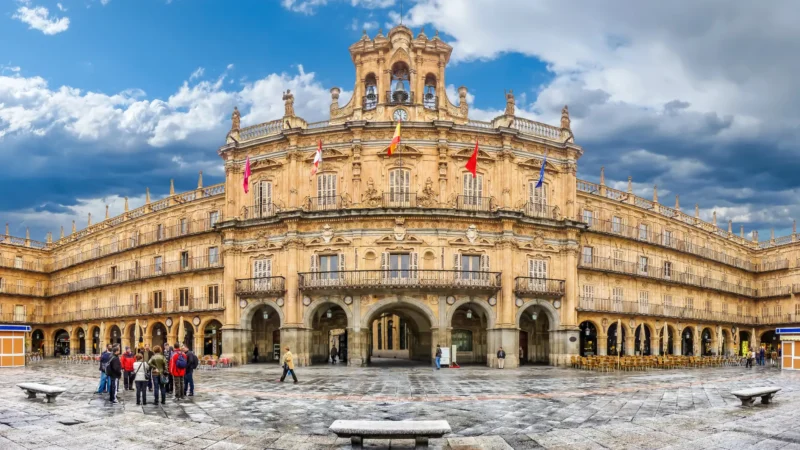
The heart of the city and one of the finest squares in Spain. Built in the 18th century in warm baroque sandstone, it is not quite a square: its sides are different lengths. Its arcades are lined with cafés, shops and the town hall, and above the arches run medallions carved with kings, writers and other figures from Spanish history. It is free, always open, and best at dusk, when the whole space glows and fills with people. Treat it as the city’s living room and keep coming back to it.
The two cathedrals
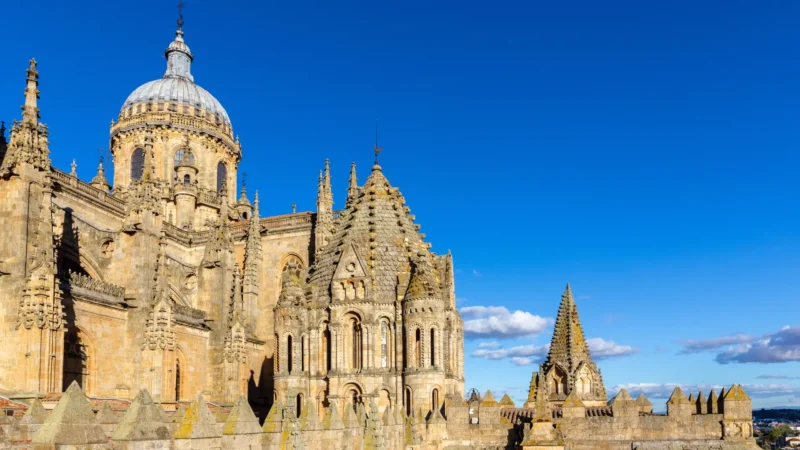
Salamanca has not one cathedral but two, built side by side and joined together. The Romanesque Old Cathedral (Catedral Vieja), consecrated in the 12th century, is smaller and older, with a jewel-like painted altarpiece and the domed Torre del Gallo. The larger New Cathedral (Catedral Nueva), built between the 16th and 18th centuries in Gothic and baroque styles, adjoins it. Look for the famous carvings on the Puerta de Ramos: an astronaut and a small creature eating an ice cream. Both were added by stonemasons during a 1990s restoration, not medieval mysteries but a modern signature.
La Clerecía & Scala Coeli
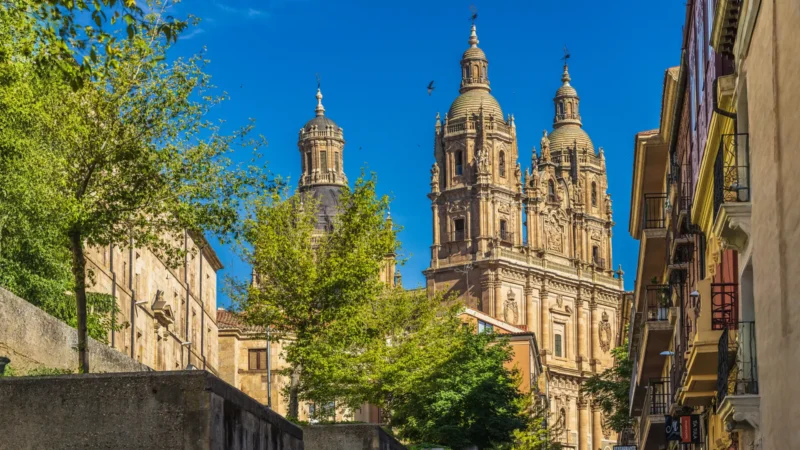
The twin baroque towers rising over the old town belong to La Clerecía, the former Jesuit college church, directly opposite the Casa de las Conchas. You can climb its Scala Coeli towers for a fine view over the cathedrals and the golden rooftops, usually quieter than the cathedral’s own tower climb. Down below, the church and its three-storey baroque cloister are worth a look in their own right.
Universidad de Salamanca (Edificio Histórico)
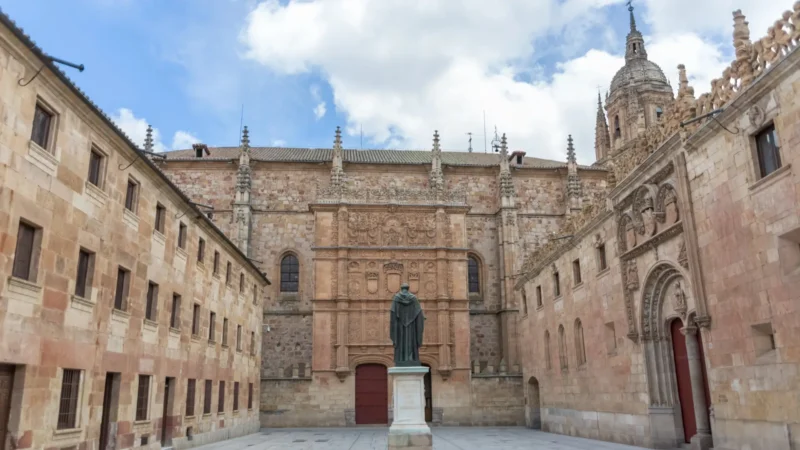
The soul of the city. The historic building of Spain’s oldest university is famous for its Plateresque “Fachada Rica”, a dense sandstone façade carved like a tapestry. On it, generations of students have hunted for the tiny carved frog said to bring luck in exams. Inside, an entry ticket takes you to the old lecture halls, including the aula of the writer Fray Luis de León. It also takes you up to the Biblioteca General Histórica, founded in 1254 and often called the first public library in Europe. The neighbouring Patio de Escuelas Menores, with its painted “Cielo de Salamanca”, is free.
Casa de las Conchas
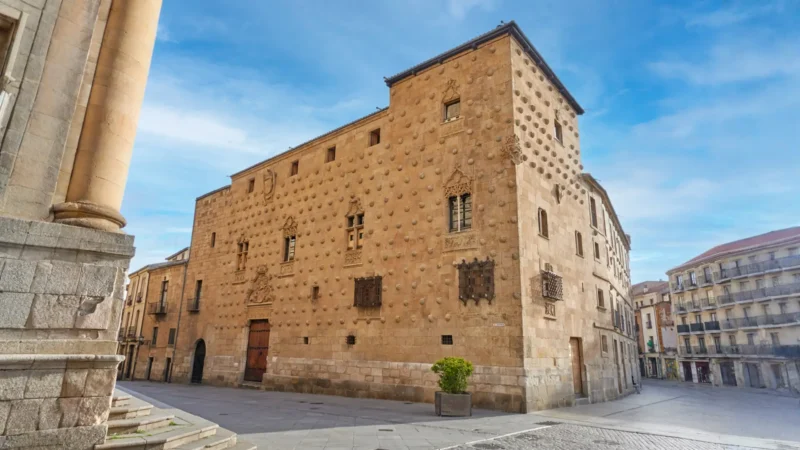
One of the city’s most photographed buildings, and one of its most charming. This late-15th-century mansion has a façade covered with more than three hundred carved stone scallop shells, the emblem of the Order of Santiago. Today it houses the public library. You can step freely into its beautiful Gothic courtyard, a calm spot right in the heart of the old town.
Convento de San Esteban
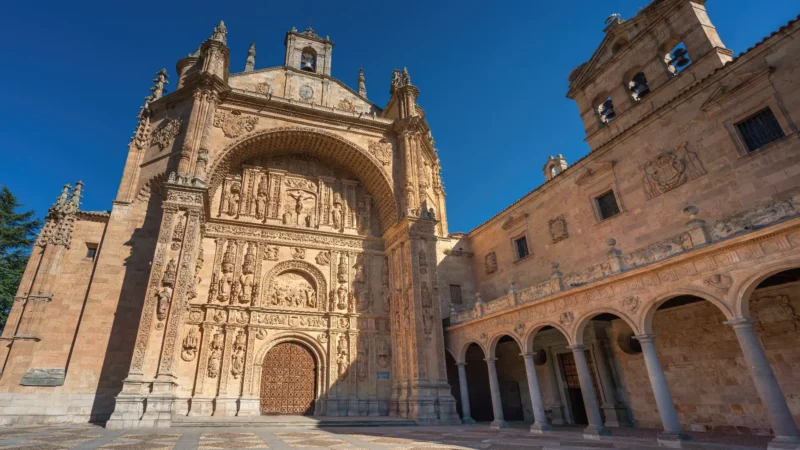
One of Salamanca’s grandest sights, this Dominican monastery is famous for its huge Plateresque façade, carved like a giant stone altarpiece above the entrance. Inside are a soaring church, an elegant cloister and a carved golden retablo. It sits a few minutes’ walk from the Plaza Mayor, and the square in front gives the best view of the façade. Nearby, keep an eye out for the Torre del Clavero, a graceful 15th-century octagonal tower that makes a fine landmark as you walk the old town.
Puente Romano
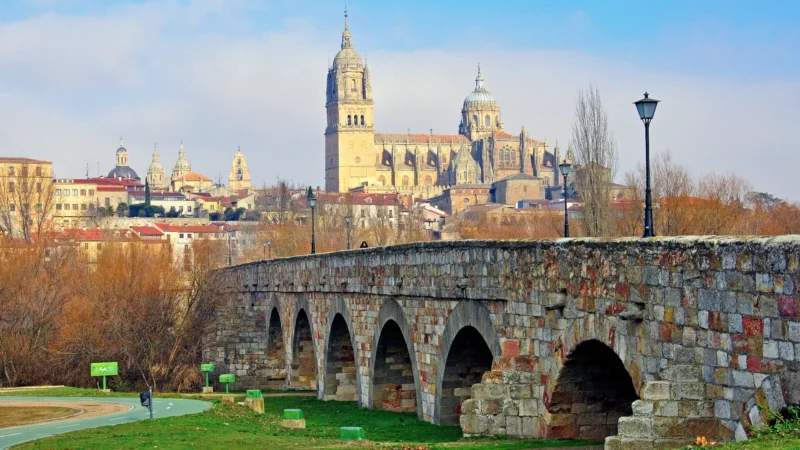
The old Roman bridge across the Río Tormes, parts of it nearly two thousand years old, carries the classic wide view of Salamanca. From the far bank you get the whole golden skyline in one frame. The cathedrals rise above the rooftops. It is free, a short walk below the cathedrals, and unbeatable at sunset, when the stone burns amber over the water.
What to Do in Salamanca
Linger in the Plaza Mayor
The single most Salamanca thing to do is simply to sit in the Plaza Mayor with a coffee or a caña and watch the city pass. Come back at different hours: quiet and golden in the morning, packed and glowing at night. It is the stage the whole city revolves around, and it costs nothing to be part of it.
Climb for the rooftop view
Get above the golden stone at least once. The Ieronimus route through the cathedral towers is the more dramatic climb, out onto high balconies over the nave and the city. The Scala Coeli towers at La Clerecía are the quieter alternative, with a fine angle back onto the cathedrals. Either way, go for the light: late afternoon rewards you with the whole town turning amber below.
Cross the Roman bridge at golden hour
Walk down to the Tormes and out onto the Puente Romano as the sun drops. This is where the postcard view lives, the full cathedral skyline reflected over the river, and it is at its best in the last hour of light. It pairs naturally with an evening back up in the old town.
Eat your way through the tapas bars
Salamanca is a student city, which means it does tapas cheaply and well. Wander the lanes around the Plaza Mayor and the Rúa Mayor in the early evening and follow the crowds; many bars still bring a free bite with a drink. It is the easiest, most local way to spend a Salamanca night.
Taste the local specialities
Look out for hornazo, the region’s dense savoury meat pie stuffed with pork, chorizo and egg, sold by the slice in bakeries and served whole in bars. The province is also famous for its cured Guijuelo ham and its Castilian roast meats, so build a meal around them.
Prefer to go with a guide for any of this? Ask where you’re staying, or at the tourist office on the Plaza Mayor — they’ll know what’s running, in which language, and can point you to something that fits.
Seasonal Events and Festivals
Ferias y Fiestas de la Virgen de la Vega (early to mid-September)The city’s biggest annual celebration, in honour of its patron, held over roughly a week around the feast day on 8 September. Expect concerts on the Plaza Mayor, street theatre, a funfair by the river, a bull fair and, best of all for visitors, the “Feria de Día”, when bars set up tapas stalls across the city. It draws big crowds, so book a room well ahead.
Semana Santa (spring, dates shift with Easter)Holy Week in Salamanca is declared of International Tourist Interest, with processions from many brotherhoods winding through the floodlit old town. One of the most atmospheric times to see the city.
Nochevieja Universitaria (December)A student invention that has become a city tradition: a mock New Year’s Eve, held in mid-December before term ends, when thousands of students fill the Plaza Mayor to “bring the bells forward” and see in a pretend new year.
Christmas lights & belén (December to January)In winter the old town is lit up and a monumental nativity scene and markets appear, turning the golden stone festive.
For exact dates each year, check the tourist office rather than relying on fixed dates, as programmes are set anew each year.
Getting There and Around
Salamanca sits in the west of Castilla y León, on the Río Tormes, well connected by road and rail. It is one of the easier cities in the region to reach without a car, thanks to a fast train from Madrid.
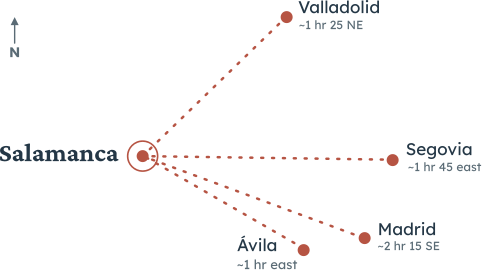
From Madridabout 2 hr 15 by car (roughly 215 km). By rail, fast Alvia trains cover it in around 1 hr 40, with slower Media Distancia services taking closer to three hours on a scenic route; the station is about 2 km from the old town. This fast link makes Salamanca noticeably easier to reach by train than Ávila.
From Ávilaabout 1 hr by car (roughly 105 km) on the A-50, east. Direct trains also run in around 1 hr 6, as Salamanca and Ávila sit on the same line.
From Segoviaabout 1 hr 45 by car (roughly 185 km), east, usually via Ávila; there is no direct train.
From Valladolidabout 1 hr 25 by car, north-east, with direct trains too.
Nearest airportsMadrid-Barajas (MAD) is the main international gateway, about 2 hr 15 by car, or reach the city by train from Madrid. The small Salamanca-Matacán airport (SLM) handles only limited domestic flights, so most visitors arrive through Madrid.
Getting around
The old town is compact and made for walking; you won’t want a car inside it, and much of the historic centre is pedestrianised and closed to traffic. Leave the car in one of the car parks on the edge of the centre and explore on foot. For the wider region, though, a car earns its keep: it’s how you reach Ávila, Segovia and the villages of the Sierra de Francia to the south at your own pace.
Looking for a ready-made plan? See our Castilla y León road trips.
Practical Info
- The two cathedralsa single combined ticket covers both the Old and New Cathedrals. Hours change with the season and around services, so check the official cathedral site for current times and prices before you go. (It’s in Spanish but you can use browser translation)
- Ieronimus towersthis is a separate ticket from the cathedral, bought at the Torre Mocha entrance on Plaza Juan XXIII, with its own opening hours; booking online for a timed slot is advised. Don’t assume it’s included in your cathedral ticket.
- University (Edificio Histórico)this is a separate ticket from the cathedral, bought at the Torre Mocha entrance on Plaza Juan XXIII, with its own opening hours; booking online for a timed slot is advised. Don’t assume it’s included in your cathedral ticket.
- Best time of dayclimb a tower in the afternoon light; save the Roman bridge and the Plaza Mayor for dusk and after dark, when the city is at its best.
- Getting aroundwalkable, pedestrianised old town; park on the edge; you’ll want a car only for the wider region.
- Climateat about 800 m Salamanca has a continental meseta climate, milder than higher Ávila but still one of big day-to-night swings. July and August are hot and dry, with highs near 30°C but cool nights around 14–15°C. Winters are cold, with January highs near 8–10°C, frequent frost and occasional snow. It is a fairly dry, sunny city year-round. The most comfortable months are roughly mid-May to mid-June and mid-September to mid-October, when days are warm and evenings pleasant — though bring a layer for the evenings whenever you come.
Where to Eat in Salamanca
Salamanca eats late, cheaply and well, powered by a big student population and a proud regional larder. The local speciality to seek out is hornazo, a dense savoury pie packed with pork, chorizo and hard-boiled egg. It’s sold by the slice in bakeries and served whole in bars. Around it sit the great Castilian meats: cured Guijuelo ham from the province, roast lechazo and suckling pig, and the beef of the plains. Two simple rules: graze the tapas bars around the Plaza Mayor and the Rúa Mayor in the early evening, then sit down for a proper dinner later, the way the city does. The picks below run from a hornazo counter to a Michelin table.
For a special occasion, this contemporary restaurant facing the Convento de San Esteban offers tasting menus built on local produce, especially the province’s Iberian pork. It holds a Michelin star. A handful of tables only, so book well ahead.
A polished, popular kitchen just off the Plaza Mayor, in a handsome vaulted cellar, known for its roast lechazo and its steaks. A reliable choice for a proper Castilian dinner; book ahead, as it fills fast.
A characterful local favourite for tapas and raciones, with its own farm produce and generous portions. Good for the classic Salamanca thing of grazing well without a formal sit-down; reserve for the downstairs tables.
A much-loved old bakery near the Rúa Mayor, going since 1948, widely rated for the best hornazo in the city. The place to buy a slice of the local speciality, or a box of pastries, to eat on a bench in the sun.
On Calle Libreros near La Clerecía, a creative, well-run kitchen with a fine view of the towers, doing modern takes on regional produce. A good middle option for a slightly special meal without the full fine-dining commitment.
Where to Stay in Salamanca
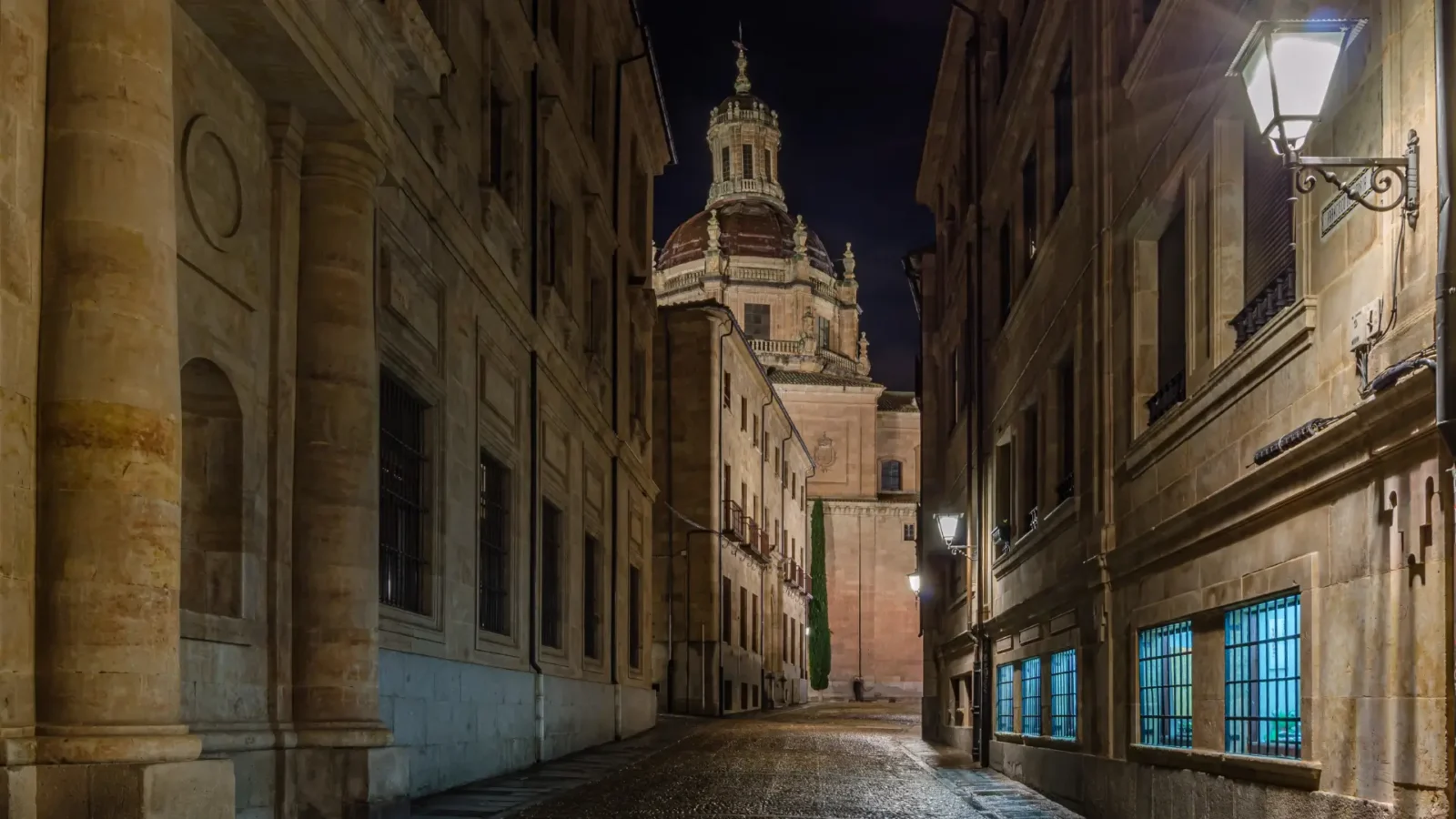
Picture the city at night: the Plaza Mayor glowing amber, the terraces full, the cathedrals floodlit above the rooftops. That evening is the reason to stay, and Salamanca lets you sleep right in the middle of it — in palaces on the old squares, or across the river with the whole golden skyline in view. Here’s where we’d book.
Parador de Salamanca
A modern Parador across the Tormes, whose great draw is the view: rooms and terrace look straight back at the golden cathedral skyline over the river. It’s a short, pleasant walk into the centre, with easy parking — the classic choice if you want the postcard panorama from your window.
Check prices & availability for Parador de Salamanca on the accommodation's websiteGrand Hotel Don Gregorio
A restored 15th-century palace in the old town, opposite the Convento de San Esteban and minutes from the Plaza Mayor. A small, luxurious boutique hotel with a garden, spa and just a handful of individually styled rooms — the top-end choice for a treat.
Check prices & availability for Grand Hotel Don Gregorio on the accommodation's websiteHostal Concejo
Simple, clean and friendly, right in the centre near the Plaza Mayor and excellent value. The honest budget pick: no frills, a central location and a warm welcome, ideal if you’re spending your money on tapas rather than the room.
Check prices & availability for Hostal Concejo on the accommodation's websiteHotel Catalonia Plaza Mayor
A comfortable, well-run hotel a short step from the Plaza Mayor, in a converted historic building with a good breakfast. A solid mid-range choice that keeps you right in the heart of the old town without the top-tier price.
Check prices & availability for Hotel Catalonia Plaza Mayor on the accommodation's websiteHotel NH Collection Salamanca Palacio de Castellanos
A 15th-century palace on Calle San Pablo, arranged around a beautiful courtyard, a few minutes’ walk from the Plaza Mayor and the cathedrals. Reliable, comfortable and full of historic character, with a genuinely central location.
Check prices & availability for Hotel NH Collection Salamanca Palacio de Castellanos on the accommodation's websiteSalamanca Luxury Plaza
A tiny, spotless boutique stay with just a handful of rooms actually on the Plaza Mayor itself — book a plaza-side room and you wake up over the finest square in Spain. Discreet, quiet and superbly located; ask for the square view.
Check prices & availability for Salamanca Luxury Plaza on the accommodation's website
Region, Nearby and Routes
Part of Castilla y León
Salamanca is in Salamanca — Castilla y León
Part of these routes
Salamanca is the final city on our The Three Walled Cities road trip see the full drive.
Salamanca is also a stop on our Castilla y León & Extremadura Road Trip: 9 Days
Nearby places
- SegoviaA high, walled city whose Roman aqueduct, fairy-tale Alcázar and Gothic cathedral make it one of Castile’s great sights.
- ÁvilaSpain’s most complete medieval walls ring a high, quiet stone city — a fortress-cathedral and St Teresa’s Ávila, best after the day-trippers leave.
- PedrazaA fully walled medieval village entered through one gate, with a clifftop castle and a colonnaded square.
- ZamoraHome to more Romanesque churches than any other European city, quiet Zamora rewards a slow evening on the Duero.
- AstorgaAstorga crowns a small Maragato town with a Gaudí palace, a Gothic cathedral and deep Roman roots.
Frequently Asked Questions
Yes, very much. It’s a UNESCO World Heritage city built almost entirely from golden sandstone, with one of Spain’s finest main squares, two joined cathedrals and the oldest university in the country. It’s also a lively student city, so unlike many monument towns it stays genuinely alive in the evenings — which is when it’s at its most beautiful.
Its golden-stone old town, nicknamed La Dorada; its baroque Plaza Mayor; the oldest university in Spain, with its carved frog and its ancient library; and its two side-by-side cathedrals, including the famous modern astronaut carving. It’s also known for lively student nightlife and for hornazo, its savoury meat pie.
You can — fast Alvia trains reach it in about 1 hr 40, and you can see the main sights in a day. But Salamanca is really an evening city: its best hours are dusk and after dark, when the stone glows and the Plaza Mayor fills. Staying at least one night shows it at its best. Ávila is only about an hour away, making a two-city trip easy.
One night is the sweet spot: it lets you climb a tower for the rooftop view, walk the cathedrals and university by day, cross the Roman bridge at sunset and enjoy the Plaza Mayor after dark. Two nights suits anyone wanting to slow down or pair it with Ávila.
Yes. The Ieronimus route takes you up through the medieval towers of the cathedral and out onto high balconies and walkways with sweeping city views. It is a separate ticket from the cathedral itself, bought at the Torre Mocha entrance on Plaza Juan XXIII, and it has its own opening hours. For a quieter, cheaper rooftop climb, try the Scala Coeli towers at La Clerecía instead.
Roughly mid-May to mid-June and mid-September to mid-October are most comfortable, with warm days and pleasant evenings. Summers are hot and dry (July highs near 30°C) but with cool nights; winters are cold, with frost and the odd snowfall and January highs near 8–10°C. Whenever you come, bring a layer for the evenings, as the meseta cools off after dark.
Stay in or beside the old town to get the glowing evenings. The Parador across the river has the best skyline view; Grand Hotel Don Gregorio and the NH Collection Palacio de Castellanos are historic palaces in the centre; Hotel Catalonia Plaza Mayor and Salamanca Luxury Plaza put you right by the main square; and Hostal Concejo is a tidy budget pick a step from the Plaza Mayor.
For the local hornazo, head to Confitería la Industrial. For a proper Castilian dinner of roast lamb and steak, El Mesón de Gonzalo near the Plaza Mayor; for tapas and grazing, La Casa de las Pulgas; for something more contemporary, Corte & Cata by La Clerecía; and for a special-occasion tasting menu, the Michelin-starred En la Parra.