
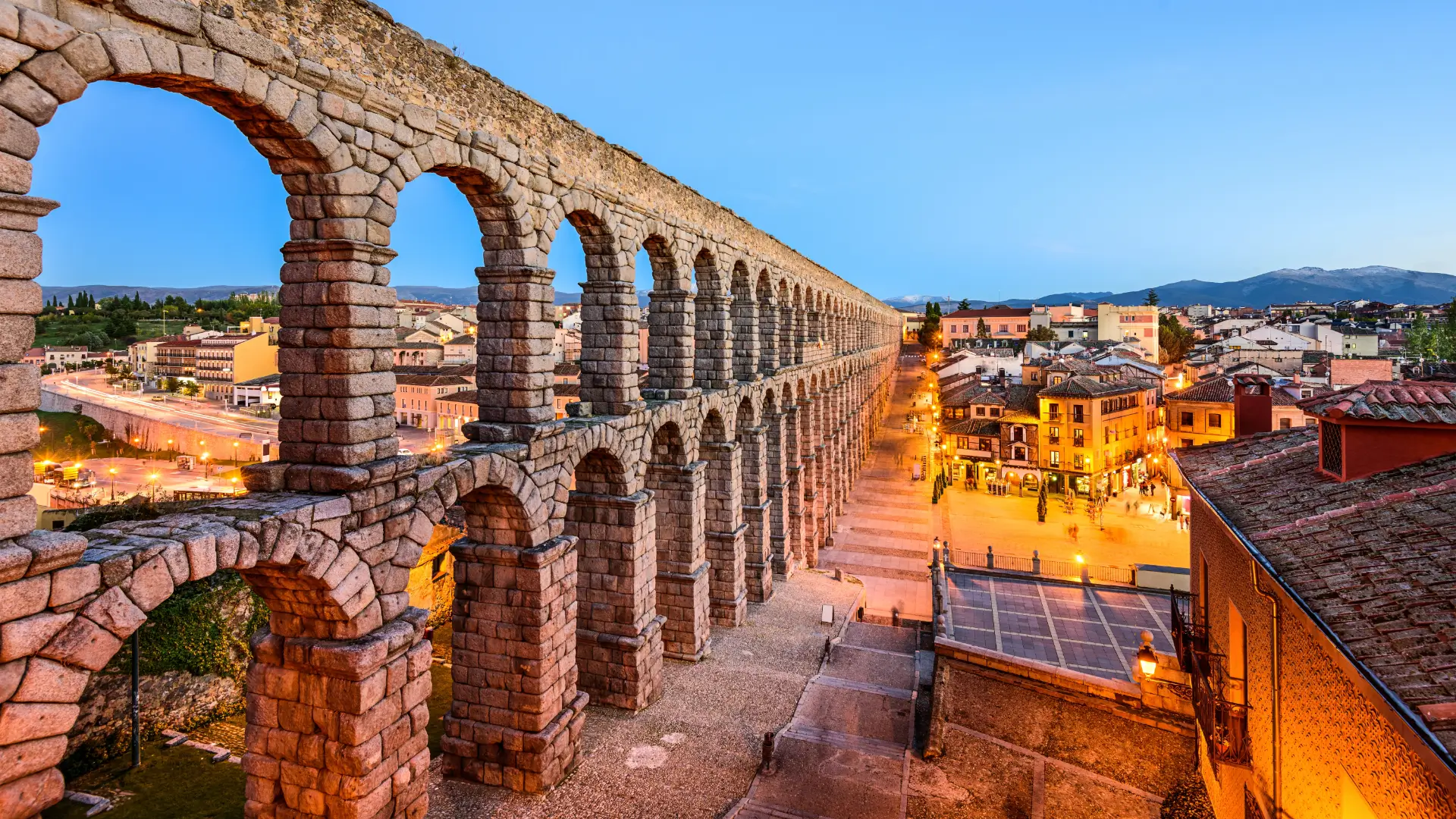
Segovia: a Roman aqueduct, a castle on a rock, and the quiet after the coaches leave
Segovia rises from the plains of Castilla y León with three landmarks that stop you in your tracks: a vast Roman aqueduct, a castle shaped like a ship’s prow, and one of Spain’s last great Gothic cathedrals. It is an easy day trip from Madrid — but it rewards those who stay after the coaches leave.
Why Visit Segovia
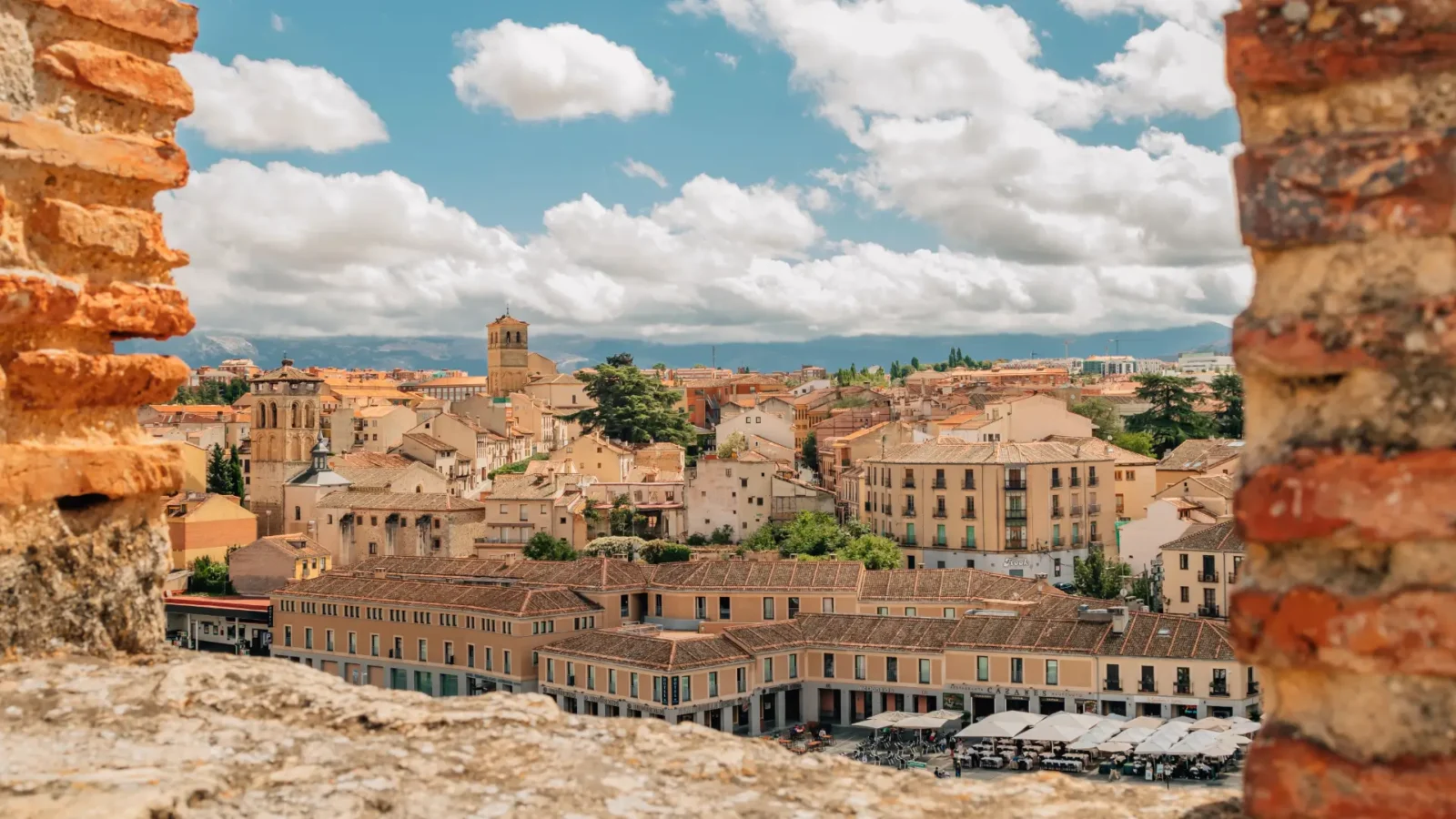
Segovia is famous, and we won’t pretend otherwise. It is one of the classic day trips from Madrid, so the aqueduct and the castle draw coach groups through the middle of the day. What sets the city apart is what happens around that. The old town sits on a high ridge between two river valleys. It is small enough to walk end to end in twenty minutes. Three of the finest monuments in Castile stand within that short walk. There is also a medieval Jewish quarter, quiet stone lanes and long views over the plains.
Segovia — a calm base, if you time it right
The reward here is timing, not avoidance. Come early or stay the night, and the same streets feel like a different city. In the evening the day-trippers thin out, the aqueduct lights up, and the plazas belong to locals again. Segovia also makes a natural base for the wider area, with the royal gardens of La Granja and the walled village of Pedraza both a short drive away.
Day trip or overnight?
You can see Segovia's headline sights in an afternoon, and many people do, on a quick day trip from Madrid. But that means arriving with the crowds and leaving just as the city gets good. Our honest advice is to stay the night. A perfect short visit looks like this: arrive in the late afternoon and walk the aqueduct while the light turns gold, then climb to the Alcázar viewpoint for sunset over the plains. Have dinner in the old town, with roast suckling pig if you eat meat. The next morning, reach the cathedral and the Jewish quarter before the first coaches arrive, when the streets are quiet and cool. That gentle rhythm simply does not fit into a single day.
What to See in Segovia

The Roman Aqueduct
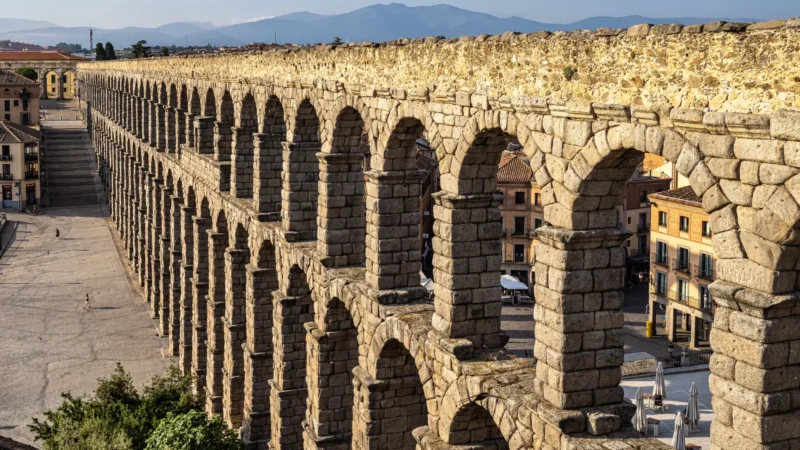
The aqueduct is the reason most people come, and it does not disappoint. The Romans built it without a drop of mortar, and it still stands after almost two thousand years. It runs for hundreds of metres through the heart of the city, rising to around 28 metres above the Plaza del Azoguejo. It is free and open air, so you can walk right up to it at any hour. For a closer look at the upper channel, climb the steps at the Postigo del Consuelo.
The Alcázar of Segovia
Perched on a rock at the western tip of the old town, the Alcázar looks like a castle from a storybook. Its shape, part fortress and part palace, is said to have helped inspire the Disney castle. Inside you can walk the royal rooms and the Royal Artillery College museum. Fitter visitors can climb the Tower of Juan II, a steep spiral of 152 steps, for the best view in the city. Entry to the palace and the tower are ticketed separately, and the tower runs on small timed slots that sell out first — see Practical Info.
Segovia Cathedral
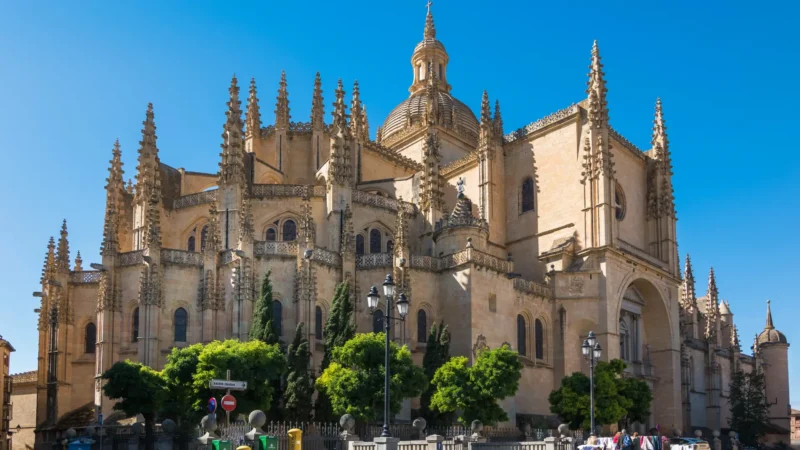
Begun in 1525, this was one of the last great Gothic churches built in Spain. Its warm stone and slim spires have earned it the nickname “the Lady of the Cathedrals”. Inside are soaring naves, a peaceful cloister and chapels full of Flemish and Castilian art. You can also join a guided climb up the bell tower, at nearly 88 metres the highest point in the old town, which includes the bell-ringer’s house and long views across the roofs.
The Puerta de San Andrés and Jewish Quarter
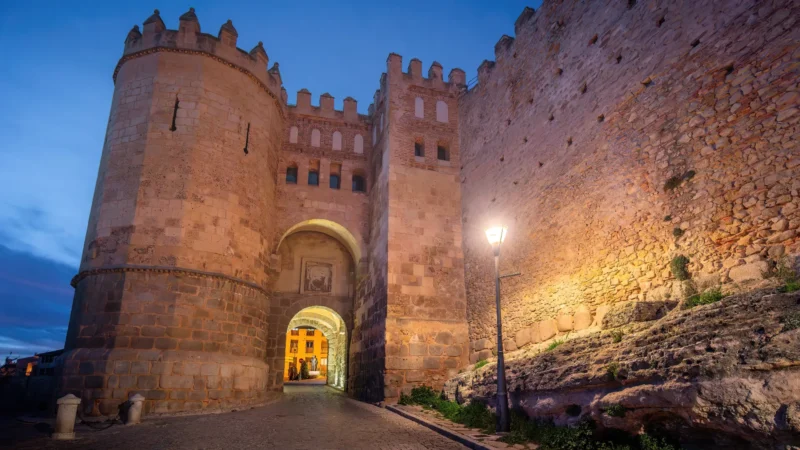
This twin-towered medieval gate on the south side of the walls was the old entrance to the Jewish quarter. It is the gate the Jews passed through when they were expelled from Spain in 1492. Its towers now hold a small centre about the city walls. Climb the steep steps to the walkway for a view over the quiet Judería and the valley. From the gate, narrow lanes lead up into the old Jewish quarter — among the calmest streets in the centre, and a lovely place to wander.
Plaza Mayor and Casa de los Picos
The arcaded Plaza Mayor is the social heart of the old town, framed by the cathedral on one side and lined with cafés. From here, Calle Juan Bravo leads down toward the aqueduct past the Casa de los Picos, a 15th-century mansion whose façade is studded with hundreds of granite points. It now houses an art school, and its strange, spiky front is one of the most photographed spots on the main street.
Monastery of Santa María del Parral
Just outside the walls, across the Eresma river below the old town, stands a monastery most day-trippers never see. Founded in the 15th century, it is one of only two in Spain still run by the Hieronymite order. A handful of monks still live here in silence. The flamboyant Gothic church holds fine carved altarpieces and royal tombs. Even from outside the walls, across the river, it is a striking sight. Opening is limited: entry is by a short guided visit at set times, in Spanish. A small donation is welcome. Check current times before you walk down.



What to Do in Segovia
Walk the aqueduct end to end
Most visitors photograph the aqueduct at the Plaza del Azoguejo and move on. Do the walk instead: follow the arches from the plaza up toward the old city walls, roughly a 25–30 minute stroll that shows how the structure shrinks and changes as the ground rises. Wear comfortable shoes, as the streets are cobbled throughout.
Catch sunset from the Alcázar side
Segovia’s western tip, around the castle and the Mirador de la Pradera de San Marcos, faces the open plains and catches the last light. Time a slow late-afternoon loop out here to watch the stone turn gold, then walk back into the old town as the aqueduct lights come on. It is the single best free hour in the city.
Take a day trip to La Granja de San Ildefonso
About 11 km away, the royal palace of La Granja is Spain’s answer to Versailles, with a grand Bourbon interior and huge French-style gardens full of fountains and statues. The monumental fountains only run on set days in the warmer months, so it is worth timing your visit around them — check the official Patrimonio Nacional site for the current schedule. On a normal day the gardens alone are worth the short drive.
Detour to Pedraza, a walled medieval village
Around 40 minutes north-east, Pedraza is a tiny walled village entered through a single gate, with a hilltop castle (now a museum dedicated to the painter Ignacio Zuloaga) and one of the prettiest squares in Spain. It is a quiet counterpoint to Segovia’s crowds. On the first two Saturdays of July it holds its famous candle-lit nights, when the whole village is lit only by candlelight — beautiful, but busy, so arrive early and check dates locally.
Prefer to go with a guide for any of this? Ask where you’re staying, or at the tourist office on the Plaza del Azoguejo beside the aqueduct — they’ll know what’s running, in which language, and can point you to something that fits.
Seasonal Events and Festivals
La Granja fountain season (spring to autumn)The monumental fountains at La Granja de San Ildefonso, 11 km away, only run on set days in the warmer months, plus the illuminated Diana Baths on selected evenings. Dates are limited and change year to year; check the official Patrimonio Nacional site before you go.
Pedraza Candle Nights (first two Saturdays of July)The walled village of Pedraza lights every street with candles on two July nights. It is one of the most atmospheric events in the province — and one of the busiest. Confirm the exact dates locally each year.
San Juan & San Pedro (late June)Segovia’s main summer fiestas fill the old town with concerts, bullfights and street life over the last week of June. Check the Ayuntamiento’s programme for the year’s dates.
Getting There and Around
Segovia sits about 90 km north-west of Madrid, on the far side of the Sierra de Guadarrama, and is one of the easiest historic cities in Spain to reach without a car.
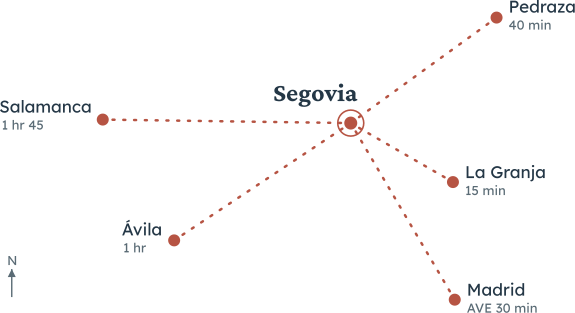
From Madridabout 1 hour by car via the AP-6 / A-6 and AP-61 (roughly 90 km). Much easier by high-speed train: AVE and AVANT services reach Segovia-Guiomar in about 30 minutes, around 25 times a day, and the Avanza bus from Madrid–Moncloa takes about 1 hour 20.
From Ávilaabout 1 hour by car (roughly 70 km); also linked by high-speed train.
From Salamancaabout 1 hour 45 by car (roughly 187 km, via Ávila); direct high-speed trains also run.
Nearest airportsMadrid–Barajas (MAD) is the closest major airport, about 90 km and roughly 1 hour 10 by road; it is also the main international gateway.
By trainnote that Segovia-Guiomar station sits about 6 km outside the centre — local buses 11 and 12, or a short taxi, connect it to the old town.
Getting around
Inside Segovia you do not need a car: the old town is small and walkable, and much of it is pedestrianised. Drivers should park outside the historic core (the underground car park near the aqueduct is the simplest) and walk in, as central parking is very limited. You will want a car for the wider area, though — it is the only practical way to reach La Granja, Pedraza and the villages beyond, and to continue on toward Ávila and Salamanca.
Looking for a ready-made plan? See our Castilla y León road trips.
Practical Info
- AqueductFree and open-air; no ticket, visitable at any hour. Walking on the water channel itself is not allowed, but the Postigo del Consuelo steps give a close view of the upper arches. An interpretation centre nearby explains the wider system.
- AlcázarTwo ticket types: palace + artillery museum, or a combined ticket that adds the Tower of Juan II (a 152-step spiral climb). The tower runs on small timed slots with limited capacity and sells out before palace entry, so book ahead if you want it. Hours change with the season, and there is a free-access window for EU citizens on non-holiday Tuesday afternoons. Buy from the official site: alcazardesegovia.com
- CathedralGeneral entry covers the naves, cloister, chapels and exhibition rooms, and includes the Episcopal Palace nearby. The bell-tower climb is a separate guided visit on scheduled sessions (with a night-tower option on some weekends). Check current times and prices at catedralsegovia.es
- Best time of dayReach the cathedral, the Alcázar and the Jewish quarter early or late. The middle of the day is when the Madrid coaches are in town.
- ClimateSegovia sits high, at around 1,000 m, so it runs hot in summer and genuinely cold in winter. July highs are around 28–30°C, occasionally higher, with cool nights. The most comfortable months are roughly April to June and September to October, in the high teens to low 20s. It is wettest in spring and autumn and driest in high summer; winters can bring frost and snow.
Where to Eat in Segovia
You’ll eat and drink well in Segovia, at every budget — and one dish rules the table. This is the home of cochinillo asado, roast suckling pig, cooked in wood ovens until the skin is glass-thin and crisp, so tender it is carved with the edge of a plate. Two simple rules make it easy: for a relaxed lunch while you’re out walking, the Plaza Mayor and its edges are full of good-value spots; for dinner, book a proper asador in the old town and make an evening of it. The picks below cover both, from a quick tapas lunch to a special-occasion table.
The best-known asador in the city, tucked right under the aqueduct on the Plaza del Azoguejo. The house ceremony — carving the suckling pig with a plate, then breaking the plate — is pure theatre, and the roast lamb and Castilian bean soup are just as traditional. Book ahead; it is popular and busy.
A Segovia institution just off the Plaza Mayor, listed in the Michelin Guide and widely rated among the best places in Spain for cochinillo. Expect polished service, a lively tavern atmosphere and a serious wine list. Reservations are essential, especially at lunch.
A little off the main tourist run, this warm, family-style grill draws locals for its cochinillo and roast lamb, both crisp outside and tender within. Friendly service and good value make it a reliable choice for a proper Castilian roast without the crush.
Down a short flight of steps just off the busy hill, this rustic grill serves a generous set menu of local dishes — partridge, judiones (big white beans) and, of course, suckling pig — at a fair price. It fills with locals, which is always a good sign.
An old-school dining room near the Plaza Mayor that, as regulars put it, has barely changed in sixty years — and that is the point. Reliable cochinillo, classic Castilian starters and good-value cooking, with a bar side that works well for a lighter tapas lunch.
Right on the Plaza Mayor, with tables looking toward the cathedral. Good for both a sit-down plate of cochinillo and Segovia’s celebrated bean soup, or just tapas and a ponche segoviano (the local marzipan cake) at the bar. A handy, central spot at either end of the day.
Where to Stay in Segovia
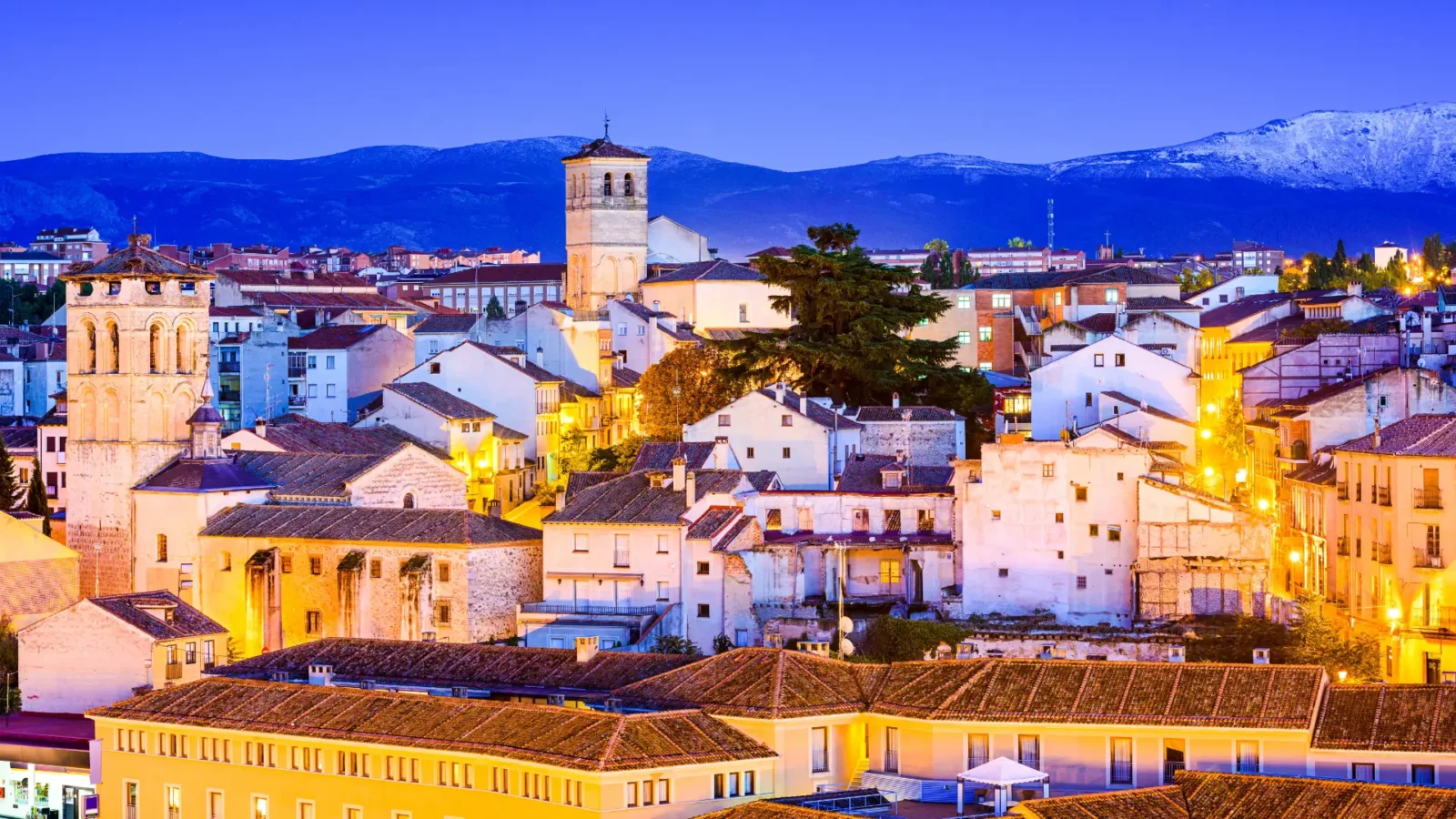
Picture the old town after dark, once the coaches have gone. The aqueduct glows against the night, the lanes fall quiet, and a table waits in a stone dining room. That evening is the real reason to stay, and it starts with the right room. Below are places we’d book, from a former convent to a simple hostal near the square. All are bookable on Booking.com and sit in or right beside the old town.
Áurea Convento Capuchinos
Sleep inside a former convent on the quiet edge of the walled old town, with stone-walled rooms, two cloisters, a garden terrace and long views over the valley — a couple of minutes’ walk from the restaurants but a world away from the daytime crush.
Check prices & availability for Áurea Convento Capuchinos on the accommodation's websiteHotel Cetina Palacio Ayala Berganza
A 15th-century noble palace turned country-style hotel near the aqueduct, with a palm-shaded patio and generous rooms. It trades on old stone and calm rather than gloss, and is an easy walk from everything.
Check prices & availability for Hotel Cetina Palacio Ayala Berganza on the accommodation's websiteHotel San Antonio El Real
Set in a former royal monastery with a beautiful cloister and gardens, a short walk up from the aqueduct. Spacious rooms and a green, peaceful setting make it a characterful mid-range base with parking — handy if you’re touring the region by car.
Check prices & availability for Hotel San Antonio El Real on the accommodation's websitePalacio San Facundo
A restored 16th-century palace-house right between the cathedral and the aqueduct, with a glass-domed courtyard where breakfast is served. Central but quiet, it puts you a two-minute walk from the Plaza Mayor.
Check prices & availability for Palacio San Facundo on the accommodation's websiteHotel Don Felipe
In the old Jewish quarter, with a garden and a sun terrace looking straight at the Alcázar. Comfortable, well-run and walkable to every sight, it’s a dependable mid-range choice with its own parking.
Check prices & availability for Hotel Don Felipe on the accommodation's websiteHostal Fornos
A friendly, well-kept little hostal a couple of minutes from the Plaza Mayor, in a characterful old building with modernist touches. Simple, clean, brightly decorated rooms and an unbeatable location make it the pick for a good-value overnight.
Check prices & availability for Hostal Fornos on the accommodation's website
Region, Nearby and Routes
Part of Castilla y León
Segovia is in Segovia — Castilla y León
Part of these routes
Segovia is the starting city on our The Three Walled Cities road trip see the full 3–4 day drive through Segovia, Ávila and Salamanca.
Segovia is also a stop on our Castilla y León & Extremadura Road Trip: 9 Days
Nearby places
- ÁvilaSpain’s most complete medieval walls ring a high, quiet stone city — a fortress-cathedral and St Teresa’s Ávila, best after the day-trippers leave.
- SalamancaUNESCO city of golden sandstone on the Tormes — baroque Plaza Mayor, two cathedrals and Spain’s oldest university, at its liveliest after dark.
- PedrazaA fully walled medieval village entered through one gate, with a clifftop castle and a colonnaded square.
- La Granja de San IldefonsoA royal palace and Versailles-style gardens in cool pine hills — the Bourbon kings’ summer retreat, still calm today.
Frequently Asked Questions
Yes. Few cities pack this much into one short walk: a giant, mortar-free Roman aqueduct, a castle on a rock that helped inspire the Disney castle, and one of Spain’s last great Gothic cathedrals, all within a compact old town. It is famous and can be busy by day, but it stays genuinely rewarding — especially early, late, or overnight.
Three things above all: the Roman aqueduct, the fairy-tale Alcázar and the Gothic cathedral known as “the Lady of the Cathedrals”. It is also famous for cochinillo asado, roast suckling pig, which is the city’s signature dish.
Easily — high-speed AVE and AVANT trains reach Segovia-Guiomar in about 30 minutes, and there are frequent buses too. You can see the headline sights in an afternoon. But a day trip means arriving and leaving with the crowds; staying the night lets you see the old town quiet and lamplit, which is when it is at its best.
For the palace itself, usually not, though it saves queueing. For the Tower of Juan II, yes — the tower runs on small timed slots with limited capacity and sells out before general palace entry, so book that part ahead if the climb and the view matter to you.
Half a day covers the aqueduct, the Alcázar and the cathedral if you move briskly. To do it justice — including the Jewish quarter, a sunset viewpoint and an unhurried dinner — plan one night. Add a second night if you also want to reach La Granja or Pedraza.
Spring and autumn are the most comfortable: roughly April to June and September to October sit in the high teens to low 20s Celsius. July highs reach around 28–30°C with cool nights, while winters are cold, with frost and possible snow. Whenever you come, early morning and evening are the calmest hours.
Stay inside or right beside the old town so you’re there when it empties out. For character, the Áurea Convento Capuchinos (a former convent) and Hotel San Antonio El Real (a former monastery) stand out; Palacio San Facundo and Hotel Don Felipe are lovely mid-range choices near the sights; and Hostal Fornos is a friendly, good-value option just off the Plaza Mayor.
For the famous cochinillo asado, the classic asadores are Mesón de Cándido, under the aqueduct, and José María, near the Plaza Mayor. For the same roast with fewer crowds and a lighter bill, try Asador Maribel or Asador David Guijarro. La Taurina on the Plaza Mayor is handy for tapas or a sit-down lunch with a cathedral view.