
The Three Walled Cities: A Castilla y León Road Trip
Three unhurried days from Segovia through Ávila to Salamanca — three walled UNESCO cities in golden stone, with quiet detours in between.
- StartSegovia
- EndSalamanca
- Duration3 driving days, 3 nights — with an easy optional extra day (and a second night in Segovia) for the La Granja and Pedraza detours; see the itinerary
- Total distanceAbout 170 km of trip driving, plus the run in and out
- NightsSegovia ×1 (×2 with the detour day) · Ávila ×1 · Salamanca ×1
- Best forCar or motorbike
- DifficultyEasy — short, well-signed drives of about an hour each, no mountain passes
- Best seasonMay–June and September–October (warm days, cool evenings, thinner crowds); winters are cold, snow likely, especially in high Ávila
- PaceRelaxed
- Flying in?Madrid (MAD) in and out, ~1¼ h to the start in Segovia. Allow an extra arrival and departure day on top of the driving days above (so 3 driving days is roughly 5 days off work). Driving your own car or bike down? Ignore this line — the trip simply starts in Segovia.
Why this Route?
Three cities, three sets of walls, one easy driving line. Segovia, Ávila and Salamanca sit within an hour of each other in southern Castilla y León, and all three are UNESCO World Heritage sites built in the same warm, golden stone. The coach tours race all three in a single day from Madrid. This trip does the opposite. You sleep a night in each, so you get the old towns in the early morning and the evening, once the day-trippers have driven home. That quiet hour, plus a couple of very calm detours, is what the trip is built around.
Three walls, three moods
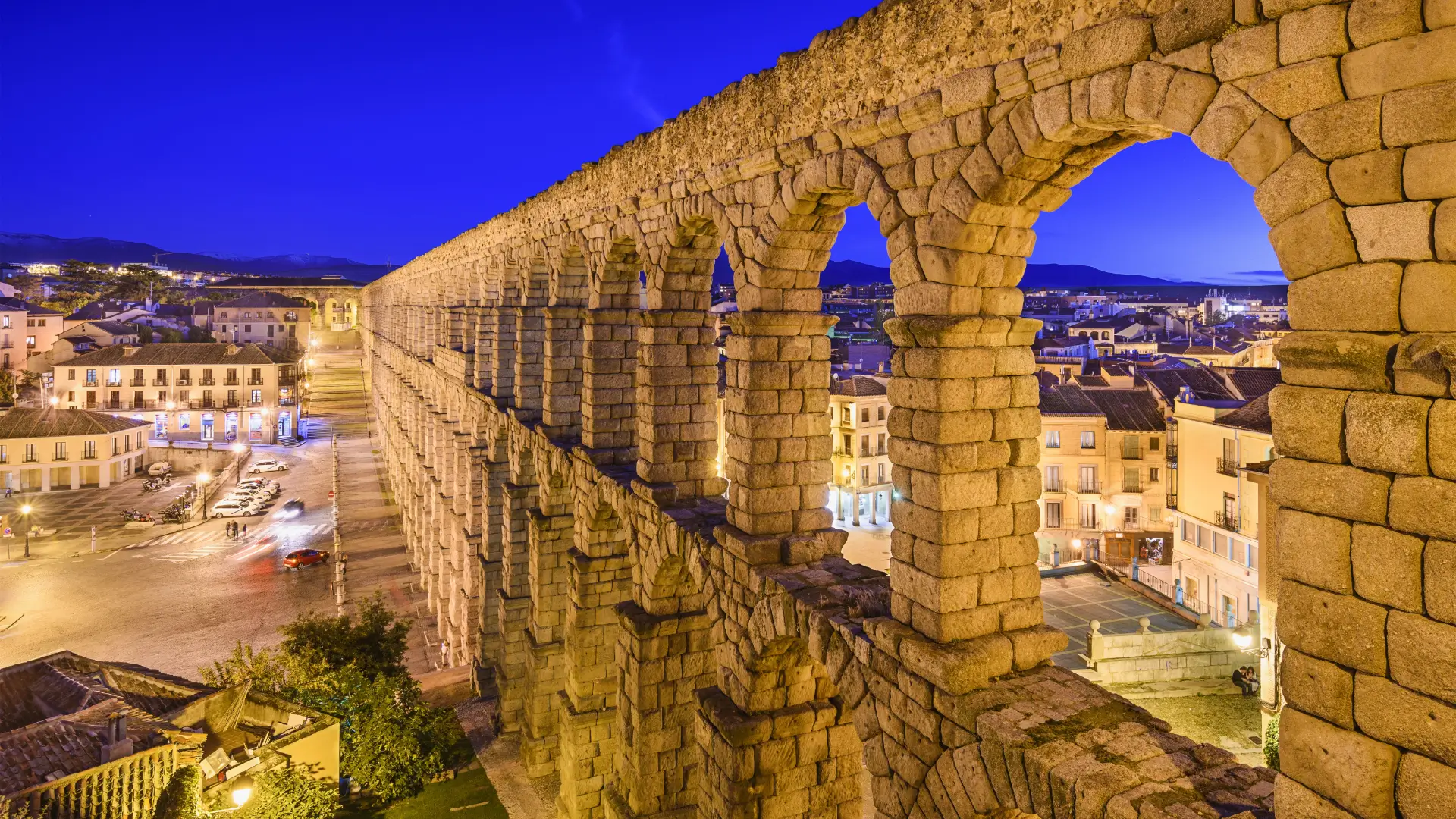
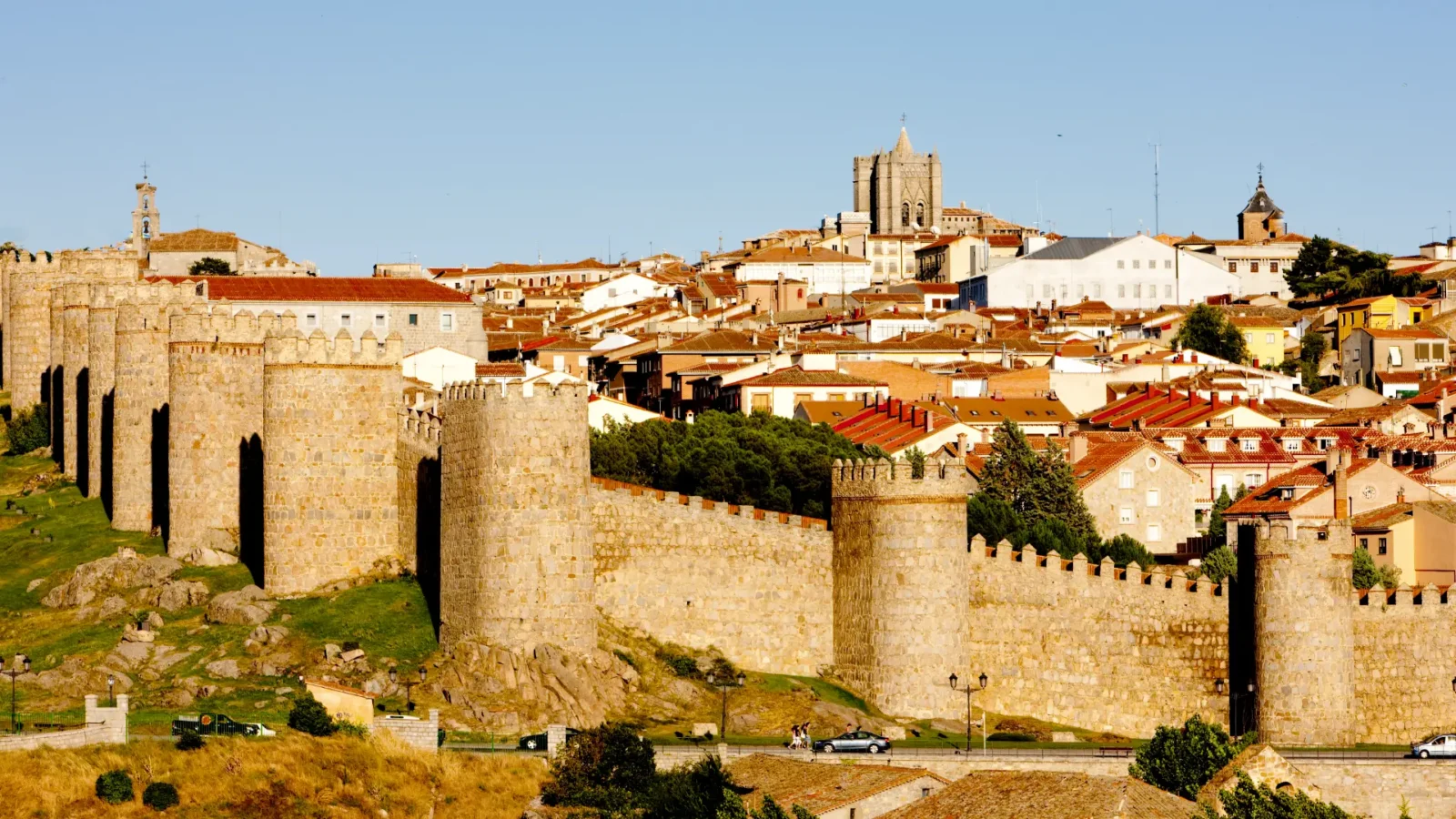
The three cities share a look but not a character, and driving them in order tells a story. Segovia is the show-stopper. A Roman aqueduct marches across the old town on stone arches, and a ship-shaped castle sits out on the cliff edge. Ávila is the fortress. Its medieval wall runs unbroken for 2.5 km around the old town, with 88 towers, and you climb up and walk along the top. Salamanca is the warm one. It is a golden-sandstone university city, and in the evening the stone turns honey-coloured while students fill the squares. Between them come the quiet layers: a walled village entered through one gate, and a royal garden with fountains in the hills. Those detours are what separate this drive from any generic “UNESCO cities” list.
How it's paced, and who it's for
This is a relaxed plan, not a checklist sprint. The drives are short, about an hour between cities, so no day is spent behind the wheel. The point is time on foot in each old town when it is quiet. The trip is the drive from Segovia to Salamanca, and it reads the same whether you fly into Madrid and hire a car or bike, or drive down from home in your own. It suits anyone who would rather have one good evening in three cities than rush all three before dinner. If you would rather settle in one base and day-trip out, that is a different kind of trip; our Castilla y León region guide covers the single-base option.
Getting there and around
The trip begins in Segovia, on the far side of the Sierra de Guadarrama from Madrid. There are two ways to reach the start: fly into Madrid and pick up a car or bike, or drive down from home and start straight in Segovia. Segovia has no airport of its own, which is part of why it stays as calm as it does once the day-trippers leave.
If you’re flying in
- Madrid (Adolfo Suárez–Barajas, MAD) This is the gateway for almost everyone: about ~105 km from Segovia, roughly 1 hr 15 by car. It is the biggest airport in Spain, with the widest choice of international flights, and the natural place to pick up a hire car or bike. There is also a fast train — the high-speed AVE/Avant from Madrid Chamartín reaches Segovia-Guiomar in under 30 minutes — but Guiomar station sits a few kilometres outside the walls, and you need a vehicle for the rest of the trip anyway, so most drivers simply collect one at the airport and go.
- Valladolid (VLL)This is a small regional airport to the north (~130 km, ~1 hr 25), worth a look only if a convenient flight lands there; Salamanca’s own airport is too limited to rely on.
Flying adds an arrival day at the start and a departure day at the end, on top of the three driving days.
If your flight lands late.If your flight lands in the evening, it is worth spending the first night near Madrid airport and starting fresh in the morning, rather than driving an unfamiliar road over the Guadarrama in the dark — and check your hire desk’s opening hours, as not all run late off-season. See our Practical Info page for driving-in-Spain details.
Self-drive — car or motorbikeHire at your arrival airport and keep the vehicle until you fly home — it is how you reach all three cities, and the quiet detours off Segovia, at your own pace. Most travellers hire a car; these are short, easy, scenic roads that also suit a touring motorbike.
If you’re arriving in your own car or motorbikeMany travellers drive down from home — the Netherlands, Belgium, France, United Kingdom, Germany — or roll straight off the end of another trip in Spain. You don’t need the flights or the hire vehicle: the trip simply begins in Segovia, and you skip the fly-in detail above.
See the drive to the startOpen in Google Maps. Set your starting point in the “from” field — your home if you’re driving down, or your arrival airport if you’re flying in — then send it to your phone or car if you want it ready for the road.
The Itinerary
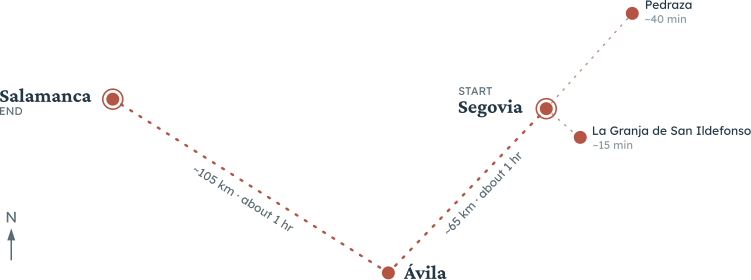
The trip runs west in a straight, relaxed line — Segovia, then Ávila, then Salamanca — sleeping in a new city each night. The drives are short, about an hour each, so there is no need to rush; the point is to have time in each old town when it is quiet. Here is the whole route at a glance.
Core trip or the detour version?
The three cities take three nights: one each in Segovia, Ávila and Salamanca. There are also two quiet detours off Segovia worth a day of their own — the royal gardens at La Granja and the walled village of Pedraza. To fit them in, give them their own day and a second night in Segovia before you move on. That makes it a four-night trip; the optional day is Day 2 below. Keep it if you have the time, or skip straight from Day 1 to Ávila if you don’t. A second night in the same city doesn’t change the rhythm — the base still moves Segovia, then Ávila, then Salamanca.
Day 1 — Segovia
Getting inIf you’re flying in, Madrid airport to Segovia is about ~105 km, roughly 1 hr 15. Arriving in your own car, or from an earlier stop, you just reach Segovia when you do.
The shape of the dayA slow one, on foot. Let the coach tours have the aqueduct at midday; you take it in the late afternoon and stay for the evening, when the lanes empty and the stone goes gold.
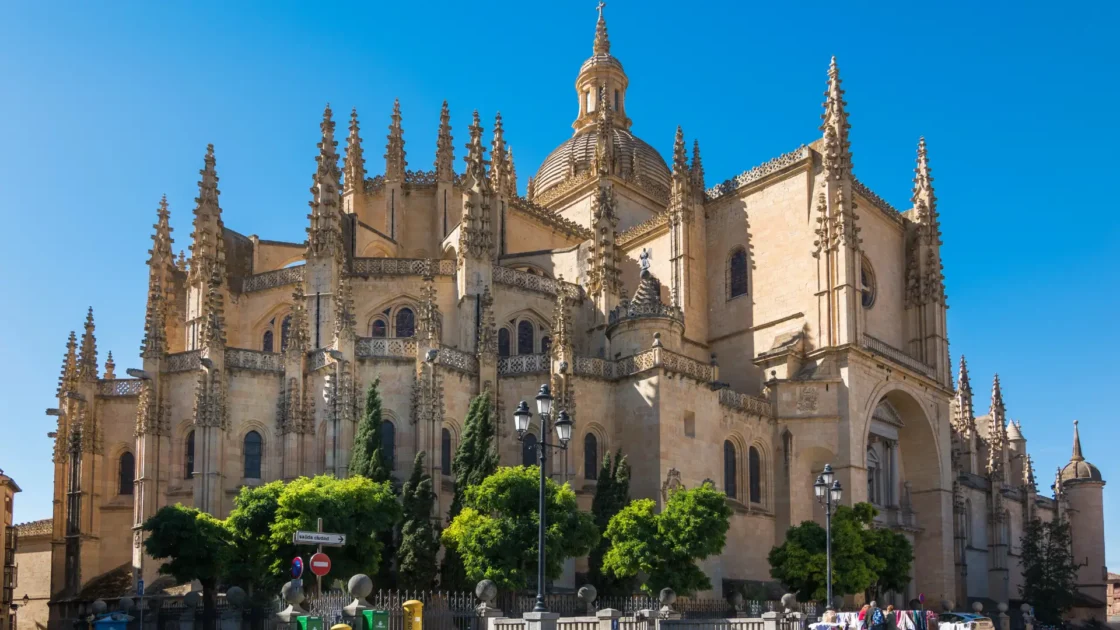
The day is about one long, unhurried loop of the old town on foot, best saved for the afternoon and evening once the Madrid coach parties have left. Start under the Roman aqueduct: 800 metres of double stone arches, built without mortar, still standing where the Romans left it — you walk right beneath it and look straight up through the gaps. Allow a slow hour to take it in and climb the stairs beside it for the view along the top. From there it is a ten-minute walk up through the old town to the Gothic cathedral on the Plaza Mayor, and on to the Alcázar at the far tip, the castle on the cliff that helped inspire the Disney logo — allow another hour or two for the walk out and the ramparts. The streets quiet down noticeably in the evening; that is when Segovia is at its best.
Want a different pace?Pick at most one; it’s still one day and your base is unchanged. Add something: climb the tower of the Alcázar for the long view over the plain, or the stairs beside the aqueduct at the Postigo. Slow it down: skip the walk out to the Alcázar and spend the late afternoon over a long lunch and a wander, saving your legs for the evening streets.
Where to eatThis is the home of cochinillo asado, the wood-roasted suckling pig carved at the table with the edge of a plate. The other local plate is judiones, the big white beans. Try the cochinillo where a local room does it properly.
- Lunch tipAsador David Guijarro (€€ · Asador · Segovia). A few steps off the tourist drag and down a short flight of stairs, full of locals on a set menu that runs to cochinillo, judiones and partridge; open daily.
- Dinner tipEl Horno de Segovia (€€€ · Asador · Segovia). A smart wood-fired asador where the cochinillo is carved at the table; reviewers who dread tourist traps single it out as the opposite, open daily.
Where you sleep tonightTonight you sleep in Segovia, in or beside the old town — your base for one night, or two if you take the detour day. See where we’d stay.
Day 2 · optional — Segovia detours: La Granja and Pedraza
The driveShort hops out and back from Segovia — no change of base. Second night in Segovia.
The shape of the dayTwo short drives and a lot of standing still. A morning in a hillside garden, an afternoon behind village walls, and no packing up — you sleep in the same Segovia bed tonight.
This is the day that sets the trip apart from a straight run between the famous cities. Both detours are quiet, close and easy from Segovia, and together they fill a comfortable day. La Granja de San Ildefonso is about 15 minutes away — a royal palace with formal, Versailles-style gardens laid out across the hillside. In the gardens, a chain of baroque fountains runs downhill on the pull of gravity alone, with no pumps; allow a relaxed morning for the palace rooms and a walk through the parterres. Pedraza is about 40 minutes north — a walled medieval village you enter through a single stone gate, with a clifftop castle and a colonnaded main square where cars are kept out. It is one of the quietest stops on the whole trip; stay into the late afternoon, when the day is at its stillest.
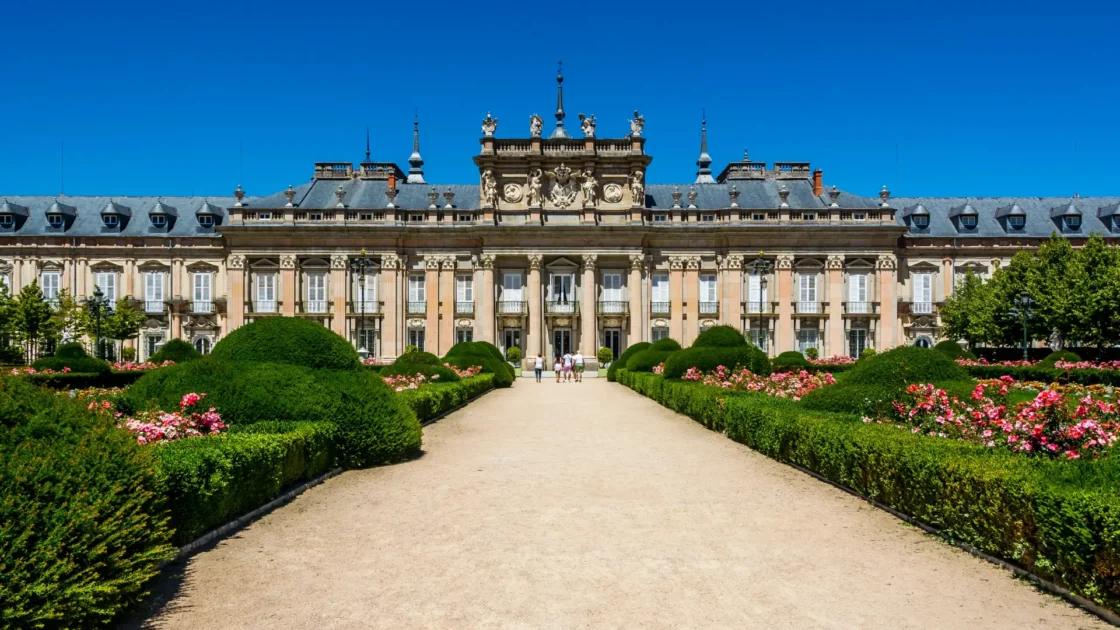
Want a different pace?Pick at most one; it’s still one day. Do just one detour: La Granja pairs naturally with a slow morning, Pedraza with a long afternoon — you don’t need both. Add something to do: time your visit for one of La Granja’s summer fountain displays, when a set of the fountains is switched on in sequence on set dates (a recurring summer fixture — check the palace’s official calendar for the days).
Where to eatThis is roast-meat country. In Pedraza it’s lechazo, the milk-fed lamb slow-cooked in wood ovens; at La Granja it’s judiones, the fat butter beans. Try the lamb where it’s cooked to order, and order it when you book.
- Lunch tipLa Taberna del Pelón (€€ · Traditional · La Granja). A cosy spot near the Plaza de España doing fresh, made-from-scratch cooking, an easy stop between the gardens and the glass factory.
- Dinner tipEl Jardín (€€€ · Castilian · Pedraza). A long-standing favourite for the full Castilian roast, the lechazo and cochinillo done well with generous judiones; book ahead.
Where you sleep tonightTonight you sleep in Segovia again — the second night that makes the detour day work. See where we’d stay.
Day 3 — Ávila
(Day 2 on the core trip, if you skipped the optional detour day.)
The driveFrom Segovia, ~65 km, about 1 hr west. To the next stop, Salamanca, is ~105 km, about 1 hr — an easy run for the following morning.
The shape of the dayAn hour’s drive, then up onto the wall. Half a day is enough to circle the ramparts and the small old town inside; save the evening for the walls lit up against the cold night air.
Ávila is the fortress of the three, and it comes down to one thing you do rather than just look at: you climb onto the medieval wall and walk it. The circuit runs 2.5 km all the way round the old town, with 88 towers, and long stretches of the rampart walk are open to climb — you look down into the streets on one side and out to the brown plain on the other. Allow a relaxed half-day for the wall walk and the old town inside it, including the fortress-cathedral built into the ramparts and the streets tied to St Teresa, who was born here. Ávila is high — at about 1,130 m it is the highest provincial capital in Spain — so the evening turns cold even in summer, and the floodlit walls after dark are the classic Ávila sight.
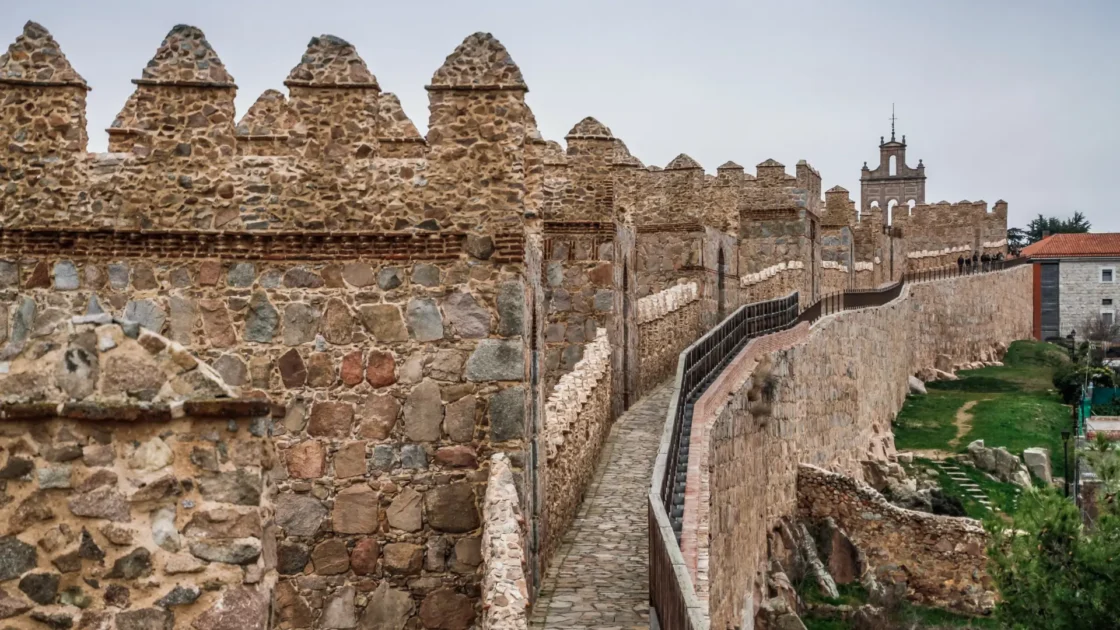
Want a different pace?Pick at most one; it’s still one day. Add something: walk out to the Cuatro Postes viewpoint just outside town for the postcard view of the whole floodlit wall at dusk. Slow it down: do a shorter section of the rampart rather than the full circuit, and spend the saved time over a long lunch and the quiet lanes inside.
Where to eatThe dish here is the chuletón de Ávila, a big bone-in beef chop grilled over coals and brought out to share. Try it with patatas revolconas — mashed potato with pimentón and crisp pork — a classic Ávila plate.
- Lunch tipLos Candiles (€€€ · Asador · Ávila). The town’s standout for the chuletón; closed Monday (and dinner only Fri–Sat), so this is a lunch pick — check ahead.
- Dinner tipRestaurante Siglodoce (€€ · Castellano · Ávila). Set against the old wall by the cathedral, doing the traditional Ávila plates: the local bean soup, the revolconas, and chuletón to share. Reliable and central, open daily.
Where you sleep tonightTonight you sleep in Ávila, inside the walls. See where we’d stay.
Day 4 — Salamanca
(Day 3 on the core trip, if you skipped the optional detour day.)
The driveFrom Ávila, ~105 km, about 1 hr west to Salamanca, the end of the trip.
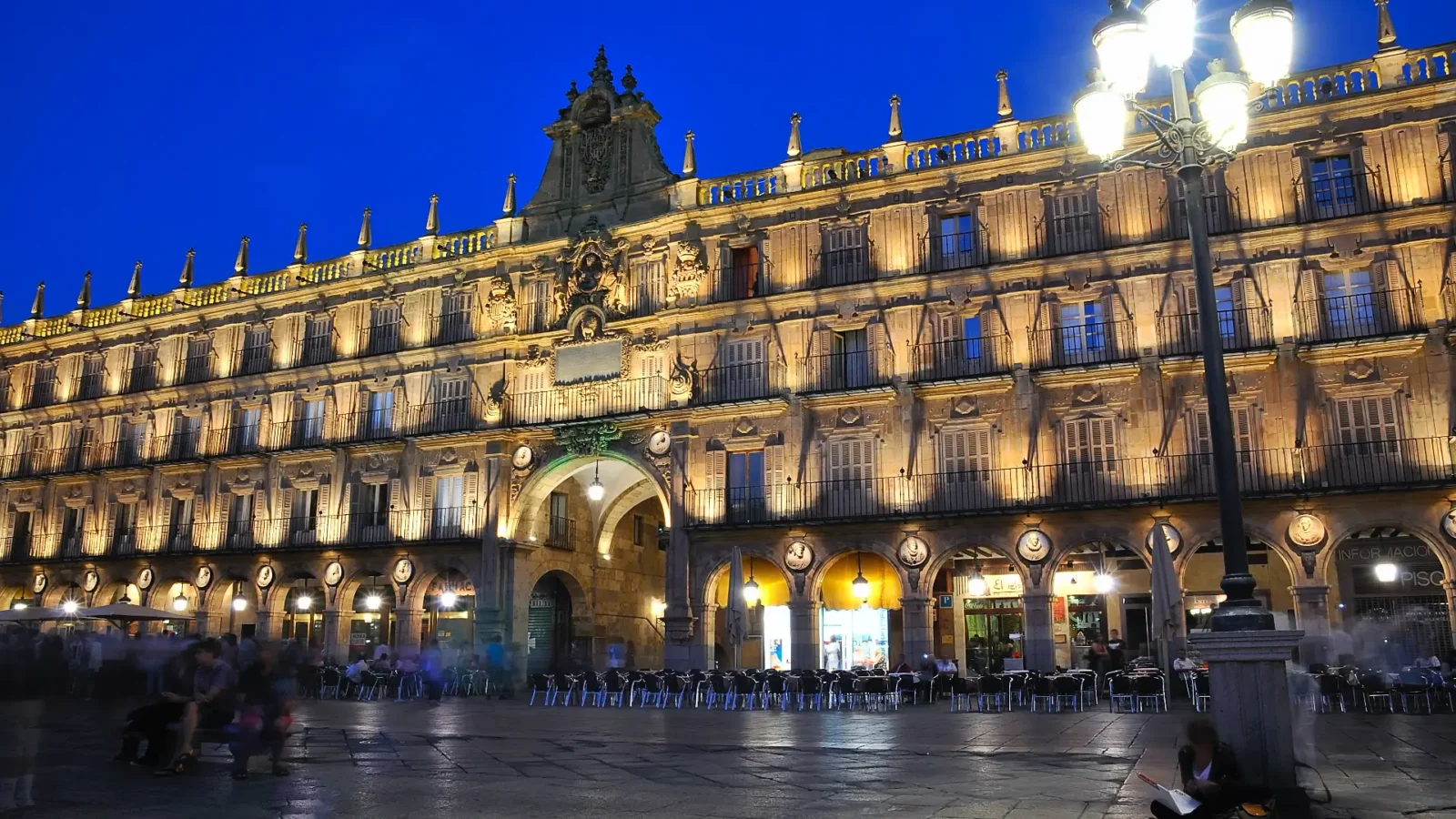
The shape of the dayThe fullest of the three, and the one to end on. Walk the old town by day, then let the evening take over — this is a student city, and the Plaza Mayor is where it spends its nights.
Salamanca is the warm finish, and the one city here that fills a full day. The golden-sandstone old town is made for walking on foot. Start in the Plaza Mayor, a baroque square ringed by arcades that is the living room of the city, then walk to the university, one of the oldest in Europe — the game is to find the small carved frog hidden in the swirl of stone on its façade before anyone tells you where it is. From there it is a short walk to the two cathedrals, old and new, built side by side. Save the evening: Salamanca is a student city, and after dark the squares fill and the sandstone glows under the lights.
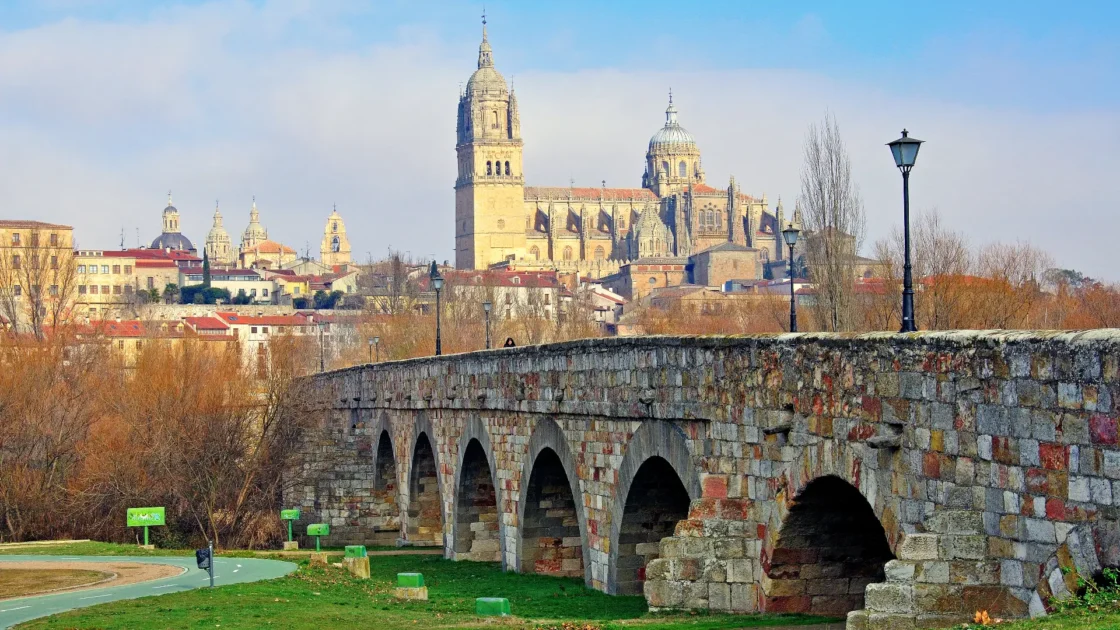
Want a different pace?Pick at most one; it’s still one day. Add something: climb the Ieronimus towers of the old cathedral for a rooftop walk above the old town, or cross the Roman bridge over the Tormes for the classic view back at the two cathedrals. Slow it down: skip the towers and take the evening slowly in the Plaza Mayor, which is the thing to do here anyway.
Where to eatSalamanca runs on tapas, and locals graze the bars behind the Plaza Mayor rather than the tourist menus on the square. Try the hornazo — a dense meat pie of pork loin, chorizo and egg — and a glass of Sierra de Salamanca red.
- Lunch tipCuzco Bodega (€€ · Tapas / bodega · Salamanca). A small local tapas bar with regional plates rather than the standard tourist tapas; closed Sunday (if you’re here on a Sunday, check more options on the Salamanca page).
- Dinner tipBambú Tapas y Brasas (€€ · Tapas and grill · Salamanca). A much-loved local spot doing tapas and grilled meats. Good honest value. Closed Monday and Tuesday, so on those nights try La Fresa (€€ · Tapas · Salamanca). A busy local staple on the Calle Van Dyck tapas street that’s open then.
Where you sleep tonightTonight you sleep in Salamanca, in the heart of the old town. See where we’d stay.
Practical Info
- Driving and roadsEasy throughout. The links between the cities are dual carriageway or good A-roads, with faster toll autopistas (the AP-6 and AP-51) as optional shortcuts near Ávila — the parallel free roads (N-110, A-50) are fine and only a little slower. No mountain passes on the route itself. Each leg is about an hour, so the daily driving load is light.
- Parking and the old townsAll three cities have walled or pedestrianised historic centres, so the rule is the same everywhere — leave the vehicle in a car park outside the walls and walk in. In Ávila, look for parking near the Exhibition Hall and the lower streets; in Segovia and Salamanca, use the signed car parks just outside the old core.
- Low-emission zones (ZBE)Less of an issue here than on the coast, and worth stating plainly because it keeps changing. Segovia’s and Ávila’s low-emission zones were both annulled by the regional court and are not in force — no restriction, no fines. Salamanca has a zone, but there is no environmental-label restriction before 2029; its pedestrian core is camera-controlled, so the only thing to avoid is driving into the pedestrian streets themselves — which the “park outside, walk in” rule already handles. (ZBE rules shift; check locally if you’re driving an older, unlabelled vehicle.)
- Driving an electric car?Easy on this trip. All three cities have chargers, including fast ones, and the legs are short (about an hour each), so range is never a worry — Salamanca is on Iberdrola’s high-power corridor, and the Parador de Ávila even has chargers in its garage. The wider back-roads of inner Castilla y León are thinner for rapid chargers, but this trip stays on the main roads. Top up overnight or while you sightsee, and use a live charging-map app to check the next stop; rates vary by operator.
- FuelNo long empty stretches — you are never far from a service station on these legs, and all three cities have fuel on their approaches.
- Altitude and seasonThis is high country. Ávila sits at about 1,130 m, Segovia and Salamanca not far below, so nights are cool even in summer and winters are genuinely cold, with snow likely. Spring and autumn are the sweet spot; if you drive it in winter, pack for the cold and check conditions over the Guadarrama.
- What to packOne thing worth knowing: this is high, cool country. Even in summer the evenings turn cold, especially in Ávila, so bring a layer for walking the walls after dark. In winter, pack properly for the cold and check road conditions over the Guadarrama before you set off. Comfortable shoes for cobbled old towns, and you’re set.
Where we’d Stay
Your three nights, in order — one strong pick per night, mostly €€, chosen so you can just book and go. Flying in? We’ve also added an optional airport-side stay for the arrival night before Day 1 — outside the three trip nights. For the full range across every budget in each town, see that town’s own guide, linked from its day in the itinerary above.
Meliá Madrid Barajas
Beside Adolfo Suárez Madrid-Barajas (MAD). If you land late or fly out early, skip the drive into the city and stay by the airport instead. This comfortable 4-star sits right next to the terminals. It runs a free shuttle to T1, T2 and T4 through the small hours, so a late arrival or a dawn departure is easy. Pick up the hire car fresh the next morning, or drop it and walk to check-in the night before.
Check prices & availability for Meliá Madrid Barajas on the accommodation's websiteHotel Don Felipe
In the old Jewish quarter, with a garden and a sun terrace looking straight at the Alcázar. Comfortable, well-run and walkable to every sight, it’s a dependable mid-range choice with its own parking.
Check prices & availability for Hotel Don Felipe on the accommodation's websiteParador de Ávila
Sleep in a 16th-century palace set right against the inside of the wall, with a garden looking onto the ramparts and an access point to the wall walk almost at the door. The classic Ávila stay: historic, calm and central, with the state-run Parador’s reliable comfort.
Check prices & availability for Parador de Ávila on the accommodation's websiteHotel Catalonia Plaza Mayor
A comfortable, well-run hotel a short step from the Plaza Mayor, in a converted historic building with a good breakfast. A solid mid-range choice that keeps you right in the heart of the old town without the top-tier price.
Check prices & availability for Hotel Catalonia Plaza Mayor on the accommodation's website
For the full range of places to stay in each town — every budget — see the individual town guides linked through the itinerary above.
Frequently Asked Questions
Three nights covers this Castilla y León road trip at an unhurried pace: one each in Segovia, Ávila and Salamanca, with time in each old town in the quiet early morning and evening. There are also two detours off Segovia — the gardens at La Granja and the walled village of Pedraza — and to fit them in you add a fourth night, staying a second night in Segovia. So it’s three nights for the three cities, four if you want the detours too. You can race all three cities in a single day from Madrid, but you would only see them at their busiest.
For this Castilla y León trip, Madrid (MAD) is the airport to use — about 1 hr 15 by car from Segovia, the closest big gateway and the one with by far the most flights. Valladolid is a small regional alternative to the north; Salamanca’s own airport is too limited to rely on. Remember to allow an extra day at each end if you fly.
Yes — this Castilla y León trip is self-drive, and a car or a touring motorbike is what makes it work. Trains and buses do link the three cities, but a vehicle lets you reach the quiet detours off Segovia, leave the old towns on your own schedule, and catch each city in its calm hours. Hire at your arrival airport and keep it the whole trip.
The driving on this Castilla y León route is easy: the legs are short, about an hour each, on dual carriageways and good A-roads with no mountain passes. Faster toll autopistas run alongside near Ávila if you want them, but the free roads are fine. The only real driving note is parking: leave the vehicle outside the walls in each city and walk into the old town.
The best time for this trip is late spring (May–June) or early autumn (September–October): warm days, cool evenings and thinner crowds. Summer is hot and busier, though the high altitude keeps the nights pleasant. Winter is cold and often snowy, especially in Ávila at 1,130 m; it is doable, but pack for it and check conditions over the Guadarrama.
No — three days suits this Segovia, Ávila and Salamanca trip well, because the cities sit about an hour apart and each day is built around one relaxed old town on foot rather than long drives. If you’d rather linger, add the optional fourth day for the La Granja and Pedraza detours, staying a second night in Segovia.
Yes — many travellers drive this Castilla y León trip in their own car or motorbike, down from northern Europe or on from elsewhere in Spain, and simply start in Segovia without the flights or hire car. You can also extend it: from Salamanca it links north onto our Cathedral Cities trip (León, Burgos and Zamora) or south-west onto the Extremadura Medieval Trail through Cáceres — see Where to next.
All three historic centres are walled and largely pedestrianised, so on this trip you park outside and walk in regardless. Segovia’s and Ávila’s low-emission zones were annulled by the courts and are not in force; Salamanca has a zone but no environmental-label restriction before 2029, with only its pedestrian core camera-controlled. A normal hire car is not affected — just don’t drive into the pedestrian streets.
Where to Next
Salamanca is the end of the line, but not a dead end — and how you close depends on when you fly home.
- Flying homeThis makes it a round trip. Salamanca to Madrid airport is about ~215 km, roughly 2 hr 45 on the A-50 and A-6, or a high-speed train in about 1 hr 35 if you drop the car in Salamanca. Plan the last day around your flight time: a slow Salamanca morning still leaves plenty of time for an afternoon or evening departure.
- Early flightIf you leave in the morning, don’t save the whole drive for the departure day. Either break it with a night on the way back near the airport, or — the cleaner option — spend the last night by Madrid-Barajas instead of in Salamanca, so you’re minutes from the terminal at dawn. Same number of nights either way; it just swaps the last base.
- See the drive onwardThis starts from Salamanca. Set your destination in the “to” field — your fly-out airport, your next trip’s first stop, or home — and send it to your phone if you want to navigate it. Open in Google Maps
- Keep goingTwo of our trips join straight onto this one:
- North to the Cathedral CitiesFrom Salamanca it is about 55 minutes to Zamora, the last stop of our The Cathedral Cities trip (León, Burgos, Astorga and Zamora). Run it in reverse from Zamora and you have chained the two Castilla y León trips into one longer drive.
- South-west into ExtremaduraSalamanca sits at the top of the A-66, the free Ruta de la Plata autovía, which runs down to Cáceres in about ~205 km, roughly 2 hr — the head of our Extremadura Medieval Trail (Cáceres, Trujillo, Mérida and Guadalupe).
Essential Reading
Regions this trip crosses
Places on this route that have a full guide
Related routes
- Castilla y León & Extremadura Road Trip: 9 Days
- Extremadura Medieval Trail
- The Cathedral Cities
This trip is also part of a longer drive. If you have more time, our Castilla y León & Extremadura Road Trip: 9 Days threads Cáceres and Mérida into a nine-day trip across two regions — do the whole thing, or pick the connecting trips.