
The Cathedral Cities: Northern Castilla y León Road Trip
Four days from Burgos to Zamora through the great cathedral cities of northern Castilla y León — Gothic glass, Romanesque stone and the Camino, a new city and a quiet morning every day.
- StartBurgos
- EndZamora
- Duration4 driving days, 4 nights (one night each in Burgos, León, Astorga and Zamora)
- Total distanceAbout 365 km between stops
- NightsBurgos ×1 · León ×1 · Astorga ×1 · Zamora ×1
- Best forCar or motorbike
- DifficultyEasy — motorway and good main roads throughout, no mountain passes
- Best seasonMay–June and September–October
- PaceRelaxed
- Flying in?Madrid (MAD), round trip. If you fly, allow an extra arrival and departure day on top of the four driving days above (so roughly six days off work). Arriving overland in your own car or bike? Ignore this line — the trip just begins in Burgos.
Why this Route?
Four cities in northern Castilla y León hold some of the finest cathedrals in Spain, and hardly anyone outside the country strings them together. Burgos and León have two of the greatest Gothic churches in Europe. Astorga has a cathedral and, right beside it, a fairy-tale palace by Gaudí. Zamora, quietest of all, holds the densest cluster of Romanesque churches on the continent. They sit within a couple of hours of each other on good, empty roads, and this trip gives each one a night. So you get the thing a day-tripper never does: the cathedral in the early morning, and the old town in the evening, once the coaches have gone.
Cathedrals without the crowds
The famous cathedral cities of southern Spain fill with coach tours. These four don’t. Burgos and León draw visitors, but they are working provincial cities first, so the crowds thin the moment you step off the main square. Astorga and Zamora see very few foreign travellers at all. You can stand alone in front of a Romanesque doorway that would have a rope line almost anywhere else. The trip also has room for a stop the big-name loops skip: the tenth-century Mozarabic monastery of San Miguel de Escalada. Its horseshoe arches, straight out of Córdoba, stand alone in the fields east of León.
How it's paced, and who it's for
This is the drive from Burgos to Zamora, and it reads the same whether you flew into Madrid and hired a car or drove down from home in your own. It moves forward every day, a new city each night, never doubling back. But the days are short, rarely more than an hour and three-quarters on the road. There is always time to arrive, settle, and be at the cathedral door when it opens. It suits travellers who like history, old streets and good regional food. It’s for people who would rather have one city to themselves each evening than tick off the whole region in a week. If you want the south of Castilla y León too — Segovia, Ávila, Salamanca — that is the longer whole-region loop instead. This trip is the north, at a slow pace.
Getting there and around
The trip begins in Burgos, in the north-east of Castilla y León. There are two ways to reach it: fly into Madrid and hire a car or bike, or drive down from home and start straight in Burgos.
If you’re flying in
- Madrid (Adolfo Suárez–Barajas, MAD) Spain’s biggest, with by far the widest choice of international flights. Madrid to Burgos is about 245 km, roughly 2 hours 25 minutes north on the toll-free A-1. There is also a direct high-speed train from Madrid to Burgos (about 1 hour 45 minutes) if you’d rather pick the car up in Burgos itself.
- Valladolid (VLL)This is a small regional airport, about 1 hour 20 minutes away. Worth a look only if a convenient flight lands there.
- Bilbao (BIO)About 1 hour 50 minutes north over the hills — worth a look if a convenient flight exists, or if you’re coming from northern Europe.
Be honest with your calendar: flying adds an arrival day at the start and a departure day at the end, on top of the four driving days.
If your flight lands lateIf you arrive in Madrid in the evening, don’t drive straight out. It’s fine — often wiser — to sleep near the airport that first night and start fresh in the morning, especially as the light fades early in winter. This is an extra night on top of the four, not one of them. Check your vehicle-hire desk’s opening hours before you book a late flight: many run to around midnight, and some offer 24-hour or key-box pickup, but not all. If the desk would be closed when you land, an airport hotel plus a morning pickup is the clean fallback. See our Practical Info page for driving-in-Spain details.
Self-drive — car or motorbikeHowever you reach Burgos, this is a self-drive trip from there. If you’re hiring, pick up at the airport and keep the vehicle until you fly home. Most travellers take a car; the roads, distances and pace suit a touring motorbike just as well, so if you ride, this trip works on two wheels.
If you’re arriving in your own car or motorbikePlenty of travellers drive down — from the Netherlands, Belgium, France, England, Germany — or already have a place in Spain, or roll off the end of another trip. If that’s you, skip the airport and hire-car detail: the trip simply begins in Burgos, whenever you arrive. Use the open-departure link below to plot the drive from wherever you actually set off.
See the drive to the startOpen in Google Maps. This shows the route to Burgos. Set your starting point in the “from” field — your home if you’re driving down, or your arrival airport if you’re flying in — then send it to your phone or car if you want it ready for the road.
The Itinerary
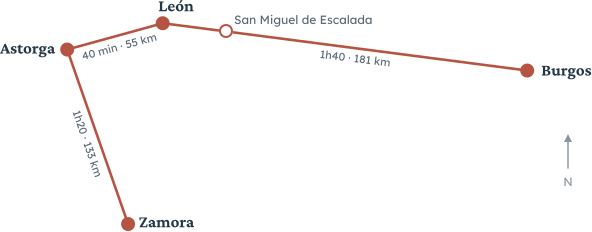
One line north and west, then south. Up to Burgos and its great Gothic cathedral, along the old Camino road to León and Astorga, then down the Vía de la Plata to quiet Zamora on the Duero. Four short driving days, a new city each night. The plan below is the backbone, not the full list: each day links to that city’s own guide, so head there for every sight, restaurant and guided tour once you know which day is yours. Here’s the whole trip at a glance.
Day 1 — Burgos
Getting inIf you’re flying in, Madrid airport to Burgos is about 245 km, roughly 2 hours 25 minutes on the toll-free A-1 — land in the morning and you can be under the cathedral spires by mid-afternoon. Arriving in your own car, or from an earlier stop, you just reach Burgos when you do.
The shape of the dayArrive, settle in, and give the afternoon and evening to one of Spain’s great Gothic cities — the cathedral while the light is low, the river and the tapas streets after.
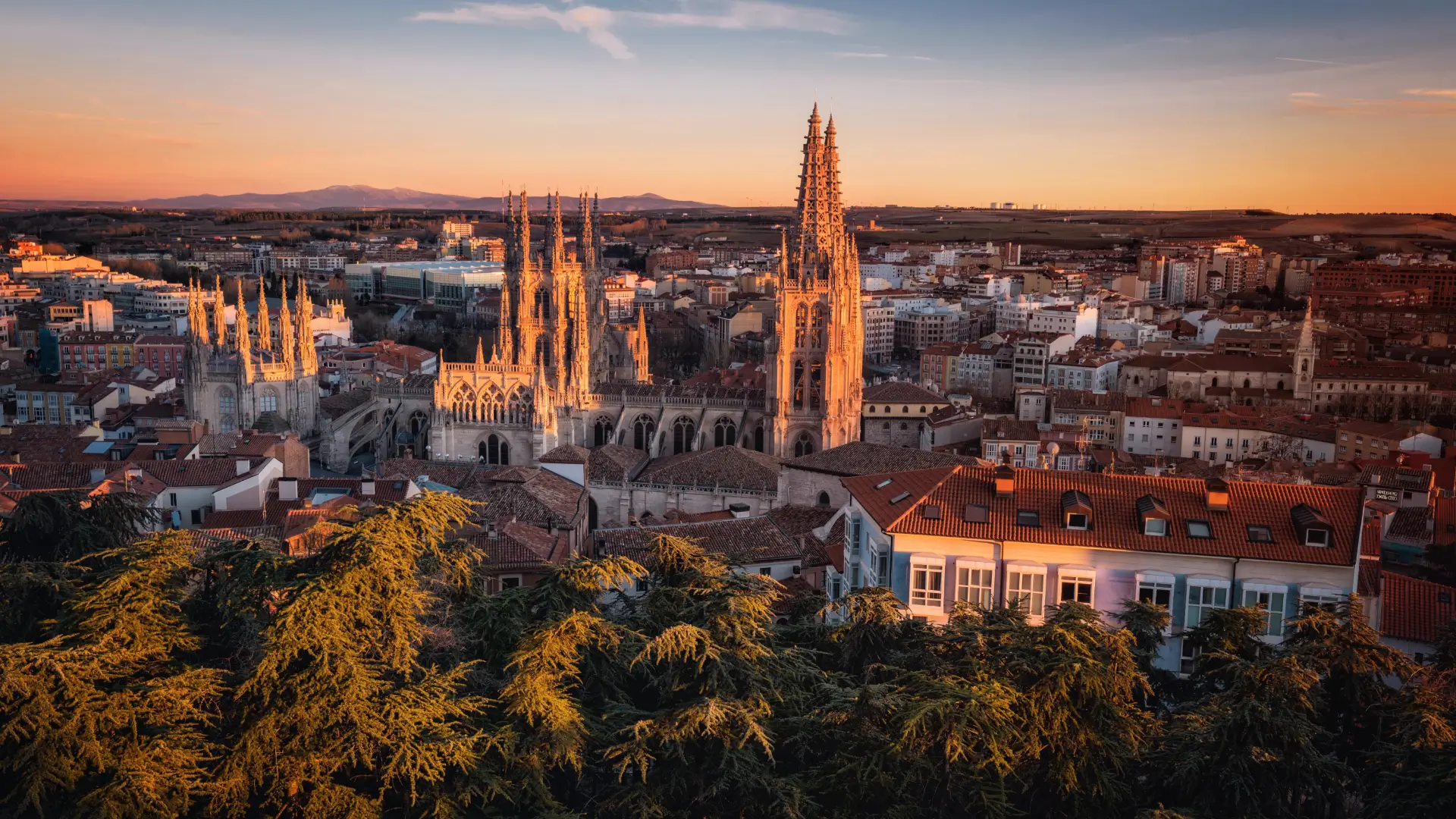
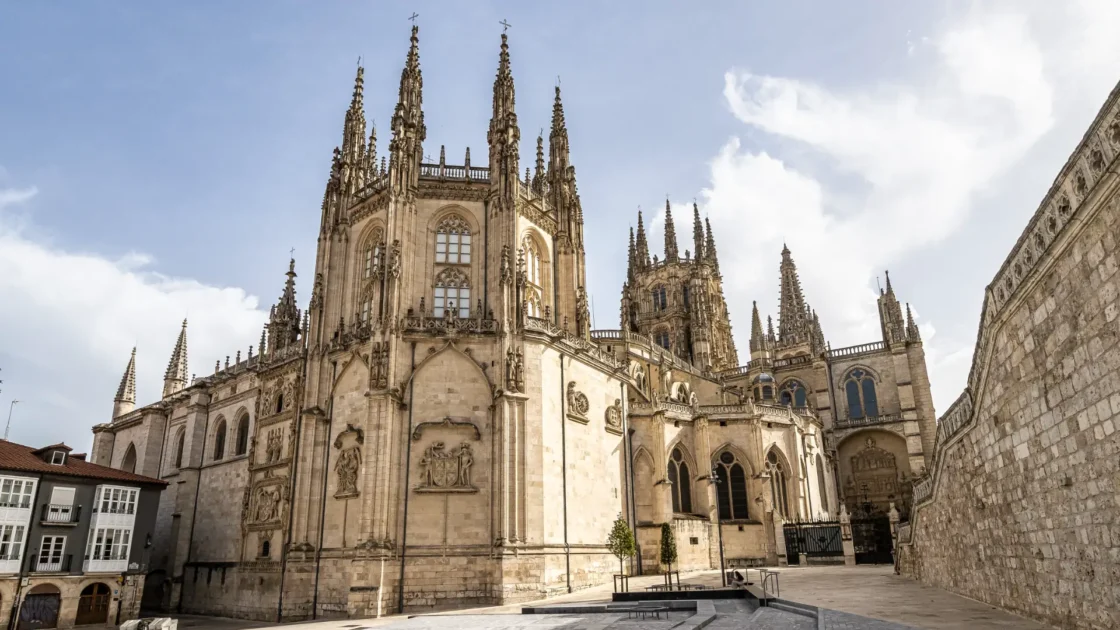
Start at Burgos Cathedral, a UNESCO World Heritage Site in its own right and one of the purest Gothic churches in Spain. Look up for the lace-like openwork spires, the star-vaulted dome over the tomb of El Cid, and the gilded Escalera Dorada. Allow a relaxed couple of hours; it’s quietest soon after it opens, so if you can, save the inside for first thing tomorrow and spend this evening outside. Walk the tree-lined Paseo del Espolón as the light softens, pass under the fortified Arco de Santa María, and climb (or drive part-way) to the castle mirador for the view over the rooftops. As dusk falls, the streets around Calle San Lorenzo fill with locals doing the rounds of the tapas bars. This is a serious food city, and the evening paseo is the best of it.
Want a different pace?Pick at most one; it’s still one day and your base is unchanged. Add something small: the Museum of Human Evolution, on the riverbank, holds the original fossils from the nearby Atapuerca digs — including Miguelón, one of the most complete early-human skulls ever found (closed Mondays, free Wednesdays; an easy hour or two). Slow it down: skip the castle climb and take the riverside path to the Cartuja de Miraflores, a free, near-empty monastery with some of the finest late-Gothic sculpture in Europe.
Where to eatBurgos is lamb-and-blood-sausage country: morcilla de Burgos (the local rice blood sausage), fresh queso de Burgos, and lechazo — milk-fed lamb roasted slowly in a wood oven.
- Lunch tip (if you arrive in time)Casa Pancho (€€ · Tapas bar · Burgos). A much-loved San Lorenzo institution for a morcilla pincho and a glass of wine at the bar, with a small dining room upstairs — local, not a coach stop. Open most days; check ahead.
- Dinner tipCasa Ojeda (€€€ · Traditional Castilian · Burgos). A Burgos institution for wood-oven lechazo, grand and old-school; the downstairs bar does a quicker bite. Closed Sunday evening — if that’s tonight, Restaurante Don Nuño (€€ · Traditional Castilian · Burgos) is a reliable, good-value alternative for morcilla and lamb.
Where you sleep tonightTonight you sleep in Burgos, in the old town near the cathedral — your base for one night. See where we’d stay.
Day 2 — León
The driveBurgos to León, about 181 km / 1 hour 45 minutes on the free A-231, the “Autovía del Camino de Santiago” that runs beside the pilgrim path across the plain — Camino waymarks and walkers the whole way. With the San Miguel de Escalada detour below, allow closer to 2 hours 30 in total for the day’s driving.
The shape of the dayA gentle Camino drive broken by a Mozarabic monastery in the fields, then an afternoon and evening in León — Gothic glass by day, free tapas by night.
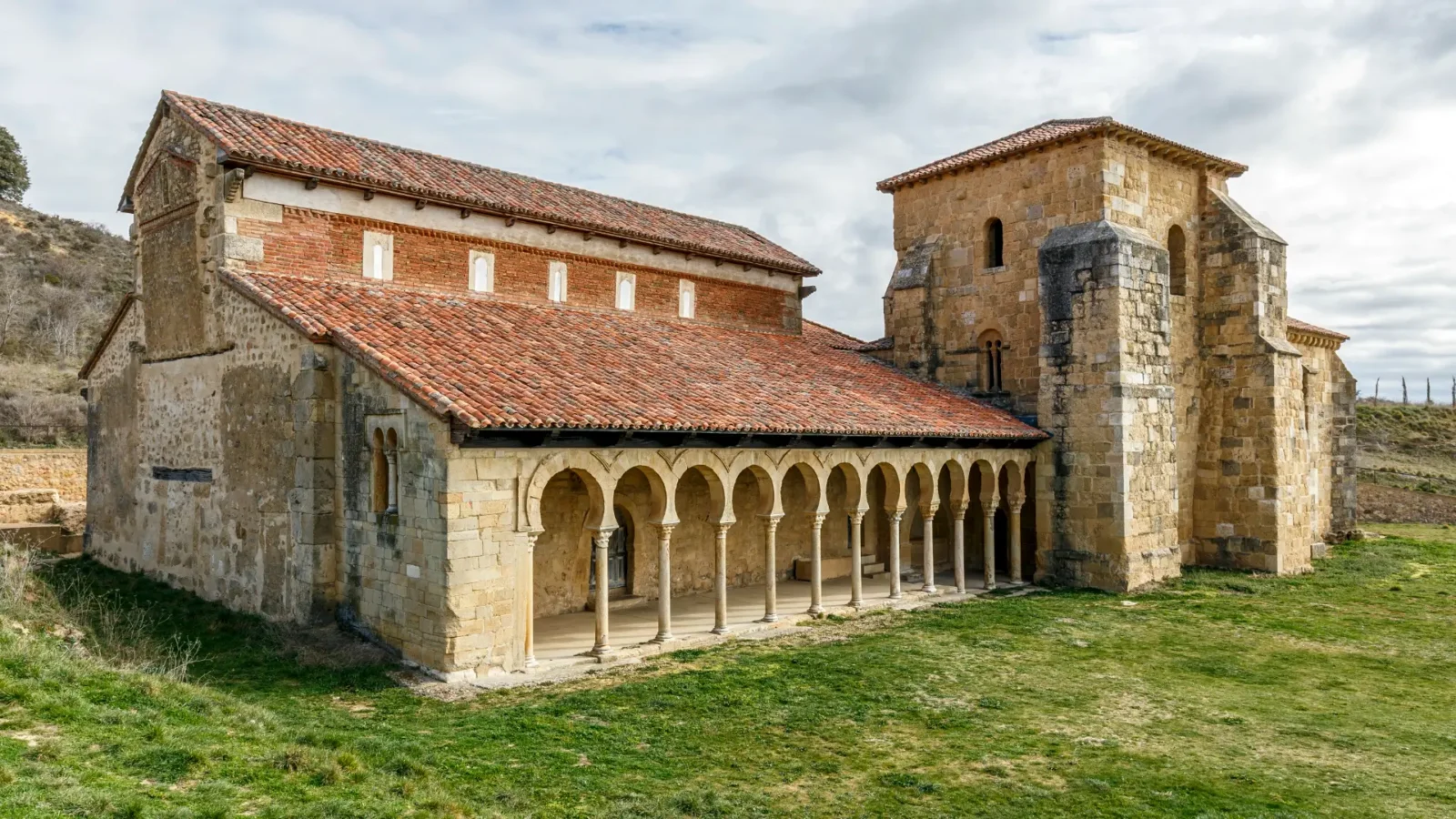
Just before León, turn off toward Gradefes for San Miguel de Escalada, about 30 km east of the city and a short way off the road near Mansilla de las Mulas. This is the stop the big loops miss: a tenth-century Mozarabic monastery church, one of the best-preserved of its kind in Europe. Monks who had fled Córdoba built it in a single year, in 913. Its glory is the portico — twelve horseshoe arches on slim columns, so purely Andalusian that for a moment you forget you’re in the green north. It’s quiet, free-ish (a couple of euros), and rarely holds more than a handful of visitors. Allow 45 minutes. (Closed Mondays, in winter also closed on Tuesday and Wednesday. Hours shift with the season).
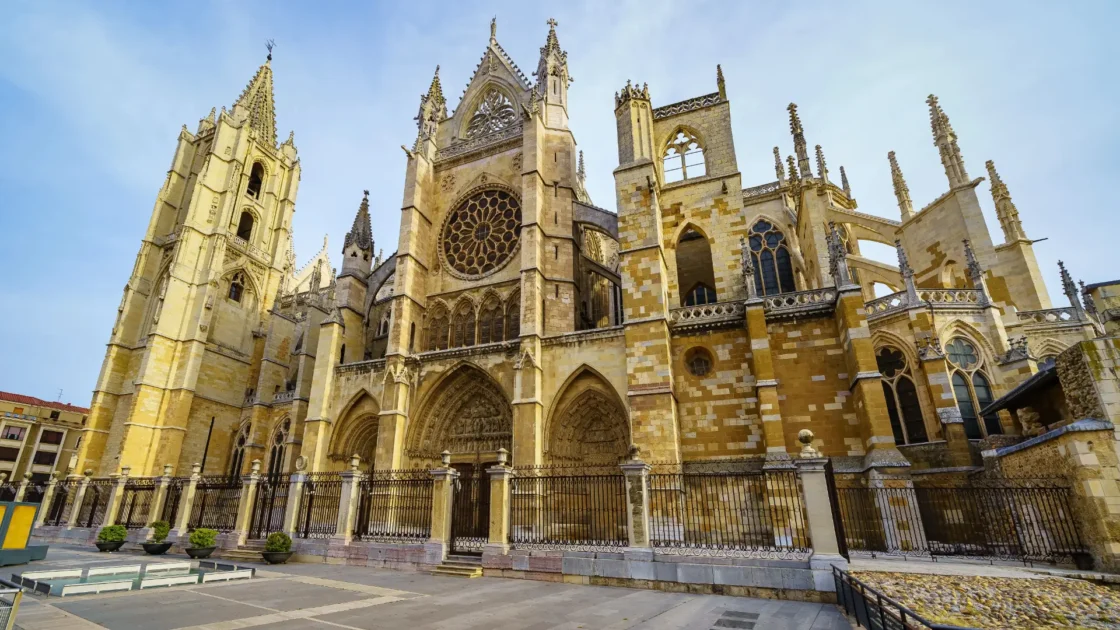
Then drive on into León. Its Gothic cathedral is the reason to come. Its walls are made more of stained glass than stone, around 1,800 square metres of it, so on a bright day the whole interior floods with colour. Allow a relaxed hour or two, best in the low afternoon light. A short walk away is the Basilica of San Isidoro. Its painted royal tombs, in the Panteón Real, are so vivid they’re called the “Sistine Chapel of the Romanesque.” Gaudí’s castle-like Casa Botines stands nearby on Plaza de San Marcelo. In the evening, the Barrio Húmedo — the old tapas quarter — comes alive with León’s own custom: a free small plate with every glass.
Want a different pace?Pick at most one. Skip the detour: if you’d rather not stop at San Miguel de Escalada — or you’re driving on a Monday, when it’s closed — take the A-231 straight to León and give the extra time to the cathedral and a long lunch. Do, don’t just look: trade the second museum for the Barrio Húmedo tapas crawl, moving bar to bar for the free-tapa custom rather than sitting down — the most local evening in the city.
Where to eatLeón’s own flavours are cecina — cured, air-dried beef — and morcilla de León, best grazed bar to bar with a glass of Bierzo red.
- Lunch tipEzequiel Calle Ancha (€€ · Cured meats and tapas · León). A long-standing León name for a stand-up plate of cecina and jamón at a buzzy bar — the local ritual, done properly. Open most days; check ahead.
- Dinner tipBodega Regia (€€ · Traditional Leonese · León). A classic old-town house strong on regional cooking — slow-roast lamb, garlic soup, local wines, carved and served with a little ceremony. A reliable sit-down dinner; check the weekly closing day. (Or skip a formal dinner and do the Barrio Húmedo free-tapa crawl instead)
Where you sleep tonightTonight you sleep in León, in the historic centre near the cathedral and the Barrio Húmedo — your base for one night. See where we’d stay.
Day 3 — Astorga
The driveLeón to Astorga, about 50 km / 45 minutes west — the AP-71 is a short toll motorway, or take the free N-120 that runs alongside it. A short hop, so there’s no rush to leave León in the morning.
The shape of the dayA slow start in León, a short drive west, then a small town with two big surprises side by side — and its own famous feast for lunch.
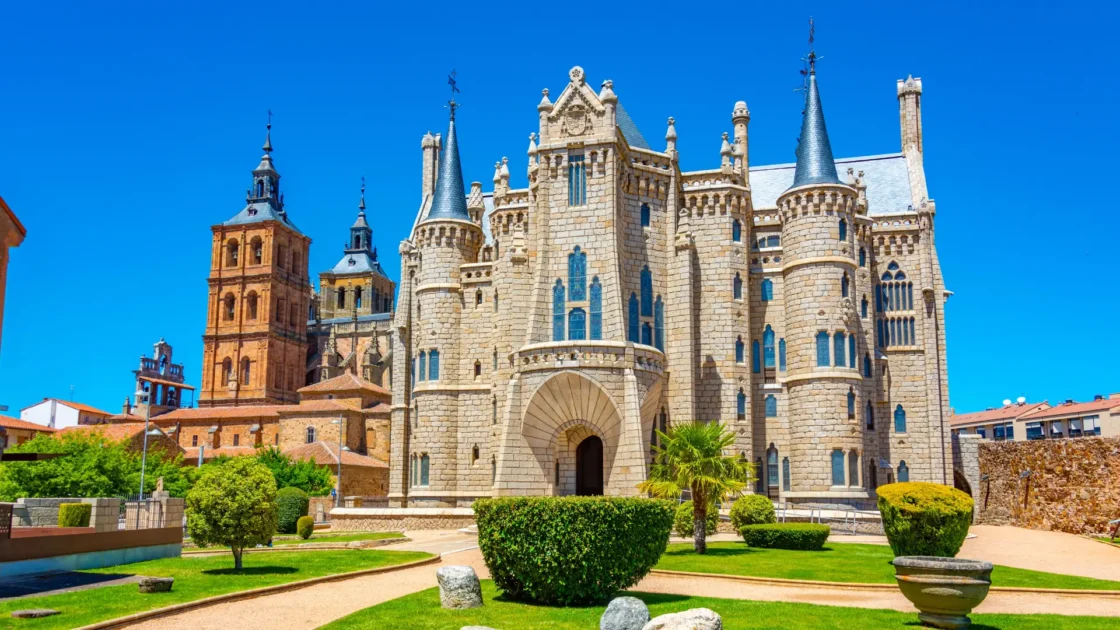
Astorga is small, and that’s the point — a gentle contrast with the two big cathedral cities. Its two headline sights face each other on one square: the Palacio de Gaudí, a pale, turreted bishop’s palace and one of only three Gaudí buildings outside Catalonia (inside is the Museo de los Caminos, which lets you walk the whole building), and beside it the late-Gothic cathedral, its front piled up in Baroque stone. But Astorga is far older than either — it was the Roman city of Asturica Augusta, and you can still walk its walls and, on the guided Ruta Romana, go down into the baths, the forum and a stretch of the Roman sewers. On the Plaza Mayor, the Baroque town-hall clock has two figures in Maragato dress who strike the hour with mallets, as they have since 1748. See the highlights in an afternoon, then have the lamplit streets almost to yourself once the day-trippers leave — which is exactly why it’s worth the night.
Want a different pace?Pick at most one; it’s still one day. Add something small: the Chocolate Museum tells the story of the town’s long chocolate trade and ends at a tasting counter (closed Mondays). Slow it down: skip the museums and simply walk the Roman walls to the Mirador de la Vega, then sit out the evening on the Plaza Mayor.
Where to eatAstorga’s dish is cocido maragato, a huge feast eaten backwards: the meats first, then the chickpeas and cabbage, then the soup, then dessert. It’s a lunchtime meal — come hungry.
- Lunch tipLas Termas (€€ · Traditional · Astorga). A warm, family-run house much loved for its cocido maragato and its welcome, especially to walkers off the Camino; the set lunch is generous and unhurried. Closed Monday — on a Monday, Casa Maragata II (€€ · Traditional · Astorga) serves the same feast (that one is closed Wednesday and Thursday).
- Dinner tipAfter a full cocido lunch, keep the evening light Restaurante Serrano (€€€ · Modern Spanish · Astorga) cooks careful seasonal food, wild mushrooms in autumn, home-made desserts (closed Monday), or Hotel Restaurante La Peseta (€€ · Traditional · Astorga) is a steady century-old house off the Plaza Mayor. Buy a box of Astorga’s IGP mantecadas before the shops shut.
Where you sleep tonightTonight you sleep in Astorga, on or near the Plaza Eduardo de Castro facing the Gaudí palace — your base for one night. See where we’d stay.
Day 4 — Zamora
The driveAstorga to Zamora, about 133 km / 1 hour 20 minutes south on the N-630 / A-66 — the old Vía de la Plata, a different Camino from the one you followed to León, running north to south.
The shape of the dayA morning drive south to the quiet jewel of the trip, then a slow afternoon and evening among the most Romanesque churches of any city in Europe.
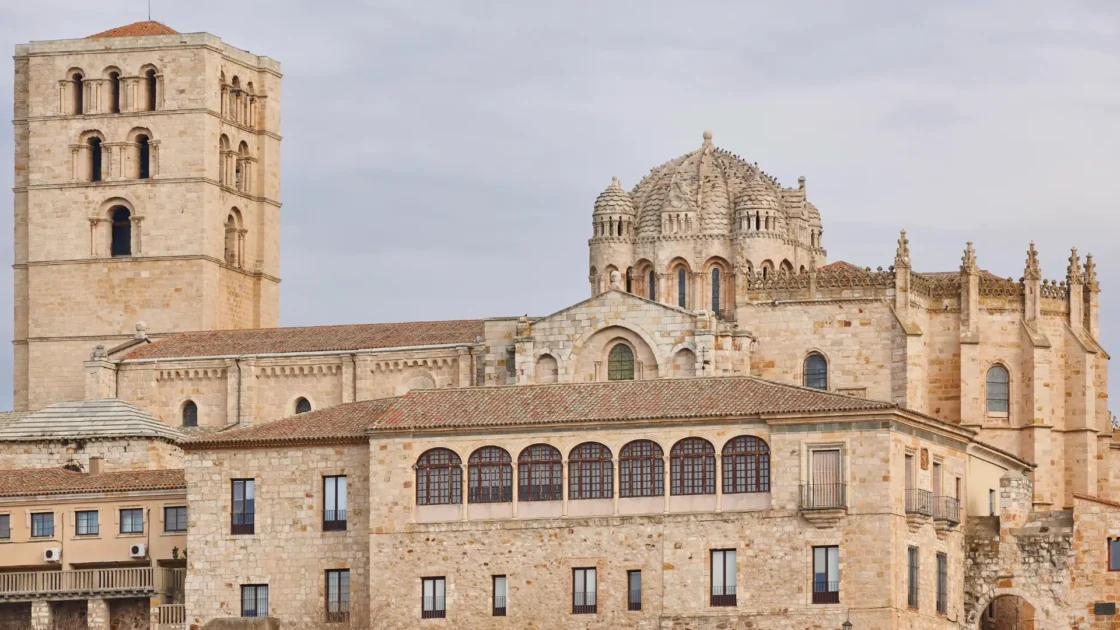
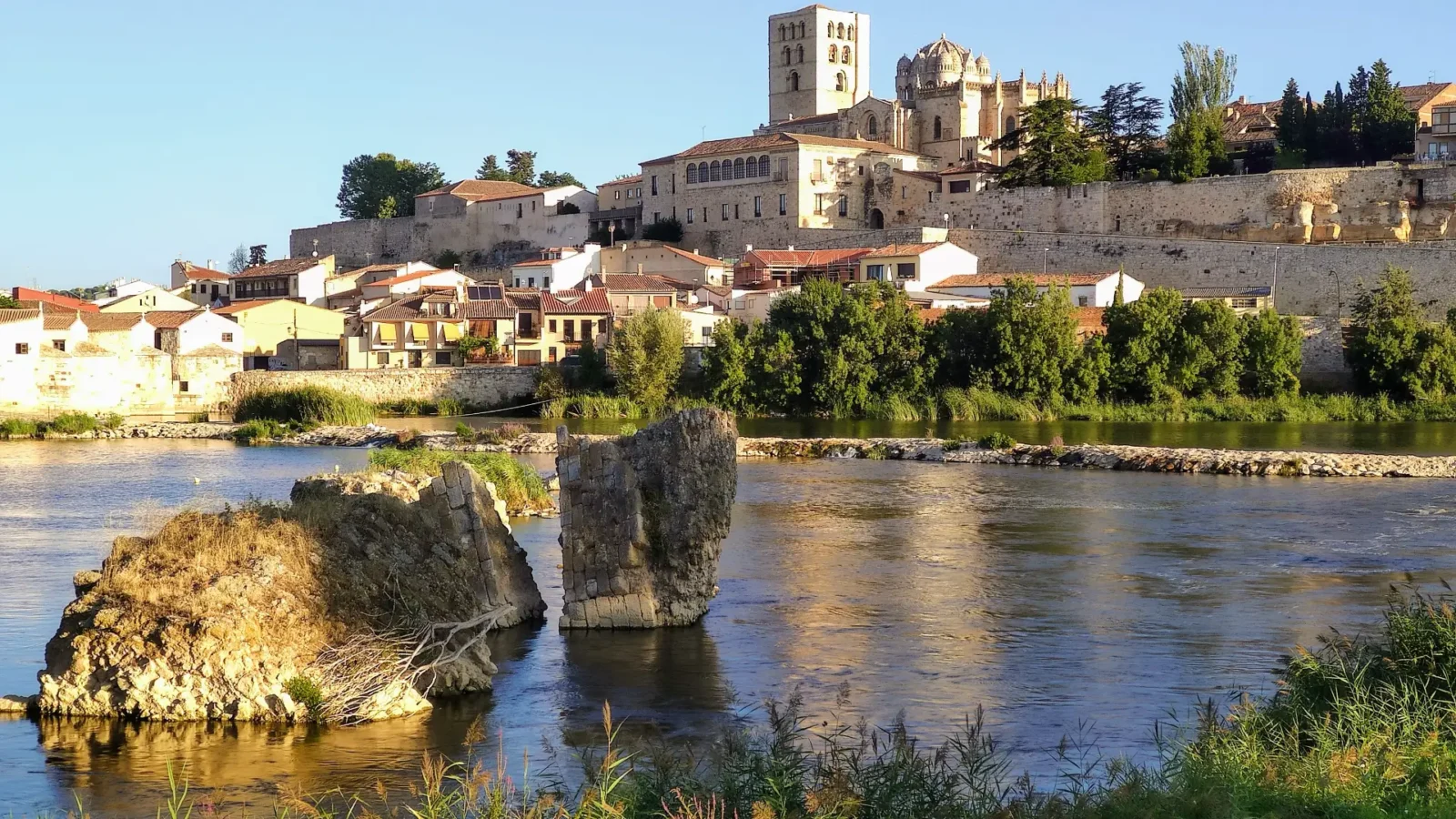
Zamora holds more Romanesque churches than any other city in Europe — more than twenty of honey-coloured stone, small and solid and often empty, scattered through a compact old town high above the River Duero. Follow the city’s self-guided Route of the Romanesque from San Juan de Puerta Nueva on the Plaza Mayor, with its “cartwheel” rose window, to the plain, perfect lines of Santiago del Burgo. Above them rises the cathedral, its scaled stone dome — Byzantine in feeling, built by local hands — unlike any other in Spain; its museum holds a world-class set of 15th-century Flemish tapestries. End the day on the water: walk down to the twelfth-century Puente de Piedra, or up to the Mirador del Troncoso beside the cathedral, for the view over the Duero and the old town at golden hour. Then wander the cobbled Calle Balborraz, one of the prettiest streets in Spain, as the lamps come on.
Want a different pace?Pick at most one; it’s still one day. Slow it down: skip the full church route and just walk the city walls, the old watermills (Aceñas de Olivares) and the stone bridge before a long lunch. Do, don’t just look: Zamora is the gateway to the DO Toro wine country just east — many bars in town pour Toro by the glass, so you can taste the local red without driving out.
Where to eatZamora eats hearty Castilian food built on Fuentesaúco chickpeas, Aliste beef and the bold reds of nearby DO Toro; the local dish is arroz a la zamorana, a rice baked in an earthenware dish.
- Lunch tipChillón (€ · Tapas bar · Zamora). A classic, busy bar full of locals, known for its tortilla with a spicy sauce, callos and good Toro reds by the glass — a cheap, honest lunch while you walk the churches. It is closed on Sunday — The alternative then is Los Caprichos de Meneses (€€ · Tapas / Traditional · Zamora).
- Dinner tipLasal (€€€ · Modern bistro · Zamora). A small open-kitchen bistro cooking fresh, seasonal local plates with a short, strong wine list — reserve a day or two ahead. For the local baked rice specifically, El Horno (€€ · Traditional · Zamora) by the Plaza Mayor does a good arroz a la zamorana.
Where you sleep tonightTonight you sleep in Zamora, near the old town and the river — your base for one night. See where we’d stay.
Practical Info
- Roads and tollsAn easy drive: motorway and good main roads throughout, no mountain passes. Most of it is toll-free — the A-1 (Madrid–Burgos), the A-231 (Burgos–León) and the N-630 (Astorga–Zamora) all cost nothing. The one short toll is the AP-71 between León and Astorga, and the free N-120 runs right alongside it.
- Low-emission zones (ZBE)León and Burgos have low-emission zones over their historic centres, but they barely affect a visitor: a modern hire car carries the accepted label, and the simplest approach in every town on this trip is to leave the car in a signed central or underground car park and walk into the old town — which you’d want to do anyway, as the cores are made for walking.
- Driving an electric car?It works well here with a little planning. All four overnight cities have fast chargers, and there’s a big ultra-rapid hub just outside Burgos on the A-1. The network across this quiet region is thinner than on the coast, though, so plan your charging stops rather than assuming a charger will appear — top up overnight or while you sightsee, and check a live app (your car’s map, or a tool like Electromaps) along each leg. A zero-emissions car also enters the León and Burgos low-emission zones freely and often parks cheaper.
- FuelFill up in or near the cities; the legs are short and petrol stations are frequent on all these roads, so running low is never a worry. On the quiet stretches — the Camino road to León, the run down to Zamora — top up before you leave town rather than counting on a station in the next village.
- Altitude and seasonThe whole region sits high — around 650–870 m — so the light is wonderful but winters are genuinely cold and summer afternoons hot. May–June and September–October are the sweet spot: warm days, cool evenings, long light on the stone. In winter, pack for real cold.
- Opening daysCathedrals here open daily, but smaller museums and monuments often close on Mondays (the Museum of Human Evolution, the Museo de Zamora, Astorga’s Chocolate and Roman museums, and San Miguel de Escalada all do). Plan any museum day around that. The two guided visits — the Atapuerca digs and Astorga’s Ruta Romana — aren’t sold on booking sites; you reserve them direct with the site or museum by phone or email, so sort those a few days ahead.
- Meal timesSpanish kitchens serve lunch from about 1:30 pm and dinner from 8 pm or later; many close in between. Plan a proper lunch by around 2 pm on driving days rather than counting on a hot meal at 5.
- What to packThis is high country, so bring layers even in summer. Evenings cool fast once the sun drops. A warm top makes the golden-hour walk along Zamora’s river or Burgos’s ramparts far better. Comfortable shoes for cobbled old towns, and in winter pack for real cold.
Where we’d Stay
Your four nights, in order — one strong pick per night, mostly €€, chosen so you can just book and go. For the full range across every budget in each city, follow the town’s own guide, linked from its day in the itinerary above. Flying in? We’ve also added an optional airport-side stay for before the trip and before you fly home — outside the four trip nights.
Meliá Madrid Barajas
Beside Adolfo Suárez Madrid-Barajas (MAD). If you land late or fly out early, skip the drive into the city and stay by the airport instead. This comfortable 4-star sits right next to the terminals. It runs a free shuttle to T1, T2 and T4 through the small hours, so a late arrival or a dawn departure is easy. Pick up the hire car fresh the next morning, or drop it and walk to check-in the night before.
Check prices & availability for Meliá Madrid Barajas on the accommodation's websiteCrisol Mesón del Cid
A classic hotel right opposite the cathedral, with some rooms looking straight onto the spires. Ask for a cathedral-view room and you can watch it light up from bed.
Check prices & availability for Crisol Mesón del Cid on the accommodation's websiteHotel Neru con Encanto
A modern, well-run small hotel on a quiet street in the historic centre, walkable to everything, with a calm, comfortable feel after a day on your feet.
Check prices & availability for Hotel Neru con Encanto on the accommodation's websiteHotel Gaudí
Right on the main square, facing the Gaudí palace and cathedral; some rooms look straight out at them. An older hotel, but the location is unbeatable and the Camino passes the door.
Check prices & availability for Hotel Gaudí on the accommodation's websiteHotel Alda Mercado de Zamora
A 19th-century Art Deco mansion on the Plaza del Mercado, opposite the central market and a few minutes’ walk from the Plaza Mayor. A grand marble entrance hall, on-site parking, and good value for a central mid-range stay.
Check prices & availability for Hotel Alda Mercado de Zamora on the accommodation's website
For the full range of places to stay in each town — every budget — see the individual town guides linked through the itinerary above.
Frequently Asked Questions
A northern Castilla y León road trip works well in four days: one night each in Burgos, León, Astorga and Zamora, so every cathedral city gets a proper evening and morning. If you fly in, add a travel day at each end. Want the south too — Segovia, Ávila, Salamanca? That’s the longer whole-region loop instead.
Fly into Madrid (MAD) for this northern Castilla y León road trip. Madrid-Barajas has by far the most international flights of any airport near the region, and it’s a straightforward 2-hour-25-minute drive north up the toll-free A-1 to Burgos, the first stop. Valladolid and Bilbao are closer but have far fewer flights.
Yes — you need a car (or a touring motorbike) for this Castilla y León trip. The cities sit far apart on an open plateau, with slow train links between them. A car lets you drive the quiet Camino roads at your own pace, and reach stops like San Miguel de Escalada that public transport makes awkward.
Driving in northern Castilla y León is easy. This trip uses motorways and good main roads the whole way, with no mountain passes, and no single leg is longer than about an hour and three-quarters. The one thing to watch is crosswind on the open plain between Burgos and León, where the land is very flat and exposed.
The best time is May–June or September–October, when the days are warm and the cities quieter. July and August are hot on the high plateau; winter is cold but often bright, and the cathedrals of León and Burgos look magnificent against a blue winter sky.
No — a four-day northern Castilla y León road trip is relaxed, not rushed, if you follow this plan. Drives are short, and you sleep in a different city each night rather than backtracking. Each day leaves time for the cathedral in the quiet early morning, and the old town in the evening.
Yes — this trip works just as well if you drive down in your own car or motorbike instead of flying in; you simply skip the hire car and begin in Burgos. To extend it, carry on south from Zamora into the walled cities of southern Castilla y León, or east from Burgos into La Rioja wine country — see “Where to next”.
Not quite. Burgos, León and Astorga sit on the Camino Francés, the main French Way to Santiago; Zamora sits on the Vía de la Plata, the Silver Route running north to south. The drive from Astorga down to Zamora follows that southern path.
Where to Next
You finish in Zamora, in the south-west of the region, with the vehicle and the whole of western Spain within reach.
- The drive back to Madrid (fly-out)Zamora to Madrid airport is about 250 km, roughly 2 hours 20 minutes on the A-11 and A-6 — an easy run, mostly motorway, so a midday or later flight is comfortable straight from Zamora. Ávila and Segovia sit right beside that road if you want one last stop.
- Flying home earlySpend the last night near Madrid airport instead of in Zamora — the same four nights, just a different final base, so the trip stays the same length (there’s an airport pick in Where we’d stay). If you’d rather not rush the last morning, or want a night on the way, Ávila breaks the drive nicely: Zamora to Ávila is about 1 hour 40 minutes, and Ávila to the airport only about 1 hour 20.
- See the drive onwardThis starts from Zamora. Set your destination in the “to” field — Madrid airport if you’re flying home, your next route’s first stop if you’re driving on, or home — and send it to your phone if you want to navigate it. Open in Google Maps
- Carry the trip onBecause you finish at Zamora with the car, this trip joins naturally onto more of Castilla y León:
- South into the walled citiesSalamanca — the start of The Three Walled Cities route (Salamanca, Ávila, Segovia) — is only about 55 minutes south of Zamora. It’s the natural next drive, and it takes in the southern half of the region this trip leaves out.
- East into La RiojaDrive the trip in reverse and, from Burgos, carry on east into Spain’s most famous wine country: Burgos to Logroño is about 1 hour 30 minutes on the A-12.
Essential Reading
Regions this trip crosses
Related routes
- Castilla y León Road Trip: One Week
- Castilla y León & Extremadura Road Trip: 9 Days
- The Three Walled Cities
Want the south of Castilla y León as well? Two longer trips take in these cities and more — do the whole thing, or pick the connecting trips.