
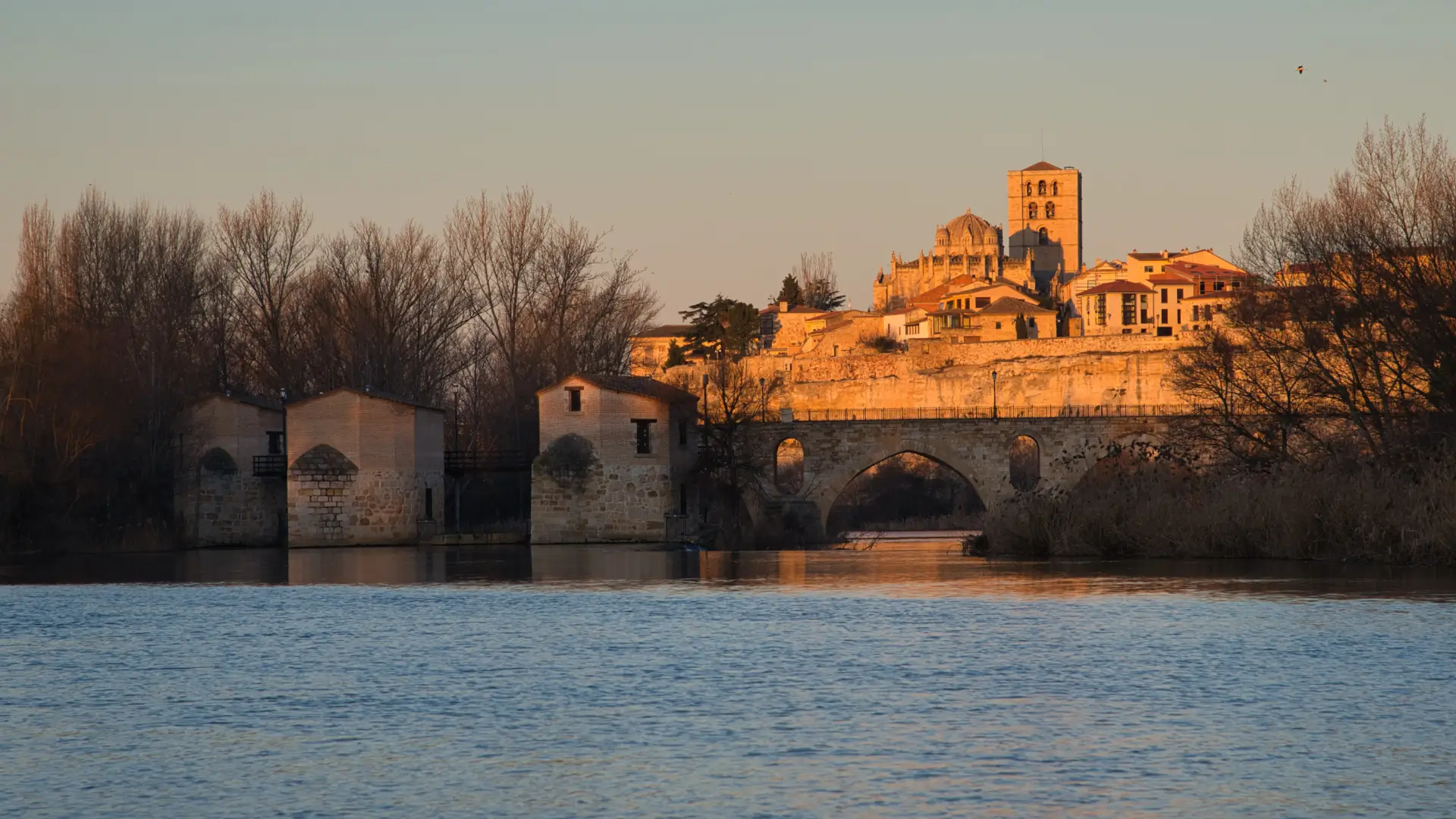
Zamora: A City of Romanesque Stone on the Duero
Zamora is a small, quiet city in north-west Castilla y León. It sits high above the River Duero on the old Vía de la Plata. It holds more Romanesque churches than any other city in Europe, crowned by a cathedral with a strange scaled dome. For most of the year almost no foreign visitors come. That is the point: this is a real, working city you can walk at your own pace.

Why Visit Zamora
Zamora is one of Spain’s best-kept secrets. It stays that way because few people outside the country have heard of it. Yet its old town holds one of the greatest concentrations of Romanesque architecture anywhere. Two dozen churches of warm golden stone stand within a short walk. Most were built in the 12th and 13th centuries. Above them rises the cathedral, with a scaled stone dome that looks like nothing else in Spain.
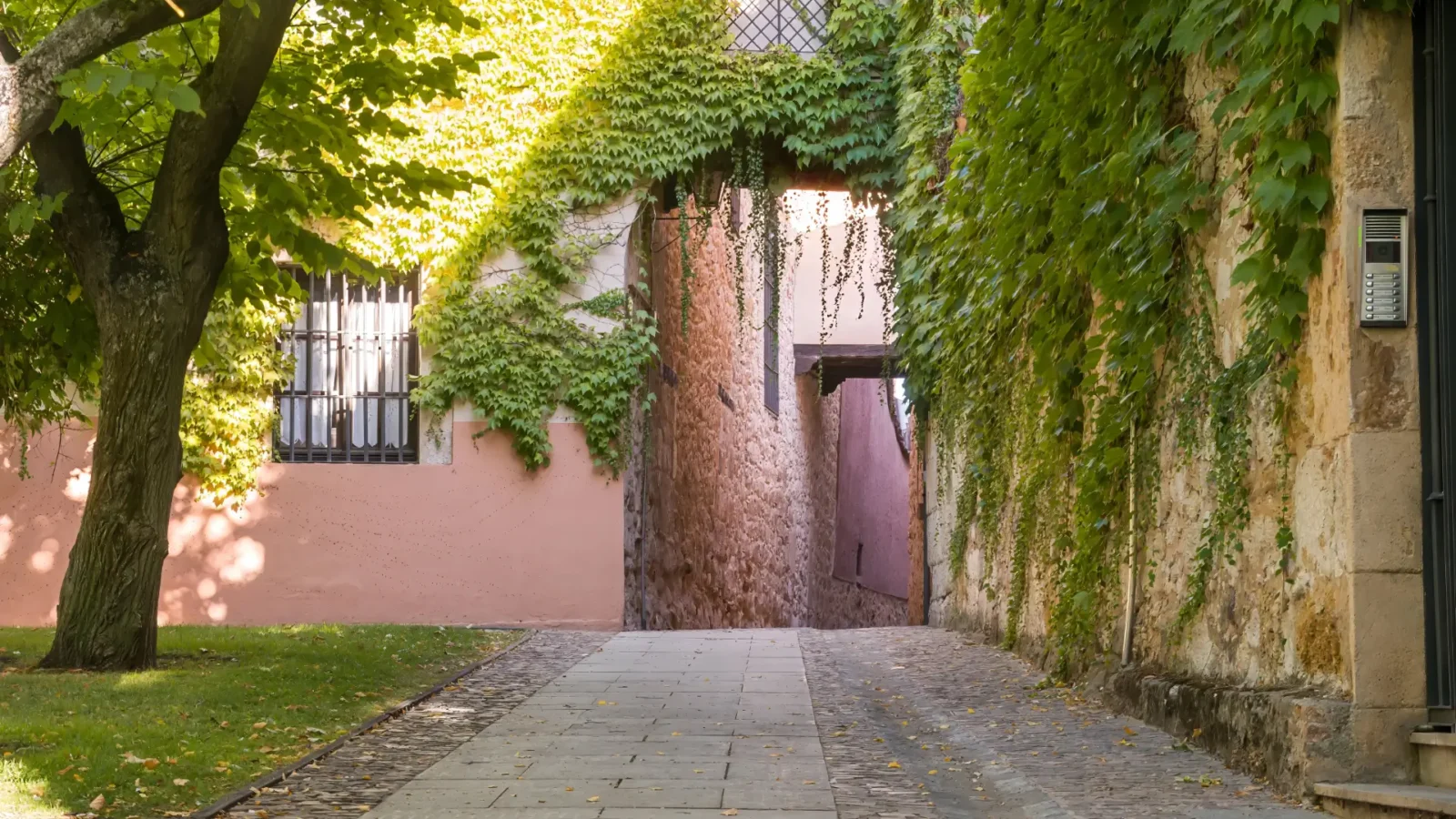
What makes Zamora special is how ordinary it feels. This is a small provincial capital of about 60,000 people, not a museum town. You can lean on the old stone bridge at dusk, walk the walls, and hear more Spanish than English. One of its finest streets, the cobbled Calle Balborraz, drops from the Plaza Mayor to the river past rows of colourful old façades. Spain's official tourism board rates it one of the twelve prettiest streets in the country, yet it stays quiet. The great sights are free or cheap to see, and rarely busy.
The city also has a place in one of Spain's oldest stories. In 1072 King Sancho II laid siege to Zamora, held by his sister Urraca, and the young warrior who fought at his side was Rodrigo Díaz de Vivar — El Cid. The siege dragged on for months, until the king was killed by a Zamoran noble who slipped back through a gate in the walls. You still walk past that gate today, and El Cid is said to have been knighted in the little church of Santiago de los Caballeros. It is that layer of real history, under the quiet, that gives Zamora its weight. your text here…
Day trip or overnight?
You can see the headline sights of Zamora in an afternoon. The cathedral, the bridge and a handful of churches sit close together, and a quick pass is easy. But that means leaving just as the city gets good. Our honest advice: stay the night. Zamora is at its best in the evening, when the day cools, the stone turns gold, and the streets empty of the few day-trippers who came. A perfect short visit looks like this: arrive by mid-afternoon and walk the Romanesque route while the light is soft; climb to the Mirador del Troncoso for the view over the Duero at golden hour; eat late in the Calle de los Herreros; then cross the Puente de Piedra after dark, when the lit old town rises above the black river. None of that fits into a day trip.
What to See in Zamora

Zamora Cathedral and its Dome
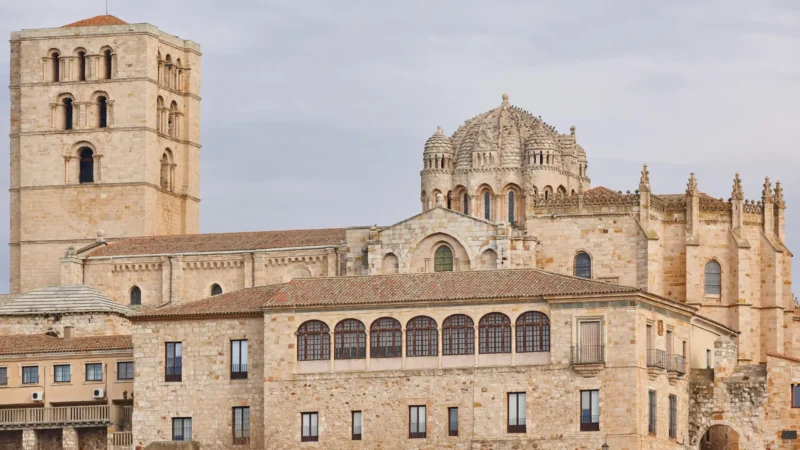
The 12th-century cathedral is the smallest in Castilla y León, but its dome is the city’s symbol. This scaled stone cimborrio, Byzantine in feeling though built by local hands, sits on the skyline beside the Torre del Salvador. The look is unlike any other cathedral dome in Spain.
San Juan de Puerta Nueva
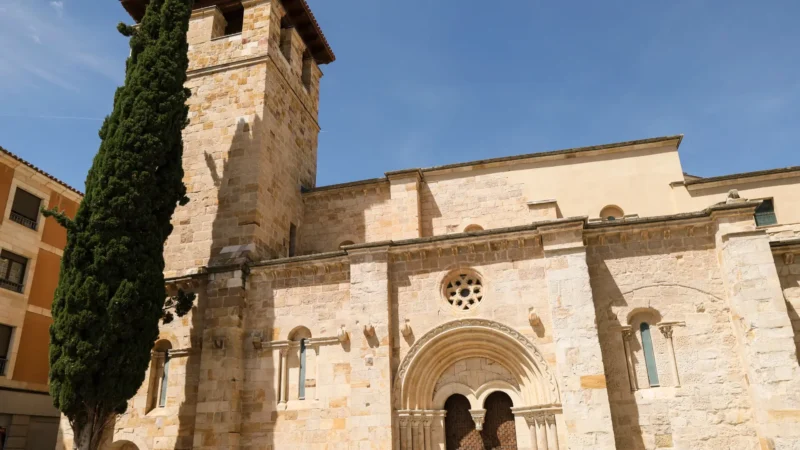
This Romanesque church, officially San Juan Bautista but known to everyone as San Juan de Puerta Nueva, stands right on the Plaza Mayor. Its round “cartwheel” rose window — the emblem of Zamora’s Romanesque — and carved south door are among the most photographed sights in the city. It is a good place to start the Romanesque route.
Santa María Magdalena
A small, plain church known for its richly carved south portal, one of the finest pieces of Romanesque stonework in Zamora. Inside stands a celebrated carved tomb of an unknown noblewoman — by tradition linked to a queen Urraca — with angels carrying her soul heavenward. It closes for the midday break, so check the hours on the door.
Santiago del Burgo
One of the purest Romanesque churches in the city, with three tall naves and three apses, declared a national monument. Its clean, sober lines make it a favourite of anyone who cares about the style. It sits a little east of the centre, an easy walk.
Santiago de los Caballeros
A tiny, ancient church near the castle, above the river. Local legend says El Cid was knighted here, which gives it a fame far larger than its size. It is one of the oldest Romanesque buildings in Zamora.
San Vicente
A Romanesque church in the historic centre, its tall stone tower a landmark on the way between the Plaza Mayor and the cathedral. Plainer than the headline churches, it rewards a look up close for the stonework. An easy stop on the walk through the old town.
The Puente de Piedra
The 12th-century “stone bridge” carries 16 Romanesque arches across the Duero and is one of the classic images of the city. It is free and open, and the walk across gives the best view back up to the old town. It is finest at dusk.
Castillo de Zamora
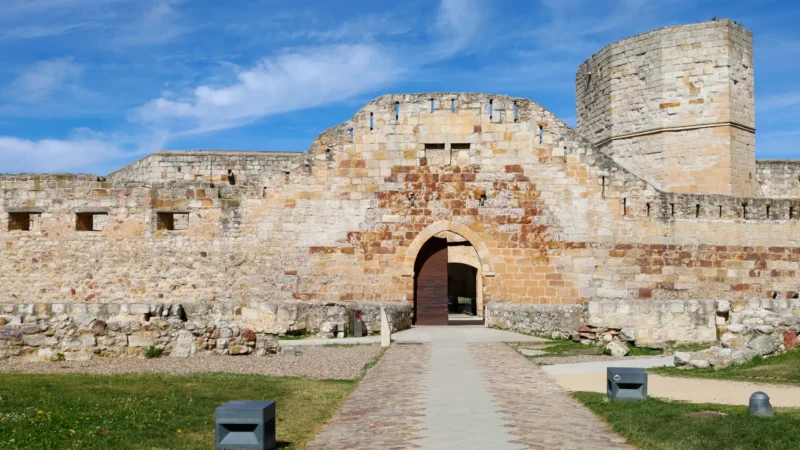
The city’s 11th-century castle stands at the highest point of the old town, beside the cathedral, with thick walls, a round keep and a deep moat. Its grounds are now a free open park, and the ramparts give wide views over the Duero and the rooftops. An easy add-on right after the cathedral.
Aceñas de Olivares
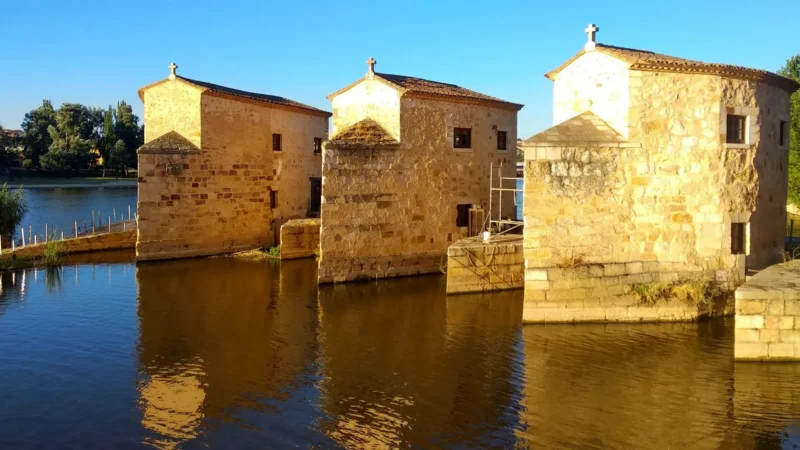
Below the old town, on the bank of the Duero, this restored group of medieval watermills once ground the city’s wheat. The stone mills sit right in the river, best seen from the bank or the bridge. A quiet, photogenic spot on the riverside walk.
City Walls, the Puerta de Doña Urraca and Mirador del Troncoso
Zamora was known as la bien cercada, the well-walled city, and long stretches of its medieval walls and gates survive. The grandest is the Puerta de Doña Urraca, a northern gate framed by two great round towers — the best-preserved of them all. Down by the cathedral, the small Puerta del Obispo (Bishop’s Gate) opens beside the Casa del Cid, and from the Mirador del Troncoso next to it you look straight down over the Duero and the stone bridge — the city’s best free viewpoint.





What to Do in Zamora
Walk the Romanesque Route
Zamora’s real pleasure is simply walking from church to church. The city has an official self-guided “Route of the Romanesque” that links the cathedral with two dozen churches, most within a compact core. Some are open with free entry, some keep short or mass-only hours, and a few are best seen from outside — so treat it as a stroll, not a tick-list, and check each door as you go. A guided walk can add the history and legends you would otherwise miss; ask locally about what is running.
See the Flemish Tapestries and the City Museums
Two indoor stops reward an hour when you want a break from the stone. The Cathedral Museum, reached from the cloister, holds a world-class set of 15th- and 16th-century Flemish tapestries — woven in Arras, Tournai and Brussels, showing the Trojan War and other old tales, still vivid after 500 years; entry is usually on the same ticket as the cathedral. Across the old town, the Museo de Zamora on the Plaza de Santa Lucía (free entry, closed Mondays) covers local archaeology, fine art and city history. Don’t confuse it with the Holy Week museum — that one is closed while its new building is finished.
See a Holy Week Procession — or the Pasos Year-Round
Zamora’s Semana Santa (Holy Week) is one of the oldest and most solemn in Spain, of national tourist interest, best known for its silence and its slow Gregorian chant. It falls in spring, in the week before Easter, and the dates move each year — check the official Junta Pro Semana Santa for the exact days. The processional statues (pasos) are normally shown all year in the Museo de Semana Santa, but note that this museum is closed while its new building is finished; ask locally or check the official source before counting on it.
Walk the Duero Riverbank
Below the old town, paths run along both banks of the Duero past the old mills (aceñas) and under the stone bridge. It is an easy, flat walk and the best way to see the city’s skyline from below. Early morning and late evening are the calmest times.
Taste the Toro Wine Country
Zamora is the gateway to the DO Toro wine region, just to the east, known for its bold, dark reds from old vines. Many bars in town pour Toro wines by the glass, so you can taste before you drive out. A guided tasting is the easy way to learn what sets Toro apart from Rioja or Ribera del Duero; ask where you are staying.
Prefer to go with a guide for any of this? Ask where you’re staying, or at the tourist office by the cathedral (Plaza de Arias Gonzalo) — they’ll know what’s running, in which language, and can point you to something that fits.
Seasonal Events and Festivals
Semana Santa (Holy Week)spring, the week before Easter (the dates move each year). One of Spain’s oldest and most solemn, and by far the busiest week of the year in Zamora. Check the official Junta Pro Semana Santa for exact dates.
Fiestas de San Pedrolate June. The city’s main summer festival, around the feast of Saint Peter, with concerts, food stalls and street life.
Feria de la Alubia (bean fair)autumn. A local produce fair around the prized Fuentesaúco chickpea and regional beans, celebrating the area’s farm food.
Getting There and Around
Zamora sits on the A-66 (the Ruta de la Plata motorway) in north-west Castilla y León, on the north bank of the Duero. It is an easy stop between Salamanca to the south and León to the north.
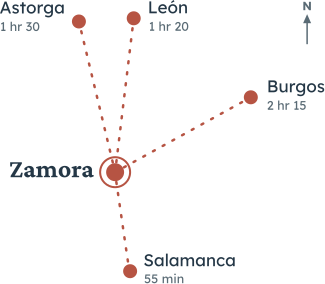
From Madridabout 2 hours 20 minutes by car (roughly 250 km). By high-speed train it is far quicker — direct Renfe services reach Zamora from Madrid in about an hour.
From Salamancaabout 55 minutes by car via the A-66 (about 65 km) — the closest major city.
From Leónabout 1 hour 20 minutes by car via the A-66 (about 140 km).
Nearest airportsValladolid (VLL) is closest, about 1 hour by car; Madrid (MAD) is the main international gateway, about 2 hours 20 minutes by car or an hour by train.
By traindirect high-speed services run from Madrid, with the station a short ride or a 20-minute walk from the old town.
Getting around
You do not need a car inside Zamora — the old town is small and easy to walk, and the sights sit close together. Park outside the historic centre or in a signed car park and go on foot. But you do want a car for the region: the DO Toro vineyards, the town of Toro, and the wider province of Zamora are best reached by road.
Looking for a ready-made plan? See our Castilla y León road trips.
Practical Info
- Cathedral and museum ticketsone combined ticket usually covers the cathedral and its museum (the Flemish tapestries), bought at the door; there is normally a small charge, with free windows at set times. Hours change with the season, and the cathedral occasionally closes for special exhibitions. Check the current times and prices at the box office or the official diocesan source before you go.
- The Romanesque churchesaccess varies church by church. Some are free and open, some keep short or mass-only hours, and a few are only seen from outside. Pick up the self-guided “Route of the Romanesque” leaflet at the tourist office (Plaza de Arias Gonzalo, by the cathedral) and check each door as you go — don’t expect all two dozen to be open at once.
- The two museumsthe Museo de Zamora (provincial archaeology and art, Plaza de Santa Lucía) has free entry and closes on Mondays. The Museo de Semana Santa (the processional statues) is closed while its new building is finished — check the official Junta Pro Semana Santa before planning around it.
- The bridge, walls and viewpoints(Puente de Piedra, city walls, Mirador del Troncoso) are free and open at all times.
- Best time of daylate afternoon into the evening — the stone warms in the low light, the day-trippers leave, and the bridge and viewpoints are at their best.
- ClimateZamora sits high on the Meseta, at about 650 m, so it has cold winters and hot, dry summers. July is the hottest month, with highs around 31°C; January is the coldest, with highs near 10°C and nights close to freezing. The most comfortable months are May, June, September and October, roughly 20–27°C. Rain is light and falls mostly in spring and late autumn; summers are very dry.
Where to Eat in Zamora
You’ll eat and drink well in Zamora, at every budget — this is honest, hearty Castilian food built on strong local products: Fuentesaúco chickpeas, Aliste beef, roast lamb, and the bold red wines of nearby DO Toro. Two simple rules make it easy: for lunch while you’re out walking, the Plaza Mayor and its edges are full of good-value spots; for dinner, head into the old town, especially the lively Calle de los Herreros, where the best small kitchens sit side by side. The picks below cover both, from a quick tapas lunch to a special table.
The city’s stand-out kitchen, on the Rúa de los Francos, turning local produce — Fuentesaúco chickpeas, game from the Sierra de la Culebra, Toro wines — into modern dishes. It carries a Repsol Sol and a Michelin Bib Gourmand, and its kimchi croquettes have a following of their own. Book ahead.
An open-kitchen bistro on the pedestrian Calle de los Herreros, cooking fresh, seasonal, local plates with a short, strong wine list. It’s small and popular, so reserve a day or two ahead.
A traditional wood-oven asador serving some of the best roast lamb (lechazo) in town, with grilled meats and roast vegetables alongside. Old-style service, generous plates.
A reliable spot right by the Plaza Mayor, good for the local arroz a la zamorana (a baked rice cooked in an earthenware dish) and sweetbreads. Fresh counter food and a friendly welcome.
On the Plaza Mayor, with a busy bar out front and a quieter dining room behind. Good for a tapas lunch of local plates and a glass of Toro before you move on.
A classic, busy tapas bar full of locals, known for its tortilla with spicy sauce, callos (tripe stew) and good red wines by the glass from Toro. A cheap, honest lunch stop.
Where to Stay in Zamora
Stay the night and Zamora changes. Once the last day-trippers drive back to Salamanca, the old town belongs to you: lamplit stone, empty lanes, and the black river below the bridge. Here is where we’d sleep to have that evening. The choices run from a hotel inside an old convent to a simple room near the cathedral.
AC Hotel Zamora by Marriott
A polished modern four-star (Marriott’s AC line) just outside the old town, near the station and river, with a Turkish bath and a good restaurant. Less historic than the others, but a comfortable, reliable upper-tier choice — a short walk in to the sights.
Check prices & availability for AC Hotel Zamora by Marriott on the accommodation's websiteNH Zamora Palacio del Duero
A polished four-star built into part of a 14th-century convent near the river, with an arched restaurant and a terrace over the church next door. Modern comfort inside old walls.
Check prices & availability for NH Zamora Palacio del Duero on the accommodation's websiteHotel Alda Mercado de Zamora
A 19th-century Art Deco mansion on the Plaza del Mercado, opposite the central market and a few minutes’ walk from the Plaza Mayor. A grand marble entrance hall, on-site parking, and good value for a central mid-range stay.
Check prices & availability for Hotel Alda Mercado de Zamora on the accommodation's websiteSan Gil Plaza
A small, contemporary hotel on a little square a minute from the Plaza Mayor. Clean, comfortable and central — an easy base for walking the old town.
Check prices & availability for San Gil Plaza on the accommodation's websiteHostería Real de Zamora
A characterful hotel in a historic house near the centre, built around a quiet courtyard with a preserved medieval Jewish ritual bath. Full of atmosphere for the price.
Check prices & availability for Hostería Real de Zamora on the accommodation's websiteHostal Don Rodrigo
A simple, good-value hostal on a quiet side street, a short walk from the cathedral and the sights. The affordable, no-frills choice.
Check prices & availability for Hostal Don Rodrigo on the accommodation's website
Region, Nearby and Routes
Part of Castilla y León
Zamora is in Zamora — Castilla y León
Part of these routes
Zamora is part of The Cathedral Cities road trip
Nearby places
- LeónA great cathedral city on the Camino, León glows with medieval stained glass, painted Romanesque royal tombs and free-tapa bars in the Barrio Húmedo.
- BurgosOne of Spain’s finest Gothic cathedrals, the tomb of El Cid and the Atapuerca fossils, in a calm, walkable Castilian city.
- SalamancaUNESCO city of golden sandstone on the Tormes — baroque Plaza Mayor, two cathedrals and Spain’s oldest university, at its liveliest after dark.
- AstorgaAstorga crowns a small Maragato town with a Gaudí palace, a Gothic cathedral and deep Roman roots.
Frequently Asked Questions
Yes. Zamora has more Romanesque churches than any other city in Europe, a cathedral with a unique scaled stone dome, and one of Spain’s oldest Holy Weeks — yet it stays quiet and un-touristed most of the year. It’s a real, working city, ideal if you want authentic Castilla y León without the crowds.
Its Romanesque architecture above all — around two dozen 12th- and 13th-century churches in a compact old town — plus its domed cathedral, its famous Semana Santa (Holy Week), the 12th-century stone bridge over the Duero, and its position at the gate of the DO Toro wine country.
Follow the city’s self-guided “Route of the Romanesque,” which links the cathedral with the main churches, most within a short walk. Some are free and open, some keep short or mass-only hours, and a few are best seen from outside, so check each door as you go rather than expecting all of them to be open at once.
They’re only about 55 minutes apart, so the honest answer is both. Salamanca is grander, golden and lively, with its great university and Plaza Mayor. Zamora is smaller, quieter and older-feeling, all Romanesque stone and empty evenings. Many travellers base in one and day-trip to the other; Zamora makes the calmer overnight.
You can see the main sights in an afternoon, but Zamora rewards a night. The old town is at its best in the evening, once the few day-trippers leave and the stone glows in the low light. Staying lets you walk the Romanesque route unhurried, catch golden hour at the Mirador del Troncoso, and cross the lit bridge after dark.
May, June, September and October are the most comfortable, roughly 20–27°C and mostly dry. July is hot, with highs around 31°C; winters are cold, with January highs near 10°C and frosty nights. Rain is light and falls mainly in spring and late autumn. Holy Week (spring) is the busiest week — book well ahead if you come then.
For character near the river, the NH Palacio del Duero occupies part of an old convent; the AC Hotel is a modern four-star just outside the old town. For a central mid-range base, San Gil Plaza and the Hostería Real de Zamora (built around a courtyard with a medieval Jewish ritual bath) are both good, the Art Deco Hotel Alda Mercado sits opposite the market, and Hostal Don Rodrigo is a solid budget choice near the cathedral. Note that the city’s Parador is closed for a long restoration, so it isn’t bookable at the moment.
For a special dinner, Cuzeo is the city’s stand-out kitchen (local produce, game and Toro wines), with Lasal a strong modern bistro nearby on the Calle de los Herreros. For roast lamb, Asador Casa Mariano; for the local baked rice (arroz a la zamorana), El Horno by the Plaza Mayor; and Chillón is the classic tapas bar for a cheap, lively lunch.