
León: Gothic Light and Free Tapas on the Camino
León sits high on the northern plains of Castilla y León, a real working city on the Camino Francés. Its Gothic cathedral holds one of the largest walls of medieval stained glass in Europe, its Romanesque royal tombs are painted top to bottom, and its old-town bars still hand you a free tapa with every glass. Famous, yes, but far calmer than Spain’s headline cities.
Why Visit León
León is one of the great cathedral cities of northern Spain, and it wears that history lightly. This was once the capital of a medieval kingdom, and its two headline monuments still show it. One is a soaring French-Gothic cathedral, built almost as a wall of coloured glass. The other is a Romanesque basilica whose royal burial chapel is painted so richly that people call it the “Sistine Chapel of the Romanesque”. Add a rare Gaudí building and a tangle of stone lanes, and a short visit fills up fast.
What keeps León honest is that it never became a museum city. Pilgrims walk through on the Camino Francés, and students fill the cafés. Every evening the Barrio Húmedo, the old tapas quarter, comes alive with the local custom of a free small plate with each drink. It is busier than the region's quiet villages, and the cathedral does get coach groups, but it stays far calmer than Seville or Toledo. The reward is the quiet layer underneath: an early-morning cathedral with the sun coming through the glass, empty Romanesque corners, and a lived-in city that is not performing for anyone.
Who León is for
León suits travellers who like their history real and their evenings social. If you care about Gothic and Romanesque art, it is one of the richest small cities in Spain. If you just want good wine, cured meats and a lively square, the Barrio Húmedo delivers that with no pretension. It also makes a natural, comfortable base for the wider north-west, with Astorga and the Camino country an easy drive away.
Day trip or overnight?
You can see León in a full day. The cathedral, San Isidoro and Casa Botines sit within a ten-minute walk of each other, so an afternoon covers the headline sights. But that means arriving with the coaches and leaving before the city is at its best. Our honest advice is to stay the night. A perfect short visit looks like this: start early at the cathedral, when the low sun sets the stained glass glowing and the crowds haven't arrived; walk to San Isidoro for the painted royal tombs; see Casa Botines and the old walls before lunch; rest through the quiet afternoon; then spend the evening bar-crawling the Barrio Húmedo, one free tapa at a time, as the lamps come on. That evening is the part a day trip skips, and it is the reason to book a room.
What to See in León

León Cathedral (Santa María de Regla)
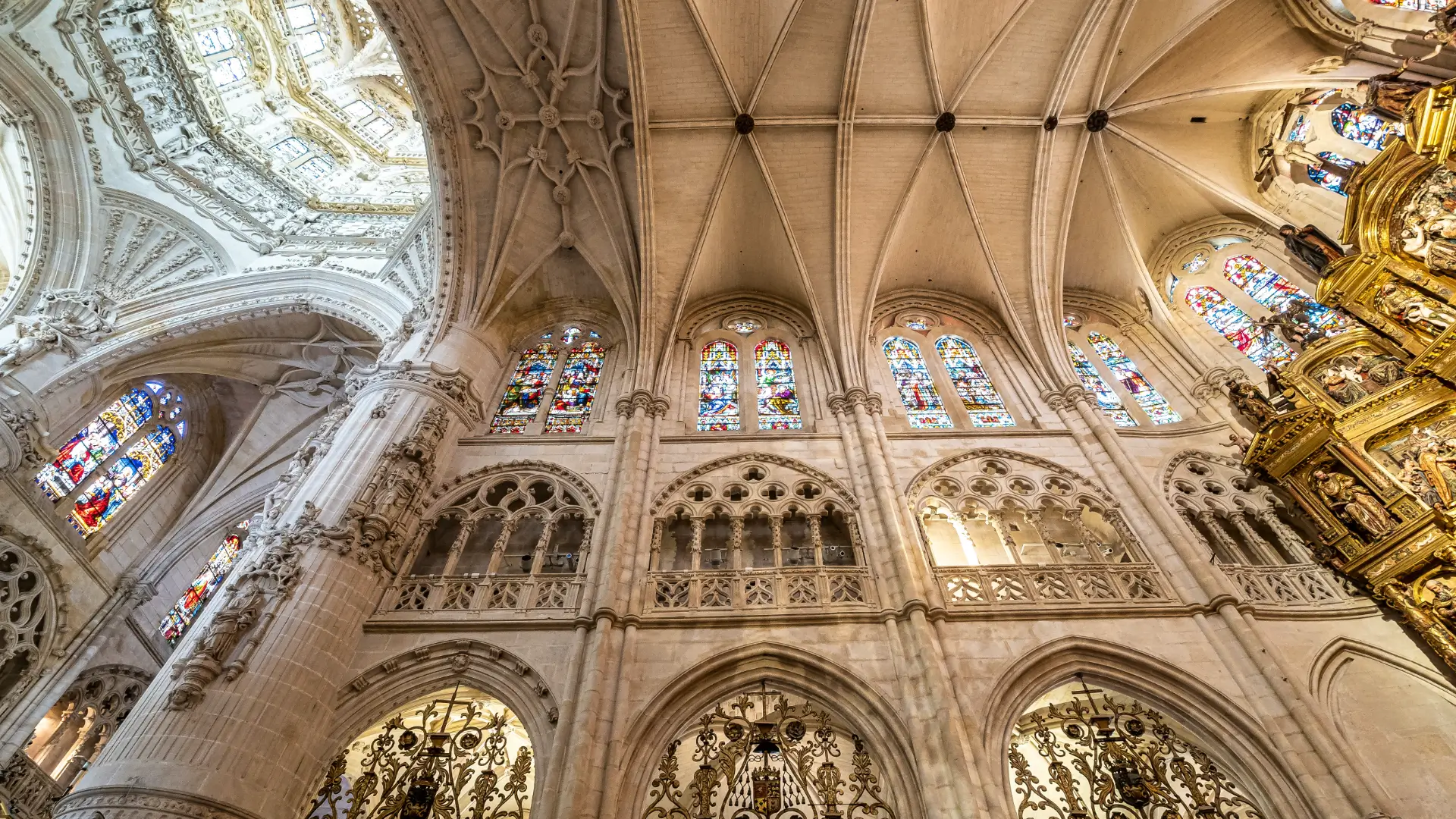
León’s cathedral, nicknamed La Pulchra Leonina, is one of the purest French-Gothic churches in Spain, begun in the 13th century. Its fame rests on its glass: around 1,800 square metres of stained glass across roughly 130 windows, one of the largest medieval ensembles in the world. The effect inside is less like a stone building than a lantern. Come early or late, when low light pours colour across the floor. A single ticket covers the church; a combined ticket adds the cloister and cathedral museum.
Basílica de San Isidoro and the Panteón Real
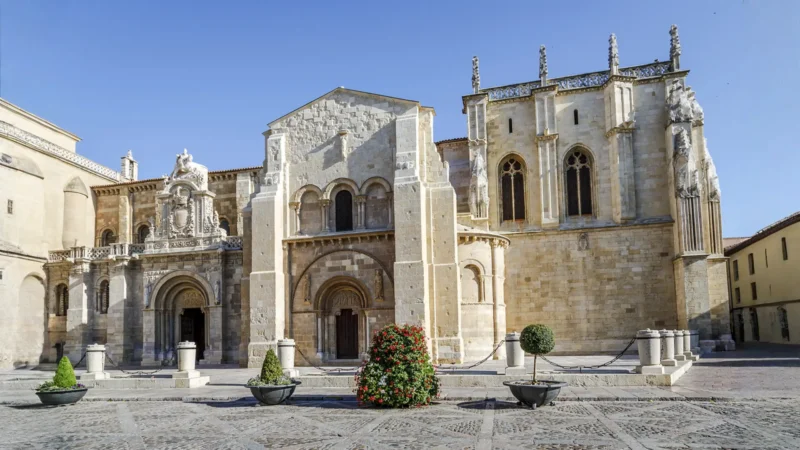
This Romanesque basilica on the edge of the old town holds the Panteón de los Reyes, the burial chapel of the old Kingdom of León. Its 12th-century vaults are covered in vivid painted scenes, so well preserved that it is often called the “Sistine Chapel of the Romanesque”. The basilica itself is free to enter; the Panteón, museum and treasury (home to the Chalice of Doña Urraca) need a ticket. Photography is not allowed inside, which keeps the space calm.
Casa Botines (Museo Gaudí)
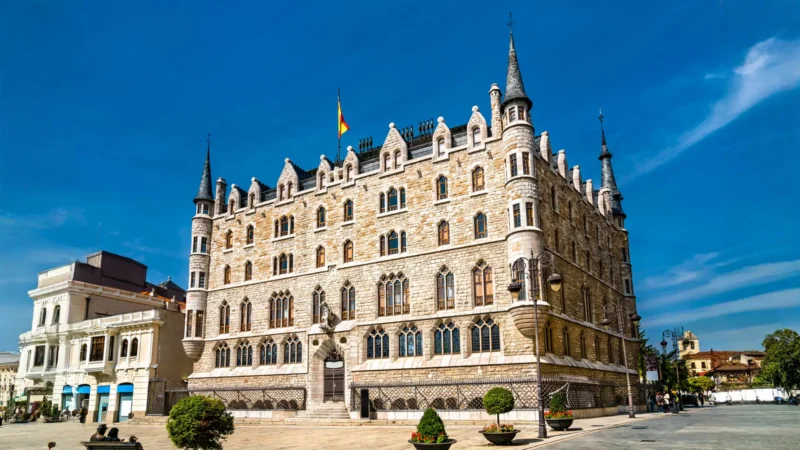
One of only a handful of Antoni Gaudí buildings outside Catalonia, Casa Botines is an 1890s neo-Gothic pile with corner turrets that make it look like a small castle. Built as a textile warehouse, it now works as a museum about Gaudí, the building and 19th- and 20th-century Spanish art. Even from the outside on Plaza de San Marcelo it is worth a look; inside you can see the Catalan vaults, cast-iron columns and the original attic tower.
Convento de San Marcos
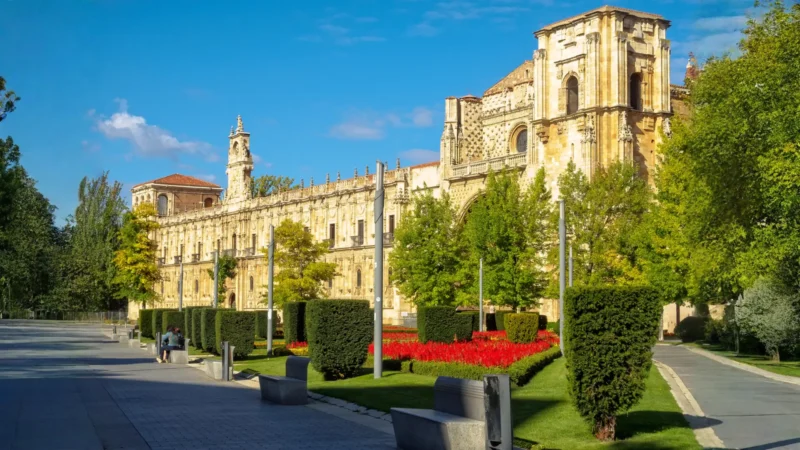
This vast 16th-century monastery has one of the finest Plateresque façades in Spain, a long carved front facing the river. Part of it is now a Parador hotel and part a church and museum, so you can admire the façade and cloister from outside even if you don’t stay. Note the name is shared: “San Marcos” means both the monument and the hotel inside it, so check which one a listing means.
Plaza Mayor and the old-town squares
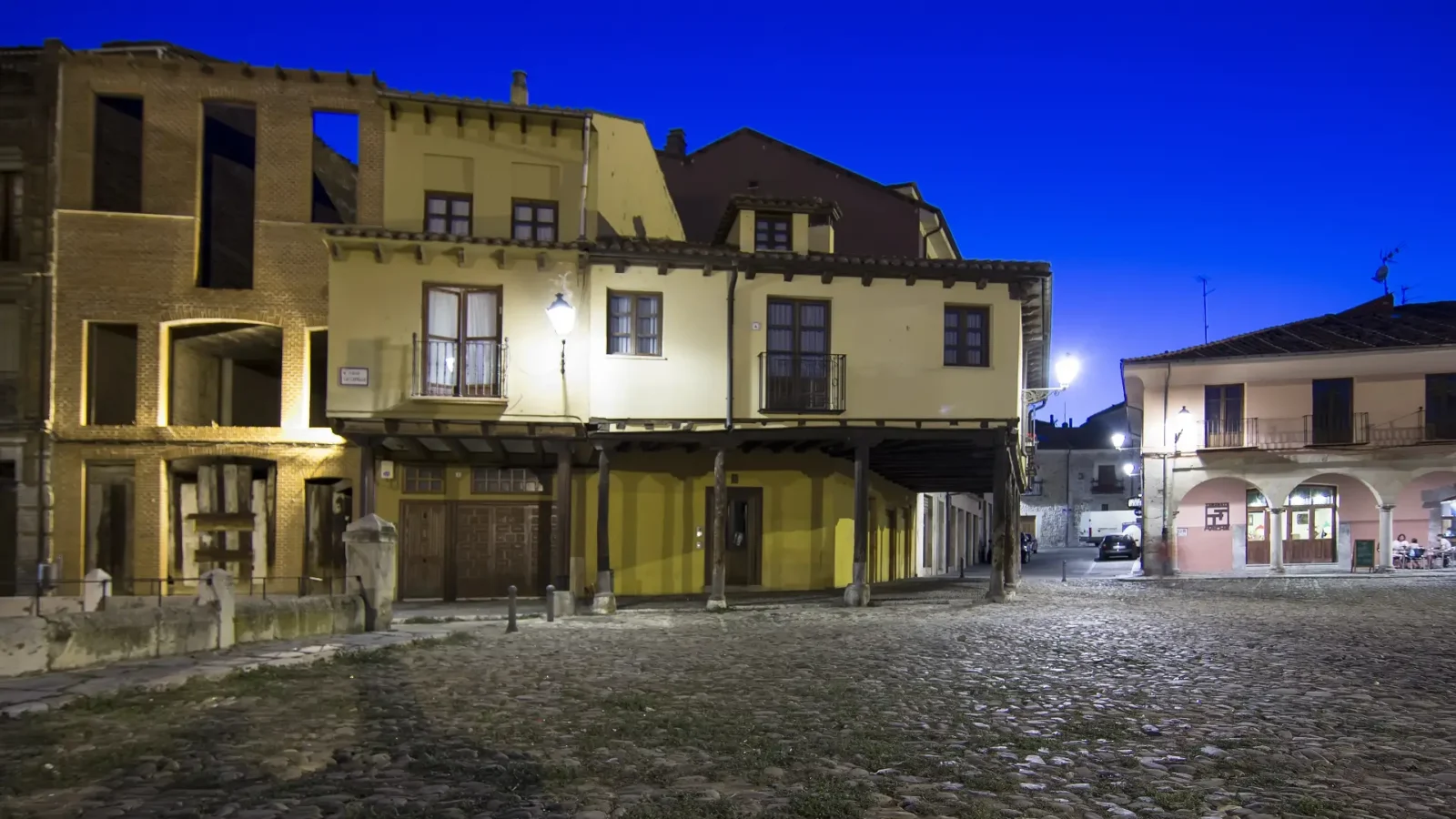
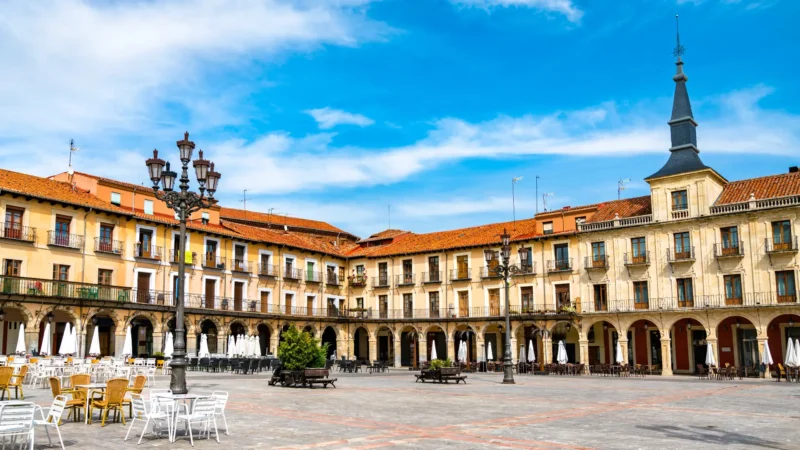
León’s old town is stitched together by handsome squares, and the Plaza Mayor is its heart: a 17th-century arcaded space with the old town hall on one side and café terraces under the porticoes. Nearby, Plaza San Martín and the lanes of the Barrio Húmedo fill with tapas bars, while stretches of the old Roman wall still edge the quarter along the Avenida de los Cubos. Wandering these squares, coffee by day and wine by night, is a sight in itself, and free.
MUSAC (Museo de Arte Contemporáneo)
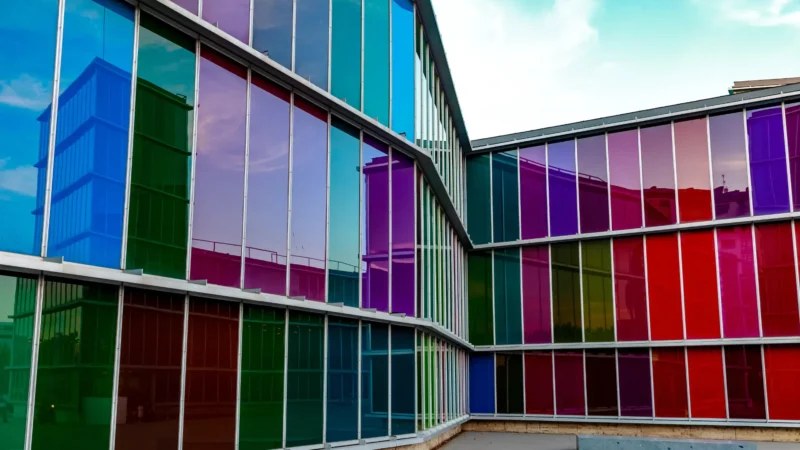
For a complete change of century, MUSAC is León’s contemporary-art museum. It’s easy to spot for its long façade of coloured glass panels, a modern nod to the cathedral’s windows. It sits a little north of the old town and hosts changing exhibitions of recent Spanish and international art. Worth it if modern art appeals or the weather turns; skippable if your time is short and the medieval core is your priority.

What to Do in León
Walk the old town, glass to stone
León’s best experience is free and self-guided: a slow loop through the historic core. Start at the cathedral, cut through to Plaza de Regla, follow the lanes to San Isidoro, then double back past Casa Botines and along the Roman walls. It is a short walk on paper but full of small squares, carved doorways and café stops. Go once in the morning for the light and once after dark, when the monuments are lit and the streets fill up.
Tapear the Barrio Húmedo
León keeps the old custom alive: order a drink in the Barrio Húmedo and a free tapa comes with it. The done thing is to move from bar to bar, one glass and one plate at a time, rather than settling in one place. Try the local specialities as you go, cecina (cured, air-dried beef) and morcilla de León (the local blood sausage), with a glass of Bierzo or Ribera wine. It is cheap, social and the most local thing you can do in the city.
Follow the Camino through the city
León is a major stop on the Camino Francés, and you don’t have to be a pilgrim to feel it. Walk the marked route through town, past the cathedral and out toward San Marcos. It’s a quiet way to read the city’s layout and see it the way arriving pilgrims do. Early morning, when walkers are setting off, is the atmospheric time. Treat the pilgrim traffic and the scallop-shell markers as part of the city’s living character.
Taste León's food culture beyond the tapa
Beyond the free bites, León is serious about food, from cecina and cured meats to slow-roast meats and a strong local wine scene. Curious eaters can go deeper. A guided tasting or food walk with a local host explains what you’re eating, where cecina comes from and how to tell the good stuff from the ordinary, and gets you into places you’d walk past. That’s the difference a guide makes here, turning a casual crawl into an education. For most people, though, the self-guided crawl above is plenty.
Prefer to go with a guide for any of this? Ask where you’re staying, or at the tourist office by the cathedral on Plaza de Regla — they’ll know what’s running, in which language, and can point you to something that fits.
Seasonal Events and Festivals
Semana Santa (Holy Week, spring — movable, March or April)León’s Holy Week is one of the most important in Spain, declared of International Tourist Interest. Its roots go back to the 16th century, and its processions are famous for solemn night marches by hooded brotherhoods, known locally as papones. It is a striking but genuinely devotional time; treat it with respect.
San Froilán (early October, around 5 October)the city’s most traditional festival, honouring its patron saint, with a medieval market near Parque del Cid and San Isidoro, folk processions, the Cantaderas, and a large pilgrimage to the nearby Virgen del Camino. It blends religion, folklore and food over several days.
Both dates move each year, so treat the periods above as recurring rather than fixed. Most travellers won’t plan a trip around either festival, but if your visit happens to overlap, it’s a memorable bonus. For the current year’s programme, the tourist office by the cathedral on Plaza de Regla can point you to what’s on and when.
Getting There and Around
León sits in the north-west of Castilla y León, high on the Meseta where the A-66 (north–south) meets the A-231 and A-60. It is well connected by fast train and easy to reach by car.
From Madridabout 3 hours 30 minutes by car (roughly 340 km) via the A-6 and A-231, though the train is faster and simpler.
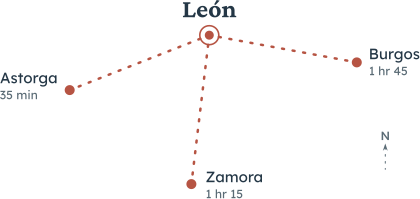
Toward the wider north-westAstorga (Gaudí’s Episcopal Palace, Roman remains, chocolate heritage) is about 35–40 minutes west; Zamora is about 1 hour 15 minutes south; and Burgos about 1 hour 40 minutes to 2 hours east.
Nearest airportsLeón has a small airport (LEN, about 6 km out) with limited, mostly seasonal flights. For reliable connections, Valladolid (VLL) is about 1 hour 30 minutes away by car (roughly 135 km), and Asturias/Oviedo (OVD) about 1 hour 50 minutes (roughly 170 km). Madrid (MAD) is the main international gateway, best reached by the direct train.
By traindirect high-speed AVE and Alvia services run from Madrid (Chamartín) to León in about 2 hours to 2 hours 15 minutes, with the station a short walk across the river from the old town. This is the easiest way to arrive without a car.
Getting around
You don’t need a car inside León. The old town is small and walkable, and the cathedral, San Isidoro, Casa Botines and the Barrio Húmedo are all within a few minutes of each other on foot. Park outside the historic core (the narrow old-town lanes are hard to drive) and walk in. You do want a car for the wider trip, though, to reach Astorga, the Camino villages and the rest of the north-west at your own pace. If you’re touring the region by road, this is the point to sort your hire car.
Looking for a ready-made plan? See our Castilla y León road trips.
Practical Info
- Cathedral accessvisiting the nave as a tourist usually carries a small charge, though there are free times of day and free entry for children and visitors with a disability. The cloister and cathedral museum can be added. The official site doesn’t sell tickets online, so buy at the door and check current times there, as hours shift with services. Confirm before you go.
- San Isidorothe basilica is free to enter, but the Panteón Real, museum and treasury need a separate ticket. No photography inside. Confirm current hours on the official museum source.
- Casa Botines:open as a museum most days, with seasonal hours; check the official site for the current timetable and any timed entry.
- Best time of day for the glassthe cathedral stained glass is at its most dramatic in low morning or late-afternoon light, and quietest first thing before the coach groups arrive.
- Getting arounduse the car parks below the walls; the old streets are narrow and mostly the old town is compact and walkable; park outside it and explore on foot. to through traffic.
- ClimateLeón sits high (about 840 m) and has a continental climate, so winters are genuinely cold, with January highs around 9°C, nights near freezing and occasional snow. Summers are warm and sunny, with July highs around 28°C but cool nights. The most comfortable months are late spring and early autumn (May, June, September, roughly 18–25°C). It’s wettest in late autumn (October and November).
Where to Eat in León
You’ll eat and drink well in León, at every budget, and much of it comes free. This is a proud food city, home to cecina (cured air-dried beef), morcilla de León and a strong local wine scene. Its old-town bars still give a free tapa with every glass. Two simple rules make it easy: in the Barrio Húmedo, crawl from bar to bar for the free-tapa tradition rather than sitting down in one place; for a proper sit-down dinner, book a table at one of the traditional houses or a tasting-menu kitchen. The picks below cover both, from a quick tapas glass to a special-occasion meal.
León’s most celebrated table, set in a historic house beside San Marcos. It has market-driven tasting menus that change weekly with the season. The special-occasion option; reserve well ahead.
A classic old-town house near the cathedral, strong on regional cooking, slow-roast lamb (lechazo), garlic soup and local wines, carved and served with a bit of ceremony. A reliable choice for a traditional sit-down dinner.
In the thick of the Barrio Húmedo, this is a friendly spot for the local rice dishes, morcilla and regional wines. A good anchor for an evening tapas crawl through the quarter.
A long-standing León institution, best known for its cecina and jamón and its buzzy bar. Good for a stand-up plate of the local cured meats with a Bierzo red, right on the main old-town street.
A well-placed bar-restaurant by the Gaudí museum on Plaza de San Marcelo, good for the León classics, morcilla among them, either as tapas at the bar or a fuller meal. Handy after a morning of sightseeing.
An intimate, creative kitchen offering multi-course tasting menus that reinvent Leonese ingredients, with local wine pairings. Book ahead; a strong choice for a memorable dinner without full fine-dining formality.

Where to Stay in León
Picture León after the day-trippers have gone. The cathedral is lit against the dark, the Barrio Húmedo is warming up, a free tapa waits with your first glass, and the whole old town is a two-minute walk from your door. That evening is the reason to stay, and where you sleep sets it up. Here’s where we’d book.
Parador de León (San Marcos)
Sleep inside one of Spain’s most famous monuments: a 16th-century monastery with a breathtaking Plateresque façade, a serene cloister and a riverside setting, freshly renovated. It’s a short, scenic walk from the old town. The building alone is worth the splurge.
Check prices & availability for Parador de León (San Marcos) on the accommodation's websiteHotel Neru con Encanto
A modern, well-run small hotel on a quiet street in the historic centre, walkable to everything, with a calm, comfortable feel after a day on your feet.
Check prices & availability for Hotel Neru con Encanto on the accommodation's websiteHostel Quartier León Jabalquinto
A well-kept, sociable hostel a five-minute walk from the cathedral, with private and shared rooms, a rustic feel and breakfast included, good value and popular with Camino walkers.
Check prices & availability for Hostel Quartier León Jabalquinto on the accommodation's websiteHospedería Pax
A characterful old-building hotel overlooking a cobbled square in the old town, steps from the Barrio Húmedo bars, roomy and central.
Check prices & availability for Hospedería Pax on Booking.comEl Rincón del Conde
A friendly, central hotel minutes from the cathedral and the Gaudí building, praised for warm service, a good base for exploring on foot.
Check prices & availability for El Rincón del Conde on the accommodation's websiteAlda Barrio Húmedo
A simple, modern budget hotel right by the Barrio Húmedo, clean and central. Ask for a quieter room, as the lively bars run late at weekends.
Check prices & availability for Alda Barrio Húmedo on the accommodation's website
Region, Nearby and Routes
Part of Castilla y León
León is in León — Castilla y León
Part of these routes
León is part of The Cathedral Cities road trip
Nearby places
- BurgosOne of Spain’s finest Gothic cathedrals, the tomb of El Cid and the Atapuerca fossils, in a calm, walkable Castilian city.
- ZamoraHome to more Romanesque churches than any other European city, quiet Zamora rewards a slow evening on the Duero.
- AstorgaAstorga crowns a small Maragato town with a Gaudí palace, a Gothic cathedral and deep Roman roots.
Frequently Asked Questions
Yes. León is one of the great cathedral cities of northern Spain. It has a French-Gothic cathedral famous for its medieval stained glass, a Romanesque basilica with painted royal tombs, a rare Gaudí building, and a lively old-town tapas scene, all far calmer than Spain’s headline cities.
ts Gothic cathedral and its roughly 1,800 square metres of medieval stained glass; the Basílica de San Isidoro and its painted Panteón Real, the “Sistine Chapel of the Romanesque”; Gaudí’s Casa Botines; its role as a major stop on the Camino de Santiago; and the free-tapa bars of the Barrio Húmedo.
A full day covers the headline sights, which cluster within a short walk. But the city is at its best in the early morning and the evening, so an overnight stay is worth it: quiet monuments by day, a lively tapas crawl by night.
Late spring and early autumn are most comfortable, with highs around 18–25°C in May, June and September. Summers are warm (July highs around 28°C) but with cool nights; winters are genuinely cold, with January highs around 9°C, frosty nights and occasional snow. It’s wettest in October and November.
Yes, from Madrid it’s about 2 hours each way by direct high-speed train, so a day trip is possible. But you’d arrive with the coach groups and leave before the evening, which is the best part, so staying the night is the better plan.
Visiting the nave as a tourist usually carries a small charge, though some times of day are free, and children and visitors with a disability enter free. The cloister and cathedral museum can be added. San Isidoro is separate: the basilica is free, but the Panteón Real and museum need their own ticket. The cathedral’s official site doesn’t sell online, so buy at the door and check current times there.
Stay in or beside the old town so you can walk everywhere. For a special stay, the Parador de León in the San Marcos monastery is one of Spain’s finest. For comfortable mid-range, Hotel Neru con Encanto, Hospedería Pax or El Rincón del Conde are all central. On a budget, Hostel Quartier León Jabalquinto or Alda Barrio Húmedo put you steps from the tapas bars.
For the local ritual, crawl the Barrio Húmedo bars for a free tapa with each glass, trying cecina and morcilla de León, at spots like Ezequiel, El Capricho and La Bodega del Húmedo. For a proper dinner, Bodega Regia does traditional Leonese cooking, while Cocina con MiMo and the Michelin-listed Cocinandos offer tasting menus for a special night.