

Castilla y León & Extremadura Road Trip: 9 Days
Nine unhurried days from Segovia to Mérida, down Spain’s old Roman silver road — walled golden cities, a green valley where an emperor came to die, and the finest Roman ruins in the country.
- StartSegovia
- EndMérida
- Duration9 driving days, 9 nights (the trip itself — the fly-in/out travel days sit outside this)
- Total distanceAbout 850 km (Segovia to Mérida, the driving core)
- NightsSegovia ×1 · Salamanca ×2 · Cuacos de Yuste ×1 · Cáceres ×2 · Trujillo ×1 · Guadalupe ×1 · Mérida ×1
- Best forCar or motorbike
- DifficultyEasy — motorways and quiet A-roads, no hard mountain driving
- Best seasonSpring (March–May) and autumn (September–October)
- PaceRelaxed
- Flying in?Madrid (MAD) in · Seville (SVQ) out. If you fly, allow an extra arrival and departure day on top of the nine driving days above (so roughly 11 days off work). Arriving overland in your own car or bike? Ignore this line — the trip just begins in Segovia.
Why this Route?
Most road trips through Spain stay inside one region. This one does something better: it runs the length of an ancient road down the country’s quiet western side, from the walled cities of old Castile to the gates of Andalucía. The thread that holds it together is the old Ruta de la Plata, the Roman “Silver Route”. It linked Mérida in the south to the north of Spain two thousand years ago. Today it survives as the A-66 motorway and a string of towns that most tour buses skip. You get two regions, one honest thread, and a great deal of space to yourself.
The road the Romans built
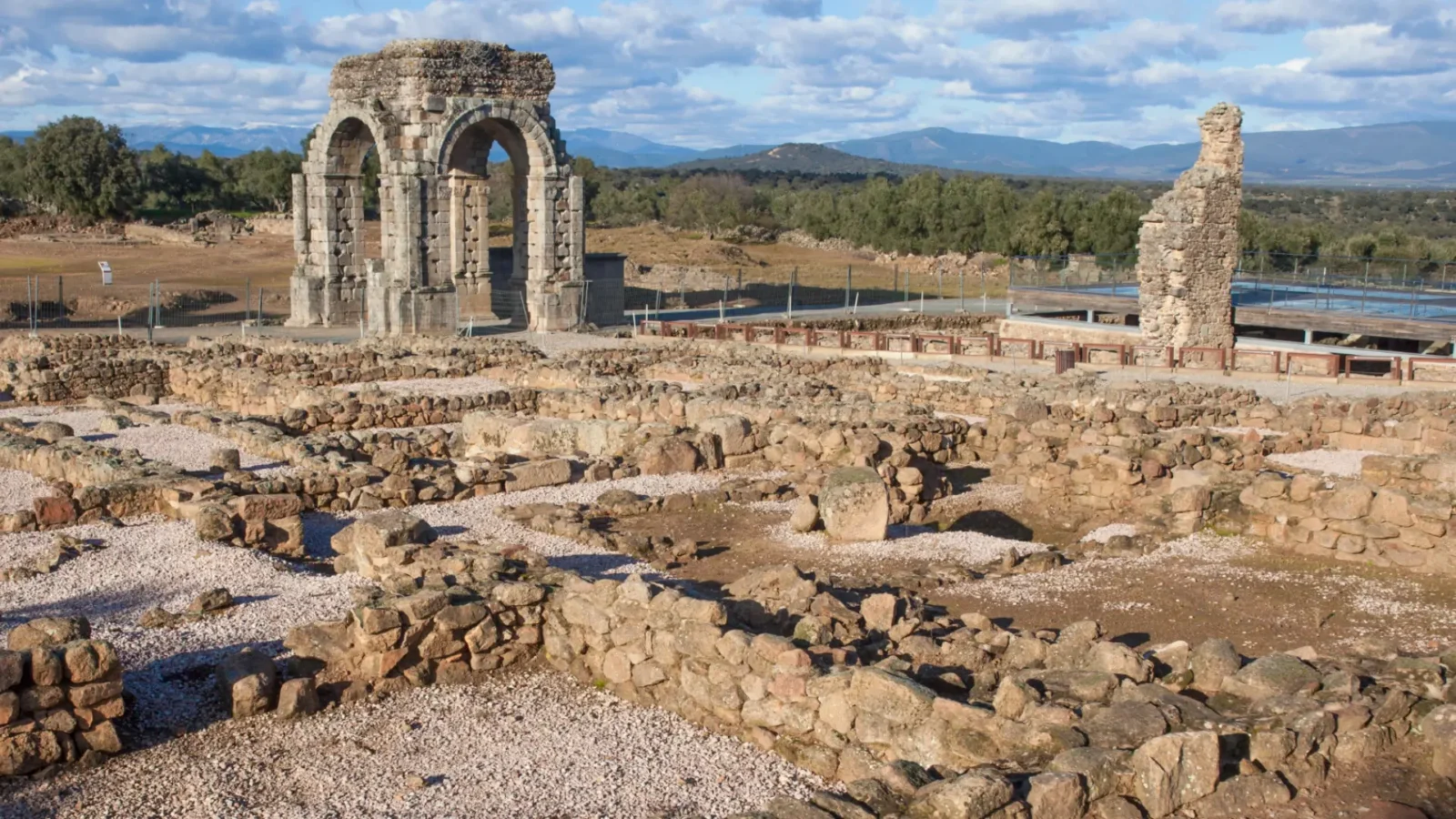
This is a trip that rewards a love of old stones. Its Roman heart runs Salamanca–Cáceres–Mérida, and you follow that heart closely. You stand under a four-sided arch alone in a field at Cáparra, run your hand over two-thousand-year-old blocks, and end among the columns of a theatre that still fills each summer. You also step off the Roman line on purpose — east to Segovia and Ávila at the start, down into the green Vera valley, out to Trujillo and Guadalupe. Those detours earn their place. You will also see the term Vía de la Plata on signs and maps; that is the walking pilgrimage route to Santiago along the same line. This is the driving version: the same historic road and the same Roman towns, but by car or bike, at your own pace.
How it's paced and who it's for
The trip is the drive from Segovia to Mérida — nine days down the Silver Route, one way, so you never retrace your steps. It reads the same whether you flew into Madrid and hired a car, or drove down from home in your own; the journey is the road between the first town and the last, not the flight around it. It moves forward almost every day. Salamanca and Cáceres get two nights each, where a city fills a full day; the smaller towns get a single night, best enjoyed in an evening and a morning. The driving is easy: fast motorways and calm A-roads, rarely more than two hours in a day. This suits travellers who want the big sights without the coach-tour crush, who would rather sit alone on a floodlit plaza at dusk than tick off ten things by lunchtime. It is a relaxed plan, not a checklist sprint.
Getting there and around
The trip begins in Segovia and runs south to Mérida. This whole section is about reaching that start — it sits around the trip and isn’t one of the nine days. There are two equal ways to arrive: fly into Madrid and hire a car or bike, or drive down from home in your own. Neither is the default. (The drive out to an airport, or onward to the next region, lives at the end in Where to next.)
If you’re flying inThe nearest major airport to the start is Madrid–Barajas (MAD) — Spain’s biggest, with the widest choice of international flights, on the north-east edge of the city, so you head out to Segovia without crossing the centre. The first drive is short: Madrid airport to Segovia is about 100 km, roughly 1 hour 10 minutes on the AP-6/AP-61 (a toll road) or the free A-6. A fast train reaches Segovia in under half an hour, but you need the vehicle for the rest of the trip, so pick it up at the airport on arrival. Be honest with your own calendar here: flying adds an arrival day at the start and a departure day at the end, on top of the nine driving days — so block out roughly eleven days for the whole thing.
If you’re arriving in your own car or motorbikePlenty of travellers don’t fly at all. They drive down from home — the Netherlands, Belgium, France, Germany, United Kingdom — already have a place in Spain, or roll straight off the end of another trip. If that’s you, none of the airport or hire-car detail applies: the trip simply begins in Segovia, and you start there whenever you arrive. Use the open-departure link below to plot the drive from wherever you actually set off.
See the drive to the startOpen in Google Maps. This shows the route to Segovia, the first stop. Set your starting point in the “from” field — your home if you’re driving down, or your arrival airport (Madrid, or wherever you land) if you’re flying in — then send it to your phone or car if you want it ready for the road.
Self-drive — car or motorbikeHowever you reach Segovia, this is a self-drive trip from there. If you’re hiring, pick up at Madrid airport and keep the vehicle until the end. Most travellers take a car; the roads, distances and pace suit a touring motorbike just as well, so if you ride, this trip works on two wheels. A one-way (open-jaw) hire between two cities usually costs a little more than a round trip — factor that in when you compare.
If your flight lands late.If you fly in and arrive in Madrid in the evening, you do not have to drive straight out. It is fine — often wiser — to sleep near the airport that first night and start fresh in the morning, especially as the light fades early in winter. This is an extra night on top of the nine, not one of them. Check your vehicle-hire desk’s opening hours before you book a late flight: many run to around midnight, and some offer 24-hour or key-box pickup, but not all, and off-season hours can be shorter. If the desk would be closed when you land, an airport hotel plus a morning pickup is the clean fallback. See our Practical Info page for driving-in-Spain details.
The Itinerary
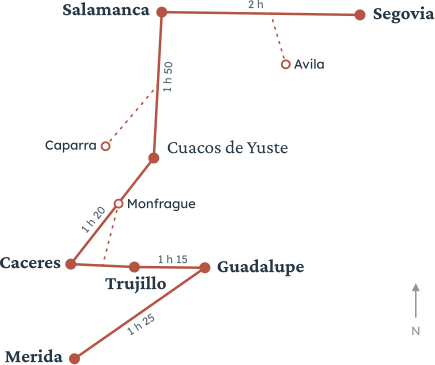
A single line south. You begin in the high, dry cities of old Castile and pick up the Silver Route at Salamanca. Then you drop into the green Vera valley halfway down, and follow the Roman road through the heart of Extremadura to Mérida. Nine nights, seven bases, and a new view most mornings.
Day 1 — Segovia
The driveIf you’re flying in, Madrid airport to Segovia is about 100 km, roughly 1 hour 10 minutes — land in the morning and you can be under the aqueduct by mid-afternoon. Arriving in your own car, or from an earlier stop, you just reach Segovia when you do; see Getting there for the ways in.
The shape of the dayStand beneath a Roman aqueduct, climb to a castle on a cliff, then let the evening slow down.
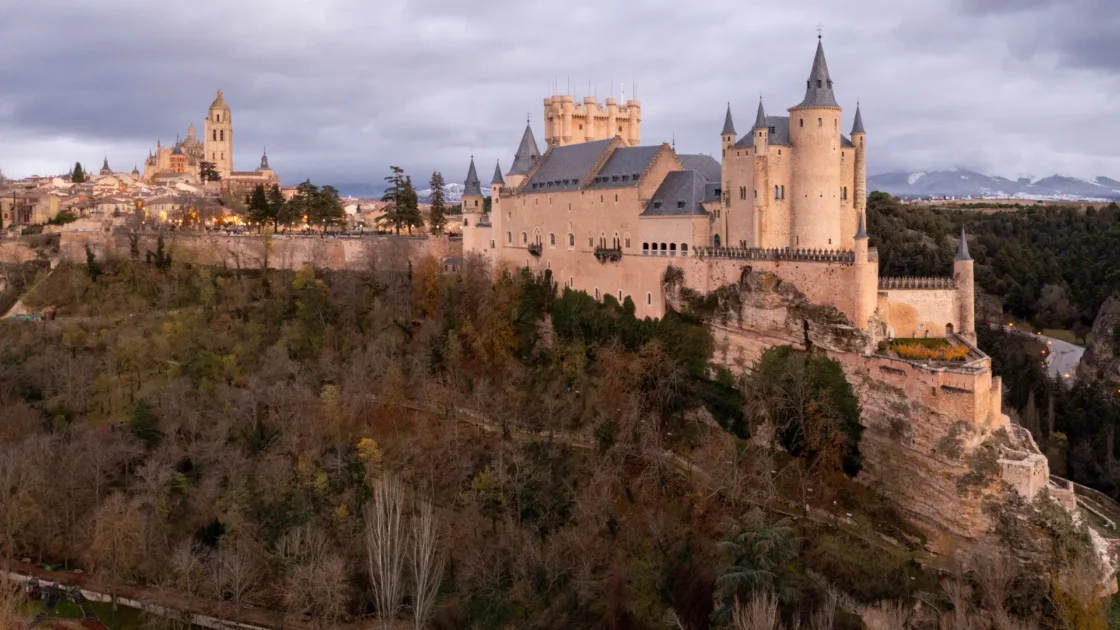
Segovia is a gentle place to begin, because its greatest sight needs no ticket and no queue. Walk to the foot of the Roman aqueduct and look straight up. It’s 25,000 granite blocks stacked into a double tier of arches, holding each other in place with no mortar at all, right across the middle of town. Allow an hour to follow its length and crane your neck under the tallest span. Then climb the old streets to the Alcázar, the ship-shaped castle on the cliff edge said to have inspired a famous fairy-tale one. Allow an hour or so, and take the tower steps if you have the legs. If there is time, step into the cathedral on the Plaza Mayor. None of this needs rushing — Segovia rewards a slow first evening.
Want a different pace?Pick at most one; it is still a single day and your base is unchanged. If you land early and have a spare afternoon, drive 15 minutes to La Granja de San Ildefonso to see the royal palace gardens and their fountains. If you would rather just settle in, skip the Alcázar climb and spend the extra hour over dinner — Segovia at night, floodlit, is reason enough.
Where to eatSegovia’s dish is cochinillo asado — suckling pig roasted until the skin cracks under a knife.
- Lunch tipEl Sitio (€€ · Castilian / tapas · Segovia). If you land early enough for lunch, this old-town classic does the full cochinillo but also a lighter tapas lunch at the bar — croquetas and a beer if you don’t want a heavy first meal. Good value for the setting. Closed Sunday; check ahead. (If you took an airport buffer night, or arrive late, skip lunch and start with the dinner below — your first proper meal then falls in the evening.)
- Dinner tipAsador Maribel (€€ · Asador · Segovia). A wood-oven roaster a couple of streets back from the tourist crush, praised in reviews for exactly that — cracking cochinillo and lechazo (roast lamb) away from the crowds. Closed Monday evening (open Monday lunch); check ahead.
Where you sleep tonightTonight you sleep in Segovia, in the old town within walking distance of the aqueduct — your base for one night before the drive west. See where we’d stay.
Day 2 — Salamanca (via Ávila)
The driveSegovia to Salamanca is about 175 km in total, roughly 2 hours, broken by a stop in Ávila. Segovia to Ávila is ~74 km (about 1 hour); Ávila to Salamanca is ~100 km (about 1 hour) on the A-50.
The shape of the dayWalk a stretch of medieval rampart at Ávila, then reach Salamanca in time for the plaza at dusk.
Leave Segovia in the morning and break the drive at Ávila. Climb onto the medieval walls and walk a stretch of the rampart-top — over two kilometres of granite curtain studded with 88 round towers, one of the most complete circuits in Europe. Allow an hour for the wall-walk (there is a ticketed section) and the cathedral built into the ramparts, then drive on.
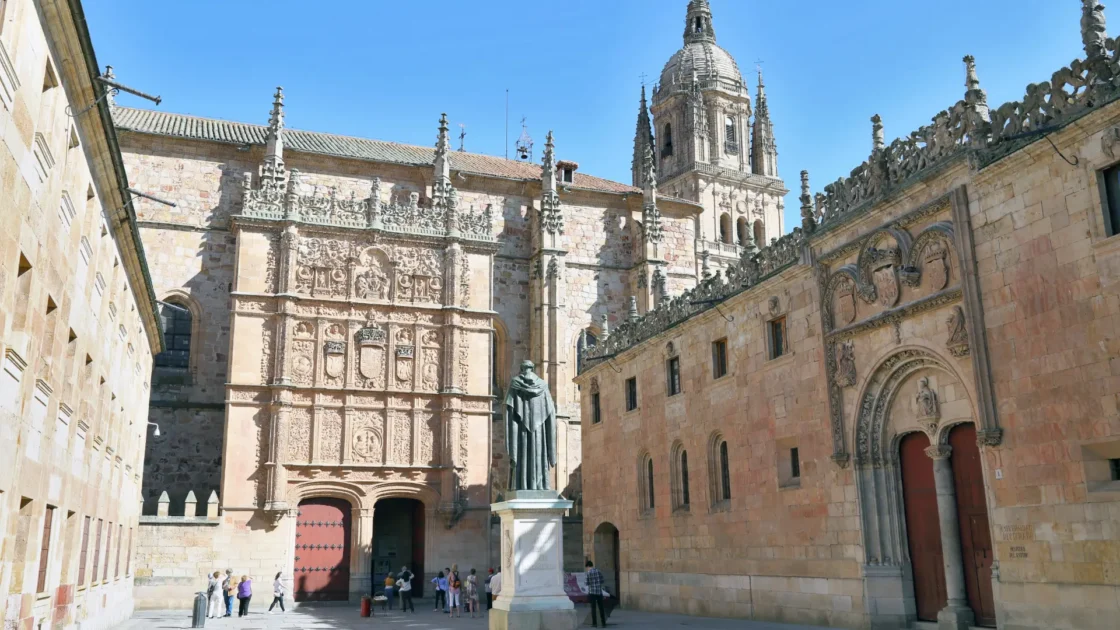
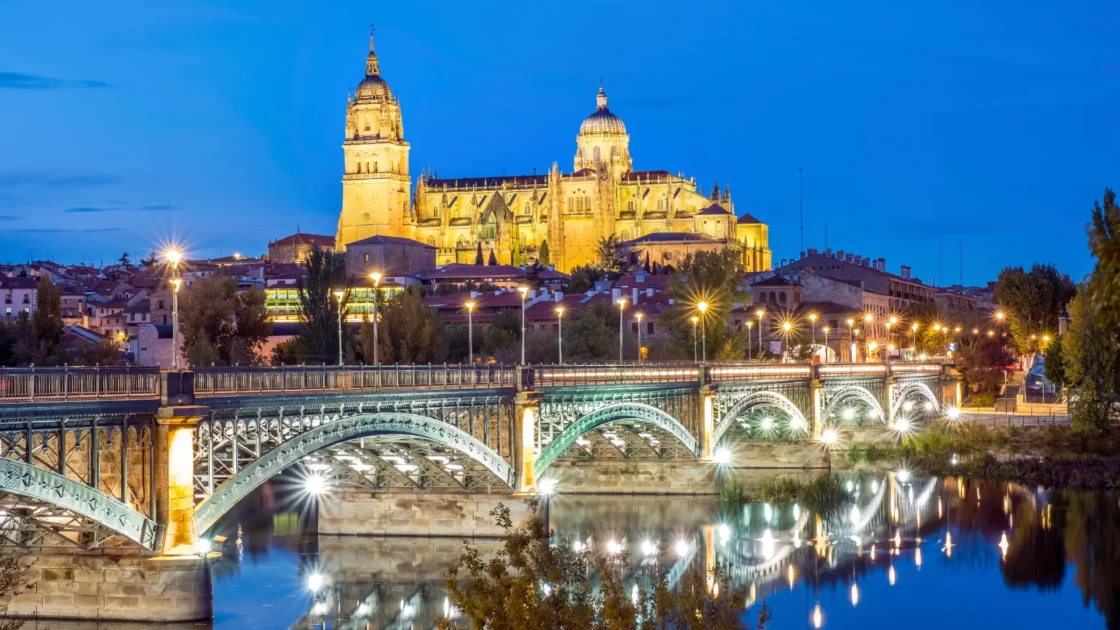
Reach Salamanca in the early afternoon. The city is cut from a golden sandstone that seems to hold the light. Its Plaza Mayor — often called the finest in Spain — fills with people as the sun drops and the stone turns amber. Spend the late afternoon there and in the lanes around the old and new cathedrals (joined side by side); save the deeper exploring for tomorrow.
Want a different pace?Pick at most one. If you would rather not stop at Ávila, drive straight through (the walls are visible from the road) and give the extra time to Salamanca. If old universities and libraries are your thing, add the Escuelas Mayores interior in the afternoon rather than saving everything for Day 3.
Where to eat
- Lunch tipRestaurante Siglodoce (€€ · Castilian · Ávila). A calm dining room inside a restored old building in Ávila, good for a proper sit-down lunch of local beef or judías del barco (the town’s famous beans) before you drive on. Open daily; check ahead.
- Dinner tipMesón Cervantes (€€ · Castilian · Salamanca). A lively first-floor tavern with balconies right over the Plaza Mayor — lean on the rail with a plate of Castilian roast and watch the square fill. Honest local cooking, a warm first night. Open daily; check ahead.
Where you sleep tonightTonight and tomorrow you sleep in Salamanca, in the old town near the Plaza Mayor — your base for two nights. See where we’d stay.
Day 3 — Salamanca
No driving todaySalamanca is yours to explore on foot, which is the whole point of a two-night stop.
The shape of the dayHunt a hidden frog on a university wall, climb the cathedral towers, and cross the Roman bridge for the skyline.
With a full day, go deeper. On the University façade, join the small crowd squinting upward for the tiny carved frog perched on a skull — find it yourself before anyone points, the local good-luck tradition says. Climb the Ieronimus towers of the cathedral for a walk along the high galleries among the carvings (allow an hour or more; there’s a self-guided route). See the Casa de las Conchas, its walls studded with carved stone scallop shells, and the Art Nouveau stained glass of the Casa Lis. In the afternoon, cross the Roman bridge over the Tormes and look back at the golden skyline. Salamanca is a student town, so the evening paseo runs late and lively.
Want a different pace?Pick at most one. For a slow day, drop the tower climb and spend the afternoon over a long lunch and a riverside walk — Salamanca is a fine city to do very little in. For something more active, the university’s historic rooms and the carved façade of the Convento de San Esteban make an easy morning circuit on foot.
Where to eat
- Lunch tipRestaurante Plaza Mayor (€€ · Castilian · Salamanca). A dependable, well-liked spot right on the square for a relaxed midday meal of Iberian ham, local cheeses and grilled meats, without the tourist-trap mark-up of some of its neighbours. Open daily; check ahead.
- Dinner tipRestaurante El Mesón de Gonzalo (€€€ · Castilian / grill · Salamanca). A polished, popular kitchen just off the Plaza Mayor, in a handsome vaulted cellar, known for its roast lechazo and its steaks. A reliable choice for a proper Castilian dinner; book ahead, as it fills fast.
Where you sleep tonightA second night in Salamanca, same base — no packing tonight. See where we’d stay.
Day 4 — Cuacos de Yuste (the descent)
The driveSalamanca to Cuacos de Yuste, about 175 km, roughly 2 hours 45 minutes of driving with stops — the longest driving day of the trip, and honestly so. It is also the most Roman: you drop down the empty middle of the Silver Route, so the day is built around its roadside relics.
The shape of the dayWalk out to a Roman arch standing alone in a field, then drop into a green valley where an emperor came to die.
Leave Salamanca after breakfast and head south on the A-66. Turn off near Plasencia for Cáparra. A short, level walk over open ground brings you to a four-sided triumphal arch standing by itself in the grass. It’s the only one of its kind in Spain, right on the old Silver Route. Allow 45 minutes and walk right under it. Cáparra is open Tuesday to Saturday and Sunday morning — closed Monday; on a Monday you’ll still see the arch from the approach, but not walk the site. A little further south, stop at Baños de Montemayor to see the Roman thermal baths that gave the spa village its name.
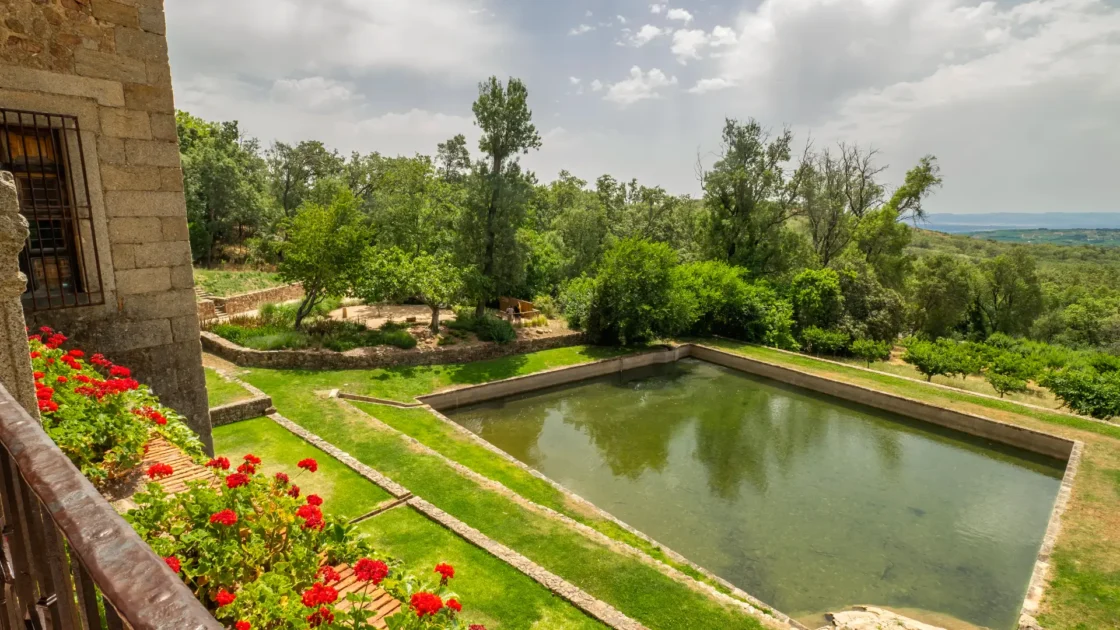
From there, leave the motorway and drop into La Vera, a watered green valley under the mountains — a sharp change from the dry plains above. Your base is Cuacos de Yuste, a stone village of timber-framed houses and arcaded squares. The Monastery of Yuste just above it is where Emperor Charles V gave up the crowns of half the world and retired to die. Allow an hour or more for the guided rooms, the cloisters, and the pond he had built to sit beside. Arrive in time to see it, then let the village empty of day-trippers around you.
Want a different pace?Pick at most one; it’s still one day and your base is unchanged. Slow it down: La Vera’s gargantas — cold mountain streams that pool into natural swimming spots such as El Bañaero and the Garganta de Cuacos — make a fine warm-afternoon swap for the second half of the sightseeing (bring proper footwear; the granite is slippery and these are wild, unfenced spots). Or go active: drive ten minutes to Garganta la Olla, another beautifully kept Vera village of steep cobbled lanes, instead of a long evening in Cuacos.
Where to eat
- Lunch tipCafé Bar la Posada (€ · Tapas bar · Cuacos de Yuste). Under the arcades on the main square, this is the easy, good-value choice for a square-side lunch after the drive — generous local plates, quick and friendly. Closed Monday; check ahead. (On a Monday, the terrace at the village swimming-pool bar or a snack on the road is the honest fallback.)
- Dinner tipRestaurante Abadía de Yuste (€€€ · Traditional / chef-led · Cuacos de Yuste). The village’s standout kitchen, taking La Vera classics — migas, patatas revolconas, slow-cooked meats — and plating them with real care, with a pretty courtyard. Book ahead; the village is small and the best tables fill fast.
Where you sleep tonightTonight you sleep in Cuacos de Yuste, in the quiet old quarter minutes from the monastery — a single night, but a memorable one once the coaches leave. See where we’d stay.
Day 5 — Cáceres (via the Vera)
The driveCuacos de Yuste to Cáceres, about 130 km, roughly 1 hour 20 minutes — back out of the valley to Plasencia, then south on the A-66 Silver Route into the heart of Extremadura.
The shape of the dayFinish the emperor’s valley in the morning, then walk into a walled city that empties and glows after dark.
Give the morning to the monastery and the village if you didn’t finish yesterday — the walk up through chestnut and oak is worth an unhurried start.
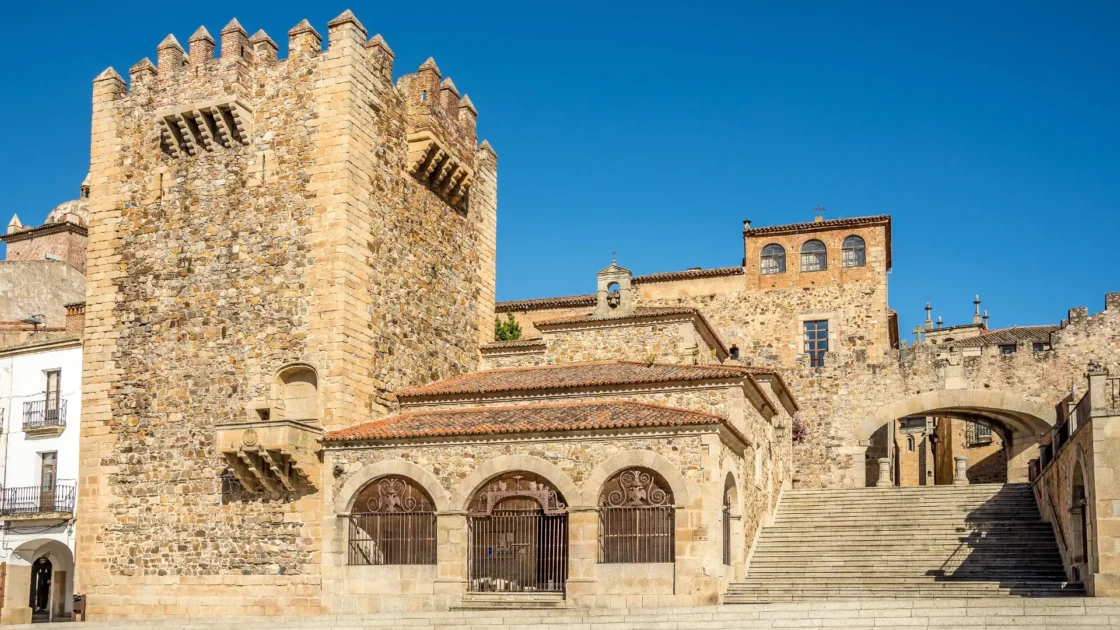
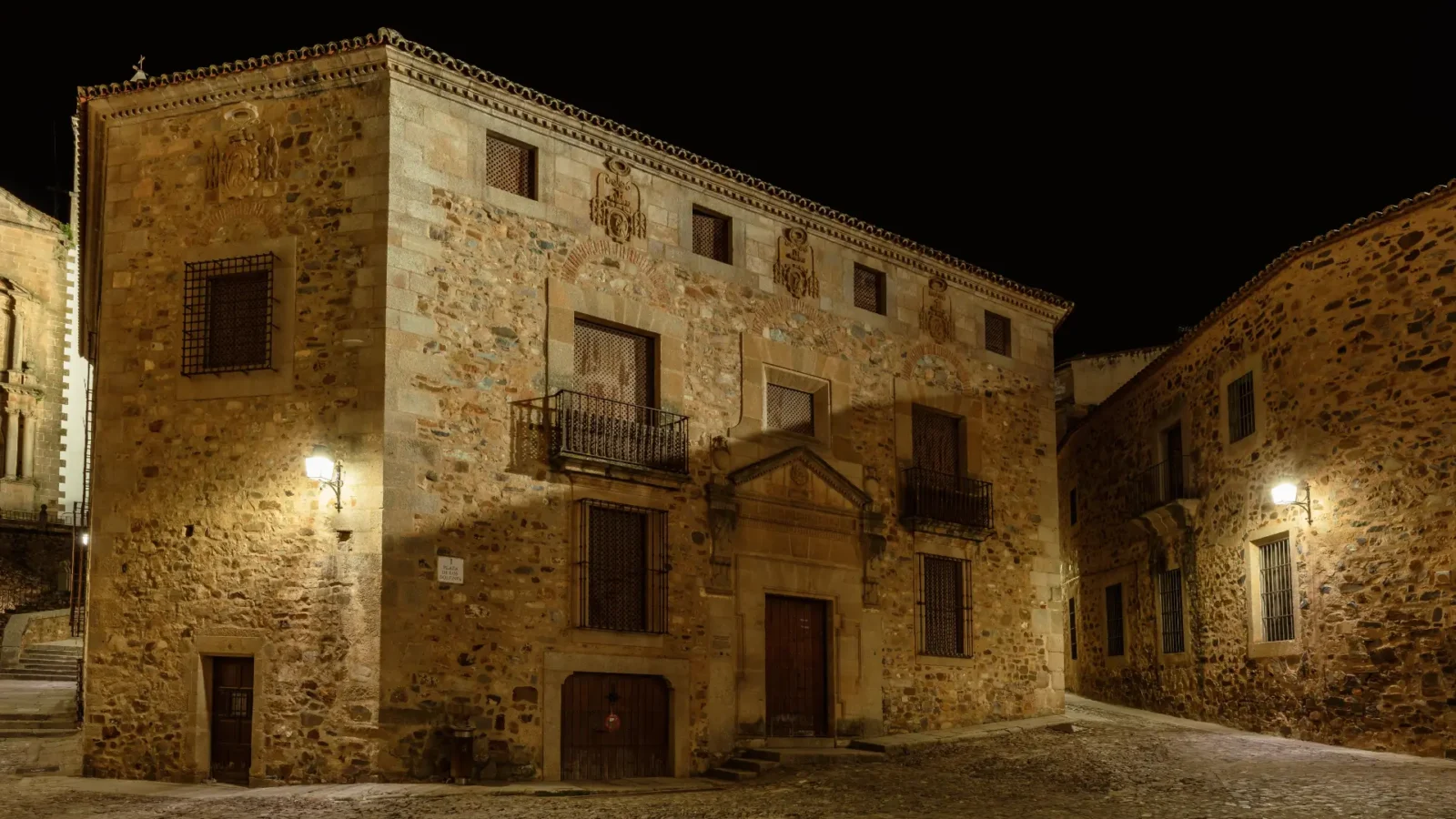
Then drive down to Cáceres, arriving in the afternoon. Cáceres has one of the best-preserved old towns in Spain: a walled quarter of palaces, storks’ nests on the towers, and cobbled squares so unchanged it is used as a film set. The pleasure is simply to walk it. Allow a couple of hours to wander the Plaza de San Jorge, climb the Bujaco Tower for the rooftop view, and lose yourself in the lanes. Save some for tomorrow, though: Cáceres is at its best after dark, when the day-trippers have gone and the golden stone stands floodlit and almost empty.
Want a different pace?Pick at most one. If you finished Yuste yesterday and left early, break the drive at Plasencia for its two-in-one cathedral and main square. If you would rather arrive and rest, skip the Bujaco climb today and do it tomorrow — the old town is small enough that nothing is far.
Where to eat
- Lunch tipon the road / in Plasencia. This is a driving morning, so lunch is best taken light — either in Plasencia as you pass (a walkable city with an arcaded main square) or on arrival in Cáceres. We would save the appetite for dinner in the old town.
- Dinner tipTorre de Sande (€€ · Traditional / Tapas · Cáceres). The casual sister of three-Michelin-star Atrio, a few steps away, set in a 15th-century mansion with an ivy-clad tower and a lovely garden terrace. Traditional Extremaduran cooking — Iberian meats and cheeses, grilled dishes, good local wines — with the odd surprising touch. A characterful old-town table without the fine-dining price.
Where you sleep tonightTonight and tomorrow you sleep in Cáceres, inside the walled old town — your base for two nights, and the reason to be here in the evening. See where we’d stay.
Day 6 — Cáceres
No driving today Apart from a short hop out to a boulder field, Cáceres is yours on foot.
The shape of the dayGo deeper into the old-town palaces, then walk among giant granite boulders mirrored in still pools.
With a full day, go deeper into the walled quarter’s palaces and museums. The Museo de Cáceres is the highlight — it’s built over a preserved Moorish cistern whose columns still stand in the water (allow an hour or two; closed Monday, check ahead). Mid-morning or late afternoon, drive about 20 minutes to Los Barruecos, outside Malpartida de Cáceres: a landscape of giant granite boulders balanced above shallow pools that mirror them on a still day. It’s free to wander, used as a dramatic filming location, and the kind of stop that never earns a guidebook entry (allow an hour or two; wear proper shoes for the rock). Back in Cáceres, give the walled quarter a second evening — it never loses its pull after dark.

Want a different pace?Pick at most one. For a slow day, skip Los Barruecos and spend the whole day inside the walls, museum-hopping and lingering over meals. For something active, the boulder field has easy marked walking, and the Museo Vostell Malpartida beside it pairs contemporary art with the old wool-washing works (check its closing day before you go).
Where to eat
- Lunch tipin the old town or at Los Barruecos. If you are out at the boulders over midday, eat lightly in Malpartida or bring something for the rocks; otherwise a tapas lunch in the Cáceres old town does the job.
- Dinner tipEl Mirador de Galarza (€€ · Traditional / Grill · Cáceres). A traditional restaurant on the edge of the old town with a terrace and wide views over the medieval quarter — strong on grilled Iberian pork and vegetables. Worth timing for sunset.
Where you sleep tonightA second night in Cáceres, same base — no packing. See where we’d stay.
Day 7 — Trujillo (via Monfragüe)
The driveCáceres to Trujillo is only ~45 minutes direct, but today go the long way — via Monfragüe National Park — for about 2 hours of driving in total on the EX-208. It earns the detour.
The shape of the dayStand under a river cliff and watch vultures ride the thermals, then climb to a conquistador’s castle at dusk.
Set off in the morning for Monfragüe , Spain’s best place to see big birds of prey. Pull in at the Salto del Gitano , a viewpoint where a sheer rock face rises straight off the Tagus. Look up: the ledges are packed with griffon and black vultures. They wheel out over your head close enough to hear the wind in their wings. Bring binoculars and give it an hour. It’s a free roadside viewpoint. Spring (March–May) is the peak for raptor activity; in high summer, go early to beat the midday heat and haze.
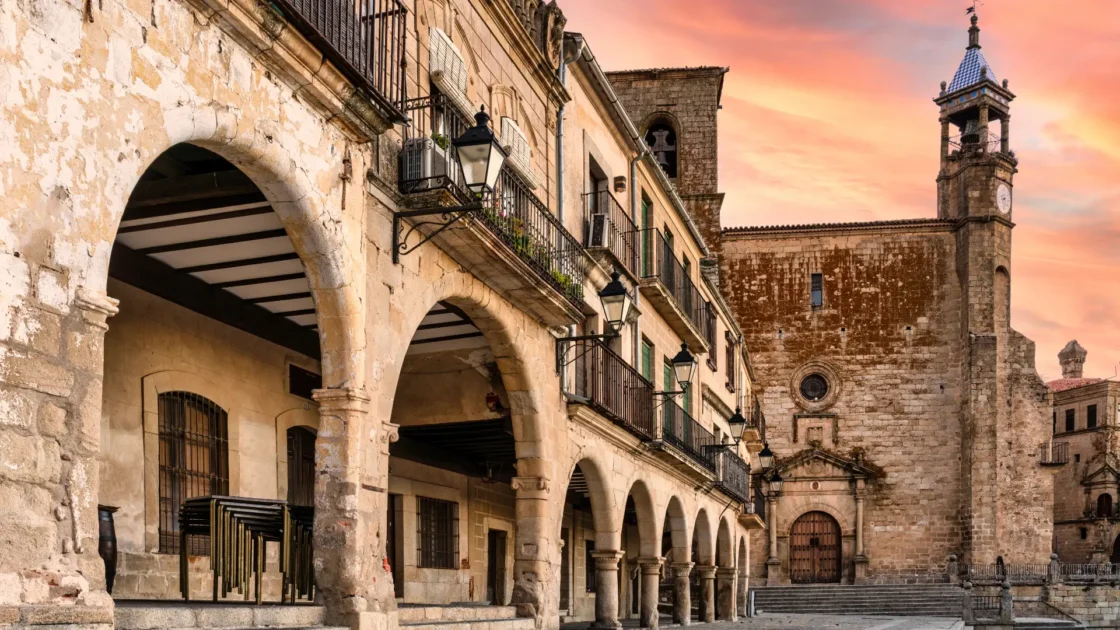
Then drive on to Trujillo, a golden town stacked up a hill under a Moorish castle. Its vast Plaza Mayor, ringed by palaces built with New World silver, is one of the grandest squares in Spain — this was Pizarro’s birthplace, and conquistador history runs through the streets. Climb to the castle for the view over the plains (allow an hour), then be on the plaza as it floodlights and the arcades throw long shadows.
Want a different pace?Pick at most one; it is still one day. If big birds are not your thing, skip Monfragüe and take the fast road straight to Trujillo (45 minutes), arriving in time for a long lunch and a full afternoon in town. If you love the park, the short Red Route walk from Villarreal de San Carlos up to the castle is a beautiful two-and-a-half-hour circuit — but then keep Trujillo simple in the evening.
Want to see the bridge from the top of this page?That stone bridge is the medieval bridge of Santiago de Bencáliz, near Aldea del Cano, on the old Silver Route about 20 minutes south of Cáceres. It does not sit on today’s eastward route to Trujillo. Seeing it means a short there-and-back from Cáceres — roughly 40 minutes of extra driving plus time at the bridge, best done first thing before you set off. If you add it, keep the rest of the day light. Skip Monfragüe and take the direct road to Trujillo afterwards, or drop the castle climb in Trujillo, so the day does not become a long one. It is a quiet, little-visited spot with no facilities, so bring water and pick a still day — the reflection is the whole point.
Where to eatTrujillo is known for its cheeses and Iberian pork
- Lunch tipHonest note. Today’s morning is birdwatching in a national park with few services, so a natural sit-down lunch is thin on the ground until Trujillo. Carry a snack for the viewpoint, or eat a late lunch on the Plaza Mayor when you arrive.
- Dinner tipRestaurante Meseguera (€€ · Regional · Trujillo). One of the better tables facing the Plaza Mayor, well-regarded for warm service and quality regional cooking, with grilled meats from the local pastures. Save room for the Torta del Casar cheesecake — it gets ordered table after table.
Where you sleep tonightTonight you sleep in Trujillo, in the old town near the Plaza Mayor — a single night, timed for the floodlit square in the evening and the quiet streets early. See where we’d stay.
Day 8 — Guadalupe
The driveTrujillo to Guadalupe, about 80 km, roughly 1 hour 15 minutes on the EX-208 and EX-102 — a pretty run east into the wooded Villuercas hills.
The shape of the dayClimb to a monastery that ruled a New World, then wander a knot of steep lanes once the day visitors leave.
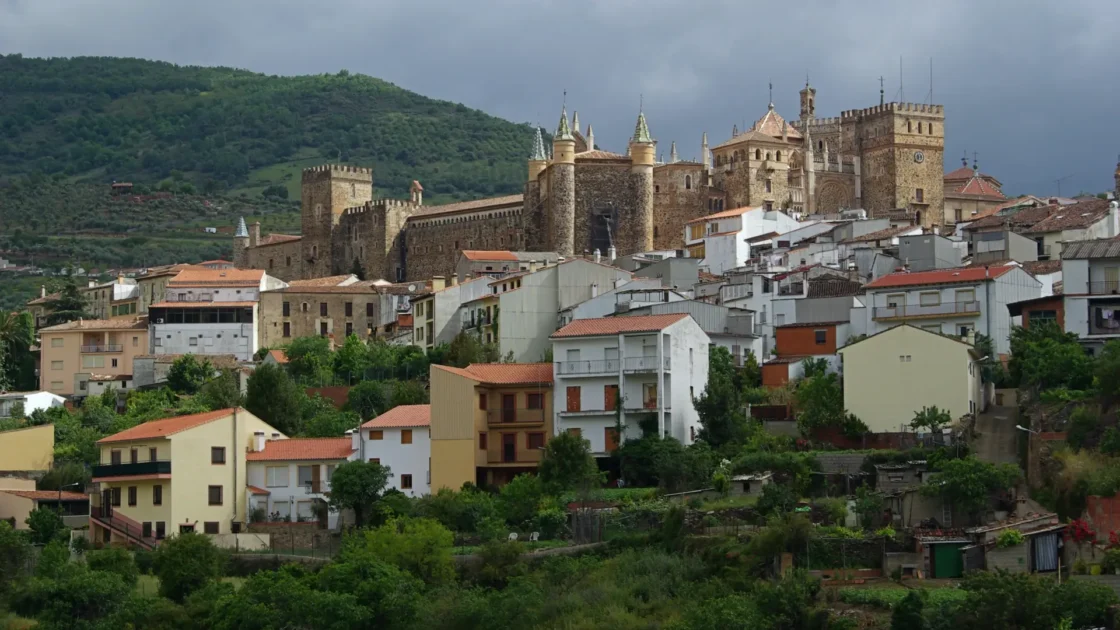
Drive over in the morning to Guadalupe, a village that grew up around one of the great monasteries of the Spanish-speaking world. Inside the Real Monasterio de Santa María de Guadalupe — a UNESCO site piling Gothic, Mudéjar, Renaissance and Baroque on top of each other — a short guided visit takes about an hour. It leads you past the revered dark statue of the Virgin, whose name Columbus and the conquistadors carried across the Americas. The monastery is open daily but closes for the afternoon siesta, roughly 12.50 to 15.30 — go late-morning before you settle in, or take the mid-afternoon slot. The rest of the village is a tangle of steep, arcaded lanes around a small square, best once the day visitors have gone.
Want a different pace?Pick at most one; it is still one day. For a slow afternoon, simply walk the village lanes and sit in the square — Guadalupe is tiny and rewards doing nothing. For something active, the surrounding Villuercas–Ibores–Jara Geopark has marked walking trails into green hills if you want to stretch your legs before dinner.
Where to eat
- Lunch tipGuadalupe Jordá (€ · Tapas / traditional · Guadalupe). Right on the Plaza de Santa María with terrace tables and a long day. An easy stop for a tapas lunch or local wine between sights, with vegetarian options — the classic migas extremeñas are the thing to order.
- Dinner tipRestaurante del Parador de Guadalupe (€€€ · Traditional Extremaduran · Guadalupe). The special-occasion table in town. Set in the Parador’s 15th-century former hospital, the kitchen takes regional cooking up a notch — bacalao monacal, slow-roast lamb shoulder, local game in season — and finishes on the celebrated Ibores-cheese ice cream. Eat on the patio under the orange trees; you don’t have to be staying to book a table.
Where you sleep tonightTonight you sleep inside part of the monastery complex itself — a single night in one of the most atmospheric stays on the whole trip. See where we’d stay.
Day 9 — Mérida
The driveGuadalupe to Mérida, about 130 km, roughly 1 hour 25 minutes on the EX-102 and A-5 — a quiet run down out of the hills to the Roman capital.
The shape of the daySee the monastery in the morning, then walk out onto the stage of a Roman theatre that still holds a summer audience.
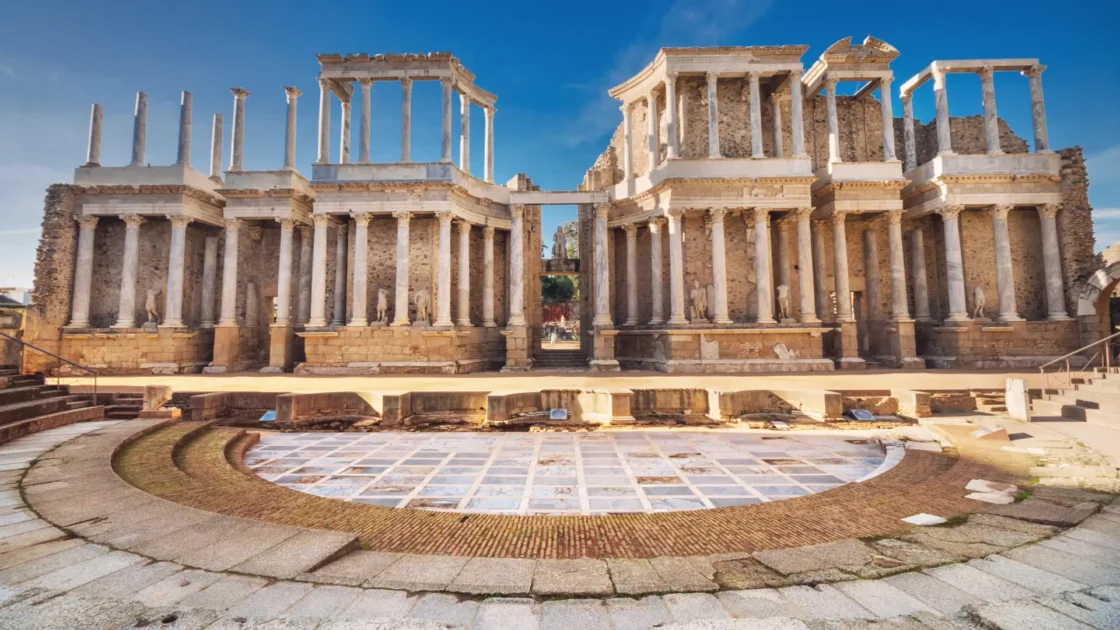
See the monastery in the morning if you have not already, before the midday closure. Then drive to Mérida, the ancient capital of Rome’s whole western province and the southern anchor of the Silver Route — the climax of the drive. Walk out onto the floor of the Roman theatre and look up at the two tiers of columns of its stage front. It still stands so complete that a festival stages plays here each summer, on the same stone an audience trod two thousand years ago. Allow two to three hours for the theatre and the great oval amphitheatre beside it, on one combined ticket. Around the city, free to see, stand the Temple of Diana, the towering Aqueduct of the Miracles with its storks’ nests, and the long Roman bridge over the Guadiana. Give the afternoon and evening to all of it, at a Roman pace.
Watch-out: the open-air Roman monuments are open daily, but the excellent National Museum of Roman Art is closed on Mondays. If your Mérida day is a Monday, see the monuments and save the museum for another time.
Want a different pace?Pick at most one; it’s still one day. For a slow finish, pick two or three sites rather than all of them and spend the saved time over a long last dinner. For something extra, the National Museum of Roman Art (except Monday) is one of the finest of its kind in Spain and sits right beside the theatre. (Mérida can easily fill a second day if you have it — the Roman sites reward a slow pace — so add a night here if your schedule allows; it’s a natural place to stretch the trip.)
Where to eat
- Lunch tipRestaurante La Extremeña (€ · Traditional Extremaduran · Mérida). A small, warm spot just off the main streets, known for regional tapas and tasting plates at very fair prices. A reliable first stop for local dishes like salmorejo and Iberian pork.
- Dinner tipRestaurante Concepto (€€€ · Modern Spanish · Mérida). A small, refined restaurant where the kitchen gives local produce a creative, elevated turn. The room is intimate and the service attentive — real fine-dining quality at a fair price for what it is. Book ahead: there are only a few tables, and they fill fast.
Where you sleep tonightTonight you sleep in Mérida, in the centre within walking distance of the Roman sites — your last night on the road for this trip. See where we’d stay.
Practical Info
- Toll vs free roadsThe first leg (Madrid to Segovia) has a toll option (AP-6/AP-61) and a free alternative (A-6). The whole spine of the trip — the A-66 Ruta de la Plata — is a free motorway, so most of your driving costs nothing in tolls.
- The driving is easyThis is not a mountain trip. Legs are short (rarely over two hours), roads are good, and the one valley descent into La Vera is on a normal A-road, not a hair-raising pass. The longest single day is Day 4 (Salamanca to the Vera, under three hours with stops).
- Fuel on the middle legsThe empty stretch of the A-66 through southern Castilla y León (Day 4) has fewer services than the busier ends. Fill up, or charge, before you leave Salamanca.
- Driving an electric car?The spine of this trip is well covered. The A-66 Ruta de la Plata has fast chargers spaced along its whole length (Zunder, Wenea and others). You’ll find 150 kW-plus stops on the quiet Salamanca-to-Plasencia stretch, near Navalmoral de la Mata, at Cáceres, and close to Mérida, so the driving legs are easy to plan. The weak spots are the small detour towns: Trujillo has only a slow (7 kW) charger, and the Vera valley and Guadalupe sit off the motorway in the hills, where fast charging is scarce. Charge on the A-66 corridor, top up whenever you stop at a city, and use your hotel’s point overnight if it has one. Check a live app (Electromaps or your network’s own) the morning you set off, since availability changes.
- A zero-emissions car has a small bonus in the citiesSpain’s low-emission zones (ZBE) restrict older, higher-polluting cars in some centres; a zero-emissions vehicle with the DGT “0” label enters freely and often parks cheaper or free in regulated zones. One honest caveat: a foreign-plated car may need to pre-register for the Madrid or Barcelona zones whatever its label — check the city’s own site before you drive in. On this trip the historic centres of Salamanca and Cáceres are best entered on foot anyway. A standard hire car is not affected, but always follow signs and park outside the old quarters.
- ParkingIn every overnight town, park on the edge of the old town rather than the narrow historic lanes. Segovia, Salamanca, Cáceres, Trujillo and Guadalupe all have walkable centres with parking just outside.
- Siesta hoursSmaller sights and the Guadalupe monastery close for a few hours in the early afternoon. Plan monastery and museum visits for the morning or later afternoon.
- SeasonSpring (March–May) and autumn (September–October) are ideal — warm days, green country, and the best time for the birds at Monfragüe. High summer is very hot in Extremadura (often well over 35 °C); if you travel then, sightsee early and rest at midday.
Where we’d Stay
These are places we’d be happy to stay in ourselves, chosen for location and character. Your nine nights, in order — one strong pick per night, a mix of characterful mid-range stays and a few special ones, chosen so you can just book and go. Flying in? We’ve also added an optional airport-side stay for the night before the trip starts and the night before you fly home — outside the nine trip nights, for whoever needs them.
Meliá Madrid Barajas
Beside Adolfo Suárez Madrid-Barajas (MAD). If you land late or fly out early, skip the drive into the city and stay by the airport instead. This comfortable 4-star sits right next to the terminals. It runs a free shuttle to T1, T2 and T4 through the small hours, so a late arrival or a dawn departure is easy. Pick up the hire car fresh the next morning, or drop it and walk to check-in the night before.
Check prices & availability for Meliá Madrid Barajas on the accommodation's websiteHotel Don Felipe
In the old Jewish quarter, with a garden and a sun terrace looking straight at the Alcázar. Comfortable, well-run and walkable to every sight, it’s a dependable mid-range choice with its own parking.
Check prices & availability for Hotel Don Felipe on the accommodation's websiteHotel Catalonia Plaza Mayor
A comfortable, well-run hotel a short step from the Plaza Mayor, in a converted historic building with a good breakfast. A solid mid-range choice that keeps you right in the heart of the old town without the top-tier price.
Check prices & availability for Hotel Catalonia Plaza Mayor on the accommodation's websiteHotel Rural Abadía de Yuste
The most comfortable base in the village itself, an easy walk from the old quarter and minutes from the monastery road. Apartment-style rooms, a courtyard for a quiet drink and the village’s best restaurant downstairs — the natural choice if you want everything within reach without giving up comfort.
Check prices & availability for Hotel Rural Abadía de Yuste on Booking.comParador de Cáceres
A 16th-century palace turned hotel deep inside the walled old town, on Calle Ancha. Atmospheric stone rooms, a courtyard and a good restaurant — the classic way to sleep inside the monument.
Check prices & availability for Parador de Cáceres on the accommodation's websitePosada Dos Orillas
A beautifully restored old house in the historic centre, warmly run and very well reviewed, with a pretty courtyard to come home to. Excellent value for this much character so close to the plaza.
Check prices & availability for Posada Dos Orillas on the accommodation's websiteHospedería del Real Monasterio
Sleep inside the monastery itself. Run by the Franciscan community, this hotel occupies part of the World Heritage complex, around a beautiful Gothic cloister. Rooms are simple in keeping with the setting, but the experience — staying within the walls, a courtyard to yourself in the evening — is unique in Spain.
Check prices & availability for Hospedería del Real Monasterio on the accommodation's websiteParador de Mérida
Sleep in an 18th-century former convent in the centre of town, a short walk from the Roman sites, with quiet rooms set around cool cloistered spaces and a well-regarded restaurant. The kind of building you come to Spain to stay in, not just walk past.
Check prices & availability for Parador de Mérida on the accommodation's websiteHotel Vértice Sevilla
Great place if you arrive late or have a very early flight home. This modern hotel sits right on the airport approach road, with 24-hour reception and on-site parking, so you can drop the car and reach the terminal in minutes. Use it as a swap for the Mérida night, or as an extra night at the end.
Check prices & availability for Hotel Vértice Sevilla on the accommodation's website
For the full range of places to stay in each town — every budget — see the individual town guides linked through the itinerary above.
Frequently Asked Questions
A road trip through Castilla y León and Extremadura works best over about nine days of driving. That gives you two nights each in Salamanca and Cáceres and single nights in the smaller towns, with short, relaxed drives. Nothing rushes the Roman sites at Mérida or the monasteries along the way. The flights in and out sit outside those nine days.
For this route you fly into Madrid–Barajas (MAD) and out of Seville (SVQ). It is an open-end trip, so you drive one line south and never backtrack. Madrid has the widest choice of international flights, and Seville sits a short drive beyond the final stop at Mérida.
Yes — you need your own vehicle for this route through Castilla y León and Extremadura. Public transport between the smaller towns (the Vera valley, Guadalupe, Monfragüe) is very limited, and the point of the trip is the freedom to stop at roadside Roman sites and quiet villages. Hire a car or a touring motorbike at Madrid airport and drop it at Seville.
Driving through Extremadura and western Castilla y León is easy. The spine of the trip is the A-66 motorway (the modern Ruta de la Plata). The legs are short — rarely over two hours — and there are no difficult mountain passes. The one valley descent into La Vera is on a normal A-road.
The best time for a road trip through Extremadura is spring (March to May) or autumn (September to October). The days are warm, the country is green, and the birds of prey at Monfragüe are most active. High summer is very hot here, often well over 35 °C, so if you travel then, sightsee early and rest at midday.
No — nine days is a relaxed pace for this route, not a rushed one. Most days involve under two hours of driving. Salamanca and Cáceres each get a full extra day. There’s room built in to slow down, too — a swim in the Vera valley, or a long evening on a floodlit plaza. It is designed to avoid the checklist sprint.
Yes — this route works just as well if you drive down in your own car or motorbike instead of flying in. You simply skip the hire car and begin in Segovia; the “get me to the start” map link routes you there from wherever you set off. To extend, you can join a neighbouring trip end-to-end or drive on from Mérida — see “Where to next” at the foot of the page for the onward options.
Yes — you can drive this route in an electric car fairly comfortably. The A-66 (the Ruta de la Plata) has fast chargers along its whole length, including the quieter Salamanca-to-Plasencia stretch, Cáceres and Mérida, so the main legs are easy. Plan more carefully for the detour towns. Trujillo has only a slow charger, and the Vera valley and Guadalupe sit off the motorway where fast charging is scarce. Charge on the corridor and use your hotel’s point overnight where possible.
For the Monastery of Yuste and the Real Monasterio de Guadalupe in Extremadura, you generally buy tickets on arrival rather than booking ahead, but both close for part of the day. Yuste’s hours shift with the season, and Guadalupe closes for the afternoon siesta (roughly 12.50 to 15.30), so time your visit for the morning or later afternoon.
Where to Next
- The drive out to SevilleThe trip ends at Mérida; the airport run is the shell around it, not a tenth day. Mérida to Seville airport is about 195 km, roughly 1 hour 45 minutes on the A-66 — the final stretch of the Silver Route, running south out of Extremadura into Andalucía. Seville airport is on the north-east side of the city, so you reach it without driving into the centre. The drive is easy and mostly motorway, so a mid-morning or later flight is comfortable straight from Mérida. If you have an hour to spare, the road passes close to Zafra, a white town with its own castle-parador, for a last Spanish coffee.
- See the drive onwardThis starts from Mérida, the last stop. Set your destination in the “to” field — Seville airport if you’re flying home, your next route’s first stop if you’re driving on, or home if you’re heading back — and send it to your phone if you want to navigate it. Open in Google Maps
- If you fly home earlyIf your flight is very early, spend the last night near Seville airport instead of in Mérida — the same nine nights, just a different final base, so the trip stays the same length. A practical choice can be found above in Where we’d Stay. If you’d rather not rush the last morning at all, add a genuine buffer night at the airport on top of the nine — that’s your own extra night, not a trip day.
- Carry the trip onBecause you finish at Mérida with the vehicle, this trip joins naturally onto more of Spain:
- On to the white villages.You end a short drive from Seville, and just beyond it the White Villages Trail loops through the Sierra de Cádiz — Arcos de la Frontera, Grazalema, Setenil, Ronda. It’s the natural next drive, and nothing on it repeats this trip.
- South-west to the coastFrom Mérida the A-66 runs on toward Huelva and the Atlantic border with Portugal, if you’d rather trade cities for coast and jamón country.
Essential Reading
Regions this trip crosses
Places on this route that have a full guide
Related routes
- Extremadura Medieval Trail
- Extremadura Emperor's Valley Trail
- The Cathedral Cities: Northern Castilla y León Road Trip
This road trip threads three of our shorter routes together — each works on its own if you have less time.