
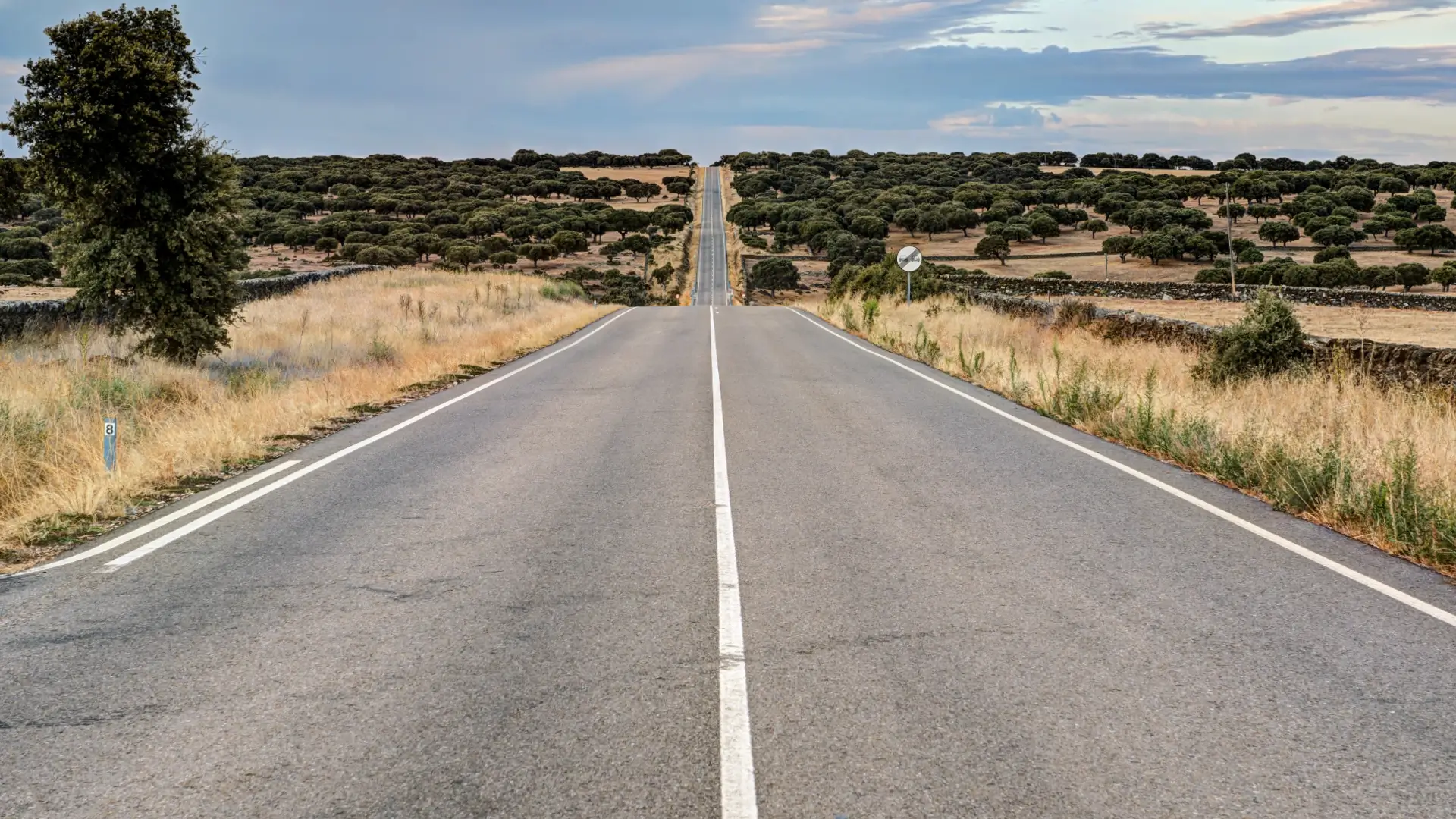
Castilla y León Road Trip: One Week
Land in Madrid, pick up a car, and drive one big loop through Castilla y León — the walled cities of the south and the great cathedral towns of the north, at an easy pace.
- Fly into / out ofMadrid (MAD) — round trip
- Duration6 days, 5 nights
- Total distanceAbout 915 km
- NightsSegovia ×1 · Salamanca ×1 · León ×2 · Burgos ×1
- Best forCar (hired at the airport)
- DifficultyEasy, motorways and good main roads the whole way
- Best seasonMay – June and September – October
- PaceRelaxed
Why this Trip?
Castilla y León is the biggest region in Spain, and its treasures sit far apart on a wide, open plateau. Two of Spain’s finest Gothic cathedrals. Three of its best-kept city walls. A Roman aqueduct that still stands after two thousand years, and one of only three Gaudí buildings outside Catalonia. All of it sits within a week’s easy driving. This loop strings the sights together so you don’t have to plan a thing. You get the famous places and the quiet roads between them, without the coach-tour crowds who only ever see one city in a day.
One region, two halves, one loop
The region already has two natural clusters. In the south sit the walled cities: Segovia with its aqueduct, Ávila behind its perfect ring of stone, and golden Salamanca. In the north run the cathedral towns of the old pilgrim road: León, Burgos and, just off it, Gaudí's Astorga. A single city break only ever shows you one of these. This road trip joins both halves into one calm circle. It starts and ends at Madrid's airport, so a first-time visitor sees the full sweep of Castilla y León in a week.
How it's paced and who it's for
This is a relaxed plan, not a checklist sprint. Most driving days are under two and a half hours, often broken by a lunch stop in a town worth seeing in its own right. You sleep two nights in León so the middle of the trip has no packing and unpacking. It suits travellers who like history, old streets and good regional food, and who would rather drive quiet main roads than fight city traffic. You do not need to be an early riser or a hard walker. If you want to slow down further, Day 4 gives you a gentle choice built right in.
Getting there and around
Madrid’s Adolfo Suárez Barajas Airport (MAD) is the gateway. It has the most flights of any airport near the region. It also sits on the north side of the city, the right side for driving straight up to Segovia. The first leg, MAD to Segovia, is about 110 km and takes around 1 hour 10 minutes on the A-6 and AP-61.
This is a round tripYou fly home from the same airport. The final leg, Burgos back to MAD, is the longest single drive of the week — about 245 km and 2 hours 30 minutes on the A-1. Plan your last day around your flight time.
Self driveHire a car at the airport on arrival and keep it until you fly home. Everything on this trip is easier by car; the region’s sights are spread out and trains between these cities are slow or indirect.
Buffer nights — read this before you book flightsThe trip itself is six days and five nights. Depending on your flight times, you may want an extra night at the airport that is not part of those five — you book it yourself, and it is not included in this plan.
- If your flight lands lateDriving an unfamiliar road after dark on your first evening is no fun. If you land in the evening, it is fine to sleep near the airport that first night and start the drive to Segovia fresh the next morning — you lose nothing but a short evening. Check your car-hire desk’s closing time first: many run to around midnight, and some offer 24-hour or key-box pickup, but not all, so on a very late landing an airport hotel plus a morning pickup is the clean fallback. See our Practical Info page for driving-in-Spain details.
- If you fly home earlyIf your return flight is early, you can spend your last night near Madrid airport instead of in Burgos — same five nights, just a different last base — so you are not rushing the 2h30 drive at dawn. This swaps a base; it does not add a day.
The Itinerary
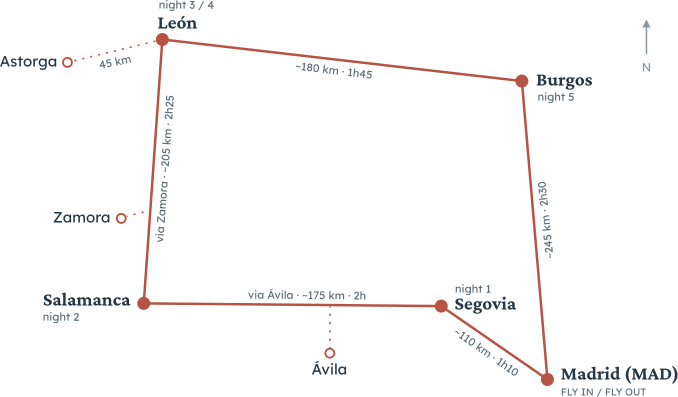
One big loop, clockwise from Madrid: up to Segovia, west to Salamanca, north to León for two nights, east to Burgos, then back down to the airport. Each leg is a comfortable drive, and most days put a second town on your plate along the way.
Day 1 — Segovia
The driveMadrid airport to Segovia, about 110 km / 1 hour 10 minutes on the A-6 and AP-61, over the Guadarrama hills. An easy first drive to shake off the flight.
The shape of the dayLand, collect the car, drive up in the late morning or afternoon, then give the rest of the day to one of Spain’s most striking small cities.
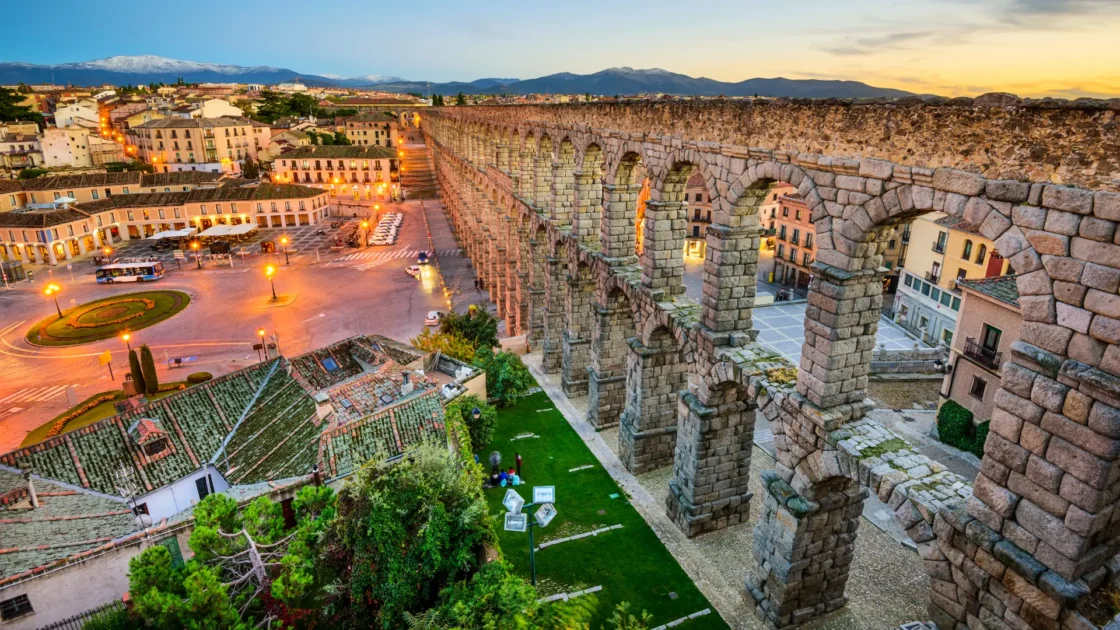
Start where everyone starts: the Roman Aqueduct, a 2,000-year-old wall of stone arches that marches straight through the middle of town with no mortar holding it up. From there a short uphill walk leads to the Alcázar, the ship-shaped castle on the cliff edge that is said to have inspired Disney’s fairy-tale look. Climb the tower for a long view over the plateau. Between the two stands the honey-coloured Cathedral, the last great Gothic church built in Spain. Allow a relaxed afternoon for all three — they are close together, and there is no need to rush.
Want a different pace?Pick at most one; it is still one day, and your base is unchanged. Slow it down: skip the tower climb and instead take the path down into the Eresma valley for the classic view back up at the Alcázar from below. Add something: the Jewish quarter and the old mint (Casa de la Moneda) make a quiet extra hour for anyone who wants more history.
Where to eatHow Day 1 eats depends on when you land. Segovia’s dish is cochinillo asado — suckling pig roasted until the skin crackles and the meat is soft enough to carve with the edge of a plate.
- Lunch tipEl Secreto de San Clemente (€€ · Bar-grill · Segovia). If you land in the morning, or start fresh from a night near Madrid airport. you’ll reach Segovia around lunchtime. This easygoing spot on the aqueduct avenue serves right through the afternoon — handy when you arrive off Spanish mealtimes — with local roast lamb, cochinillo and lighter plates, indoors or on the terrace. Open daily.
- Dinner tipAsador Maribel (€€€ · Asador · Segovia). A wood-oven asador a couple of blocks back from the aqueduct, so you eat the city’s signature roast among locals rather than in the coach-tour crush. The suckling pig and the roast lamb both come out of the same oven, crisp-skinned and tender; the welcome is warm and family-run. Open daily for dinner (closed Monday evening — on a Monday, keep it for lunch instead).
Where you sleep tonightTonight you sleep in Segovia, in the walled old town within a short walk of the aqueduct — your base for one night. See where we’d stay.
Day 2 — Salamanca
The driveSegovia to Salamanca, about 175 km / 2 hours, with a stop in Ávila on the way. Segovia to Ávila is ~1 hour; Ávila to Salamanca is another ~1 hour on the A-50.
The shape of the dayA morning sight, a lunch town, an afternoon arrival in one of Spain’s most beautiful cities, and an evening in its glowing main square.
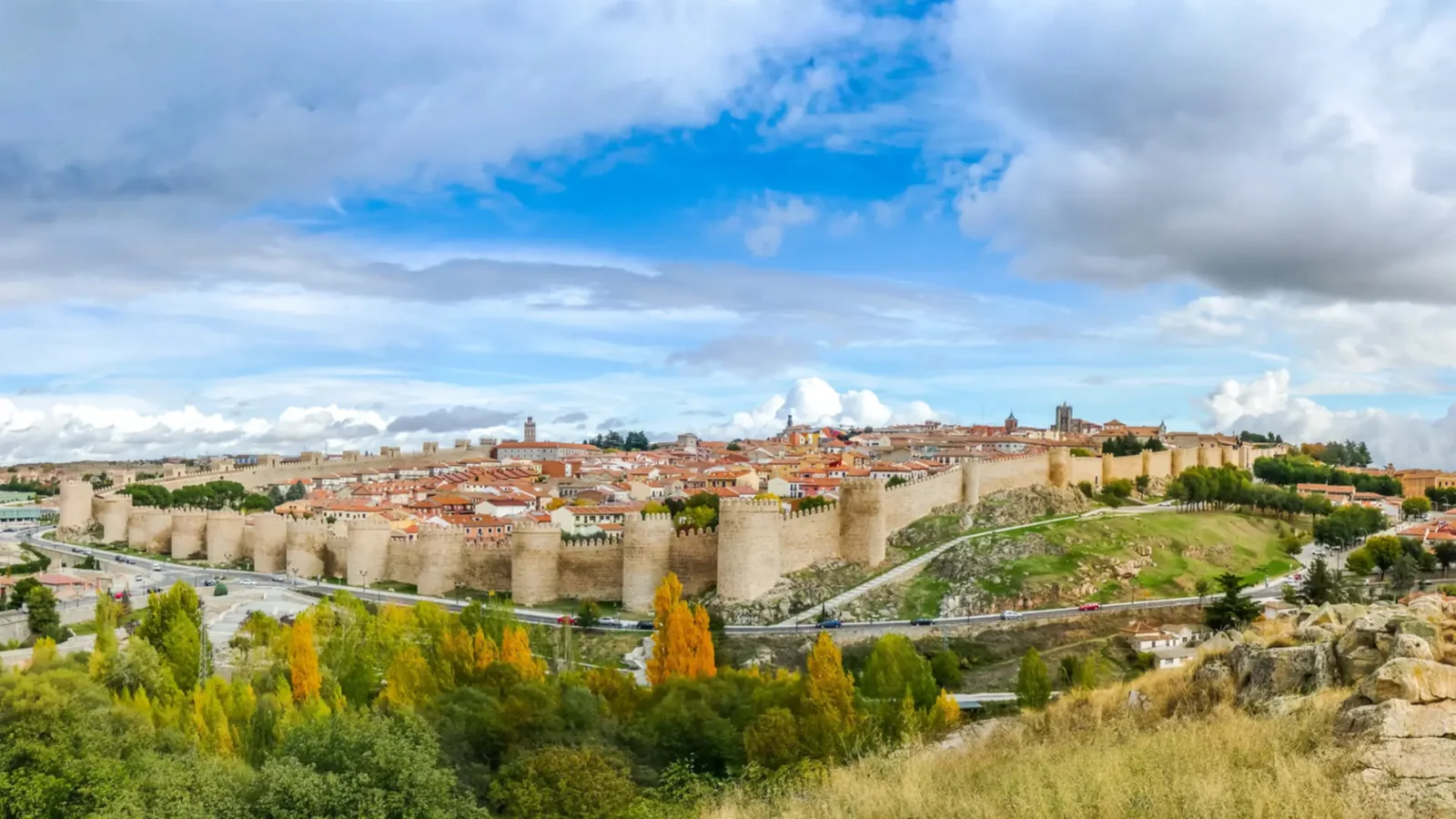
Break the drive at Ávila, wrapped in the most complete medieval walls in Spain — nearly two and a half kilometres of stone with 88 towers, and you can walk long stretches along the top. An hour or two here is plenty before lunch.

Then drive on to Salamanca, whose sandstone glows gold in the afternoon sun. Its Plaza Mayor is often called the finest in Spain. The old and new cathedrals stand side by side. The university, one of Europe’s oldest, has a carved stone façade where visitors hunt for a hidden frog. Save the Plaza Mayor for after dark, when it is floodlit and the whole city seems to gather there.
Want a different pace?Pick at most one. Slow it down: skip Ávila’s wall walk and just circle the outside on foot for the views, saving your energy for Salamanca. Add something: in Salamanca, climb the Ieronimus towers of the cathedral for a rooftop walk high above the city.
Where to eat
- Lunch tip (Ávila)Restaurante Siglodoce (€€ · Castilian · Ávila). Built right into the medieval wall beside the cathedral, this is a calm, good-value stop for the province’s famous beef chuletón and the hearty judías del Barco bean stew. Portions are generous and the set menu is honest value; open daily, so it fits whatever day you pass through.
- Dinner tip (Salamanca)Mesón Cervantes (€€ · Castilian · Salamanca). An old first-floor dining room with a balcony over the Plaza Mayor — you get the floodlit square without paying pure terrace prices. Reliable Castilian grills, tapas and a well-priced menú del día; open daily. On its main-square location it draws visitors, but the kitchen stays genuinely local in what it cooks.
Where you sleep tonightTonight you sleep in Salamanca, in the old town near the Plaza Mayor — your base for one night. See where we’d stay.
Day 3 — León
The driveSalamanca to León, about 205 km / 2 hours 25 minutes, with a lunch stop in Zamora. Salamanca to Zamora is ~55 minutes; Zamora to León is ~1 hour 30 minutes on the A-66.
The shape of the dayA short morning drive to a quiet riverside city for lunch and a wander, then on to León for two nights.

First stop is Zamora, a calm town on the Duero with the highest concentration of Romanesque churches in Europe. There are more than twenty of them, small and solid and often empty. Its riverside cathedral has an unusual scaled, dome-like tower. Give it a couple of hours and a long lunch; it rarely feels crowded. Then drive north to León. Arriving in the late afternoon leaves the evening free for the Barrio Húmedo, the old tapas quarter, where a drink still comes with a free small plate.
Want a different pace?Pick at most one. Slow it down: skip the church-hunting in Zamora and just walk the old walls and the stone bridge before lunch. Add something: in León, an evening visit to the cathedral to see the stained glass is worth the short wait until the light is low.
Where to eat
- Lunch tip (Zamora)Asador Casa Mariano, (€€€ · Asador · Zamora). A family-run asador with its own wood oven, turning out some of the best lechazo (milk-fed roast lamb) in town, plus good starters and homemade desserts. Service is old-school and unhurried — a proper long Castilian lunch. Closed Tuesday; if you pass through on a Tuesday, try El Rincón del Tío Jerónimo (€€ · Castilian · Zamora) instead, a warm local spot known for rabbit, grilled sweetbreads and cod (that one is closed Monday).
- Dinner tip (León)La Bodega del Húmedo (€€ · Castilian · León). In the heart of the Barrio Húmedo tapas quarter, this is a friendly, buzzy spot for León’s own flavours: cecina (air-dried beef), morcilla, and a good Iberian rice. Open daily, and a fine place to feel the evening rhythm of the old town.
Where you sleep tonightTonight you sleep in León, near the cathedral and the Barrio Húmedo — your base for two nights, so unpack properly. See where we’d stay.
Day 4 — León and Astorga
The driveNo long drive today. León is yours, with an optional short hop to Astorga, about 45 km / 40 minutes each way on the A-71.
The shape of the dayA slow morning in León, then either an afternoon trip to Astorga or a gentle day in the city — your choice.
León’s Cathedral is the reason to be here: its walls are made almost entirely of stained glass, over 1,800 square metres of it, so on a bright day the interior floods with colour. Nearby stands the Casa Botines, an early building by Antoni Gaudí, and the Basílica de San Isidoro, whose painted royal tombs are called the “Sistine Chapel of the Romanesque.” A relaxed morning covers all three.
In the afternoon, consider the short drive to Astorga, a small hilltop town with two big surprises. The first is the fairy-tale Episcopal Palace by Gaudí, one of only three Gaudí buildings outside Catalonia, and open daily. The second is a fine Roman past you can still walk through. 2026 marks 100 years since Gaudí’s death, so it is a fitting year to see both his León and Astorga work.
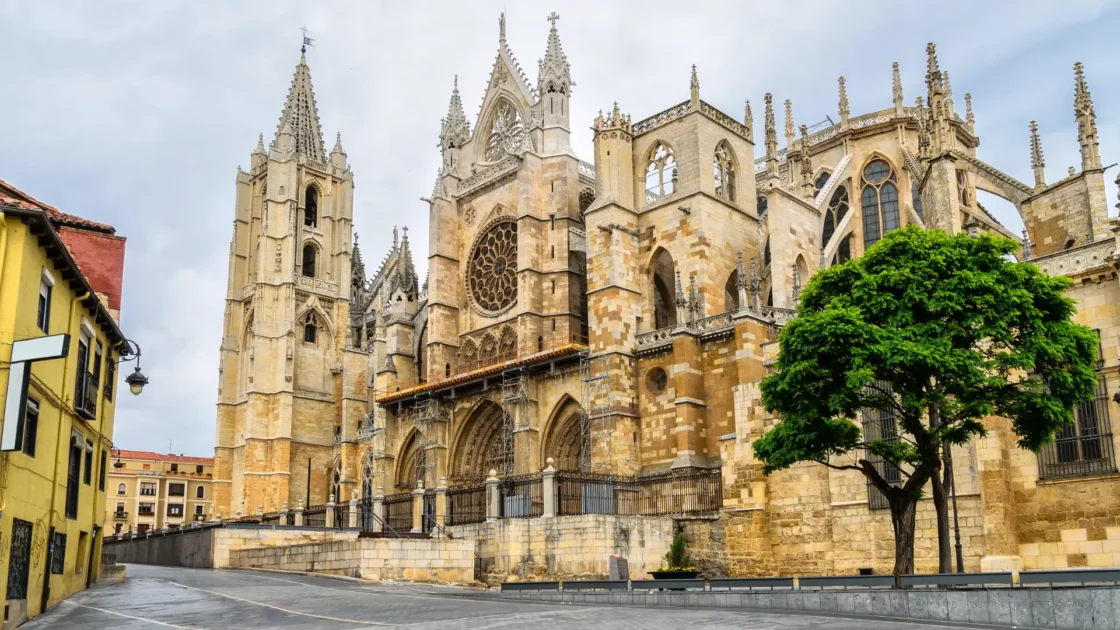
Want a different pace?Pick at most one; the day stays a single day and your base is unchanged. The full plan: León in the morning, Astorga in the afternoon. Slow it down: skip Astorga entirely and spend the whole day in León at walking pace — the cathedral, a long lunch, the old quarter, and the riverside — a genuine rest day in the middle of the trip.
Where to eat
- Lunch tip (Astorga, if you go)Las Termas (€€ · Maragato · Astorga). Astorga’s dish is cocido maragato, a huge feast eaten backwards: the meats first, then the chickpeas and cabbage, then the soup, then dessert. Las Termas is a warm, family-run house that serves it beautifully as a fixed menu — arrive hungry and leave slowly. Closed Monday; on a Monday, Casa Maragata II (€€ · Maragato · Astorga) serves the same feast (that one is closed Wednesday and Thursday).
- Lunch tip (if you stay in León)the Barrio Húmedo bars from Day 3 are open at midday too — an easy, low-key plate-and-a-glass without planning.
- Dinner tip (León)La Gitana (€€ · Castilian · León). A long-standing Barrio Húmedo favourite with a good-value set menu and a hot-stone steak locals still rate; a different corner of the quarter from last night’s dinner. Closed Tuesday — if that lands tonight, stay with La Bodega del Húmedo from Day 3.
Where you sleep tonightA second night in León — no need to move. See where we’d stay.
Day 5 — Burgos
The driveLeón to Burgos, about 180 km / 1 hour 45 minutes on the free A-231, the “Camino de Santiago motorway” across the open plain. Watch for crosswinds on the exposed stretches.
The shape of the dayA straightforward morning drive, then an afternoon and evening in Burgos, home to one of the greatest Gothic cathedrals in Spain.
Burgos is built around its Cathedral, a UNESCO World Heritage Site and a masterpiece of Gothic stonework, all spires, star-vaults and carved chapels. It holds the tomb of El Cid, the medieval hero born nearby, and it is open daily. Around it, the old town is made for an evening stroll. Take in the arched Arco de Santa María gate, the leafy riverside walk, and the hilltop castle viewpoint above. Allow the afternoon for the cathedral and a wander.
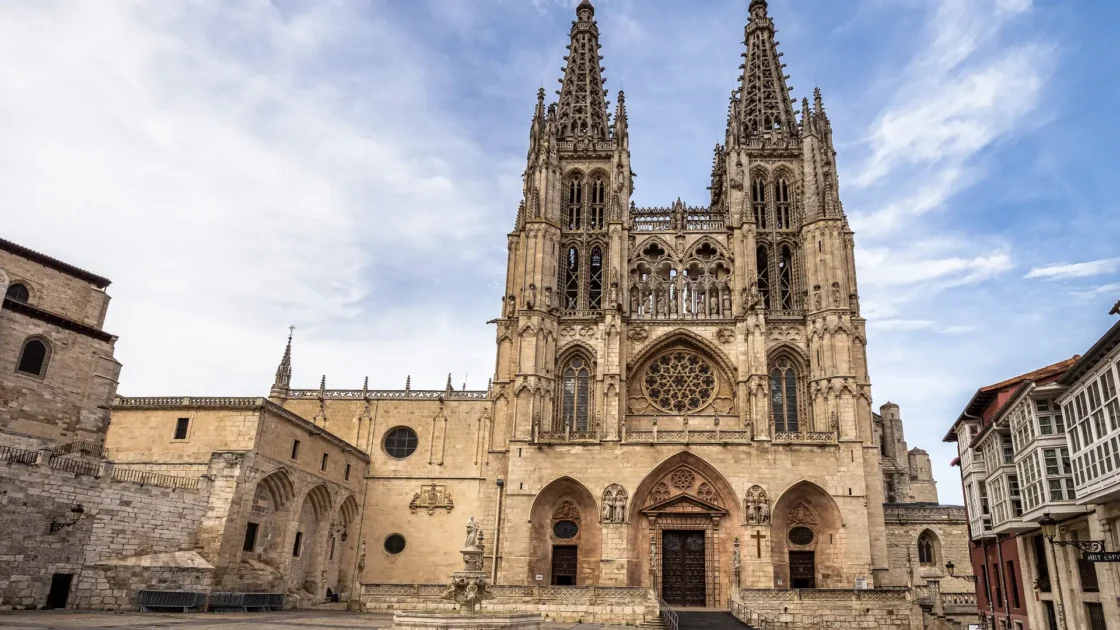
Want a different pace?Pick at most one. Slow it down: skip the castle climb and take the riverside paseo instead, ending with a drink under the arches. Add something: the Museum of Human Evolution in Burgos is world-class, tied to the nearby Atapuerca dig sites — an easy extra hour or two for anyone interested.
Where to eatBurgos is lamb-and-blood-sausage country — lechazo (milk-fed roast lamb) and morcilla de Burgos, the local rice blood sausage.
- Lunch tipAsador Los Trillos (€€€ · Asador · Burgos). A traditional asador near the centre where the wood-oven lechazo is the thing to order, finished with a homemade flan. It’s a lunch house by tradition, which suits an afternoon arrival perfectly. Confirm evening service if you’d rather go later.
- Dinner tipRestaurante Azofra (€€ · Asador · Burgos). A dependable family-run kitchen serving lechazo and grills into the evening most nights — a reliable dinner option in a city where many asadores only open for lunch. Closed Sunday evening. For a more celebrated (but busier) alternative, Casa Ojeda by the Arco de Santa María is a Burgos institution — but it’s closed Monday and serves dinner only Thursday to Saturday, so it’s easiest as a lunch.
Where you sleep tonightTonight you sleep in Burgos, in the old town near the cathedral — your base for one night. See where we’d stay.
Day 6 — Home
The driveBurgos back to Madrid airport, about 245 km / 2 hours 30 minutes on the A-1 — the longest single leg of the trip. Leave a comfortable margin before your flight.
There is no sightseeing programme today; it is the run home. If your flight is early, remember the buffer-night option in “getting there“: you can spend the final night near the airport instead of in Burgos, keeping the same five nights but shortening the last morning. Return the car at the airport and fly home.
That is the full loop — the south and the north of Castilla y León in one relaxed week.
Practical Info
- Roads are easyThis loop uses motorways and good main roads throughout. The A-231 (León–Burgos) and A-1 (Burgos–Madrid) are toll-free; the AP-61 near Segovia has a small toll. No mountain-pass driving is needed.
- Crosswinds on the plainThe open plateau between León and Burgos can be windy — keep both hands on the wheel on exposed stretches.
- Low-emission zones (ZBE)León and Burgos have low-emission zones in their centres, and Segovia’s status has changed back and forth. A standard modern hire car is fine, but park at your hotel or in a signed public car park rather than driving deep into the historic core.
- Monuments and meals keep Spanish hoursMany kitchens serve lunch only from about 1:30 pm and dinner from 8 pm or later. Cathedrals here open daily, but smaller museums often close on Mondays — check ahead for anything specific.
- FuelDistances between cities are real — this is a big, empty region — so fill up when you can on longer legs and don’t leave the tank low overnight.
- Driving an electric car?It works well here, with one caveat. The A-1 (Burgos–Madrid) has fast chargers roughly every 50 km, but the León–Burgos plateau leg has fewer, so plan that stretch with a charging app before you set off. On the plus side, a zero-emissions car enters the León and Burgos low-emission zones freely and often parks cheaper — the hire company supplies the car with its Spanish emissions label already sorted.
- Meal times, plan around themSpanish kitchens keep their own hours, and this is the single most useful thing to know for a road trip. Lunch is served from about 1pm to 4pm (locals eat around 2pm), then most kitchens close until 8pm or later for dinner. The gap to watch is mid to late afternoon: arrive at a restaurant after about 4pm and you will usually find only cafés and tapas bars serving, not full kitchens. So on driving days, aim to sit down for lunch by around 2pm, and don’t count on a proper hot lunch at 5pm. Many smaller sights and shops also close in the early afternoon — plan lunch as a real break rather than fighting the rhythm.
- FoodThe food is meat-heavy and portions are generous; the regional roasts (suckling pig in Segovia, lamb in Burgos, cocido in Astorga) are best at lunch, when you have the afternoon to walk them off.
- Best monthsMay–June and September–October give warm days and thinner crowds. July and August are hot on the plateau; winter is cold but clear, and the cities look wonderful under a blue winter sky.

Where we’d Stay
Your five nights, in order — one strong pick per night, chosen so you can just book and go, all verified bookable directly on Booking.com. Two nights are in León, so you settle in there for the middle of the trip. Where a town has its own place page, a link routes you to the full range across every budget.
Hotel Don Felipe
In the old Jewish quarter, with a garden and a sun terrace looking straight at the Alcázar. Comfortable, well-run and walkable to every sight, it’s a dependable mid-range choice with its own parking.
Check prices & availability for Hotel Don Felipe on the accommodation's websiteParador de Salamanca
A modern Parador across the Tormes, whose great draw is the view: rooms and terrace look straight back at the golden cathedral skyline over the river. It’s a short, pleasant walk into the centre, with easy parking — the classic choice if you want the postcard panorama from your window.
Check prices & availability for Parador de Salamanca on the accommodation's websiteHotel Neru con Encanto
A modern, well-run small hotel on a quiet street in the historic centre, walkable to everything, with a calm, comfortable feel after a day on your feet.
Check prices & availability for Hotel Neru con Encanto on the accommodation's websiteCrisol Mesón del Cid
A classic hotel right opposite the cathedral, with some rooms looking straight onto the spires. Ask for a cathedral-view room and you can watch it light up from bed.
Check prices & availability for Crisol Mesón del Cid on the accommodation's website
Frequently Asked Questions
A Castilla y León road trip works well in about six days. That is enough to loop from Madrid through the southern walled cities (Segovia, Ávila, Salamanca) and the northern cathedral towns (León, Burgos, Astorga) at a relaxed pace, without long daily drives. Two weeks would let you add Valladolid, Soria and the Ribera del Duero wine country, but one week covers the headline sights comfortably.
Fly into Madrid (MAD) for a Castilla y León road trip. Madrid’s Barajas Airport has by far the most US and UK flights of any airport near the region, and it sits on the north side of the city, a straightforward 1-hour-10-minute drive up to Segovia, the first stop on this loop.
Yes — you really need a car in Castilla y León. The region is vast and its cities sit far apart on an open plateau, with slow or indirect train links between them. A hire car lets you drive the quiet main roads at your own pace and reach the smaller stops, like Ávila, Zamora and Astorga, that public transport makes awkward.
Driving in Castilla y León is easy. This loop uses motorways and good main roads the whole way, with no mountain passes; most days are under two and a half hours behind the wheel. The one thing to watch is crosswind on the open plain between León and Burgos, where the land is very flat and exposed.
The best time to visit Castilla y León is May–June or September–October, when the days are warm and the cities are quieter. July and August are hot on the high plateau, while winter is cold but often bright and clear — the cathedrals of León and Burgos look magnificent against a blue winter sky.
No — a six-day Castilla y León road trip is not rushed if you follow this plan. Drives are short, most days pair one main city with a lunch stop, and you sleep two nights in León so the middle of the trip has no packing. It is built as a relaxed loop, not a race between cathedrals.
Yes — this Castilla y León road trip can be fully tailored. The ready-made loop is a starting point; if you want it shaped to your own dates, party size, budget and pace, our Custom Route Service does exactly that, adding or trimming stops to fit the trip you actually want.
Yes — you can do this Castilla y León road trip in an electric car, with a little planning on one leg. The A-1 between Burgos and Madrid is a main motorway corridor with fast chargers roughly every 50 km. The quieter León-to-Burgos leg across the plateau has fewer, so plan that stretch ahead using a charging app. An electric car is actually an advantage in the towns: with a zero-emissions label it enters the low-emission zones of León and Burgos freely, and often parks cheaper.
Yes — the Gaudí Palace (Episcopal Palace) in Astorga is worth the short 45-minute drive from León. It is one of only three Gaudí buildings outside Catalonia, and 2026 marks 100 years since his death, which makes it a fitting year to pair it with his Casa Botines in León. Astorga also has a fine Roman past and its own famous stew, cocido maragato.