

Pedraza: a walled village where the day-trippers leave and the evening stays
Pedraza is a small walled village in Castilla y León, set on a hill about 35 km north-east of Segovia. One gate lets you in. Inside are honey-coloured stone houses, a colonnaded main square and a castle on the cliff edge. It fills with day-trippers on summer weekends and empties midweek. Come when it is quiet, or stay the night, and the old village is yours.
Why Visit Pedraza
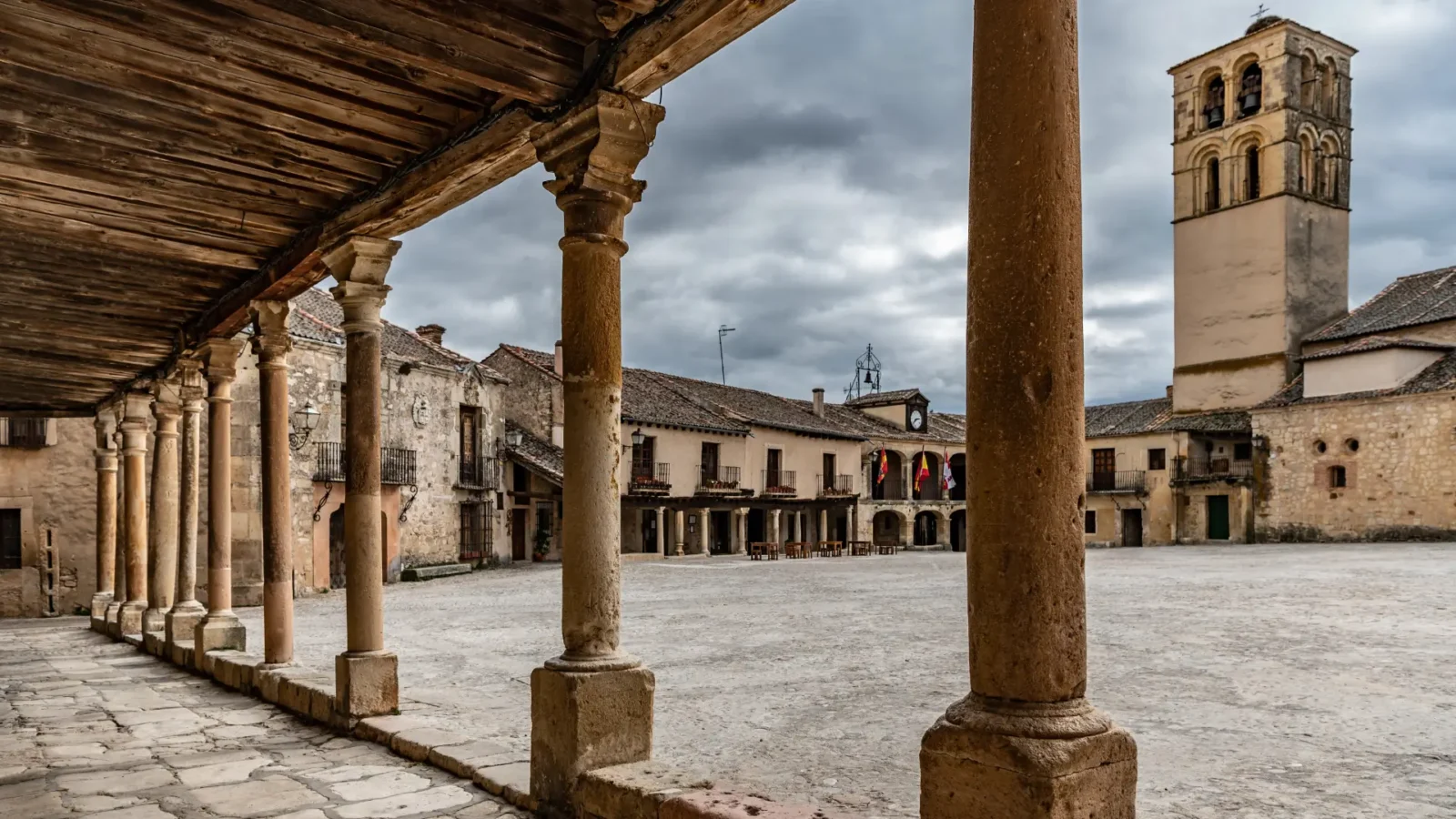
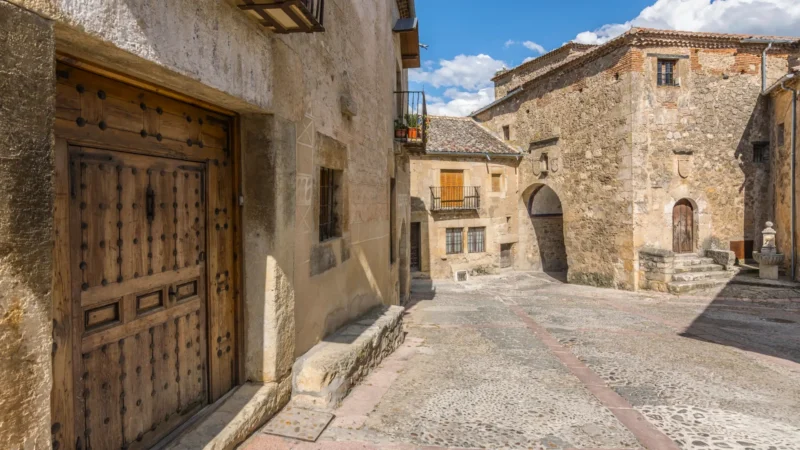
Most Spanish hill villages have grown outward over the years. Pedraza has not. It is still fully walled, and you still enter it the medieval way, through one gate, the Puerta de la Villa. Inside, cars mostly stay out and the streets are stone. The stone houses carry the coats of arms of the families who once lived here. The village grew rich on wool in the 16th and 17th centuries. That money built the mansions you walk past today.
It is a small place. You can see the main sights in an afternoon: the gate, the medieval jail built into it, the colonnaded Plaza Mayor, the church tower and the castle on its rock. What makes Pedraza worth more than an afternoon is the rhythm of the place. On summer weekends and on the famous candlelit July nights, it fills with visitors from Segovia and Madrid. Midweek and out of season, it is almost empty, and that is when the walled village is at its best.
Who Pedraza is for
This is the quiet counterweight to Segovia. Segovia has the aqueduct and the crowds; Pedraza has the silence after the coaches leave. It suits the traveller who wants an unspoiled medieval village, a slow evening, and a very good roast-lamb dinner, rather than a checklist of monuments. If you are touring the Segovia area by car, it is an easy, rewarding detour.
Day trip or overnight?
You can see Pedraza in an afternoon, and many people do, driving up from Segovia or Madrid, walking the square and the castle, and driving back. That works, but it means leaving just as the village gets good. The day-trippers go home in the late afternoon, the streets empty, and the low sun turns the stone gold. Our honest advice: stay the night. A perfect short visit looks like this. Arrive after lunch and start at the Puerta de la Villa and the old jail. Walk the Calle Real up to the castle, then take the dirt path around its outside for the cliff-edge view. Head back to the Plaza Mayor for a glass of local wine under the arcades. Have a slow roast-lamb dinner inside the walls. Then walk the empty lanes after dark, when the village is quiet and lamplit and almost entirely yours.
What to See in Pedraza

Puerta de la Villa
This is the only way in and out of the walled village, and it always has been. The gate goes back to the village’s medieval defences, and the coat of arms of the Fernández de Velasco family, lords of Pedraza for centuries, sits above the arch. The jail is built into the same structure, so the first thing you see is also part of the second.
Cárcel de la Villa (medieval jail)
Set into the gate is one of the best-preserved medieval village jails in Spain, open as a small museum since the 1990s. A short guided visit takes you down through two levels of cells, the upper one for minor offenders and the lower dungeon for the worst, with the old stocks and shackles still in place. It is run by the Fundación Villa de Pedraza, and the visit lasts around 20 minutes.
Plaza Mayor
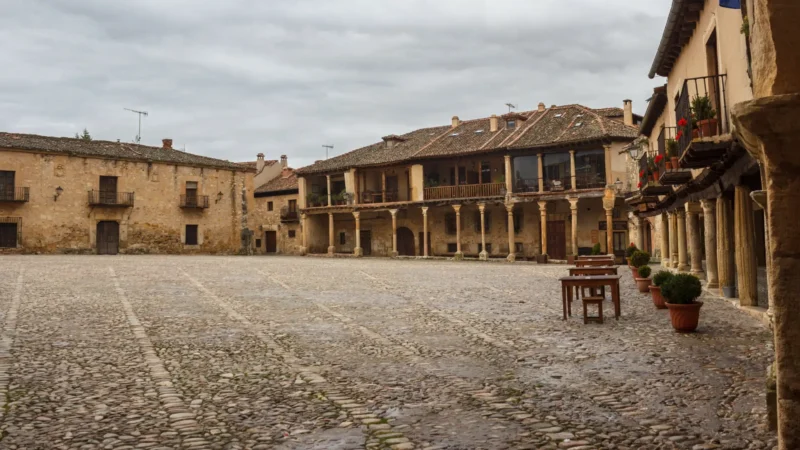
The heart of the village, and for many the finest square in the province. It is irregular in shape, not a neat rectangle, and ringed by stone columns and wooden balconies. The columns were reused over the centuries from older buildings, so no two are quite alike. There are cafés under the arcades, and the church tower rises straight off one corner.
Iglesia de San Juan Bautista
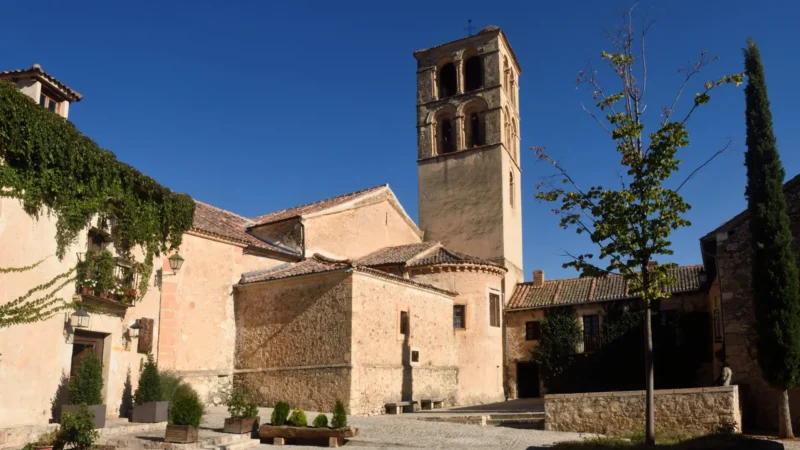
The church on the Plaza Mayor is Romanesque in origin, from the 13th century, though later centuries reshaped the inside. Its landmark is the tall stone tower with a double row of arches, one of the defining shapes of the village skyline. It is the only church in Pedraza still open for worship.
Castillo de Pedraza (Zuloaga Museum)
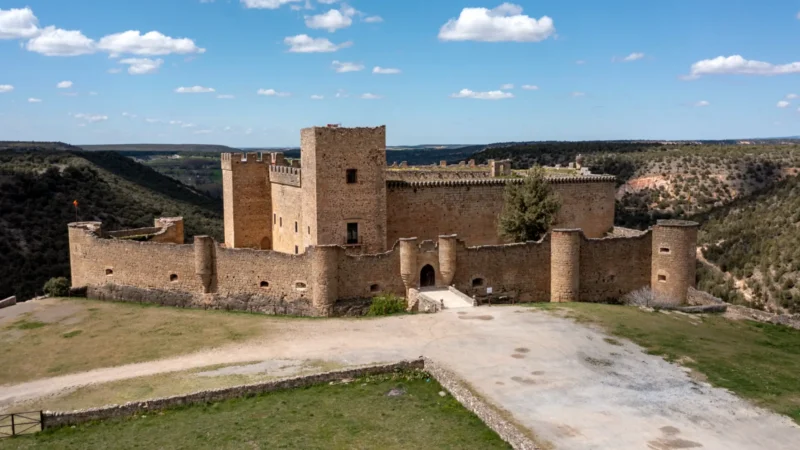
The castle sits on the very edge of the rock, ringed by a drop on almost every side. Its origins are old, built in the 13th century over earlier Roman and Arab remains, and rebuilt in the 15th by the powerful families who held Pedraza. The Basque painter Ignacio Zuloaga bought it in the 1920s and made it his home and studio. His family later opened part of it as a museum, in the keep, showing his own paintings alongside works he collected, including a Greco and a Goya. Since 2024 the castle has had new owners, who are turning it into a cultural-events venue while keeping it open to visitors by guided tour.

What to Do in Pedraza
Walk the old village slowly
Pedraza is small enough to walk end to end in minutes, but it rewards going slowly. Follow the Calle Real from the gate up toward the castle, looking for the carved coats of arms above the doorways, then wander off into the side lanes, which are quieter still. A free map from the tourist office marks the main points; the pleasure is in the wandering between them.
Catch the castle at golden hour
The set-piece of any evening here is the walk out to the castle at sunset. Take the dirt path that circles the outside of the fortress, mind your footing near the edge, and you get the keep silhouetted against the sky with the valley falling away below. It is the spot that explains why a painter chose to live here, and it is best once the day visitors have gone.
Walk the walls to the Mirador de las Tongueras
Stretches of the old wall still ring the village, and a short walk brings you to open viewpoints over the valley and the Sierra de Guadarrama beyond. Head for the Mirador de las Tongueras, on the edge of the village. It gives a wide look over the countryside, and shows just how the walled hilltop sits above the land around it. Quiet, free, and best in the soft light of early evening.
Visit the Cueva de los Enebralejos
About 12 km away, near Prádena, this is the most important cave in the province. Inside are limestone formations, prehistoric engravings and Bronze Age burials, with a small archaeological display and a reconstructed prehistoric settlement above ground. It makes an easy half-day trip from Pedraza for anyone travelling with children or wanting a break from stone streets.
Prefer to go with a guide for any of this? Ask where you’re staying, or at the tourist office on Calle Real — they’ll know what’s running, in which language, and can point you to something that fits.
Seasonal Events and Festivals
Noche de las Velas / Conciertos de las Velas (first two Saturdays of July)This is Pedraza’s signature event, and its busiest moment by far. On the first and second Saturdays of July, the village switches off its street lighting after dark and lights tens of thousands of candles along its streets, squares and balconies, with a classical concert on the castle esplanade. It has run since 1993 and is organised by the Fundación Villa de Pedraza. It is not a secret; it draws visitors from across Spain and abroad, tickets sell out in advance, and on those nights you need a pass to enter the village at all. Treat it as the one time Pedraza is full rather than empty, and book far ahead. Check the official Fundación Villa de Pedraza source for the exact dates and ticketing each year.
Fiestas de la Virgen del Carrascal (September)The village’s patronal festival, with religious and popular events over several days in early autumn. Dates shift year to year; check locally.
Getting There and Around
Pedraza sits on a hill in the north-east of Segovia province, reached by a short country road off the N-110 between Segovia and the Somosierra pass.
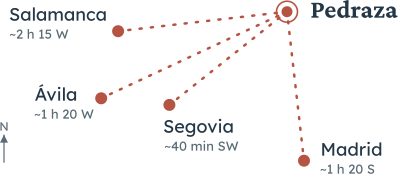
From Segoviaabout 40 minutes by car (roughly 35 km), the natural base and the obvious pairing.
From Madridabout 1 hour 15–20 minutes by car (roughly 120 km), north via the A-1 and the N-110.
From Ávilaabout 1 hour 20–30 minutes by car (roughly 100 km), usually via Segovia.
Nearest airportsMadrid-Barajas (MAD) is the closest major airport, about 120 km and roughly 1 hour 15 by car; it is where almost every international visitor will land and pick up a car.
By public transportservices are limited and awkward; there is no easy train, and buses are sparse. This is a place you reach by car.
Getting around
You do not need a car inside Pedraza. The walled village is tiny and walkable, and traffic mostly stays out, so you park below the walls and walk up through the gate. But you do want a car for the area. Pedraza works best as one stop on a wider Segovia road trip, and the things around it — Segovia itself, the Duratón gorge, the Cueva de los Enebralejos, La Granja — all assume you are driving. Park in the lots at the foot of the village rather than trying to drive into the old streets.
Looking for a ready-made plan? See our Castilla y León road trips.
Practical Info
- Getting inentry to the village is free and on foot through the Puerta de la Villa on normal days. On the two candlelit July Saturdays only, access is controlled and you need a pass or concert ticket to enter — book ahead.
- Tickets for the sightsthe jail and the castle-museum are visited by short guided tours, bought on the day; hours change with the season and the castle is closed on some weekdays. Rather than rely on printed prices, check the tourist office for current hours and fees.
- Best time of daylate afternoon into evening, once the day-trip traffic thins. The village is at its most photogenic at sunset from the castle path.
- Parkinguse the car parks below the walls; the old streets are narrow and mostly closed to through traffic.
- ClimatePedraza sits high, around 1,070 m, so it runs cooler than lower Castile. July is the warmest month, averaging about 21°C with daytime highs that can reach the low-to-mid 30s in a hot spell; January is coldest, averaging around 2°C with hard frosts. It is driest in July and wettest in spring and early winter. The most comfortable months are late spring and early autumn.
Where to Eat in Pedraza
You’ll eat and drink well in Pedraza, and eating well here means one thing above all: roast meat. This is roast-lamb country: lechazo and cochinillo, slow-cooked in wood-fired ovens. The village punches far above its size for good tables, several of them clustered right on the Plaza Mayor. Two simple rules make it easy: for a lighter lunch while you are out walking, the square and its arcades have easy, good-value spots; for dinner, sit down properly inside the walls and give the roast the evening it deserves. Book ahead on weekends, and order the lamb or suckling pig when you reserve, as the best kitchens cook it to order.
A long-standing favourite for the full Castilian roast, with cochinillo and lechazo done well and generous portions of the local judiones (large white beans).
A handsome ivy-covered house on a small square just off the Plaza Mayor, known for carefully cooked roast lamb and suckling pig and a warm dining room. A reliable special-occasion table.
A family-run restaurant in the heart of the village with a shaded courtyard, fair prices and a loyal following. Good roast meats, gazpacho and local wine, and a pleasant spot for a long lunch.
Right on the Plaza Mayor under the arcades, with a good-value set lunch and a busy, friendly room. A dependable choice when you want to eat on the square itself.
Casa Felisa – La Calesa
A carefully run kitchen beside the main square, mixing the classic Castilian dishes with a few more modern plates, plus a terrace and bar for a drink or coffee.
A characterful spot with a more formal restaurant and an informal tavern side, and prime tables out on the Plaza Mayor. Good for a relaxed meal with plenty of local flavour.

Where to Stay in Pedraza
The whole case for staying is the evening. Once the last cars roll back down to Segovia and Madrid, the gate quietens, the lamps come on, and the walled village settles into a silence that day visitors never see. That is the Pedraza worth booking a bed for. There are enough characterful places inside and just below the walls to make it easy. All of the picks below are bookable online. The price levels are a guide, and you can check current rates through the links.
Hospedería de Santo Domingo
A hotel set in an early-18th-century noble house in the old Jewish quarter, with valley views and a strong local reputation. Traditional stone-and-beam character, a short walk from the Plaza Mayor. A comfortable, central mid-range base.
Check prices & availability for Hospedería de Santo Domingo on the accommodation's websiteHotel Mirador del Vadillo
A rural hotel just below the walls, well-liked for its calm, its cleanliness and the wide valley views from the rooms and terrace. An easy, restful choice with breakfast included and parking nearby.
Check prices & availability for Hotel Mirador del Vadillo on Booking.comEl Hotel de la Villa
A small character hotel inside the village, with individually styled rooms and a restaurant. The familiar, higher-comfort option for those who want a proper hotel within the walls.
Check prices & availability for El Hotel de la Villa on the accommodation's websiteSantamaría – Mirador de Pedraza
An upper-tier stay on the edge of the village, prized for its outlook over Pedraza and the sierra. The choice for a special weekend, when the view from the balcony is part of the point.
Check prices & availability for Santamaría – Mirador de Pedraza on the accommodation's websiteEl Bulín de Pedraza – Casa del Serrador
A characterful self-catering casa rural steps from the centre, good for couples or a small group who want their own stone-walled space and the run of the village after dark. Balcony and full kitchen.
Check prices & availability for El Bulín de Pedraza – Casa del Serrador on the accommodation's websiteHostería del Arco
A simple, friendly two-star with a bar, garden and restaurant, and the most affordable beds in the village. The budget pick for travellers who want to wake up inside the walls without paying for a view.
Check prices & availability for Hostería del Arco on the accommodation's website
Region, Nearby and Routes
Part of Castilla y León
Pedraza is in Segovia — Castilla y León
Part of these routes
Pedraza is a quiet detour off the Segovia day on our The Three Walled Cities road trip
Nearby places
- ÁvilaSpain’s most complete medieval walls ring a high, quiet stone city — a fortress-cathedral and St Teresa’s Ávila, best after the day-trippers leave.
- SalamancaUNESCO city of golden sandstone on the Tormes — baroque Plaza Mayor, two cathedrals and Spain’s oldest university, at its liveliest after dark.
- SegoviaA high, walled city whose Roman aqueduct, fairy-tale Alcázar and Gothic cathedral make it one of Castile’s great sights.
- La Granja de San IldefonsoA royal palace and Versailles-style gardens in cool pine hills — the Bourbon kings’ summer retreat, still calm today.
Frequently Asked Questions
Yes. It is one of the best-preserved walled medieval villages in Castile, entered through a single gate, with a clifftop castle and a colonnaded Plaza Mayor that is among the finest squares in the province. It is small, so pair it with Segovia or with the countryside around it, and time your visit for midweek or the evening to avoid the summer-weekend crowds.
Yes, easily. It is about 40 minutes from Segovia and around 1 hour 15 from Madrid by car, and you can see the village in an afternoon. But the village is at its best in the evening, once the day-trippers leave, so staying the night is the better choice if you can.
On the first two Saturdays of July, Pedraza turns off its street lighting after dark and lights tens of thousands of candles through the village, with a classical concert by the castle. It is the busiest event of the year, tickets sell out in advance, and on those nights you need a pass to enter the village. Check the official Fundación Villa de Pedraza source for each year’s dates.
Half a day is enough to walk the village and see the main sights. To get the best of it, stay overnight: an afternoon and evening, a roast-lamb dinner, and the quiet lamplit streets after dark, then leave in the morning.
Late spring and early autumn are the most comfortable, roughly in the high teens to low twenties Celsius. July, the warmest month, averages about 21°C but can reach the low-to-mid 30s; January, the coldest, averages around 2°C with hard frosts. It is driest in July and wettest in spring and early winter. Sitting at about 1,070 m, Pedraza stays cooler than lower Castile and has big day-to-night swings, so bring a layer even in summer.
For a central mid-range base, the Hospedería de Santo Domingo, in an 18th-century house in the old Jewish quarter, or the Hotel Mirador del Vadillo just below the walls, both with valley views. For more comfort inside the village, El Hotel de la Villa or the view-focused Santamaría – Mirador de Pedraza. On a budget, the simple Hostería del Arco has the most affordable beds in the village, and El Bulín de Pedraza is a good self-catering casa rural.
This is roast-lamb and suckling-pig country. El Jardín and La Olma de Pedraza are the standout tables for the full Castilian roast, while El Corral de Joaquina and El Soportal are dependable, good-value choices, several of them right on the Plaza Mayor. Book ahead on weekends and order the roast when you reserve.