
Campo de Criptana: The Giants Above the White Town
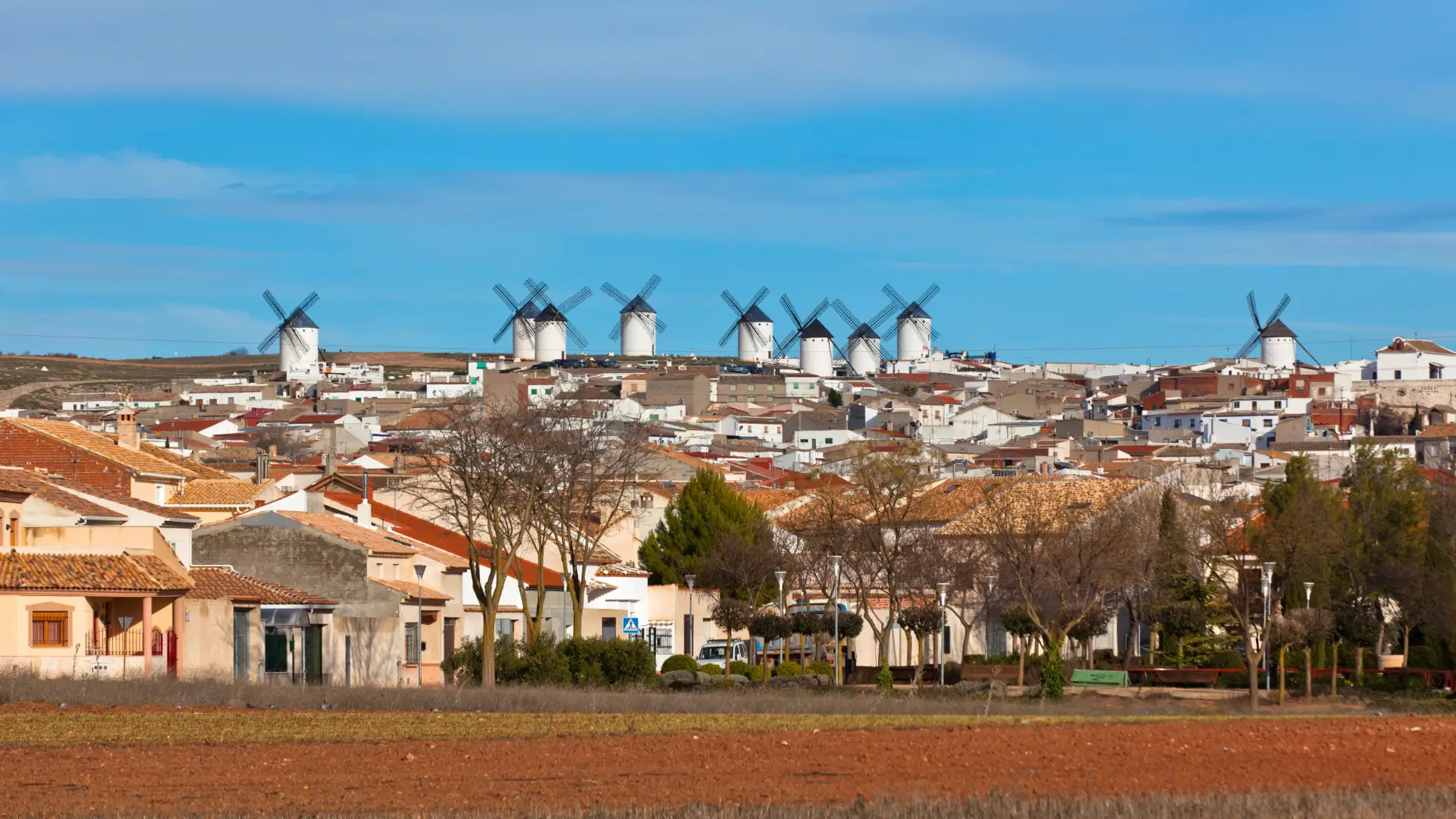
Campo de Criptana is a windmill town in Ciudad Real, in the heart of La Mancha. Ten white mills line the hill above it — the giants Don Quixote charged in Cervantes’ book. What sets this town apart is how close the mills sit to daily life: they rise straight from the whitewashed Albaicín quarter, not a lonely ridge. Come early or late, and the giants are yours alone.
Why Visit Campo de Criptana
Everyone comes for the windmills, and they are worth the trip. Ten of them stand in a line along the Sierra de los Molinos, their white towers and dark sails cut sharp against the sky. Three are true survivors from the 16th century, with their original wooden gears still inside. This is the exact spot that Cervantes turned into giants, and the view is one of the most famous in Spain.
What makes Campo de Criptana different
Plenty of towns in La Mancha have windmills. What makes Campo de Criptana stand out is how the mills and the town knit together. The hill drops straight into the Albaicín, a steep quarter of low white houses with deep-blue skirting and old cave homes cut into the rock. You walk up through lived-in streets to reach the giants, not across an empty car park. That mix of grand view and real town is the town's quiet advantage over its neighbours.
Day trip or overnight?
You can see the mills in an afternoon, and many people do — a quick stop between Madrid and the south. But that means arriving with the coaches and leaving before the best light. Our honest advice: stay the night. A perfect short visit looks like this. Reach the Sierra de los Molinos in the late afternoon, when the crowds thin and the sails glow warm. Walk down into the Albaicín as the light drops, past blue-and-white houses to the Plaza Mayor. Eat well over a long dinner. Then climb back up at dawn, when the giants stand alone against a pink sky and the town below is still asleep. That morning hour is the reason to stay, and it never fits inside a day trip.
What to See in Campo de Criptana
Sierra de los Molinos — the ten windmills
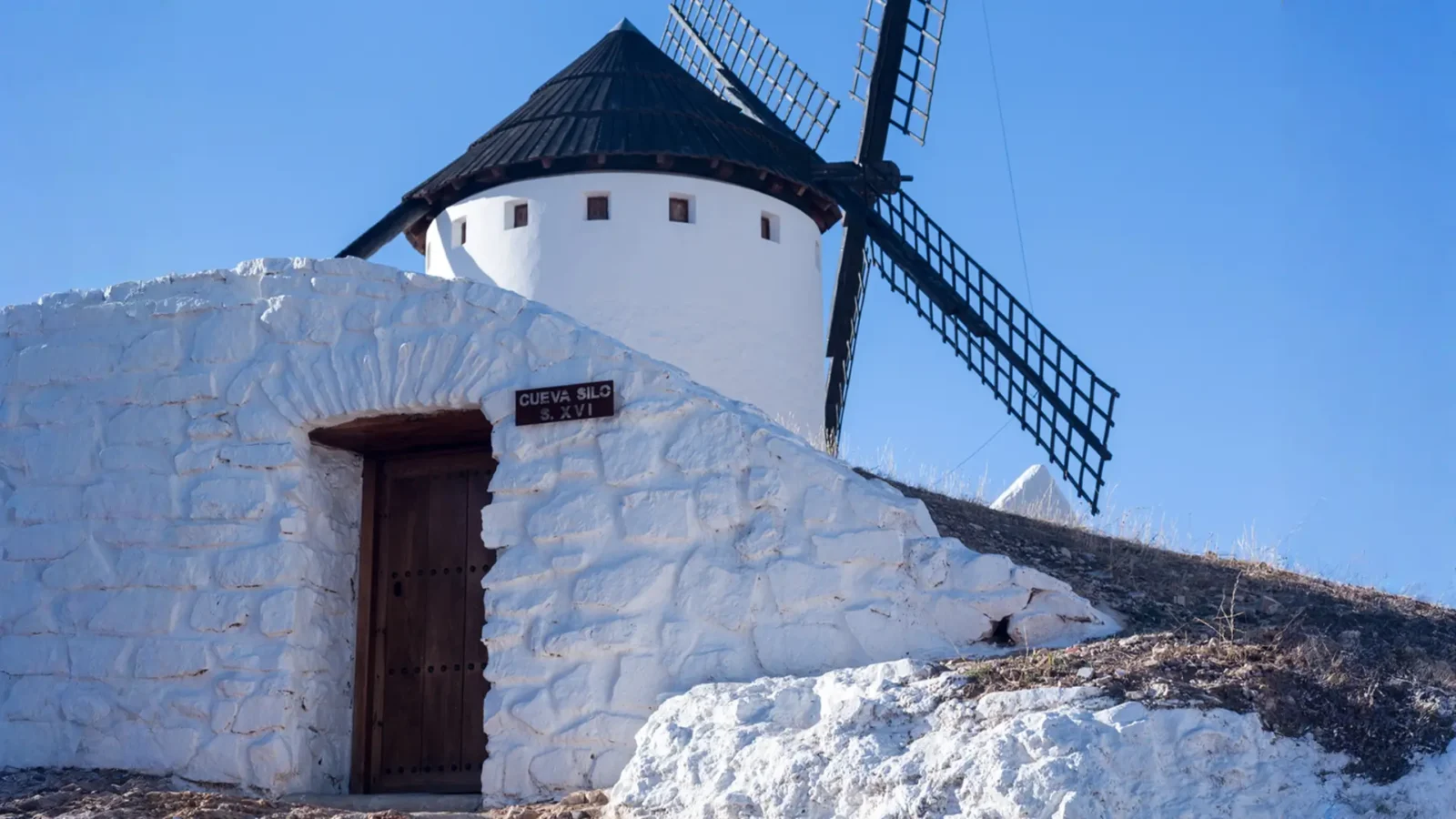
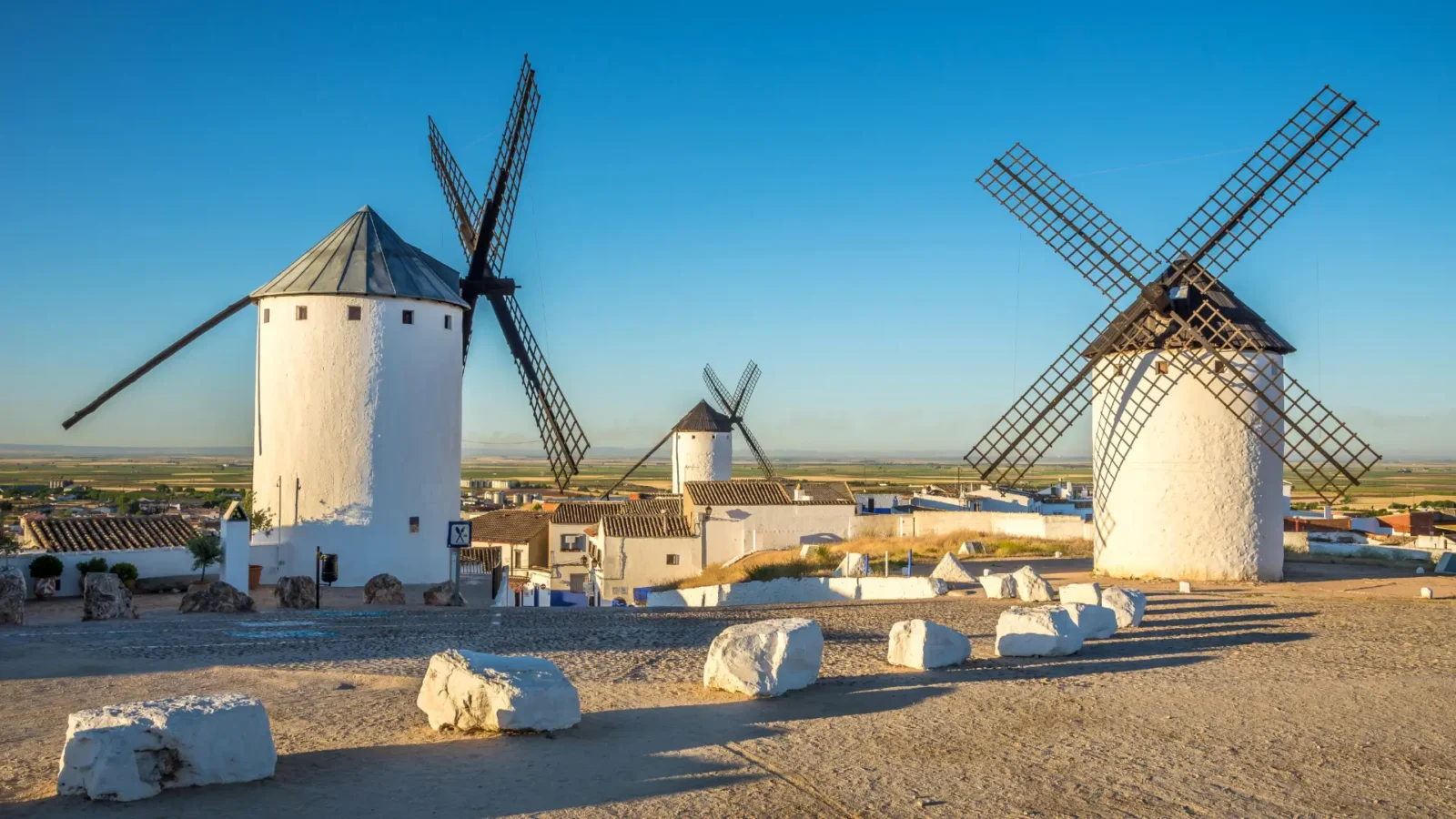
Ten white tower mills line the hill above the town, on the Sierra de los Molinos and the neighbouring Cerro de la Paz. Once there were more than thirty; the ten that remain were declared protected monuments in 1978. Three — Infanto, Burleta and Sardinero — keep their original 16th-century workings. On the first Sunday of most months, the Burleta is set turning again in a live milling demonstration. The wide gravel space around the mills is open and free to walk at any hour.
The visitable mills and their museums
Several mills are open inside, each with a small display, and you buy tickets at the tourist office. Infanto and Burleta show the old milling machinery itself. The Culebro holds a museum to Sara Montiel, the singer and film star born in the town, with costumes, posters and a piano from her career. The Quimera keeps a collection of miniature Holy Week floats. The Poyatos is the tourist information point. It’s a compact, low-cost way to see how the giants actually worked.
Plaza Mayor and the Church of the Asunción
The main square is the town’s meeting point, ringed by the town hall and the tall parish church of Nuestra Señora de la Asunción. The church was rebuilt in 1958 after the earlier one burned in the Civil War, and its high bell tower is a landmark from all over town. Inside are stained glass, altar paintings and two old wooden carvings worth a look.
Barrio del Albaicín
The old heart of the town spills down the hillside below the mills in a tangle of steep, narrow lanes. Its low white houses wear a band of deep indigo at the base, and several old cave homes are cut back into the rock. It shares its name with the famous quarter in Granada and has the same climbing, whitewashed feel. Walking up through it to the giants is half the pleasure of a visit.
Pósito Real (Museo Municipal)
This sturdy 16th-century building near the square was once the town grain store and farmers’ bank, lending grain to growers in hard years. Its doorway carries the arms of Philip II and two shields recalling the Order of Santiago, which once held the town. Today it houses the municipal museum, with a permanent display of local archaeology.
What to Do in Campo de Criptana
Walk the windmill hill at golden hour
The single best thing to do is simple and free: walk the crest of the Sierra de los Molinos as the day cools. The open ground between the mills gives long views over the plain in every direction. The light on the white towers is at its best in the last hour before sunset and the first after dawn. Go up on foot from the town rather than driving straight to the top — the climb through the Albaicín is part of it.
Explore the Albaicín and its cave houses
Give yourself an unhurried hour in the old quarter below the mills. Wander the blue-and-white lanes, look into the small chapels, and see how the old cave homes were dug into the hillside. The tourist office runs guided visits to some of the caves for anyone who wants to step inside one.
Taste the local La Mancha wine
Campo de Criptana sits in La Mancha, Spain’s largest wine region, and the plain around it is a sea of vines. Several local wineries welcome visitors for a look at how the wine is made and a tasting of the young reds and whites of the area. A tasting with a grower is the easy way to understand why this dry, sunny plain makes the wine it does. Ask at the tourist office who is open to visitors and when.
Join an evening walk up to the mills (summer)
On summer evenings the town runs a guided walk called Criptana bajo las estrellas — “Criptana under the stars” — up through the Albaicín to the Sierra de los Molinos at dusk. It’s a lovely, low-key way to see the giants in the cool of the night. It plays straight into the reason to be here: the hours after the day-trippers have gone. The walks run on set evenings through summer. Ask at the tourist office or check the town’s events calendar for the current dates.
Prefer to go with a guide for any of this? Ask where you’re staying, or at the tourist office in the Molino Poyatos up on the Sierra de los Molinos — they’ll know what’s running, in which language, and can point you to something that fits.
Seasonal Events and Festivals
Campo de Criptana keeps a full calendar, much of it built around the mills and the town’s patron saints. Dates shift from year to year unless noted, so check the current programme with the tourist office before you plan around one.
Carnival (February)a lively few days of costumes and satire, with the town’s comic troupes taking to the Teatro Cervantes.
Holy Week / Semana Santa (spring, moves with Easter)one of the town’s biggest events, listed as being of Regional Tourist Interest, with processions dating back to the 1560s. On Easter Monday, the town carries the Virgin of Criptana up to her hilltop shrine in a popular pilgrimage.
Cruces de Mayo (early May)flower-decked crosses set up around the streets and squares.
Music among the mills (July–August)through high summer the town stages concerts in striking spots, including the Sierra de los Molinos itself and the Cerro de la Paz, mixing classical, jazz and flamenco. The wine-and-music strand, AirenFest, runs on the Cerro de la Paz around late spring and summer.
Criptana bajo las estrellas (summer evenings)a run of guided dusk walks up to the Sierra de los Molinos and through the Albaicín, on set evenings from June to September.
Feria y Fiestas del Cristo de Villajos (late August)the big patron-saint fair that closes the summer, held around 23–28 August. It opens with a 1960s-themed “Fiesta Ye-yé” up on the windmill hill and fills the Plaza Mayor with music, food and dancing.
For exact dates each year, check with the town tourist office or the town council’s official events calendar
Getting There and Around
Campo de Criptana sits in the north-east of Ciudad Real province, on the flat Mancha plain, just off the A-43 and close to the main Madrid–Alicante rail line.
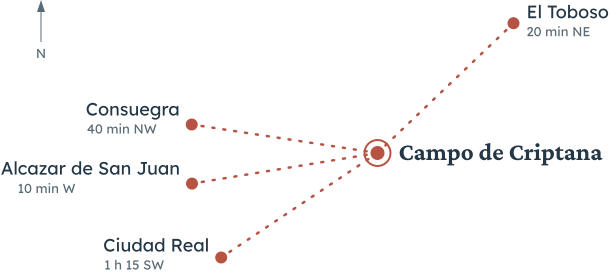
From Madridabout 1 hour 40 minutes by car (roughly 170 km) via the A-4 and A-43. Direct trains also run from Madrid to Criptana station in under two hours.
From Alcázar de San Juanabout 10 minutes by car (roughly 9 km); this is the nearest big rail hub, with frequent trains linking the two in about 6 minutes.
From Consuegraabout 40 minutes by car (roughly 52 km) — the other great windmill town, and the neighbouring stop on the Don Quixote route.
Nearest airportMadrid–Barajas (MAD) is the practical gateway, about 170 km and 1 hour 40 minutes by road, or reachable by train via Madrid.
By trainCampo de Criptana has its own station on the Madrid–Alicante line, with direct services from Madrid; Alcázar de San Juan, one stop away, adds more connections.
Getting around
You don’t need a car inside Campo de Criptana. The town is small and easy to walk, and the climb up to the mills is best done on foot. Park in the town or in the car park by the Sierra de los Molinos. But you do want a car for the wider trip. The Don Quixote towns — Consuegra, El Toboso and the rest — sit apart on the plain, and the region rewards driving between them at your own pace.
Looking for a ready-made plan? See our Castilla-La Mancha road trips.
Practical Info
- TicketsThe mills’ outer area is free to walk at any time. To go inside the visitable mills and their small museums, buy a ticket at the tourist office; combined tickets covering several mills work out cheaper than paying one by one. Ask about the monthly live-milling day if you want to see a mill actually turning. Prices and opening hours change with the season, so check them with the tourist office on the day rather than trusting a fixed figure online.
- Getting around townThe town is walkable; leave the car in the town or the windmill car park and go up on foot.
- Best time of dayEarly morning and late afternoon, for soft light on the mills and far fewer people. Midday in summer is hot and exposed up on the hill.
- ClimateSummers are hot and very dry — July and August highs sit around 33–34°C, with cool nights. The most comfortable months are May, June, September and early October, roughly 18–24°C by day. Winters are cold, with December and January highs near 11°C. Most rain falls in spring and autumn; high summer is almost rainless.
Where to Eat in Campo de Criptana
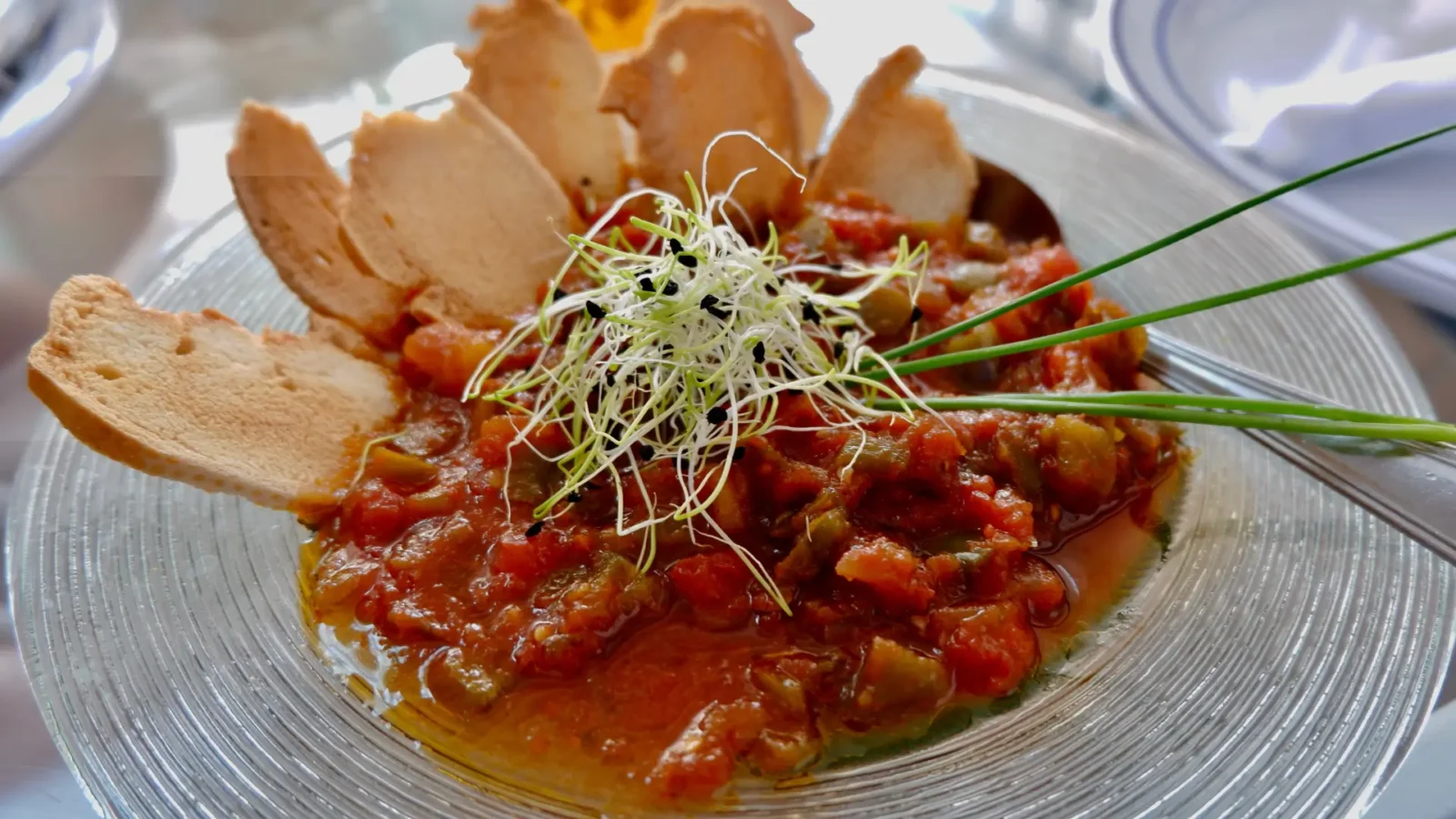
You’ll eat and drink well in Campo de Criptana, and it’s honest, hearty La Mancha cooking. Think slow-cooked gachas and migas, grilled Manchego lamb, strong sheep’s cheese and the young local wines. Two simple rules make it easy. For lunch while you’re out at the mills, the spots up near the Sierra do good-value plates with a view. For dinner, come down into the town and take your time. The picks below run from a windmill-view table to a classic village bar.
The town’s best-known table, set right below the mills with windmill views from the terrace and a Repsol Sun to its name. The kitchen leans on the grill — Iberian pork, aged beef — cooked over charcoal. A special-occasion lunch or dinner with the giants in sight.
A meat-focused local restaurant near the fairground, part of the Abrasador group known for its own farm-raised beef and pork. Solid grills, Manchego classics like migas, and a warm, local room.
A newer arrival bringing Galician cooking to La Mancha — octopus, scallops and good local wine alongside grilled meats. High marks from locals and a friendly, family-run feel.
A classic neighbourhood bar with paper tablecloths and honest home cooking — the kind of place people drive in for the gachas. Great value and a genuine village feel.
Right up by the windmills, with a heated terrace and a viewpoint over the town one way and the mills the other. The easy choice for a coffee, a light lunch or a glass of local wine after the climb.
Bar Castillo Gastrobar
A small, cosy spot in the old town with award-winning tapas and homely cooking. The gachas, the oxtail croquettes and the grilled sirloin are the things to order. Book ahead — it’s tiny and popular.
Where to Stay in Campo de Criptana
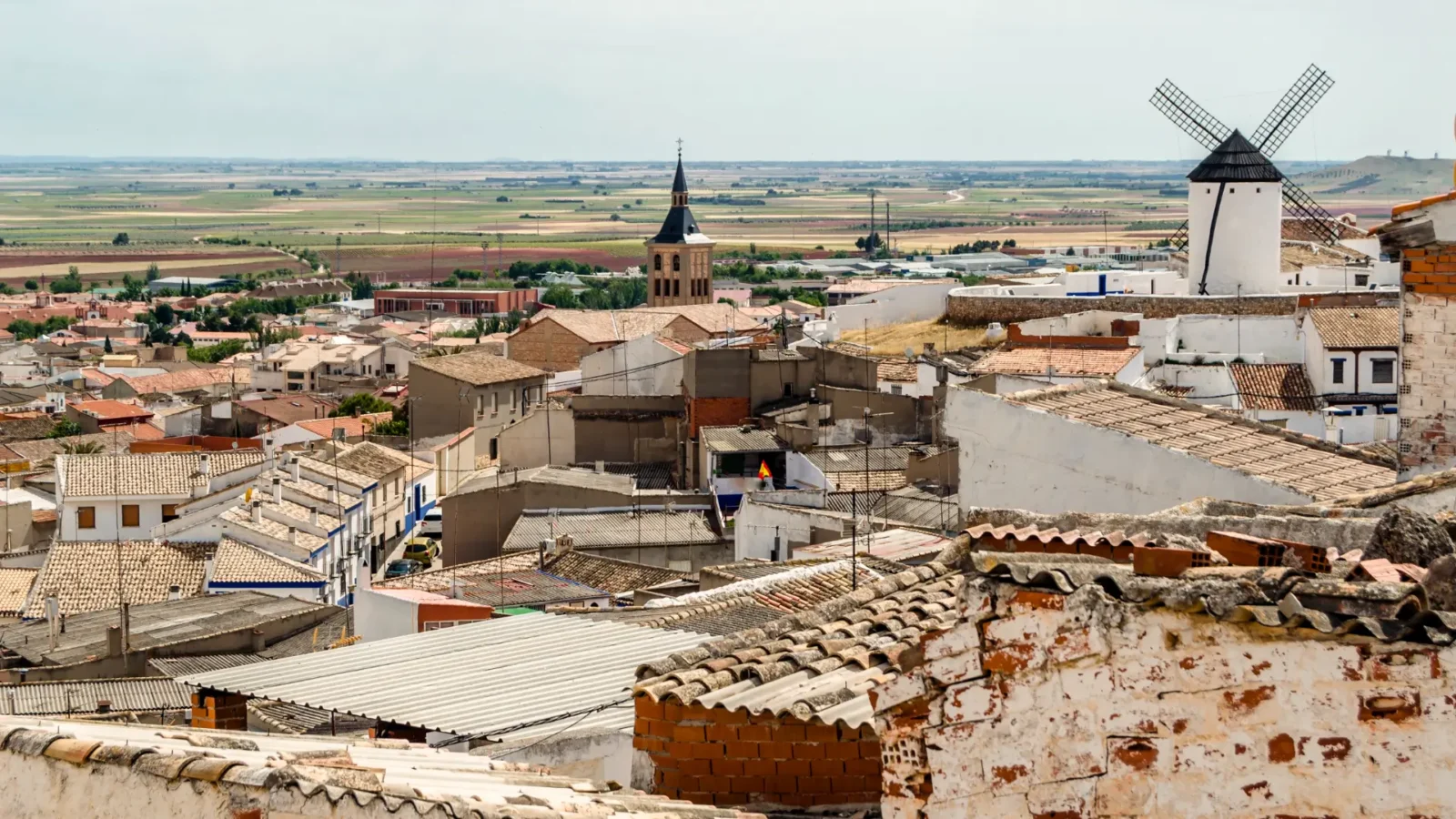
Stay the night and the town changes. Once the day-trippers have gone, you can walk up through the empty Albaicín to the mills at dusk, then again at first light. The giants and the whole plain are yours alone. Sleeping in the old quarter or right under the Sierra puts that morning within a short walk. Here’s where we’d stay.
Hotel Rural La Casa de los Tres Cielos
A restored Manchego house in the Albaicín, turned into a nine-room rural hotel with an outdoor pool, just a short walk below the mills. Comfortable, homely and very well placed for an early climb to the giants.
Check prices & availability for Hotel Rural La Casa de los Tres Cielos on the accommodation's websiteLa Casa del Bachiller
A country house right up on the Cerro de la Paz, in the heart of the Albaicín beside the windmills, with a terrace that looks straight out over the mills and the plain. Best of all for waking up next to the giants.
Check prices & availability for La Casa del Bachiller on the accommodation's websiteHotel Boutique Casa Treviño
A four-star boutique hotel in a restored 1905 mansion in the old town, with a garden, an outdoor pool and a small cave-spa. Design-led rooms and a quiet, cared-for feel, a short walk from the mills. The most polished stay in town.
Check prices & availability for Hotel Boutique Casa Treviño on the accommodation's websiteHostal Restaurante Ego's
A simple, family-run inn with clean, basic rooms and a kitchen serving traditional home cooking. Friendly, dog-friendly and very good value — a genuine taste of the pueblo, a short walk from the mills.
Check prices & availability for Hostal Restaurante Ego's on the accommodation's websiteCasa Rural Vamos Allá
A smart, modern whole-house rental at the foot of the Albaicín, minutes from both the mills and the square. Roomy and well kept, and a good-value base for a family or a group of friends.
Check prices & availability for Casa Rural Vamos Allá on the accommodation's websiteCasa de la Torrecilla
A characterful small hotel in a striking old town house, with a well-regarded restaurant of its own and a warm, personal welcome. A good base for a special, unhurried night in La Mancha.
Check prices & availability for Casa de la Torrecilla on the accommodation's website
Region, Nearby and Routes
Part of Castilla-La Mancha
Campo de Criptana is in Castilla-La Mancha
Part of these routes
Campo de Criptana is one stop on our In the Footsteps of Don Quixote road trip see the full trip.
Nearby places
- ConsuegraTwelve windmills and a Knights’ castle crown the ridge above this classic La Mancha town.
- El TobosoThe white Toledo village Cervantes gave to Dulcinea, with Quixote quotes on the walls and a Gothic church locals call the cathedral of La Mancha.
- ToledoA hilltop UNESCO city of cathedrals, synagogues and mosques, at its finest in the early and late hours.
- BelmonteA complete walled town crowned by one of Spain’s best-preserved castles, just off the windmill trail.
- Villanueva de los InfantesThe Golden Age capital of the Campo de Montiel, where Quevedo died and Don Quixote may have lived.
Frequently Asked Questions
Yes. Its ten white windmills on the hill are one of the most famous sights in La Mancha and the scene of Don Quixote’s battle with the giants. What makes it special is that the mills rise straight from a lived-in white town, not an empty ridge. Come early or late to see them without the crowds and it easily earns the stop.
It’s known for its ten restored windmills on the Sierra de los Molinos, three of them original 16th-century mills with their old machinery. It’s also the birthplace of the singer and actress Sara Montiel, whose museum sits in one of the mills, and it’s a well-known stop on the Don Quixote route.
Campo de Criptana is in the province of Ciudad Real, in Castilla-La Mancha. It sits on the Don Quixote route alongside Consuegra and El Toboso, but those two are in the neighbouring province of Toledo.
Half a day is enough to see the mills, the Albaicín and the main square. But staying the night is far better: you get the giants at sunset and again at dawn, without the day-trip coaches, and time for a proper dinner in town.
Spring and autumn are the most comfortable — May, June, September and early October run roughly 18–24°C by day. July and August are hot and dry, around 33–34°C, though the mills still shine at dawn and dusk. Winters are cold, near 11°C in December and January.
Yes. It’s about 1 hour 40 minutes by car, or under two hours by direct train, so a day trip works. But if you can, stay over — the early-morning light on the mills is the best reason to be there, and it doesn’t fit a day trip.
For a special night, the boutique Hotel Casa Treviño or the characterful Casa de la Torrecilla are the top choices. For a rural feel near the mills, La Casa de los Tres Cielos and La Casa del Bachiller sit right in the Albaicín. On a budget, the family-run Hostal Ego’s and the whole-house Casa Rural Vamos Allá are good value.
For a meal with windmill views, Las Musas below the mills is the landmark table. In town, Bar Castillo Gastrobar does award-winning tapas and Abrasador Alforja de Sancho is the place for grilled meat. For a coffee or light lunch by the mills, El Ricote has the view.