
Villanueva de los Infantes: The Town That Claims Don Quixote
Most people chase Don Quixote to the windmills. The real literary prize sits further south. Villanueva de los Infantes is the old capital of the Campo de Montiel, in Ciudad Real province. One university study names it as the village Cervantes refused to name. Francisco de Quevedo died here in 1645. You get a Golden Age town of arcades, crests and wooden balconies — and almost no tour groups.
Why Visit Villanueva de los Infantes
Villanueva de los Infantes was the capital of the Campo de Montiel from 1575, and it shows. During Spain’s Golden Age this was the cultural centre of the plains. Money and learning left behind a town of noble houses, convents and courtyards. It has been a Conjunto Histórico-Artístico since 1974, and one of the Pueblos Más Bonitos de España since 2017.
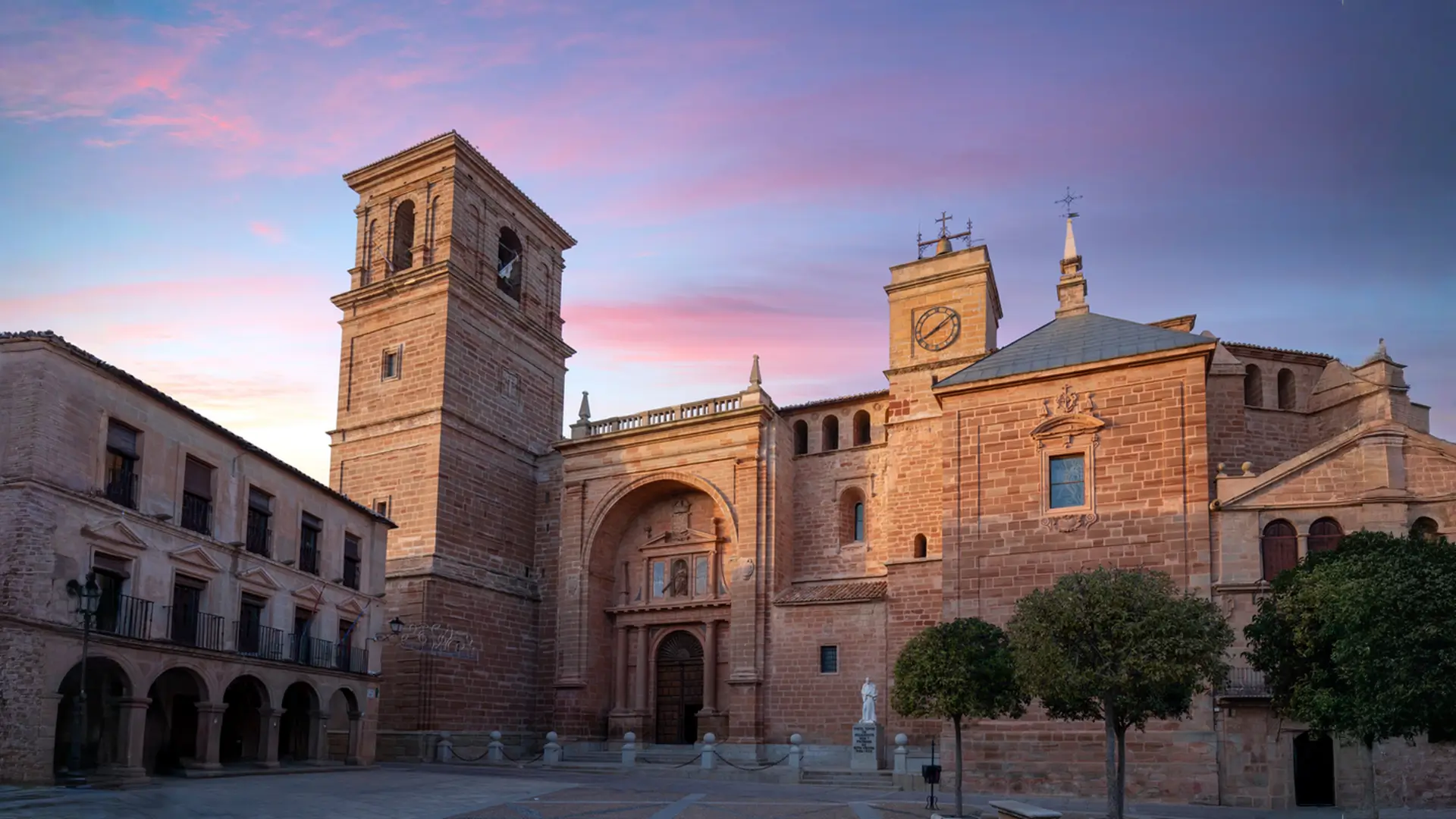
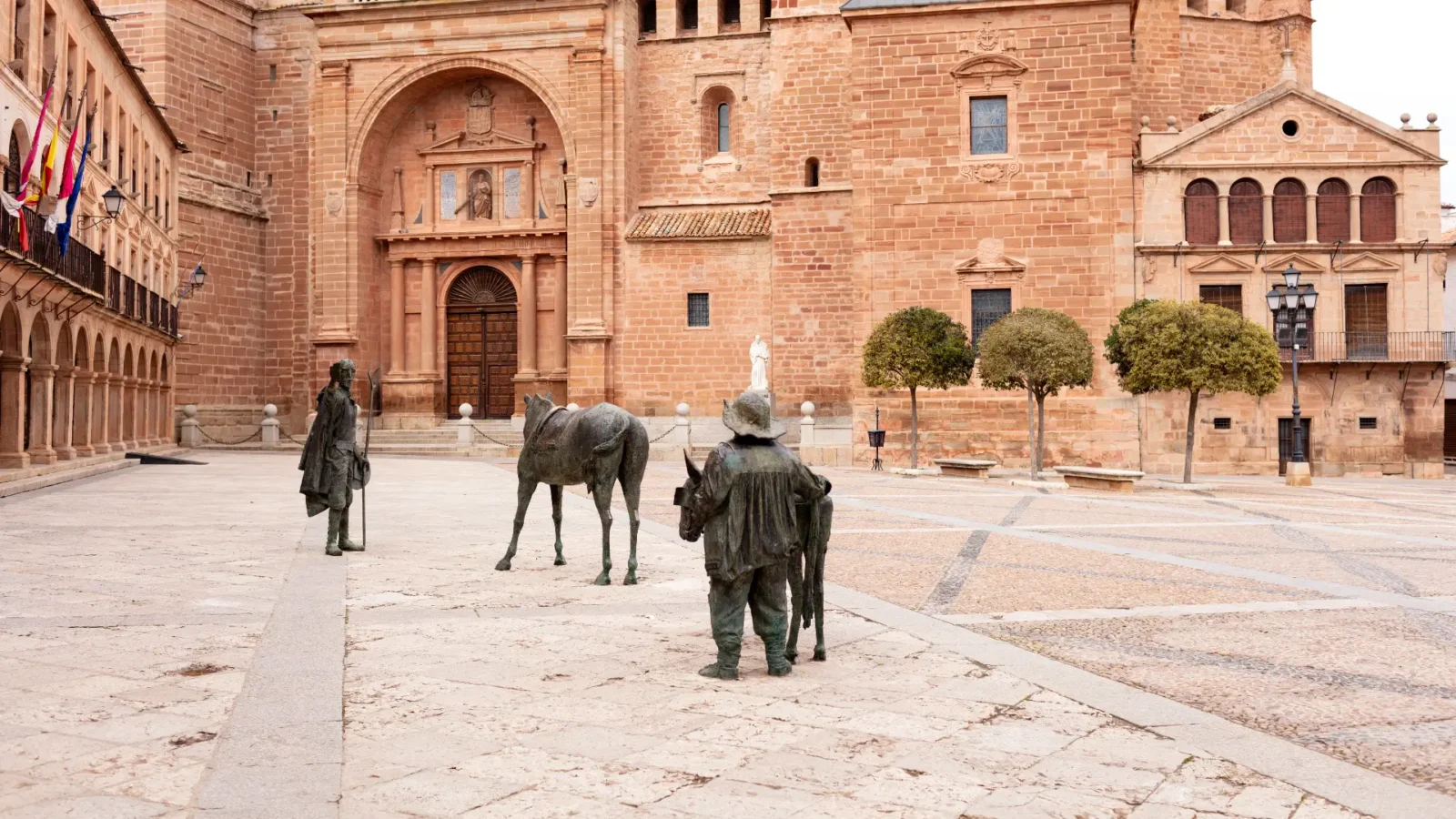
The Plaza Mayor is the reason most people stop. Two sides are stone arcades of round arches. Another carries long wooden balconies on timber posts. The Ayuntamiento sits at an angle, and the huge classical front of San Andrés closes the north side. Bronze figures of Don Quixote and Sancho stand in the middle. It is one of the finest squares in Castilla-La Mancha, and on a weekday morning you may have it to yourself.
Villanueva de los Infantes — who is it for
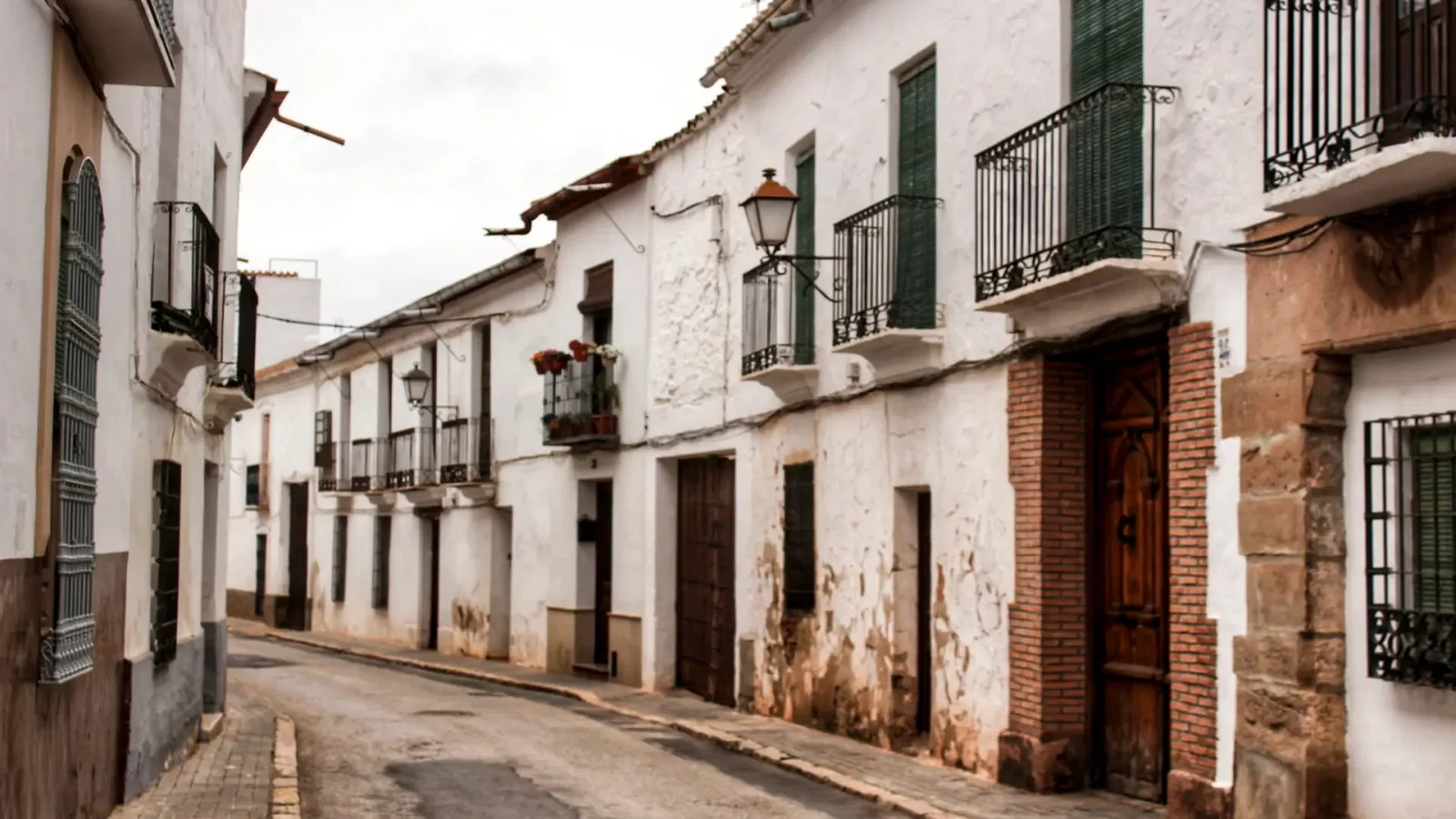
This is a town for readers, slow walkers and anyone tired of coach parties. Look up and you will count carved coats of arms on house after house. Push at an open door and you may find a Castilian courtyard with Tuscan columns and a well. Nothing here is polished for visitors, and that is the appeal. The streets stay Spanish, the bars stay local, and the town keeps its own rhythm.
Day trip or overnight?
You can see the core in an afternoon, but you would be seeing the wrong half of it. The Plaza Mayor faces the light badly at midday, and the town only comes back to life in the evening. So our Don Quixote route sleeps here on its third night, and we would do the same on any trip. A good visit looks like this. Arrive late afternoon and buy your San Andrés ticket at the tourist office in the Casa de Rueda. Walk down to the Plaza de San Juan for the Quevedo cell. Come back to the Plaza Mayor as the arcades fall into shadow, and eat on Calle Quevedo. Next morning, walk the Calle Cervantes crests before nine. Then drive out to the Santuario de la Virgen de la Antigua while the plain is still cool, and go on to the Lagunas de Ruidera in the afternoon.
What to See in Villanueva de los Infantes
Plaza Mayor
The square was built between the 15th and 17th centuries and reads as one design. Two sides are runs of round stone arches; a third carries long wooden balconies and an upper timber gallery under a deep eave. The Ayuntamiento holds the arms granted to the town by Enrique de Aragón, Master of the Order of Santiago.
Iglesia de San Andrés Apóstol
The parish church takes up the north side of the square. Its main front is a deep classical arch, framed by two late Renaissance doorways. Inside are ribbed vaults, a Plateresque pulpit and the Capilla de los Bustos, where Quevedo was buried in 1645. His remains were identified in 2007 and returned to the church.
Convento de Santo Domingo and the Quevedo cell
The convent was founded in 1526 on the southern edge of the old town, and its church was built in the 17th century. Quevedo came here from his estate at Torre de Juan Abad, looking for medical care, and died a few months later on 8 September 1645. The bare cell can be visited. The Iglesia de Santo Domingo next door is free to enter.
La Alhóndiga
Built in the mid-16th century as a grain store and trading house, this became the town prison in 1719. Prisoners cut their names and marks into the columns, and you can still read them. Today it holds the municipal library and an exhibition courtyard, and entry is free.
Casa de Rueda
A stately house beside the Plaza Mayor, now the visitor centre and tourist office. It has a beautiful Castilian courtyard and an interpretation centre upstairs. One room is devoted to the study that named this town as “el lugar de la Mancha”. Tickets for San Andrés are sold here, not at the church door.
Casa del Caballero del Verde Gabán
A 16th-century house on Calle Cervantes, the street locals still call the Calle Mayor. It is linked to Don Diego de Miranda, the Knight of the Green Coat, who hosts Don Quixote in chapter eighteen of the second part. The front and the crest are the draw; interior access is limited.
Casa Museo Francisco de Quevedo, Torre de Juan Abad
Quevedo spent years of exile on his estate at Torre de Juan Abad, 22 minutes south-west. His house there is now a small museum. The rooms are restored rather than original, so the guided visit is the real draw, and admission is low. Closed Mondays and Tuesdays. See it before the cell in Villanueva and his last journey falls into order.
Santuario de Nuestra Señora de la Antigua
The town’s patron sanctuary stands alone in the fields about five kilometres south. The chapel is small and plain, the courtyard is pretty, and a pine grove beside it is set up for picnics. Bring what you need — there is nothing to buy out here. It is a good early-morning drive before the heat builds.
What to Do in Villanueva de los Infantes
Walk the crests, doors and courtyards
Villanueva de los Infantes has one of the highest counts of carved coats of arms in Spain, and the walk is the main event. Start on the Plaza Mayor, take Calle Cervantes past the Casa del Caballero del Verde Gabán, then loop down Calle Santo Tomás to the Plaza de San Juan. Keep looking up, and glance through any open doorway: the courtyards with their Tuscan columns are half the pleasure.
Eat the Campo de Montiel plate
The local pepper is a point of pride, and the local pisto manchego is built on it. Ask for pisto with a fried egg, gachas, or duelos y quebrantos — scrambled eggs with chorizo and bacon, named in Don Quixote itself. Queso manchego and a glass of red from the Valdepeñas or La Mancha DOs finish it. Most bars around the square will serve all of this without ceremony.
Take the Quevedo and Quixote reading trail
This is the one town where the Don Quixote route stops being about windmills. Read the opening page of the novel on the square, then walk to the cell where Quevedo died. The Casa de Rueda sets out the case for this being Don Quixote’s village. It is one team’s argument, not a settled fact, which makes it better company than a plaque.
Drive out into the Campo de Montiel
The plain around the town is empty, high and quietly beautiful. Montiel is about fifteen minutes east, under the ruined Castillo de la Estrella. The castle is being restored and you cannot go inside, so this is a hillside walk and a view rather than a visit. Torre de Juan Abad, where Quevedo held his estate, is about twenty-two minutes south-west. The Lagunas de Ruidera lakes are about forty minutes north-east, and close our Don Quixote route.
Go to the Friday market
The weekly market fills the Plaza de San Juan on Friday mornings. It is a working market for local people, not a craft fair, and it is a good place to buy cheese, fruit and the local peppers in season.
Prefer to go with a guide for any of this? Ask where you’re staying, or at the tourist office in the Casa de Rueda beside the Plaza Mayor — they’ll know what’s running, in which language, and can point you to something that fits.
Seasonal Events and Festivals
Los Mayos (eves of 30 April and 2 May)Sung verses to the ladies and to the crosses of the town, on two fixed nights. A local tradition, not a show for visitors.
Festival Internacional de Música Clásica (July–August)Classical concerts in the town’s historic buildings across the high summer.
Certamen Internacional de la Orden Literaria Francisco de Quevedo (late August)An international poetry prize founded here in 1981, with readings and talks around it.
Jornadas Cervantinas, Día del Pimiento and the Muestra Nacional de Folclore (first weekend of September)The big one. A giant pisto manchego is cooked on the square and shared with thousands of people, alongside a Cervantine market and folk groups from across Spain. If you want the town at full volume, come now — and book a bed early.
Dates shift from year to year, and the programmes are published locally rather than in English. If you are planning a trip around one of these, ask the tourist office in the Casa de Rueda or the place you are staying. Both will know what is confirmed.
Getting There and Around
Villanueva de los Infantes sits on the CM-412, the road that runs east from Valdepeñas and the A-4 motorway into the Campo de Montiel. It is 880 metres up, on open plain.
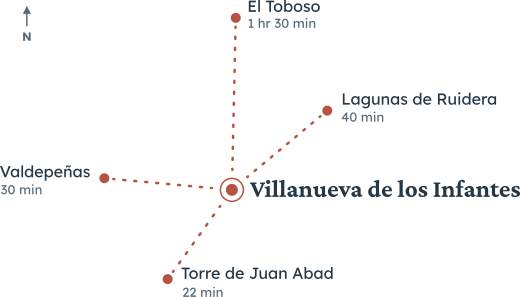
From Madridabout 2 hours 15 minutes by car, roughly 220 km, south on the A-4 and then east on the CM-412.
From Toledoabout 1 hour 45 minutes by car, roughly 170 km.
From El Tobosoabout 1 hour 30 minutes by car, straight south on good main roads. This is the Day 3 leg of our Don Quixote route.
From Valdepeñasabout 30 minutes by car, 34 km on the CM-412. This is your motorway and railway link.
On to the Lagunas de Ruideraabout 40 minutes by car, roughly 40 km north-east. This is the closing leg of our Don Quixote route.
Nearest airportMadrid-Barajas (MAD) is the practical international gateway, about 230 km. There is no useful airport closer.
By trainthere is no station in town. The nearest Renfe stop is Valdepeñas, about 30 minutes away by road; Ciudad Real has high-speed services and sits about an hour west.
By busservices are very thin — a single weekly coach from Madrid, and a few local runs. Treat public transport as unworkable here.
Getting around
You do not need a car inside the town. Everything on this page except the sanctuary is within a ten-minute walk, and the old streets are narrow. Leave the car on the edge of the centre; street parking is free and easy outside festival weekends.
You do want a car for the region, and this is the honest reason to hire one. The Campo de Montiel has no rail and almost no bus service. The good things are spread out: Montiel’s castle, Quevedo’s Torre de Juan Abad, the Lagunas de Ruidera. Without a car you will see the square and nothing else.
Fuel before you come south. Petrol stations thin out once you leave the windmill towns for the Campo de Montiel. If you are driving our Don Quixote route, fill the tank in Campo de Criptana or Alcázar de San Juan before the southern leg.
Looking for a ready-made plan? See our Castilla-La Mancha road trips.
Practical Info
- TicketsSan Andrés and the Quevedo cell each charge a small admission, with reduced rates for students and seniors. San Andrés tickets are sold at the tourist office in the Casa de Rueda, beside the Plaza Mayor, not at the church door. The Alhóndiga and the Iglesia de Santo Domingo are free. Hours change with the season and some sites close on Tuesdays. Make the Casa de Rueda your first stop and you will have the current times and prices in one go — it is a two-minute walk from the square, and staff there hold the keys to the rest.
- Best time of dayLate afternoon and early morning. The square faces the light badly at midday, and the arcades only look their best in low sun.
- ClimateJuly and August are the hottest months, with highs near 32°C. April, May, September and October are the most comfortable, with highs of roughly 17–26°C. Rain falls mainly in spring and late autumn, and April is the wettest month. The town sits at 880 metres, so winters are cold: January highs are around 10°C.
- ParkingFree street parking around the edge of the historic centre. Avoid driving into the core.
- WalkingStone paving and some slopes. The Plaza Mayor itself is flat and easy.
- LanguageEnglish is not widely spoken. A few Spanish phrases go a long way here.
- Shops and mealsSmall town hours. Lunch runs late, kitchens close in the afternoon, and Monday and Tuesday are common closing days.
Where to Eat in Villanueva de los Infantes
You’ll eat and drink well in Villanueva de los Infantes, and cheaply. This is the pepper capital of the Campo de Montiel, so the pisto manchego is the local badge of honour. The set lunch menus are some of the best value in La Mancha. Two simple rules make it easy. At lunch, take a menú del día at one of the working restaurants just off the square. Twelve to sixteen euros gets you three courses and wine. In the evening, stay on Calle Quevedo and the Plaza Mayor, where the tapas bars fill up and the arcades are lit. And if you want one serious meal, the region’s most ambitious kitchen sits twenty minutes down the road.
A small, loud, much-loved bar on Calle Quevedo, with a Sancho Panza mural outside and a heated patio for cold evenings. The fried cod is what regulars order, with a glass of La Mancha red. The warmest welcome in town.
Just outside town on the Ctra. de Murcia, set among olive trees, and the place locals book for a proper lunch. Gachas manchegas and cod are the regional plates to order here. Closed Monday and Tuesday.
Game is the whole point here — partridge, wild boar, venison and rabbit, cooked as high Campo de Montiel cuisine. It is the only Michelin-starred kitchen in the Campo de Montiel. There is no à la carte, only tasting menus, and the gastronomic room has six tables. A simpler second dining room, Origen, does stews and home-made partridge pâté in the same rural hotel without the ceremony. Book well ahead for either.
The most ambitious kitchen in town: traditional Manchego dishes given a light modern turn. The pork sirloin in Manchego cheese sauce is the dish people come back for. Worth booking, and worth the short walk out from the square.
La Trastería del Estrecho
A friendly bar a step from the Plaza Mayor, run as a two-person operation. Portions are large enough that half-rations are the smart order. The garlic prawns are done their own way. Closed Monday and Tuesday.
Restaurante La Pámpana
Old-fashioned home cooking, unpretentious and generous. The weekday set menu is very cheap and the weekend one a little wider. Desserts are made in house; the rice pudding and the flan both have a following. Closed Tuesdays.
Where to Stay in Villanueva de los Infantes
Here is the argument for staying. At about seven in the evening the day visitors drive off toward Valdepeñas. The arcades go into shadow. The Plaza Mayor then becomes what it has been for four hundred years: a square where a small Spanish town sits outside and talks. Sleep behind one of those crested doorways and you get the morning too: the crests on Calle Cervantes in first light, before anyone else is up. Six of the best options are below.
Hotel Boutique La Morada de Juan de Vargas
Seven rooms in an old house a few steps off the Plaza Mayor, run by the owners themselves. It is the best-reviewed place in town, and the reviews are mostly about the welcome. Being able to walk out to dinner and back after dark is the reason to sleep here rather than drive on.
Check prices & availability for Hotel Boutique La Morada de Juan de Vargas on the accommodation's websiteCasa Rural Los Galanes
The cheapest reliable bed in the centre, and consistently spotless. Guests write more about the owners waiting up with coffee than about the rooms, which tells you what kind of place it is. A five-minute walk from the square.
Check prices & availability for Casa Rural Los Galanes on the accommodation's websiteLos Girones Pacheco
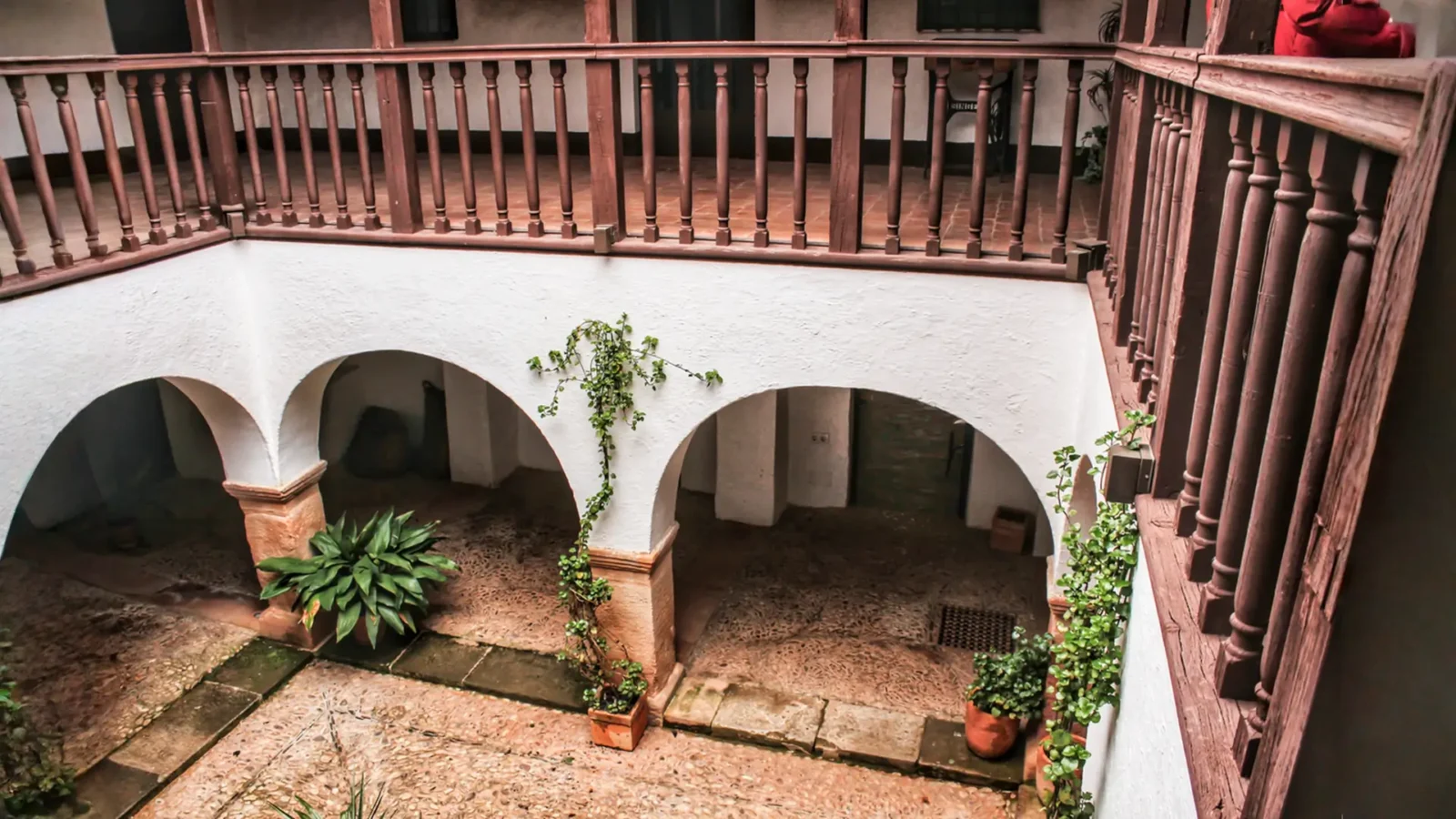
A traditional La Mancha manor house minutes from the Plaza Mayor, built around a central courtyard that is the reason to book it. Rooms are large and quiet, and breakfast is included. This is the closest you get to sleeping inside the town’s own architecture.
Check prices & availability for Los Girones Pacheco on the accommodation's websiteCasa Rural Señorío de Quevedo
A new build in the centre, put up in the style of the historic quarter, and let as a whole apartment. The owners farm vines nearby and will take guests down to the cellar. Good for families who want space and a kitchen.
Check prices & availability for Casa Rural Señorío de Quevedo on the accommodation's websiteLas Violetas
Two patios, one of them with a small pool, and jasmine in the air at breakfast. It sits near the centre but away from the noise, and the breakfast is included. A good pick in high summer, when the pool stops being a nice extra.
Check prices & availability for Las Violetas on the accommodation's websitePosada Abuela Fidela
An eighteen-room posada on the edge of the centre, with a shared kitchen, a lounge and a buffet breakfast. Parking is easy, which matters on a road trip, and the square is five minutes on foot. Straightforward, comfortable and very well run.
Check prices & availability for Posada Abuela Fidela on the accommodation's website
Region, Nearby and Routes
Part of Castilla-La Mancha
Villanueva de los Infantes is in Castilla-La Mancha
Part of these routes
Villanueva de los Infantes is one stop on our In the Footsteps of Don Quixote road trip See the full trip.
Nearby places
- El TobosoThe white Toledo village Cervantes gave to Dulcinea, with Quixote quotes on the walls and a Gothic church locals call the cathedral of La Mancha.
- Campo de CriptanaTen white windmills rise straight from a whitewashed old town, giants and cave houses together.
- ConsuegraTwelve windmills and a Knights’ castle crown the ridge above this classic La Mancha town.
- BelmonteA complete walled town crowned by one of Spain’s best-preserved castles, just off the windmill trail.
- ToledoA hilltop UNESCO city of cathedrals, synagogues and mosques, at its finest in the early and late hours.
- Lagunas de Ruidera A chain of turquoise lagoons and waterfalls on the high La Mancha plain, ringed by Don Quixote legend.
Frequently Asked Questions
Yes, if you like Golden Age architecture and quiet streets. Its Plaza Mayor is one of the finest in Castilla-La Mancha, and the whole town has been protected as a Conjunto Histórico-Artístico since 1974. It sees far fewer visitors than the windmill towns to the north.
Two things. Francisco de Quevedo died here in 1645, and his cell and tomb can both be visited. A team from the Universidad Complutense de Madrid also published a study in 2005. It named the town as “el lugar de la Mancha”: the village Cervantes deliberately left unnamed at the start of Don Quixote. Other towns dispute that, which is part of the fun.
Nobody can prove it. The Complutense team argued the case from distances and travel times in the novel. It placed Villanueva de los Infantes at the geographic centre of the Campo de Montiel, which Cervantes names five times. Alcázar de San Juan and Argamasilla de Alba both make rival claims. Treat it as a good argument, not a fact.
Half a day covers the main sights. One night is better, because the square is at its best in the evening and early morning. Two nights work well if you want to drive out into the Campo de Montiel.
April, May, September and October, when highs run roughly 17–26°C. July and August reach around 32°C, and the light is harsh at midday. Rain is most likely in spring and late autumn. Winter is cold and clear, with January highs near 10°C.
It is possible but long: about 2 hours 15 minutes each way by car, and there is no practical train or bus. It works far better as a stop on a La Mancha road trip, or as a night’s stay on the way south.
Hotel Boutique La Morada de Juan de Vargas is the pick for a room a few steps off the Plaza Mayor. Los Girones Pacheco puts you in a traditional manor house with a central courtyard. Casa Rural Señorío de Quevedo suits families who want space and a kitchen. Casa Rural Los Galanes is the best cheap bed in the centre.
Bar Las Tapas de Sancho on Calle Quevedo is the most enjoyable spot for tapas and a glass of local red. La Pámpana does a very cheap set lunch of traditional home cooking. Hotel Rural La Gavilla has the most ambitious kitchen in town. Bar Entrebrasas is the place for charcoal-grilled meat. For one special meal, Coto de Quevedo Evolución at Torre de Juan Abad is the region’s finest kitchen, twenty-two minutes away.