
Santo Domingo de la Calzada: The Great Town of the Camino
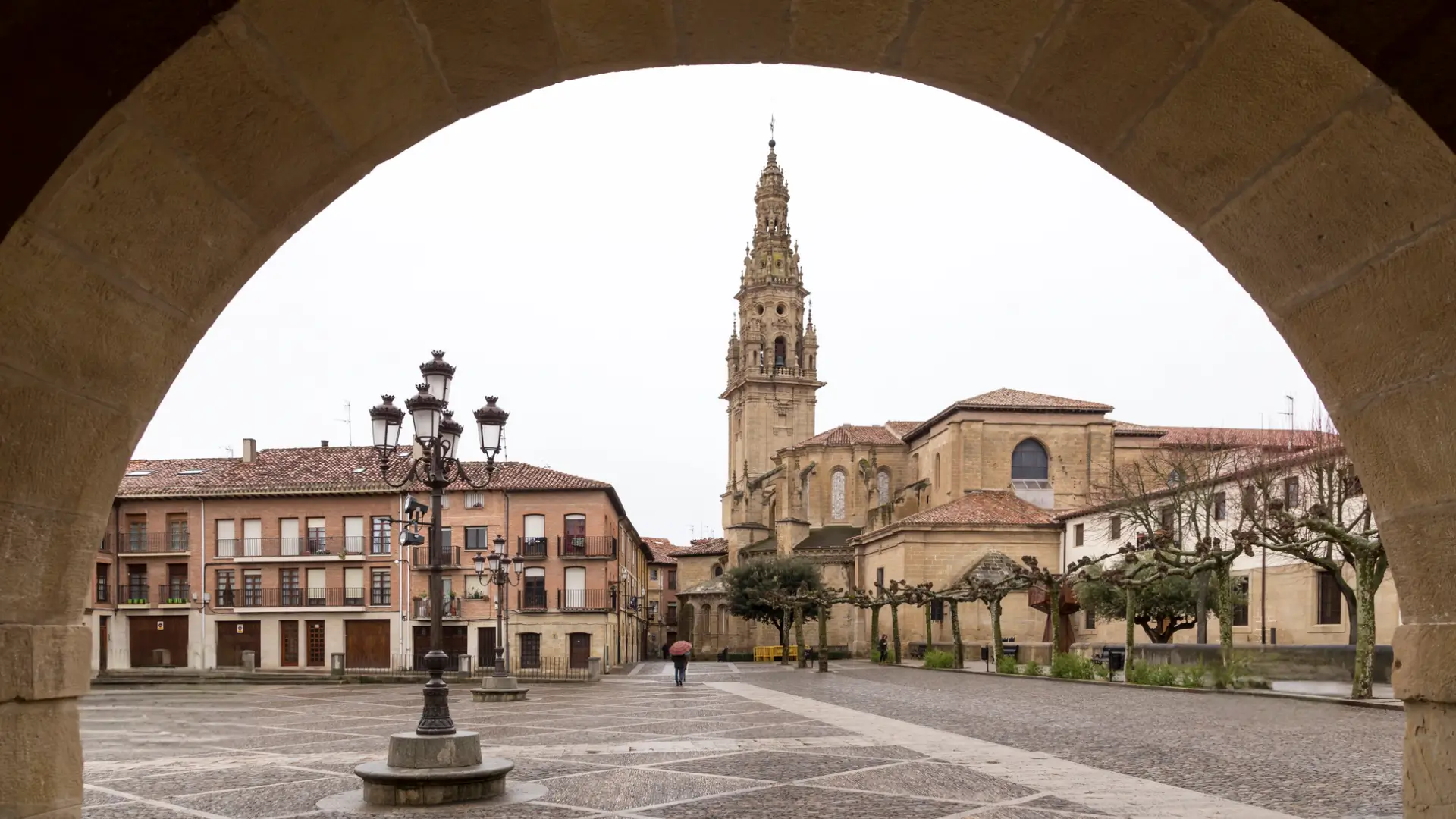
Santo Domingo de la Calzada is a small walled town in La Rioja, in the north of Spain, built almost a thousand years ago to help pilgrims on the Camino de Santiago. Its cathedral holds one of Spain’s strangest sights: a live rooster and hen, kept in a Gothic henhouse inside the church. Around it curls a compact old town of stone lanes, arcaded squares and the longest medieval wall in the region.
Why Visit Santo Domingo de la Calzada
People come to Santo Domingo for the Camino and for one very odd cathedral. The town was founded to help pilgrims, and it still lives by that rhythm. Walkers pass through each day, then move on, so by evening the streets belong to locals again. Inside the cathedral you find the tomb of the saint, a gilded Renaissance altarpiece, and the famous cockerel and hen. They are kept alive as a reminder of a medieval miracle, and you may well hear them crow during your visit. It is a working pilgrim town, lived-in and quiet, not a monument behind glass.
Santo Domingo de la Calzada — A calm base in the Rioja Alta
Santo Domingo sits in the Rioja Alta, the western wine zone, between Haro and the hills of the Sierra de la Demanda. That makes it a good base for touring the wine country and the small Camino towns around it. It is smaller and quieter than Haro or Logroño, and its old town is easy to walk end to end. Come for the cathedral and the Camino history, and use the town as a calm place to sleep between days out among the vineyards and monasteries.
Day trip or overnight?
You can see Santo Domingo in a few hours. Walk the Calle Mayor, step into the cathedral for the tomb and the hens, climb the tower, and you have the shape of it. But by mid-afternoon the day's pilgrims have moved on, and the town empties out. Our honest advice is to stay the night. A perfect short visit looks like this: arrive by early afternoon, tour the cathedral and climb the free-standing tower, then walk the old walls as the light softens. Eat a slow Riojan dinner on the Calle Mayor, sleep inside a former pilgrim hospital, and wake to the quiet walled town in the morning. A day trip makes you leave just as the town becomes itself again.
What to See in Santo Domingo de la Calzada
The Cathedral and the rooster and hen
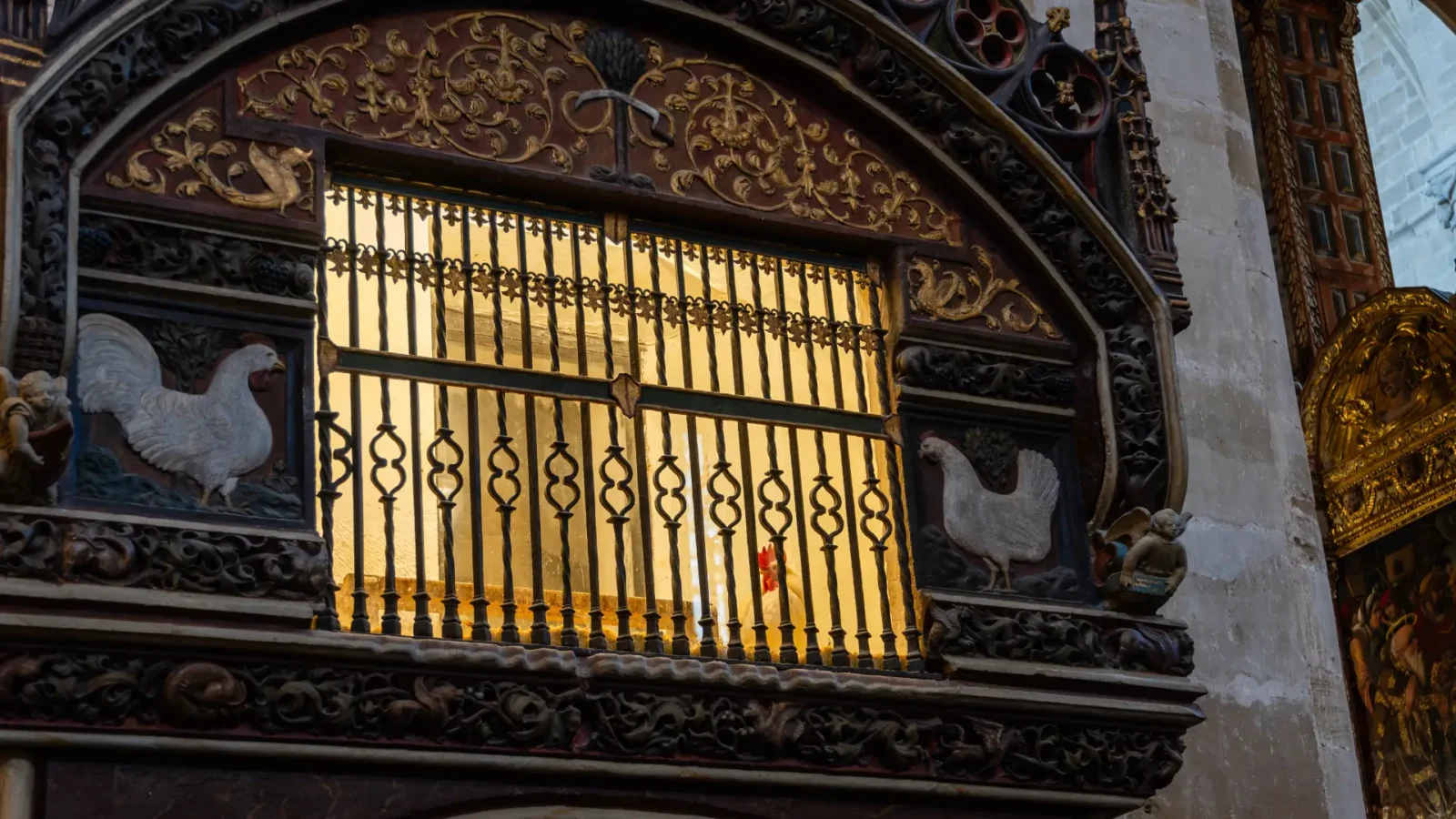
Santo Domingo’s cathedral was begun in the 12th century and holds the tomb of the saint who founded the town. Opposite the tomb, in a carved 15th-century Gothic henhouse set into the wall, a live white rooster and hen are kept — the only church in Spain with living birds inside it. They recall a medieval miracle: a young pilgrim, wrongly hanged for a theft he did not commit, was found still alive on the gallows. When his parents told the judge, he scoffed that the boy was as alive as the roast birds on his plate — and the cooked cockerel and hen stood up and crowed. A live pair has been kept in the cathedral ever since, swapped for fresh birds every couple of weeks.
The free-standing bell tower (Torre Exenta)
The cathedral’s Baroque bell tower stands apart from the church, alone in the square, because the soft ground beside the cathedral could not bear its weight. Built in the 1760s and nearly 70 metres tall, it is the highest tower in La Rioja. You can climb it, and from the top the whole town spreads out below: the red-tiled roofs, the line of the old walls, and the Camino running off across the plain toward Burgos.
The medieval walls
Santo Domingo keeps the largest walled enclosure in La Rioja, raised in the 14th century under King Pedro I. More than 1,600 metres survive, with towers and a gateway still standing, wrapping the old town in warm stone. You can walk alongside long stretches of them, tracing the edge of the medieval town. They are best in low evening light, when the stone turns gold.
Plaza de España and the old town
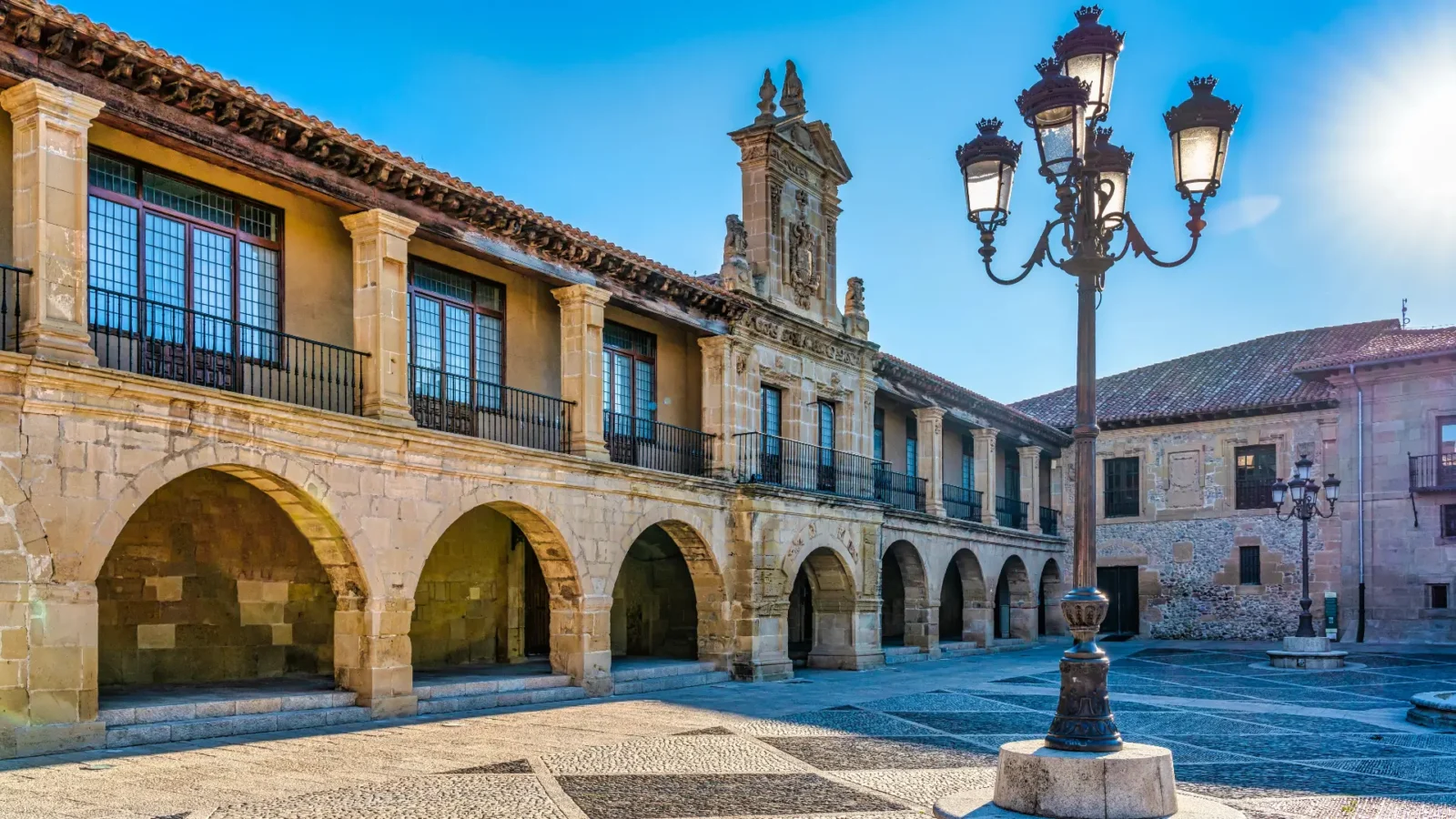
Behind the cathedral, the arcaded Plaza de España is the social heart of the town, once its market and bullring. The 18th-century town hall stands on one side, its upper floor built right onto the medieval wall, above a run of stone arches. Sit under the arcades with a coffee, then wander the Calle Mayor — the pilgrims’ street — which threads the whole old town from gate to cathedral.
The Parador and the Convento de San Francisco
Two great buildings bracket the town’s pilgrim history. Facing the cathedral, the 12th-century former Pilgrims’ Hospital, built by the saint himself, is now a Parador hotel. A short walk west, the Herrerian-style Convento de San Francisco — plain, grey and severe, in the style of El Escorial — holds the tomb of its founder and a second Parador. You can step into both to see the stonework, even if you sleep elsewhere.
What to Do in Santo Domingo de la Calzada
Walk the Calle Mayor and the old walls
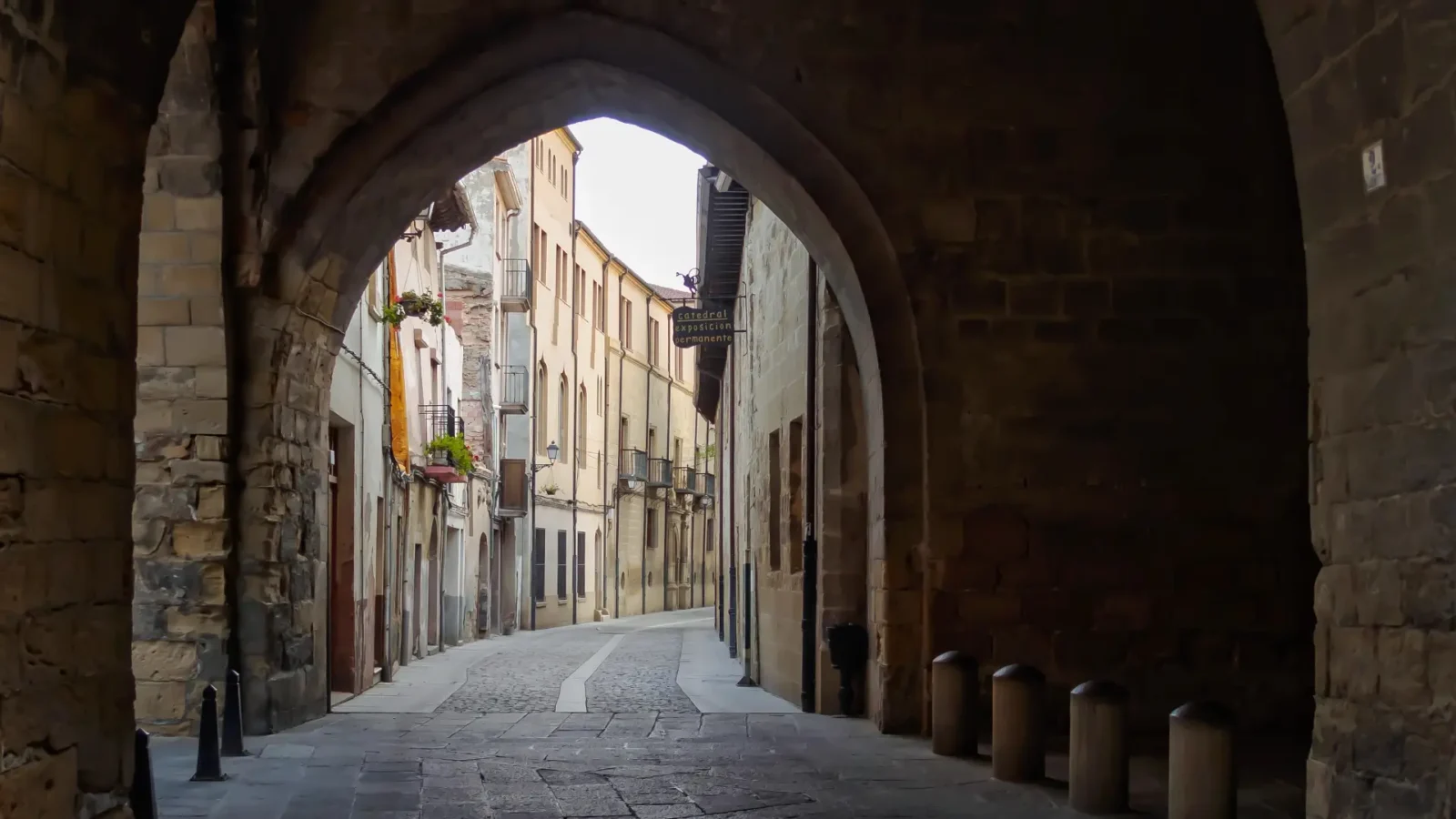
The best way to feel Santo Domingo is on foot, along the same street the pilgrims walk. Start at one of the medieval gates, follow the Calle Mayor past stone mansions and the cathedral, then drop down to trace the old walls around the edge of town. It is a free, self-guided loop that links most of the sights, and it is quietest and prettiest in the late afternoon, once the day’s walkers have moved on.
Climb the cathedral tower for the view
The free-standing bell tower is the one climb in town, and it earns the effort. The stairs bring you out high above the roofs, with a clear view over the walls, the plain and the thread of the Camino heading west. Go in the last hour of light, when the low sun catches the red tiles and the tower’s own shadow falls long across the square.
Follow the Camino out toward Grañón
Santo Domingo is a full stage on the French Way, and it is worth walking a short piece of it even if you are not a pilgrim. Head west out of town, cross the old bridge over the River Oja, and follow the marked path a little way into open farmland toward Grañón, the last village in La Rioja. It is a flat, easy stroll, and it shows you the town the way walkers first see it — from the fields, low on the plain, with the tower rising above.
Use the town as a base for the Rioja Alta
Santo Domingo makes a calm base for the wider wine country. Within half an hour you can reach Haro and its historic bodegas, the monasteries of Suso and Yuso at San Millán de la Cogolla (the cradle of the Spanish language), and the old royal town of Nájera. A guide who knows the bodegas can get you tastings and cellar access you cannot easily book alone, which is where going with one earns its keep.
Prefer to go with a guide for any of this? Ask where you’re staying, or at the tourist office on the Plaza de España — they’ll know what’s running, in which language, and can point you to something that fits.
Seasonal Events and Festivals
Fiestas del Santo (10–15 May)the town’s biggest week, honouring Santo Domingo around his feast day. The old streets fill with processions, giant figures and drummers, religious rites tied to the saint and the Camino, and food stalls on the squares. It is a deeply local festival, more pilgrim town than tourist show. Rooms sell out well ahead, so book early if you want to be here for it.
Fiestas de la Virgen de la Plaza (September)a second, quieter patron-saint festival in the early autumn, centred on the town’s Gothic Virgin. It is a smaller, more neighbourhood affair than the May week, with processions and local music.
For the exact daily programme of either festival, check with the local tourist office before you plan around it — the dates and running order are set fresh each year.
Getting There and Around
Santo Domingo de la Calzada sits in western La Rioja, in the Rioja Alta, just off the N-120 road that runs between Logroño and Burgos, right on the Camino de Santiago.
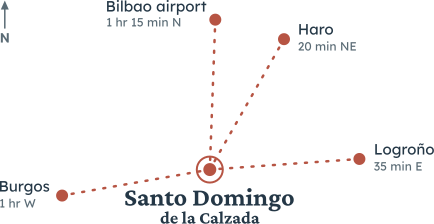
From Logroñoabout 35 minutes by car (roughly 46 km) on the LO-20 and N-120 — the easy run from La Rioja’s capital and its nearest airport.
From Haroabout 20 minutes by car (roughly 21 km) — the closest town, and the gateway to the wine bodegas.
From Burgosabout 1 hour by car west on the N-120 — the link to the Castilla y León cathedral cities.
From Bilbaoabout 1 hour 15 minutes by car via the AP-68 and N-232 (roughly 110 km). Bilbao is the most useful international gateway by air.
Nearest airports Logroño-Agoncillo (RJL) is closest but tiny, with mainly a Madrid link. Vitoria (VIT) is small. Bilbao (BIO) is the nearest major international airport, about 1 hour 15 minutes away.
By busregular buses link Santo Domingo with Logroño, Haro and Burgos, and there are longer-distance services to Bilbao, Zaragoza and Madrid. There is no passenger train.
Getting around
You do not need a car inside Santo Domingo — the walled old town is small, flat and easy to cross on foot, and everything worth seeing is a few minutes apart. Park once on the edge of the centre and leave it; there is free parking a short walk from the cathedral. You do want a car for the region: the whole reward of basing yourself here is reaching the wider Rioja Alta — Haro’s bodegas, the monasteries at San Millán de la Cogolla, and the old towns of Nájera and Briones — none of which is well served by bus. Pick the car up at Bilbao or Logroño airport and keep it for the whole trip.
Looking for a ready-made plan? See our La Rioja road trips.
Practical Info
- One ticket covers the monumentsThe cathedral, its free-standing tower and the Convento de San Francisco are sold together on a combined visitor ticket, cheaper than paying separately, with a reduced pilgrim rate. Book on the cathedral’s official site a guided option is also offered.
- The tower is a climbGoing up the free-standing bell tower means stairs and a timed or capacity-limited entry at busy periods — check on arrival or book ahead in high season.
- Cathedral hours shift with the season and with servicesOpening is longer April–October and shorter in winter, and the cathedral closes to visits during Mass. Check the official site for the current timetable rather than relying on a fixed one.
- Old town on footThe centre is compact and mostly flat, wrapped by the walls. Wear comfortable shoes for the stone lanes; most of it is easy going.
- Closing daysIndividual restaurants each take their own weekly rest day — several close Monday or Wednesday. Check ahead for a specific place rather than assuming.
- ClimateThis is cooler, greener country than the Ebro lowlands. Summers are warm and dry — July and August highs sit around 26–27°C. The most comfortable months are May, June, September and October, roughly 18–26°C. Winters are cold, with January nights near freezing, and the wettest spells come in spring (April is the rainiest) and late autumn.
- ParkingUse the free car park on the edge of the centre; the walled core is tight and partly restricted, especially during the May festival.
Where to Eat in Santo Domingo de la Calzada
You’ll eat well in Santo Domingo, at every budget — this is hearty Camino country, and the food is built for hungry walkers: lamb chops grilled over vine cuttings (chuletillas al sarmiento), red beans with chorizo and morcilla, and thick bean soups, all washed down with Rioja. Two simple rules make it easy: for lunch, most bars run a good-value three-course pilgrim menu, aimed at people who have walked all morning; for dinner, book a proper table on the Calle Mayor and eat slowly. The picks below cover both, from a plate of grilled mushrooms to a full Riojan spread.
The town’s best table, on the Calle Mayor right beside the cathedral, doing polished Riojan cooking — steak, lamb chops, cod — with a strong, fairly priced regional wine list. It is a step up from the pilgrim menus without being stiff, and it fills quickly, so book. Closed Monday, and dinner is not served on Sunday.
Bar Restaurante Casa Amparo
A warm, long-running home-cooking spot next to the cathedral, known for generous plates of Riojan classics — grilled mushrooms, blood sausage with peppers, slow-cooked pork — and a well-priced menú del día. It is the kind of honest, comforting cooking that fills you after a day on foot. Open daily.
A locals’ grill a few minutes off the main Camino street, worth the short walk for ribeye, hake and squid cooked simply and well, at fair prices. It has more local soul than the busier pilgrim restaurants on the through-route. Closed Wednesday.
Restaurante Hidalgo
An old-town restaurant near the cathedral serving a generous, good-value set lunch — garlic omelette, salt cod, flan — to a steady stream of pilgrims and locals. It is mainly a lunch place, with dinner only on Saturday, so time it for the midday meal.
El Sarmiento Azul Mediterráneo
Just outside the old wall, this friendly, well-run spot does fresh, market-led plates — paella, grilled fish, good salads — with a warm welcome and a shaded terrace. A relaxed choice for a lighter meal or a sit-down lunch off the busy centre.
A busy tapas and pintxo bar on the main avenue, good for a quick, cheap graze — grilled skewers, tuna toasts, a cold beer or a glass of Rioja at the counter. This is where to eat light and fast rather than sit down to a full meal. Closed Monday.
Where to Stay in Santo Domingo de la Calzada
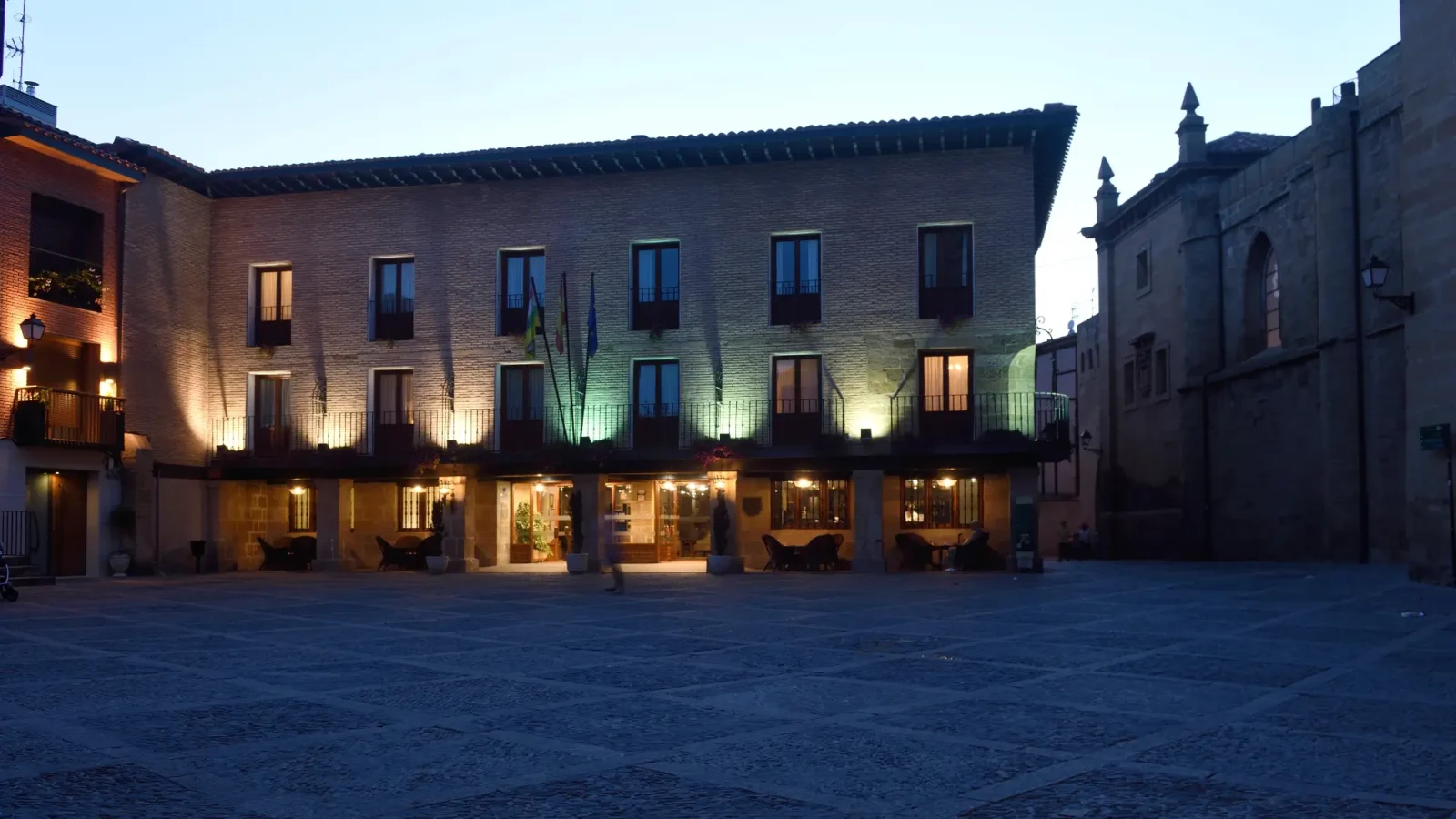
Stay the night and Santo Domingo becomes itself again. The day’s pilgrims walk on toward Burgos, the tour groups drive off, and the walled old town goes quiet under the tower — lamplit, near-empty, yours to wander before dinner. Best of all, you can sleep inside the town’s own pilgrim history: two of its finest stays are a former hospital and a former convent. Here’s where we’d book, from a nun-run guesthouse to a Parador.
Parador de Santo Domingo de la Calzada
Sleep inside the 12th-century former Pilgrims’ Hospital that the saint himself built, right beside the cathedral on the Plaza del Santo — original stonework, soaring arches, and the best location in town. Step out of the door and you are at the cathedral; the birds are a few metres away. The signature “stay inside the history” choice.
Check prices & availability for Parador de Santo Domingo de la Calzada on the accommodation's websiteParador de Santo Domingo Bernardo de Fresneda
A second Parador, this one in the former Convento de San Francisco, a short walk from the centre — a grand, medieval-feeling building with a fine breakfast and quiet, comfortable rooms. It reads calmer and more monastic than the central Parador, and it is often the better-value of the two. Note that the restaurant here mainly serves breakfast; walk into town for dinner.
Check prices & availability for Parador de Santo Domingo Bernardo de Fresneda on the accommodation's websiteHostal El Molino de Floren
A characterful small hostal in a converted old mill in the centre, run by a warm family who cook some of the best home-style dinners and breakfasts on this stretch of the Camino. Rooms are clean and cosy, a few with a bathtub — a real treat after a day walking. The friendly, well-priced middle choice.
Check prices & availability for Hostal El Molino de Floren on the accommodation's websiteHostal Rey Pedro I
A rustic old building carefully updated near the centre, with spotless rooms, heated bathroom floors, and hosts who go out of their way — early breakfasts, picnic packs, a safe place for bikes. Small, personal and comfortable, it is a favourite with walkers and cyclists. Good value for the care you get.
Check prices & availability for Hostal Rey Pedro I on the accommodation's websiteHospedería Cisterciense
Stay in a working Cistercian convent, in simple, spotless rooms run by the nuns, with a shared home-cooked meal and a genuinely historic, peaceful atmosphere. It is basic — thin on frills, light on heating in winter — but few stays are more in keeping with a pilgrim town. The characterful budget choice.
Check prices & availability for Hospedería Cisterciense on the accommodation's websiteCarpe Viam Hostel
A bright, exceptionally clean hostel a corner from the cathedral, with private rooms as well as beds, a little kitchen, a coffee machine and helpful owners who point you to the right bars and bodegas. Some rooms open onto a small terrace. The reliable, central low-budget option.
Check prices & availability for Carpe Viam Hostel on the accommodation's website
Region, Nearby and Routes
Part of La Rioja
Santo Domingo de la Calzada is in La Rioja
Part of these routes
Santo Domingo de la Calzada is one stop on our La Rioja Road Trip: 12 Days See the full trip
Nearby places
- LogroñoLa Rioja’s relaxed capital, where the Camino, a twin-towered co-cathedral and Spain’s best-loved pintxos street meet at the gateway to the wine region.
- HaroThe wine capital of La Rioja, home to the world’s densest cluster of century-old bodegas and a hilltop old town of tapas bars.
- EzcarayA mountain town of arcaded stone squares and cool forest air, off the Rioja wine trail — with one of Spain’s great kitchens.
- NájeraLa Rioja’s old royal capital, where a fortress-like monastery holds thirty kings’ tombs beneath cliffs full of man-made caves.
- BrionesA walled medieval village on a hill in Rioja Alta, home to one of the world’s best wine museums and streets that stay quiet after dark.
- San Vicente de la SonsierraA wine village crowned by a walled castle and Gothic church, with Rioja’s oldest traditions still alive.
Frequently Asked Questions
Santo Domingo de la Calzada is well worth visiting, especially if you like history and the Camino de Santiago. Its cathedral keeps a live rooster and hen inside the church, a tradition found nowhere else in Spain, alongside the tomb of the town’s founding saint. Around it sits a quiet walled old town with the longest medieval walls in La Rioja.
Santo Domingo de la Calzada is known as one of the great towns of the Camino de Santiago. It is most famous for the live rooster and hen kept inside its cathedral, in memory of a medieval miracle. It is also known for the region’s largest medieval walls and its free-standing Baroque bell tower, the tallest in La Rioja.
Santo Domingo de la Calzada needs about half a day to see, and ideally one night. You can walk the old town, visit the cathedral and climb the tower in a few hours. But the town is at its best in the evening, once the day’s pilgrims have moved on, so staying overnight makes far more of the visit.
The best time to visit Santo Domingo de la Calzada is late spring or early autumn — May, June, September and October — when days are a comfortable 18–26°C. July and August are warm and dry, with highs around 26–27°C. Winters are cold, with frosty nights, and spring is the rainiest season. The town’s big Fiestas del Santo fall in mid-May and draw crowds.
You can do Santo Domingo de la Calzada as a day trip from Logroño — it is only about 35 minutes by car. But the town empties of visitors by mid-afternoon and is quietest and most atmospheric in the evening, so staying a night makes more of it if your plans allow.
Stay in or beside the walled old town, close to the cathedral. The two Paradores are the standout choices: one inside the 12th-century former Pilgrims’ Hospital next to the cathedral, the other in a former convent a short walk away. For mid-range, Hostal El Molino de Floren and Hostal Rey Pedro I are warm, well-run and central, and Carpe Viam Hostel is the reliable budget option.
Eat on and around the Calle Mayor, the old town’s main pilgrim street. Restaurante Los Caballeros, beside the cathedral, is the best table in town for Riojan cooking, and Casa Amparo is the classic for hearty home-style plates. NK-Guipúzcoa is a locals’ grill a few minutes off the main street, and most bars run a good-value three-course pilgrim menu at lunch.