

Castilla-La Mancha Road Trip: One Week
Land in Madrid, pick up a car, and follow six unhurried days through La Mancha’s windmill country and the mountains beyond Cuenca.
- Fly into / out ofMadrid (MAD) — round trip
- Duration6 days, 5 nights
- Total distanceAbout 640 km
- NightsToledo ×1 · Campo de Criptana ×1 · Cuenca ×3
- Best forCar (hired at the airport)
- DifficultyEasy — short, calm driving days, no leg over two hours
- Best seasonSpring (April–June) and early autumn (September–October)
- PaceRelaxed
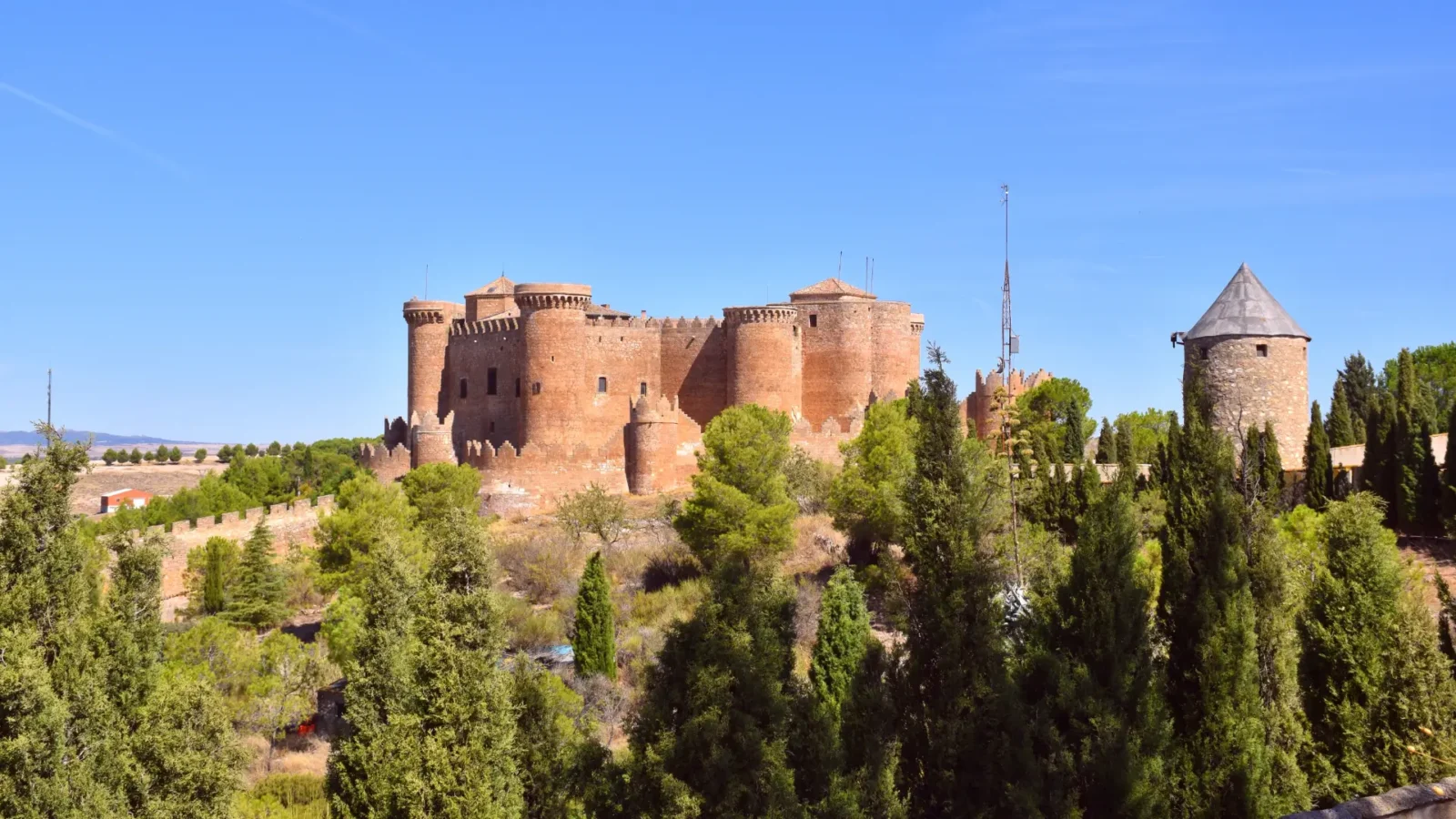
Why this Trip?
Most people meet Castilla-La Mancha through a car window on the way south, or on a half-day dash to Toledo from Madrid. This trip slows all of that down. The region is quietly famous for two things: the windmills of the plain and the gorges of Cuenca. This loop links them into one calm, self-contained trip. You start in one of Spain’s great historic cities. From there you cross the wide La Mancha plain, where Don Quixote charged his giants, then climb into a range of pale limestone and pine that most foreign visitors never reach. It stays uncrowded because the region has no coast and no airport of its own. You have to want to come here, and that is exactly the point.
A plain, a city, and a mountain range
What ties these six days together is contrast. The first half is flat, golden and enormous. Think whitewashed towns, ridgelines of windmills, and a horizon that goes on for ever. The second half rises into the Serranía de Cuenca. Here rivers have carved rock into shapes with names, and cold clear springs feed forest waterfalls. Between the two sits Cuenca itself, a city stacked on a spur of rock with houses that hang over a 40-metre drop. Seeing the plain and the mountains in one unhurried trip, rather than rushing either, is what makes this more than a checklist of sights.
How it's paced and who it's for
This is a relaxed loop, not a sprint. No driving day runs over two hours, and three of your five nights are in one place, so you unpack once and let Cuenca be your base for the mountains. It suits travellers who would rather walk a quiet lane at dusk than queue for a photo at noon, and who like a plan that leaves room to breathe. You fly into Madrid because it is the natural gateway from both the plain and the mountains. Hire a car at the airport, and hand it back there six days later. The shape is a simple ring: out across the plain, up into the hills, and a short run home. It is a "we planned it, you just drive it" trip. We're honest about the busy hours at the famous sights, and smart about avoiding them.
Getting there and around
Your first practical question is the airport, so here it is before the days begin.
The fly-in airportYou fly into Adolfo Suárez Madrid-Barajas (MAD) and hire a car there. It is the natural gateway for this loop: Madrid sits almost equally close to both ends of the trip, with far more flights and better prices than any regional alternative. From the airport it is about 89 km / 1 hour south to Toledo, your first night, on the A-42 motorway. Toledo’s own train station is beautiful but sits outside the walls, and the region beyond needs a car regardless — so collect the car on arrival and keep it the whole trip.
A round trip, not open-jawThis is a loop back to the same airport. On the final day you drive Cuenca → Madrid airport, about 172 km / 1 hour 45 minutes on the A-40 and A-3 — a short, easy run rather than a dawn sprint. (Valencia airport is a similar distance east of Cuenca, but flying in and out of Madrid is simpler and usually cheaper, so we keep the loop on Madrid.)
Self-driveHire at Madrid airport on arrival, keep the car until you fly home. You want it for the whole trip: the windmill towns and the Serranía are only realistically reachable by road, and public transport into the mountains is thin.
Buffer nights — read this before you book flightsThe trip itself is six days and five nights. Depending on your flight times, you may want one extra night at the airport that is not part of those five — you book it yourself, and it is not included in this plan.
- If you land in the eveningDon’t drive an unfamiliar road in the dark. Sleep near Madrid airport that first night and start fresh the next morning. That is an extra night on top of the trip, not day one of it. Check your car-hire desk’s hours before you book a late flight — many run to around midnight, but not all, and “24-hour” pickup isn’t always reliable off-season. See our Practical Info page for driving-in-Spain details.
- If you fly home earlyThe Cuenca → Madrid run is only about 1 hour 45, so most travellers make a mid-morning flight comfortably. If yours is very early, you can swap the last planned night (Cuenca) for a night near the airport instead — same five nights, just a different last base — or add an airport night of your own. Either way, a buffer night swaps or adds on your terms; it never quietly turns this into a seven-night trip.
The Itinerary
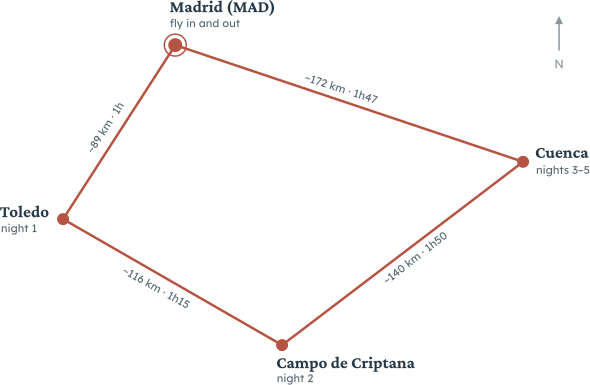
A quick word on the shape before the days. This is a clockwise loop. You head south to Toledo, then east across the plain to the windmill towns. From there you climb to Cuenca and settle for three nights, exploring the mountains from a single base, before a short run back to Madrid. Nothing is rushed, and the map below shows the whole arc.
Day 1 — Toledo
The driveMadrid airport → Toledo, about 89 km / 1 hour on the A-42.
The shape of the dayA short transfer, then your first evening in a UNESCO city just as the day-trippers leave.
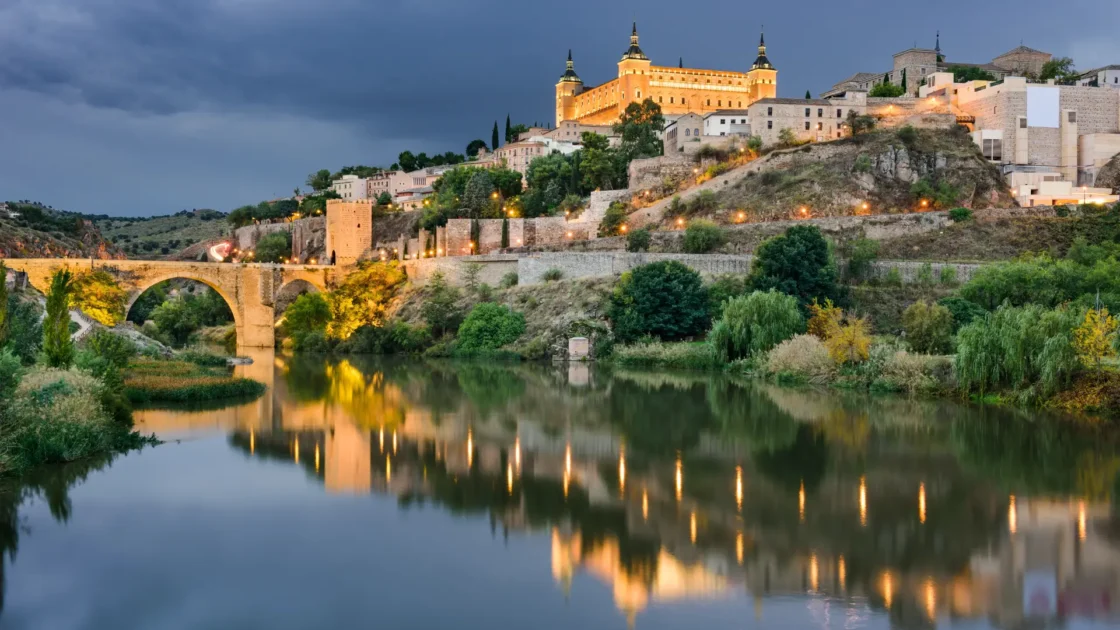
Collect the car at the airport and drive straight down to Toledo. Don’t take the car into the old town — the lanes were built for mules. Leave it in one of the car parks below the walls (Safont, Azarquiel or Circo Romano) and ride the free escalators up. Then simply walk. Toledo grew for a thousand years as a city of three cultures, and you can trace that history in an afternoon. A Gothic cathedral stands on the site of a mosque. There are two medieval synagogues, and a small mosque from the year 999. The single best thing to do on a first evening is a slow loop of the three quarters on foot. Start at Plaza de Zocodover and walk down to the cathedral. Head west into the Jewish quarter, past the synagogues, out to the Monasterio de San Juan de los Reyes. Come back up through the quieter northern lanes. Then cross the Puente de San Martín and climb to the Mirador del Valle for the classic skyline as the light softens. Allow a relaxed half-day; there’s no need to rush, because the city gets better as it empties. For the full picture, see our Toledo guide .
Want a different pace?Pick at most one; it’s still a single day, your base is unchanged. Slow it down: skip the river climb and simply sit out the evening on your hotel’s roof terrace with the cathedral lit above the rooftops. Go deeper: Toledo has a strong tradition of after-dark walking tours covering legends and lit monuments — they run once the day-trippers have gone and suit an overnight visitor exactly.
Where to eatHow Day 1 eats depends on when you land. Toledo’s own dish is carcamusas — a pork-and-tomato stew with peas, invented here in the 1950s and still the thing to order.
- Lunch tipLo Nuestro Taperia (€€ · Tapas bar · Toledo). If you land in the morning, or start fresh from a night near Madrid airport, you’ll reach Toledo around lunchtime. This reliable spot in the Jewish quarter, a short walk from the synagogues, does carcamusas, torreznos and handmade croquetas, plus its own wine. Used to visitors without being a tourist trap. (On a late-landing buffer night, lunch falls the next day — start at dinner.)
- Dinner tipTaberna El Botero (€€ · Modern tapas · Toledo). A tavern with a serious kitchen below, on a quiet lane near the cathedral, cooking contemporary Spanish with an unusually good cocktail list. It stays open late, which makes it one of the better answers to dinner after an evening walk through the emptied streets. Open daily.
Where you sleep tonightTonight you sleep in Toledo, on a quiet lane in the old town near the cathedral — your base for one night before the plain. See where we’d stay.
Day 2 — Campo de Criptana
The driveToledo → Consuegra → Campo de Criptana, about 116 km / 1 hour 15 driving, spread across the day.
The shape of the dayA windmill morning, a whitewashed-town evening.
Leave Toledo after a slow morning and head east onto the plain. The first stop is Consuegra, about 45 minutes south-east, where twelve windmills and a Knights’ castle line the Cerro Calderico ridge — the classic La Mancha skyline, free to walk at any hour. Allow an hour or so up on the ridge for the mills and the views over the plain.
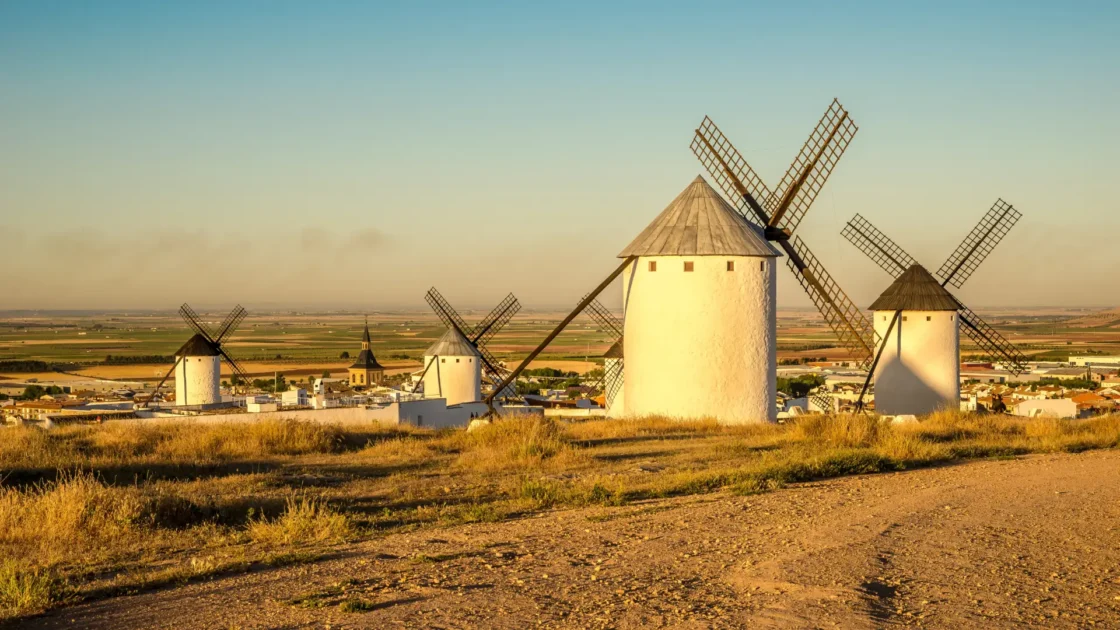
Then it’s about 35 minutes on to Campo de Criptana, your base for the night. Here the windmills are the point again, but with a twist. Ten white mills rise straight from the whitewashed Albaicín quarter, so you climb to the giants through lived-in streets rather than across a car park. Three of the mills keep their original 16th-century workings. Walk up the crest of the Sierra de los Molinos in the last hour before sunset, when the light on the white towers is at its best and the coaches have gone. For deeper detail on both towns, see Consuegra and Campo de Criptana.
Want a different pace?Pick at most one; it’s still a single day, your base is unchanged. Go deeper: Campo de Criptana sits in La Mancha, Spain’s largest wine region, and several local growers welcome visitors for a tasting of the young reds and whites — ask at the tourist office (in the Molino Poyatos, up on the Sierra) who’s open. Slow it down: skip Consuegra and drive straight to Campo de Criptana for a longer, lazier afternoon in the old quarter before the sunset climb.
Where to eatCampo de Criptana is honest, hearty La Mancha country. Think slow-cooked gachas and migas, grilled lamb, strong sheep’s cheese, and the young local wines.
- Lunch tip (Toledo)Bar Ludeña (€ · Tapas bar · Toledo). Eat before you leave Toledo: this is the birthplace of carcamusas and still the place to eat them, a 1950s room on a small square just off Zocodover with tiled walls and no interest in changing. Small and always full. Closed Wednesdays; if it’s shut, Lo Nuestro from Day 1 is the easy fallback.
- Dinner tip (Campo de Criptana)Restaurante Las Musas (€€ · Asador · Campo de Criptana). The town’s best-known table, set right below the mills with windmill views from the terrace and a Repsol Sun to its name. The kitchen leans on the charcoal grill — Iberian pork, aged beef — a fine first-night-on-the-plain dinner with the giants in sight. Open daily.
Where you sleep tonightTonight you sleep in Campo de Criptana, in the Albaicín below the mills — close enough to climb up for the giants at dawn. See where we’d stay.
Day 3 — Cuenca
The driveCampo de Criptana → Belmonte → Cuenca, about 140 km / 1 hour 50, with a mid-morning stop.
The shape of the dayCross the last of the plain, break at a castle, and arrive in Cuenca for the first of three nights.
This is your longest driving day, and it’s still under two hours at the wheel. Break it at Belmonte, about 40 minutes on. Here one of Spain’s best-preserved castles crowns a complete walled town, a natural place to stretch your legs and have lunch before the second leg. From Belmonte it’s about 70 minutes on to Cuenca, where the plain finally gives way to rock.
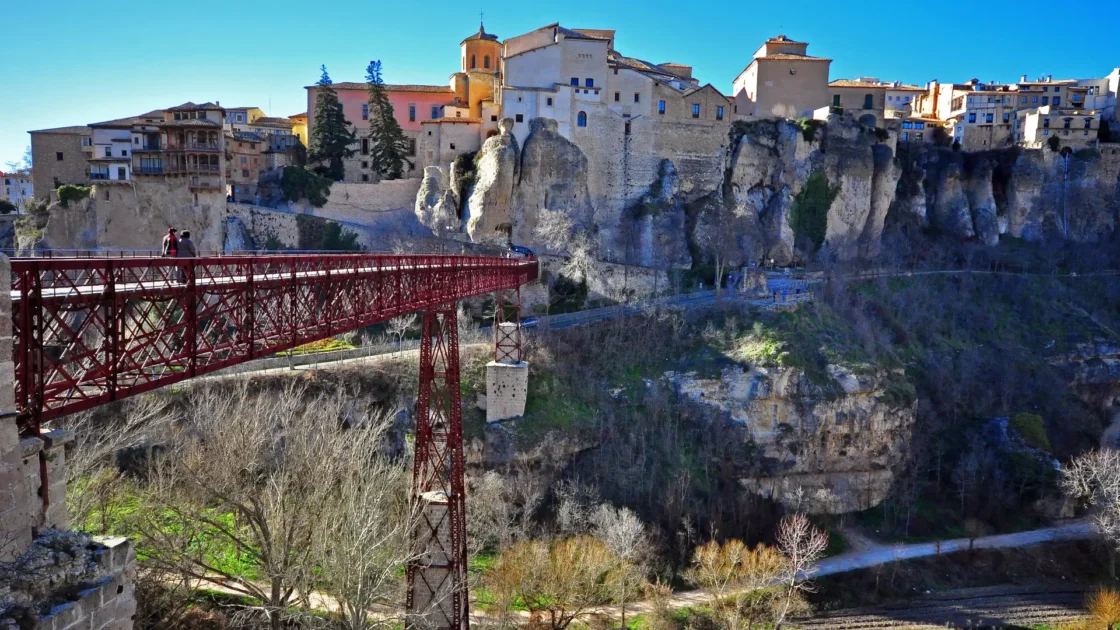
Cuenca hangs on a spur between two river gorges, its famous Casas Colgadas — the hanging houses — clinging to the cliff above the Huécar, their wooden balconies out over a 40-metre drop. Arrive in the late afternoon and drop your bags. Then walk the old town while the day-trippers drive home. Cross the San Pablo bridge for the postcard view, climb to the Plaza Mayor, and take in the blunt, unfinished front of one of Spain’s earliest Gothic cathedrals. Step out again after dark, when the gorge is lit and the lanes are almost empty. You have two more nights here, so there’s no rush tonight. See our Cuenca guide and Belmonte.
Want a different pace?Pick at most one; it’s still a single day, your base is unchanged. Go deeper: step inside the largest of the hanging houses, which holds the free Museo de Arte Abstracto Español, its bright rooms hanging over the gorge. Slow it down: skip the castle stop at Belmonte and drive straight through for an easy first evening settling into Cuenca.
Where to eatCuenca is mountain-edge cooking, built around lamb and game. Look for local dishes like morteruelo, a warm game pâté, and zarajos, grilled lamb offal, with Manchego wines.
- Lunch tip (Campo de Criptana)El Ricote (€ · Café / mirador · Campo de Criptana). Right up by the windmills, with a heated terrace and a viewpoint over the town one way and the mills the other. The easy choice for a coffee and a light lunch before you drive off — or break at Belmonte’s castle instead, halfway along.
- Dinner tip (Cuenca):El Torreón (€€ · Traditional / tapas · Cuenca). Up in the old town, good for tapas, aged steaks and one of the widest Spanish wine lists in the city — zarajos and torreznos among the regional plates. A fine spot for a first evening inside the walls. Open daily.
Where you sleep tonightTonight you sleep in Cuenca, in the old town on the edge of the Huécar gorge — your base for the next three nights. See where we’d stay.
Day 4 — Cuenca
The driveNone today — Cuenca is yours to explore on foot.
The shape of the dayA slow city day, no car, either active or easy.
With no drive and your bags already unpacked, today is Cuenca at its own pace. The city’s best free activity is a walk that links its two gorges. Drop down from the old town into the Hoz del Huécar, and follow the river path beneath the hanging houses. Loop around the tip of the rock and climb back up the Hoz del Júcar. It takes a couple of hours at an easy pace, and shows you the town from angles the day-trippers never see, with the tall houses seeming to grow straight out of the rock. Add the cathedral properly, the Plaza Mayor, and the Espacio Torner in the stripped Gothic church of San Pablo across the gorge. This is a day to wander slowly rather than tick things off.

Want a different pace?Pick at most one; it’s still a single day, your base is unchanged. This is the day to choose your own tempo. Active: walk the full two-gorge loop, then climb to the castle ruins and the old walls for the long view. Slow it down: skip the loop and spend the afternoon quietly — a long lunch, the free abstract-art museum over the gorge, and an evening on a terrace watching the light change on the hanging houses. Either way it’s one day, and you sleep in the same bed.
Where to eat
- Lunch tipBodeguita Capuz (€€ · Traditional bodega · Cuenca). A classic old-town bodega for regional plates — fried kid, bull’s tail, home-style dishes — and good local wine by the glass. Closed Monday and Tuesday; if it’s shut, take a fair-value plate at one of the bars around the Plaza Mayor instead.
- Dinner tipCasa Manzar (€€€ · Modern conquense · Cuenca). A short, seasonal menu of local dishes given a light, creative twist, with a terrace looking across to the Parador and the hills. Warm, careful service — book ahead.
Where you sleep tonightA second night in the same Cuenca base — nothing to pack, nothing to move. See where we’d stay.
Day 5 — The Serranía de Cuenca
The driveA there-and-back mountain day from Cuenca, roughly 160 km round trip on the CM-2105 / CM-2104 — the scenic climax of the week.
The shape of the dayOne road up into the mountains, three stops, and back to your Cuenca base by evening.
Today is why you based yourself in Cuenca. A single mountain road climbs north into the Serranía de Cuenca, and the best sights are strung along it, so you drive up, stop as you go, and come back the same evening. First stop, about 25 minutes up, is the Ventano del Diablo — a free clifftop viewpoint framing the Júcar gorge through a window in the rock. A little further on is the Ciudad Encantada, a “city” of limestone shapes carved by water over millions of years. The formations have names like the Ships and the Mushroom, and a flat, well-marked 3-km circular walk loops through them (allow around 1 hour 30).
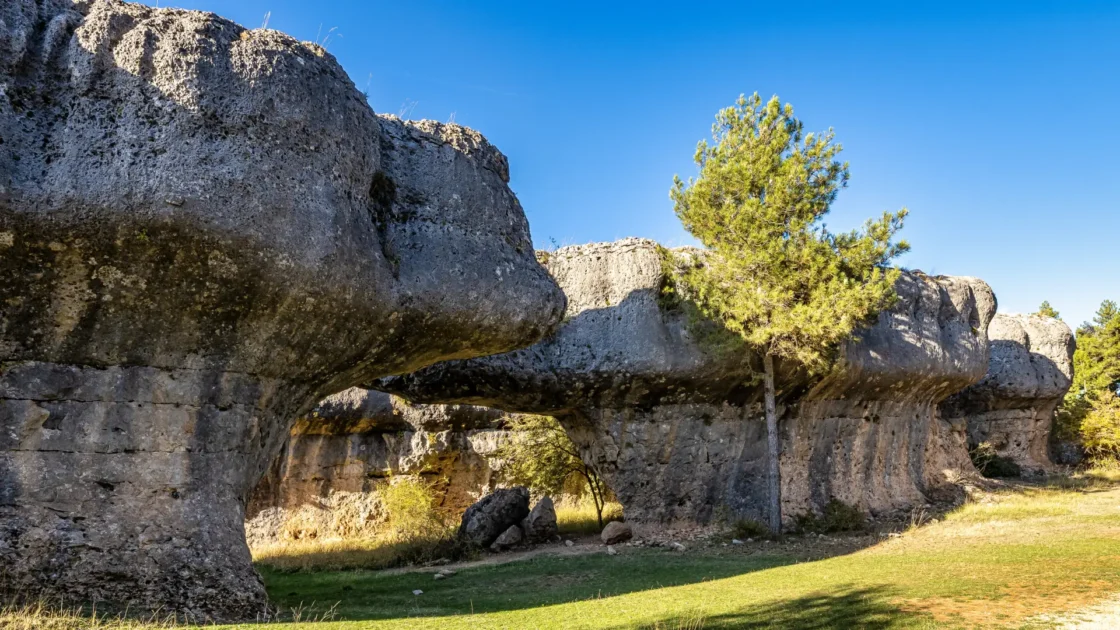
Then the road runs on, past the high stone village of Tragacete, to the Nacimiento del Río Cuervo. This is the source of the Cuervo river, where tufa waterfalls fall through moss and pine. A short, mostly accessible path of about 500 metres reaches the main falls from the car park at Vega del Codorno. It’s the quietest and most beautiful stop of the trip, and the water is at its fullest in spring. Turn around here and drive back down to Cuenca for the night.
Want a different pace?Pick at most one; it’s still a single day, your base is unchanged. Go deeper: add the Laguna de Uña, a small turquoise lagoon a short detour off the road, for a gentle 20-minute leg-stretch. Slow it down: skip the long push to the Río Cuervo and turn back at the Ciudad Encantada, leaving the afternoon free for a slow return and another quiet evening in Cuenca. A note: the Ciudad Encantada is ticketed, cash only at the gate (no online booking), and the ticket desk closes well before the park — see Practical Info.
Where to eatThis is a mountain day, so be realistic — there’s no natural town lunch out in the sierra.
- Lunch tip (in the sierra)Carry a picnic, or stop at one of the simple bar-restaurants near the Río Cuervo car park at Vega del Codorno or in the stone village of Tragacete. There’s no standout name to book — this is a fuel-and-go lunch, not a destination meal, so keep it easy and save your appetite for Cuenca.
- Dinner tip (Cuenca)Asador de Antonio (€€ · Asador · Cuenca). A long-running family asador where the locals go for slow-roast lamb (cordero lechal), honest and generous, away from the busiest streets. For atmosphere instead, Grotte del Huécar (€€ · Grill · Cuenca) sits in a cave dug into the gorge — one of the city’s most memorable tables. Confirm the day’s opening before you set out, as old-town hours shift.
Where you sleep tonightYour last night in Cuenca, same base — an easy end to the biggest day. See where we’d stay.
Day 6 — Home
The driveCuenca → Madrid airport, about 172 km / 1 hour 45 on the A-40 and A-3.
The shape of the dayaAshort, easy run back to where you started.
The loop closes gently. It’s under two hours from Cuenca to Madrid airport, so unless your flight is very early there’s time for a last slow breakfast and a final look at the gorge before you go. This is a driving-only run home, so there’s no natural lunch stop to invent. Fuel up, hand back the car at the airport, and fly out. If your flight is very early, remember the buffer-night option from Getting There: a last night near the airport keeps the trip to the same five nights.
Practical Info
Only what’s true and useful for this specific loop. Verify anything time-sensitive before you travel.
- Roads are easyThis is mostly toll-free motorway (A-42, A-43, A-40, A-3) and good regional roads. No driving day runs over two hours. The one stretch with real bends is the climb into the Serranía on Day 5 — take it slowly and enjoy it.
- Fuel up before the mountainsPetrol stations thin out once you’re in the Serranía de Cuenca. Fill the tank in Cuenca before the Day 5 drive rather than hoping for a pump up the valley.
- Ciudad Encantada — how it worksEntry is bought only at the gate on arrival; there is no online sale. Card payment is sometimes possible, but mobile coverage in the sierra is patchy and the machine isn’t guaranteed, so carry cash. The park opens daily year-round from 10:00, but the closing time changes with the season (earlier in winter, later in summer), and the ticket desk shuts well before the park does.
- Río Cuervo runs fullest in springThe waterfalls are fed by snowmelt, so April–June is the strongest flow. In deep winter it can freeze — beautiful, but check mountain road conditions before you set off.
- Old-town parkingDon’t drive into the historic centres of Toledo or Cuenca. Both have car parks in the lower town with an easy walk or escalator up. Ask your hotel about access before you drive in — some old-town streets are restricted.
- Driving an electric car?It works well on this loop, with one thing to plan. The motorway legs are well covered. The A-42 and A-4 down the plain and the A-3 back from Cuenca all have fast chargers along the way, and Cuenca itself has several public points, including a fast charger. The weak spot is the same as for petrol: the Day 5 mountains. Charging is thin once you’re deep in the Serranía de Cuenca. So treat Cuenca as your charging base. Top up there before the sierra day, and plan that stretch with a charging app (ABRP, Electromaps or PlugShare) rather than hoping for a fast charger up the valley. In town, an electric car is an advantage — it parks easily and cheaply while you explore Cuenca on foot.
- Best direction and timingThe loop is built clockwise so the biggest driving day (Day 3) lands mid-trip and the run home is short. At the famous sights — Toledo, the windmills, Cuenca — the crowds arrive late morning and thin by early evening, so aim for early and late.
- What to packThe Serranía sits high (Cuenca is at ~950 m, the mountains well above that), so evenings are cool even in summer — bring a layer for the Day 5 mountain stops and the Cuenca evenings. Comfortable shoes matter more than anything: Toledo and Cuenca are steep and cobbled, and the gorge and Río Cuervo walks are on uneven ground.

Where we’d Stay
Your five nights, in order — one strong pick per night, chosen so you can just book and go. Three of them are the same Cuenca base, so you unpack once for the mountains.
Meliá Madrid Barajas
Beside Adolfo Suárez Madrid-Barajas (MAD). If you land late or fly out early, skip the drive into the city and stay by the airport instead. This comfortable 4-star sits right next to the terminals. It runs a free shuttle to T1, T2 and T4 through the small hours, so a late arrival or a dawn departure is easy. Pick up the hire car fresh the next morning, or drop it and walk to check-in the night before.
Check prices & availability for Meliá Madrid Barajas on the accommodation's websiteHotel Santa Isabel
A restored fifteenth-century building on a quiet lane, two minutes’ walk from the cathedral and about five from Zocodover. The roof terrace looks straight across the old-town skyline, which is a remarkable thing to get at this price. Simple rooms, genuinely warm staff, on-site parking for a nightly fee. This is the night-one pick on our Don Quixote route.
Check prices & availability for Hotel Santa Isabel on the accommodation's websiteCasa de la Torrecilla
A characterful small hotel in a striking old town house, with a well-regarded restaurant of its own and a warm, personal welcome. A good base for a special, unhurried night in La Mancha.
Check prices & availability for Casa de la Torrecilla on the accommodation's websitePosada de San José
A characterful old house clinging to the edge of the Huécar gorge, with steep stairs and some of the best window views in the city. For travellers who want atmosphere over polish.
Check prices & availability for Posada de San José on the accommodation's website
Frequently Asked Questions
A week is the sweet spot for Castilla-La Mancha. Six days and five nights is enough to link the windmill towns of the La Mancha plain with the gorges and mountains of Cuenca without rushing either. Shorter than that and you’d have to drop one half of the region; this loop gives you both at a relaxed pace.
You fly into Madrid-Barajas (MAD) for a Castilla-La Mancha road trip. The region has no international airport of its own, and Madrid sits close to both ends of this loop — about an hour from Toledo and under two hours from Cuenca — with far more flights and better fares than any regional alternative.
Yes — you need a car in Castilla-La Mancha. The windmill towns are spread across the plain and public transport into the Serranía de Cuenca is very thin, so a hire car is the only realistic way to follow this route. You don’t want a car inside the old towns of Toledo and Cuenca, though; park below and walk up.
The driving on this Castilla-La Mancha route is easy. It’s mostly toll-free motorway and good regional roads, with no day over two hours at the wheel. The only twisty stretch is the scenic climb into the Serranía de Cuenca on Day 5 — slow and enjoyable rather than difficult.
The best time to visit Castilla-La Mancha is spring (April to June) and early autumn (September to October), when days are warm and the plain isn’t baking. The Serranía sits high and stays cooler; the Río Cuervo waterfalls run fullest in spring on snowmelt. July and August are very hot on the plain, though the mills still shine at dawn and dusk.
No — the six-day Castilla-La Mancha itinerary is built to be relaxed, not rushed. No driving day runs over two hours, and three of the five nights are in Cuenca, so you unpack once and explore the mountains from a single base. There’s a slow city day built in, and an optional slow-down on every day.
No, the main Serranía de Cuenca sights don’t need booking ahead, but bring cash. The Ciudad Encantada sells tickets only at the gate — there’s no online booking — and card machines can fail with the patchy mountain signal. The Ventano del Diablo and the Nacimiento del Río Cuervo are both free to visit.
Yes — this Castilla-La Mancha road trip can be tailored to your own dates, party and pace. This is a ready-made plan, but if you’d like it shaped around your flights, your budget or a slower rhythm, our Custom Route Service does exactly that.
Yes — you can do this Castilla-La Mancha road trip in an electric car, with a little planning on one leg. The motorway legs are well served. The A-42 and A-4 down the plain, and the A-3 back from Cuenca, all have fast chargers, and Cuenca itself has several public charging points. The one stretch to plan is Day 5 in the Serranía de Cuenca, where charging is thin. Fill up in Cuenca before the mountain drive, and map that leg ahead with a charging app. In the towns, an electric car is actually an advantage, as it parks easily and cheaply while you walk.
Essential Reading
Region
Places on this route that have a full guide
Related routes
- In the Footsteps of Don Quixote: La Mancha Road Trip
This road trip threads two of our shorter routes together — each works on its own if you have less time.