
The Three Walled Cities
A 3 to 4 day drive through Segovia, Ávila and Salamanca — three walled UNESCO cities in golden stone, with a quiet detour day off Segovia.
- DistanceAbout 170 km on the road (Segovia → Ávila → Salamanca), plus short detours
- Duration3 nights (core route) / 4 nights with the optional Segovia detour day
- Route TypeLinear (the base moves with you — a new city each night; see “Why linear” below)
- Best forCar
- DifficultyEasy (short, well-signed drives of about an hour each; no mountain passes)
- Best seasonMay–June and September–October (warm days, thinner crowds); winters are cold, especially in high Ávila
- ThemeHistorical — three walled UNESCO cities of Castile
- Start / end pointStart in Segovia · end in Salamanca · nearest airport Madrid-Barajas (MAD)
Why this Route Exists
Three cities, three sets of walls, one easy driving line. Segovia, Ávila and Salamanca sit within an hour of each other in southern Castilla y León, and all three are UNESCO World Heritage sites built in warm, golden stone. You could rush them in a single day from Madrid, the way the coach tours do. This route does the opposite: a night in each, so you see the cities in the early morning and the evening, after the day-trippers have gone home. That, plus a couple of very quiet detours, is where the trip earns its keep.
Three walls, three moods
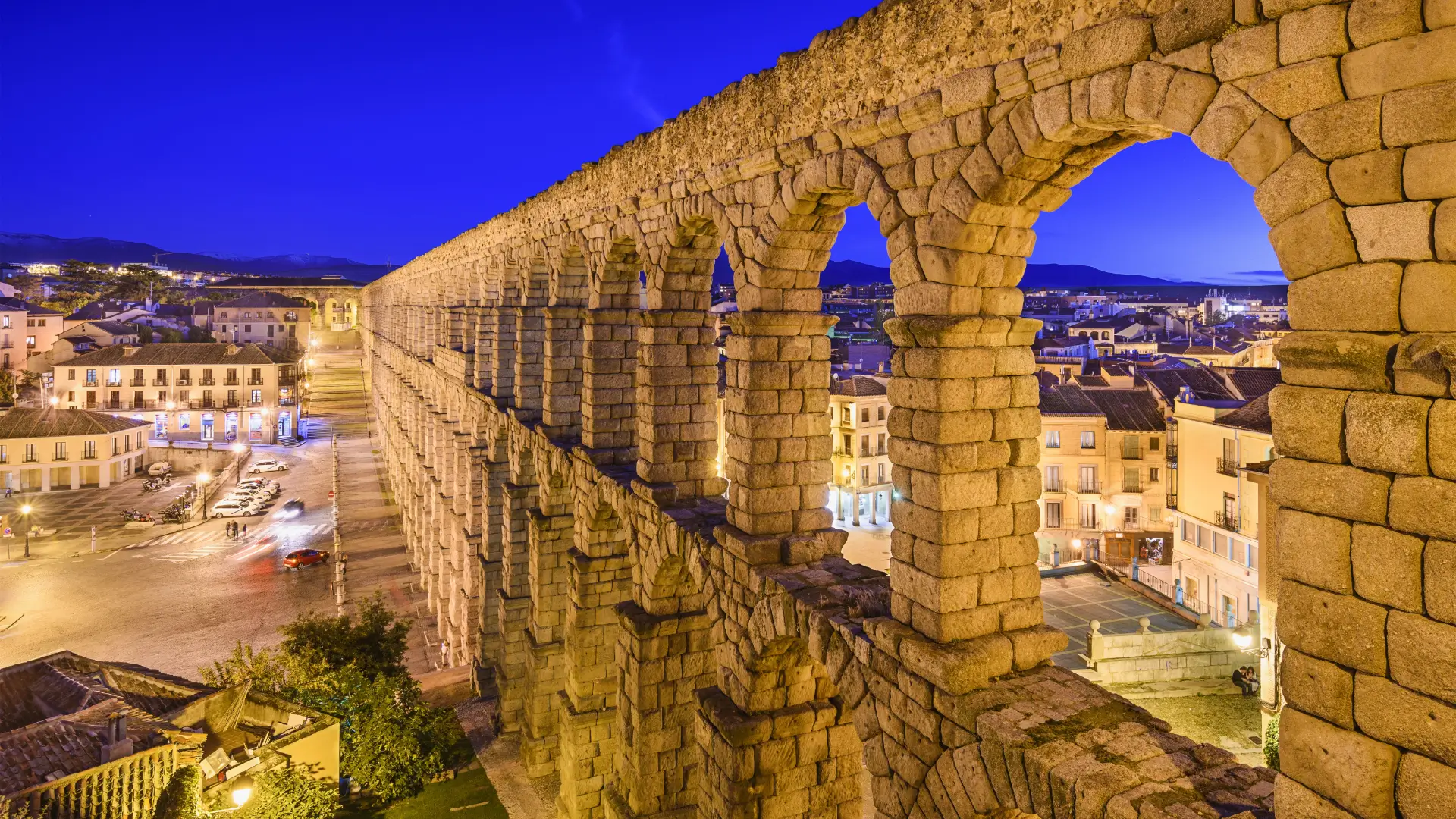
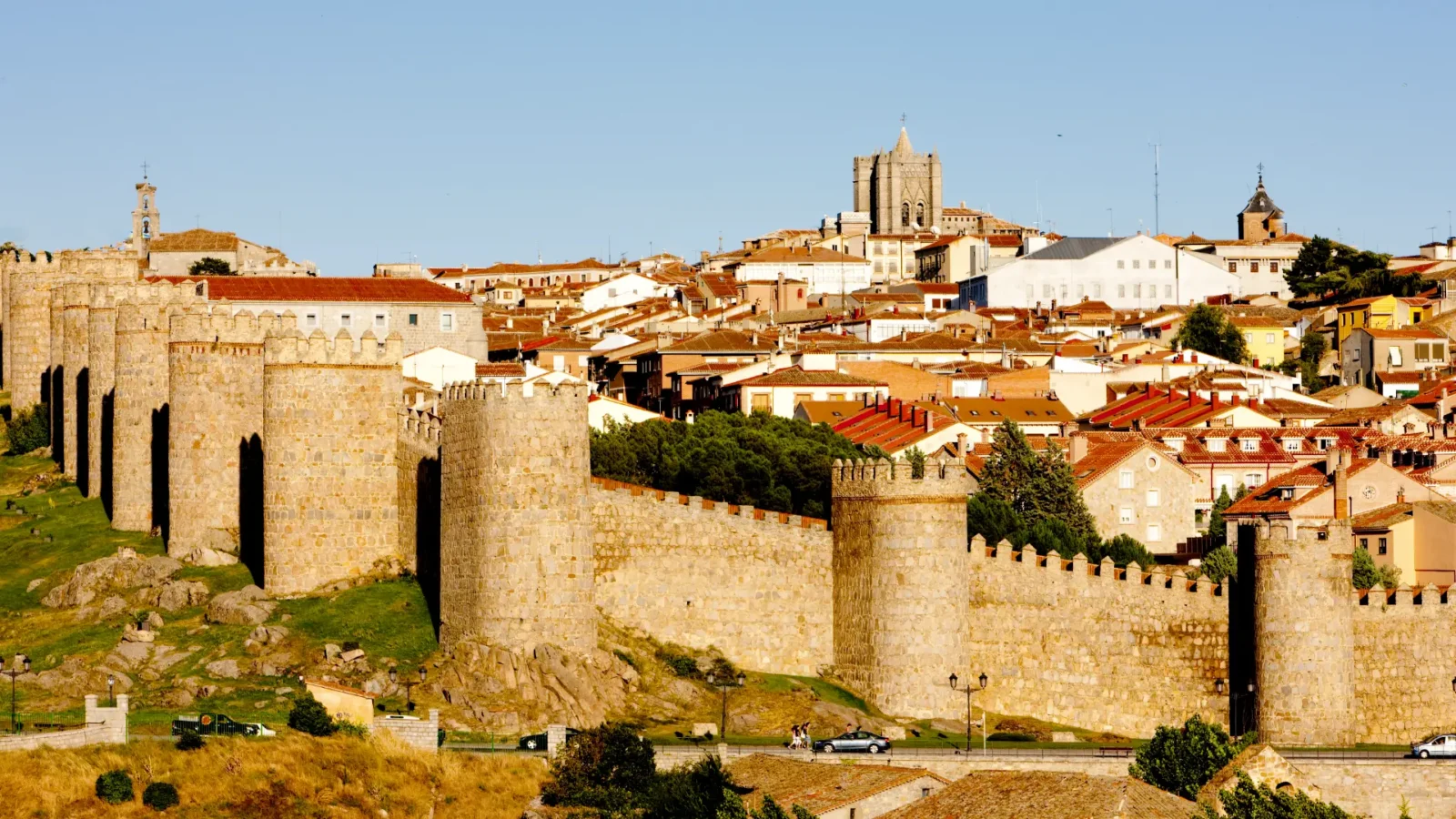
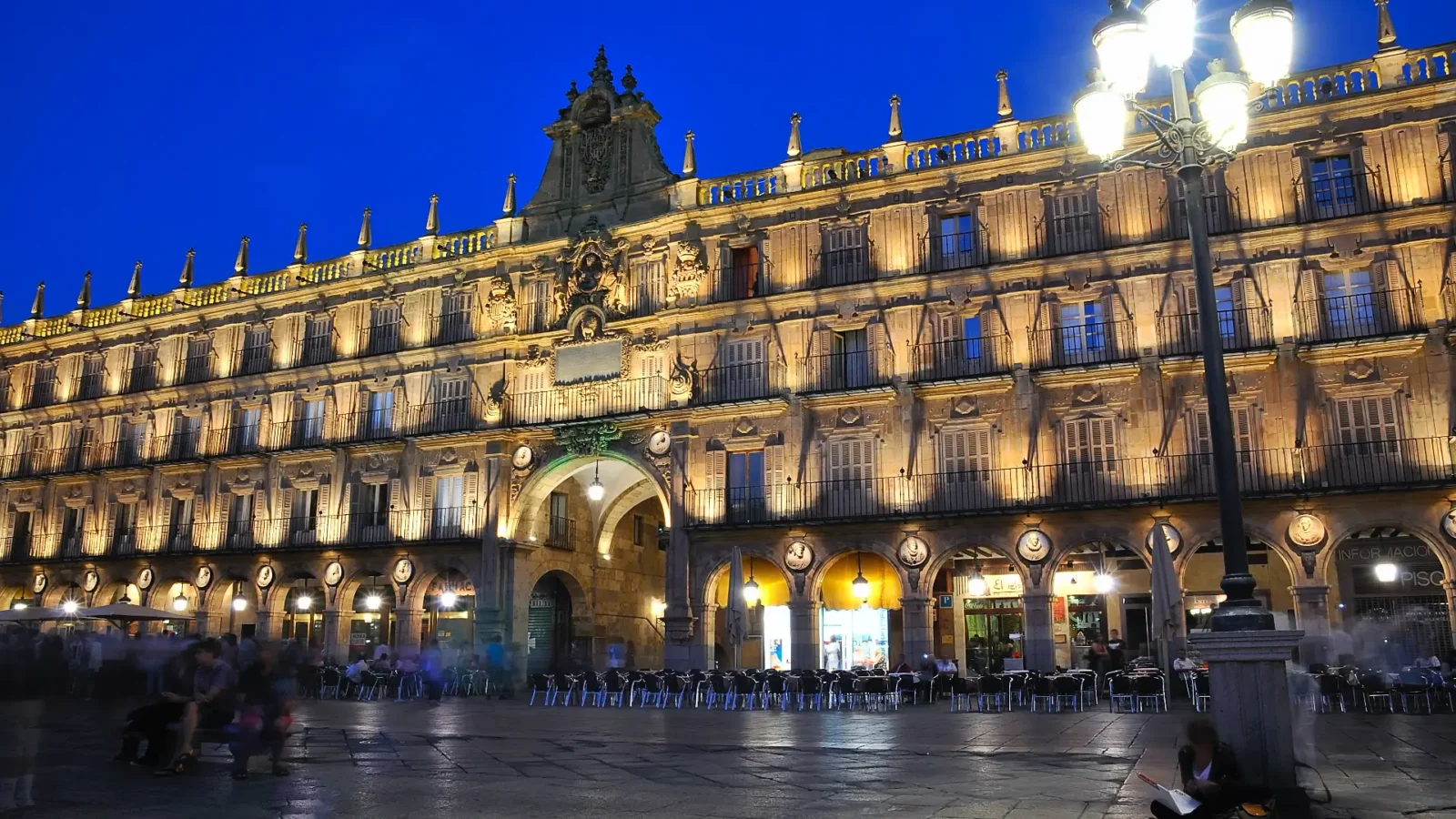
The three cities share a look but not a character, and driving them in order tells a story. Segovia is the show-stopper: a Roman aqueduct marching across the old town, a cliff-top Alcázar that looks like a fairy tale. Ávila is the fortress — the most complete medieval walls in Spain, a 2.5 km circuit of 88 towers you can walk right around, wrapped tight around a small, devout old town. Salamanca is the warm one: a golden-sandstone university city with a grand Plaza Mayor and two cathedrals side by side, at its best in the evening when the stone glows and the students fill the squares. Between them come the quiet layers. A walled medieval village and a royal garden separate this drive from any generic "UNESCO cities" list.
Why linear, not a loop
The stops sit too far apart to run from a single base. Segovia to Ávila is about an hour; Ávila to Salamanca is about another hour. Driving back to one hotel each night would waste the best parts of the day, the quiet mornings and evenings in each old town. So the base moves: you sleep in Segovia, then Ávila, then Salamanca, one new city a night. On the map the route is a corridor, not a circle — it runs west across the region and finishes in Salamanca rather than returning to the start. If you would rather pick one base and day-trip out, that is a different kind of trip; our Castilla y León region guide is the better starting point for it. This page is for the traveller who wants the journey itself.
Getting to the start
The route starts in Segovia, about an hour and a quarter north-west of Madrid on the far side of the Sierra de Guadarrama. Segovia has no airport of its own, which is part of why it stays as calm as it does once the day-trippers leave — but it is easy to reach, and one big international gateway does almost all the work.
Affiliate note: some links below are affiliate links. If you book through them, we may earn a small commission at no extra cost to you. It helps us keep GoHiddenSpain running and growing. We only suggest services we'd feel comfortable recommending.
Arrival airports, closest first:
Madrid (Adolfo Suárez–Barajas, MAD)about ~105 km, roughly 1 hr 15 by car. This is the gateway for almost everyone: the biggest airport in Spain, with the widest choice of international flights, and the natural place to hire a car. There is also a fast train link — the high-speed AVE/Avant from Madrid Chamartín reaches Segovia-Guiomar in under 30 minutes — but Guiomar station sits a few kilometres outside the walls, and you need a car for the rest of the route anyway, so most drivers simply pick up a hire car at the airport and go.
Valladolid (VLL)about ~130 km, roughly 1 hr 25 by car. A small regional airport north of the route with a handful of domestic and European flights. Worth a look only if a cheap, convenient flight happens to land here; otherwise Madrid is the practical choice.
Salamanca-Matacán (SLM)sits at the far end of the route, but it is tiny — a seasonal handful of flights only — so it is not a realistic way in or out. Plan around Madrid.
This is a self-drive route. Hire a car at your arrival airport and keep it for the whole trip — it is how you reach all three cities, and the quiet detours off Segovia, at your own pace.
Arriving late? If your flight lands in the evening, it is worth spending the first night near Madrid airport and starting fresh in the morning, rather than driving an unfamiliar road over the Guadarrama in the dark.
See our Practical Info page for how to handle late arrivals, plus everything on driving in Spain (low-emission zones, tolls, fuel and parking).
The Itinerary
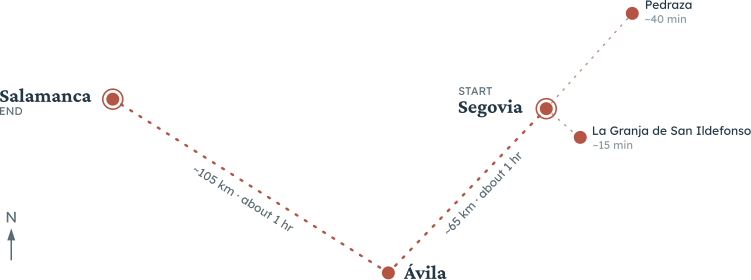
This is a linear route: the base moves with you, and you sleep in a different city each night. The shape on the map is a corridor running west — Segovia, then Ávila, then Salamanca — with two short detours branching off the Segovia end. The drives are short and easy, about an hour between cities, so there is no need to rush; the point is to have time in each old town when it is quiet.
Core route or the detour version?
The three cities take three nights: one each in Segovia, Ávila and Salamanca. But there are two quiet detours off Segovia worth a day of their own — the royal gardens at La Granja and the walled village of Pedraza. To fit them in, give them their own day and a second night in Segovia before you move on. That makes it a four-night trip. Day 2 below is that optional detour day: keep it if you have the time, or skip straight from Day 1 to Ávila if you don’t. A second night in the same city doesn’t change the linear rhythm — the base still moves Segovia → Ávila → Salamanca, just with a pause at the start.
Day 1 — Segovia
The drivenone to start — you arrive in Segovia. If you’re doing the core three-night route, the drive to the next stop, Ávila, is ~65 km, about 1 hr the next morning; if you’re taking the detour day, you stay put for Day 2.
Give Segovia a full, relaxed day. The three big sights sit close together in the old town: the Roman aqueduct, one of the best-preserved in Europe and free to stand beneath; the Gothic cathedral on the Plaza Mayor; and the cliff-top Alcázar at the tip of the old town, the castle said to have inspired Disney. Allow the afternoon and, ideally, the evening — Segovia draws coach parties from Madrid by day, and the streets quiet down noticeably once they leave.
Tonight you will sleep in SegoviaSee where we’d stay.
Day 2 · optional — Segovia detours: La Granja and Pedraza
The driveshort hops out and back from Segovia — no change of base. Second night in Segovia.
This is the day that sets the route apart from a straight run between the famous cities. Both detours are quiet, close, and easy to reach from Segovia, and together they fill a comfortable day — which is exactly why they earn their own day rather than being squeezed onto the Segovia afternoon.
La Granja de San Ildefonso is about 15 minutes from Segovia — a royal palace with formal, Versailles-style gardens and fountains set in the hills. Allow a relaxed morning for the palace and a wander through the gardens.
Full detail on La Granja de San Ildefonso
Pedraza is about 40 minutes north — a fully walled medieval village entered through a single gate, with a clifftop castle and a colonnaded square, and one of the quietest stops on the whole trip. It’s worth staying into the late afternoon, when the day is at its stillest.
Both are signposted side trips, not overnight stops: you visit and return to Segovia for a second night. Short on time? Do just one — La Granja pairs naturally with a slow morning, Pedraza with a long afternoon.
TonightYou sleep in Segovia. See where we’d stay.
Day 3 — Ávila
The drivefrom Segovia, ~65 km, about 1 hr west. To the next stop, Salamanca, is ~105 km, about 1 hr — an easy run for the following morning.
Ávila is the fortress of the three, and half a day is enough to feel it, though it rewards an overnight. The reason to come is the walls: the most complete medieval circuit in Spain, 2.5 km of rampart with 88 towers, and you can walk long stretches along the top. Add the fortress-cathedral built into the wall and the streets tied to St Teresa, who was born here. The old town is small and easily walked in an afternoon. Ávila is high — at about 1,130 m it is the highest provincial capital in Spain — so evenings are cool even in summer, and the walls lit up after dark are the classic Ávila sight.
TonightYou sleep in Ávila. See where we’d stay.
Day 4 — Salamanca
The drivefrom Ávila, ~105 km, about 1 hr west to Salamanca, the end of the route.
Salamanca is the warm finish, and the one city here that asks for a full day. The golden-sandstone old town is UNESCO-listed and made for walking: the grand baroque Plaza Mayor, the university (one of the oldest in Europe, with the famous carved frog to find on its façade), and the two cathedrals standing side by side. Save the evening for it — Salamanca is a student city, and the squares come alive after dark, with the stone glowing in the low light.
TonightYou slee in Salamanca. See where we’d stay.
Where to next
Salamanca is the end of the line, but not a dead end. Your genuine onward options:
Back to Madrid for a flight homeabout ~215 km, roughly 2 hr 45 by road (or a high-speed train from Salamanca to Madrid in about 1 hr 35, if you drop the car here). The simplest close to the trip.
North into the Camino cathedral citiesLeón, Burgos and Zamora sit a couple of hours north and make a natural second leg for anyone with more time.
South-west into ExtremaduraSalamanca sits at the top of the A-66, the free Ruta de la Plata autovía, which runs straight down to Cáceres in about ~205 km, roughly 2 hr. That drops you at the head of our The Medieval Loop — Cáceres, Trujillo, Mérida and Guadalupe — so the two trips chain into one longer run through western Spain.
Want the full picture of each town? Each stop links to its own guide above, with every sight, restaurant and place to stay.
Where we’d Stay
One strong, bookable pick for each night — enough to book on the spot. For the full choice across every budget in each city, follow the link to the place page.
Hotel Don Felipe
In the old Jewish quarter, with a garden and a sun terrace looking straight at the Alcázar. Comfortable, well-run and walkable to every sight, it’s a dependable mid-range choice with its own parking.
Check prices & availability for Hotel Don Felipe on the accommodation's websiteParador de Ávila
Sleep in a 16th-century palace set right against the inside of the wall, with a garden looking onto the ramparts and an access point to the wall walk almost at the door. The classic Ávila stay: historic, calm and central, with the state-run Parador’s reliable comfort.
Check prices & availability for Parador de Ávila on the accommodation's websiteHotel Catalonia Plaza Mayor
A comfortable, well-run hotel a short step from the Plaza Mayor, in a converted historic building with a good breakfast. A solid mid-range choice that keeps you right in the heart of the old town without the top-tier price.
Check prices & availability for Hotel Catalonia Plaza Mayor on the accommodation's website
Practical Info
- Driving and roadseasy throughout. The links between the cities are dual carriageway or good A-roads, with faster toll autopistas (the AP-6 and AP-51) as optional shortcuts near Ávila — the parallel free roads (N-110, A-50) are fine and only a little slower. No mountain passes on the route itself. Each leg is about an hour, so the daily driving load is light.
- Parkingall three cities have walled or pedestrianised historic centres, so the rule is the same everywhere — leave the car in a car park outside the walls and walk in. In Ávila, look for parking near the Exhibition Hall and the lower streets; in Segovia and Salamanca, use the signed car parks just outside the old core.
- Low-emission zones (ZBE)Ávila and Salamanca both have low-emission zones covering their historic centres, but in practice a normal hire car is not affected — any car with a standard Spanish environmental label may enter, and Salamanca’s zone has no active restrictions before 2029. The point that matters is simply not to drive into the pedestrian streets.
- Altitude & seasonthis is high country. Ávila sits at about 1,130 m, Segovia and Salamanca not far below, so nights are cool even in summer and winters are genuinely cold, with occasional snow. Spring and autumn are the sweet spot; if you drive it in winter, pack for the cold and check conditions over the Guadarrama.
- Fuelno long empty stretches — you are never far from a service station on these legs, and all three cities have fuel on their approaches.
- What to pack?One thing worth knowing: this is high, cool country. Even in summer the evenings turn cold, especially in Ávila, so bring a layer for walking the walls after dark. In winter, pack properly for the cold and check road conditions over the Guadarrama before you set off.
Frequently Asked Questions
Three nights covers the core route: one each in Segovia, Ávila and Salamanca, with time in each old town in the quiet early morning and evening. There are also two detours off Segovia — the gardens at La Granja and the walled village of Pedraza. To fit them in, add a fourth night, staying a second night in Segovia to give them a full, unrushed day. So: three nights for the three cities, four if you want the detours too. You can drive all three cities in a single long day from Madrid, but you would only see them at their busiest and miss the point of the trip.
One-way. It is a linear route: you start in Segovia and finish in Salamanca, sleeping in a different city each night. The cities sit too far apart, about an hour between each, to run from a single base. On the map it forms a corridor running west, not a circle.
Yes. Trains and buses connect the cities, but a car is what makes the route work — it lets you reach the quiet detours, arrive and leave the old towns on your own schedule, and catch each city in its calm hours. Hire at your arrival airport and keep the car for the whole trip.
Easy. The legs are short, about an hour each, on dual carriageways and good A-roads with no mountain passes. Faster toll autopistas run alongside near Ávila if you want them, but the free roads are fine. The only real driving note is parking: leave the car outside the walls in each city and walk into the old town.
Late spring (May–June) and early autumn (September–October) are ideal — warm days, cool evenings and thinner crowds. Summer is hot and busier, though the high altitude keeps the nights pleasant. Winter is cold, sometimes snowy, especially in Ávila at 1,130 m; it is doable, but pack for it and check conditions.
Start in Segovia. The closest and by far the most useful airport is Madrid-Barajas (MAD), about 1 hr 15 away by car and the natural place to hire a car. Valladolid (VLL) is a small regional alternative to the north; Salamanca’s own airport is too limited to rely on.
Moving along the line: Segovia, then Ávila, then Salamanca, staying in or right beside each walled old town so you can enjoy it on foot after the day-trippers leave. If you’re taking the detour day, book two nights in Segovia rather than one — both La Granja and Pedraza run out and back from there. Our pick for each night is above, with a link to the full range on each city’s page.
All three historic centres are walled and largely pedestrianised, so you park outside and walk in regardless. Ávila and Salamanca have low-emission zones, but a normal hire car with a standard environmental label is not restricted, and Salamanca’s zone has no active limits before 2029. Just don’t drive into the pedestrian streets themselves.

Essential Reading
Connecting routes
- The Medieval LoopSouth-West into Extremadura
- The Cathedral CitiesNorth to the Camino cathedrals via Zamora.